2025-11-02
#13 Artificial Materials as a Cause of Nose Surgery Side Effects: Revision Rhinoplasty_About Nose Surgery Materials 3/3
This article discusses the problems with artificial materials like Medpor®, Mesh, and silicone in rhinoplasty, which often lead to revision surgery due to inflammation, contracture, perforation, and thinning skin. It highlights the anatomical challenges of Medpor® removal and introduces SH Plastic Surgery's approach to natural and safe recovery.
Rhinoplasty using artificial materials such as Medpor®, Mesh, and silicone in the nasal tip often requires revision surgery over time due to problems like inflammation, contracture, perforation, and thinning skin. Medpor®, in particular, strongly adheres to tissues, making removal difficult, and cases of nasal tip structural collapse after removal are common. In this blog, Dr. Kim Sung-hoon of SH Plastic Surgery introduces a lifting rhinoplasty approach for natural and safe recovery after artificial material removal, focusing on the anatomical difficulty, strategy, and cartilage reconstruction methods for recovery, along with actual cases. Face Designer, Dr. Kim Sung-hoon of SH Plastic Surgery
Can a nose operated on with Medpor® be restored to its original state? – Revision Surgery Strategy for Artificial Materials
A female client in her 50s visited the clinic.
She said the surgery was performed 15 years ago at a hospital in a rural area.
At the time, she was told it was a ‘firm and long-lasting material’ and had Medpor® inserted into her nasal tip.
For several years, her skin had been gradually thinning, making her nasal tip visible,
and recently, she experienced recurrent mild inflammation, making daily life uncomfortable.
The examination revealed that the Medpor® was strongly adhered to the soft tissues,
and inflammatory tissue within the capsule was also observed.
Removal was not simple, and most importantly, how to restore the space after removal was key.
Anatomical Problems of Medpor® Insertion Surgery
Medpor® is made of high-density porous polyethylene (HDPE) and has the advantage of quickly integrating with tissues,
but that very aspect becomes a major disadvantage in revision surgery. The following problems occur:
Tissue infiltration: Surrounding soft tissues grow into the material, leading to significant bleeding or tissue damage during removal.
Skin atrophy: Over the long term, the skin at the nasal tip thins, becomes translucent, and in severe cases, leads to skin perforation.
Inflammation: Foreign body reactions or bacterial infections can easily cause chronic inflammation, and contracture (shrinkage) also occurs.
Structural weakening: After removal, the nasal tip structure collapses, and the septum is also damaged, leading to the breakdown of normal supporting structures.
Medpor®
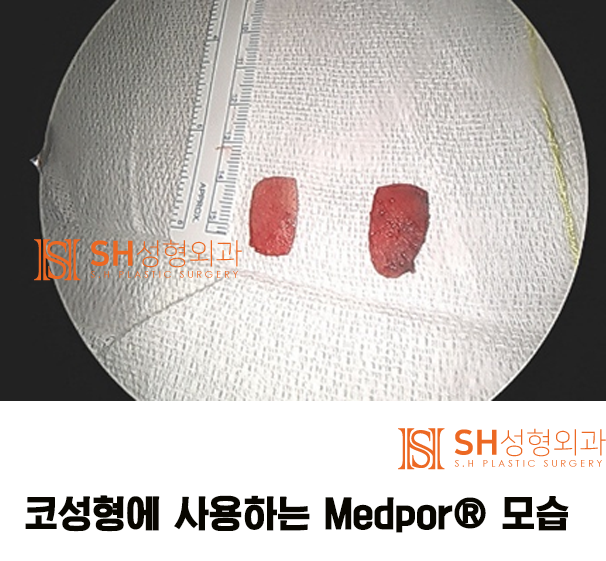
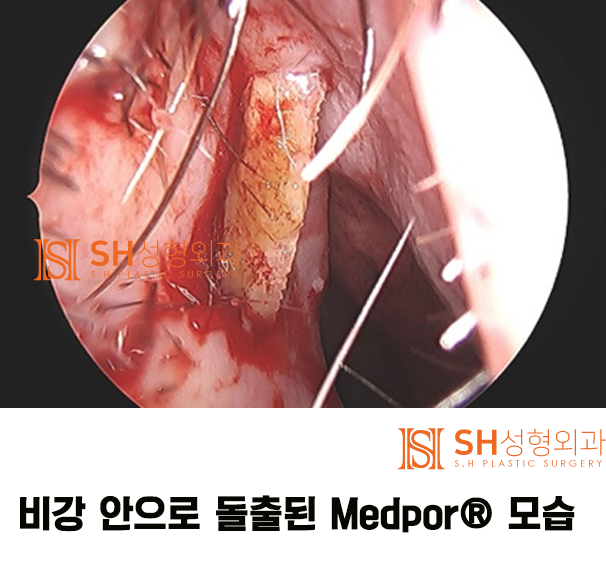
<Photo Source>
Shabahang Mohammadi. Use of porous high-density polyethylene grafts in open rhinoplasty: no infectious complication seen in spreader and dorsal grafts. Head Face Med. 2014 Dec 22;10:52
‘Medpor® is good for facial bones but not suitable for the nasal tip.’
When Medpor® first came out, it was truly considered a ‘dream material.’
This was because it had the advantage of being firm and integrating well with tissues.
However, problems emerged when it was used in the nasal tip.
Over time, it thinned the surrounding tissues, and cases of inflammation, perforation, and even contracture became common.
Even now, many people come for revision surgery because of Medpor®.
To be honest, it is a material that should no longer be used in the nasal tip.
It is still an excellent material for reinforcing bones, such as in orbital fractures.
However, every material has its ‘right place.’
My judgment is that it is not suitable for sensitive and thin areas like the nasal tip.
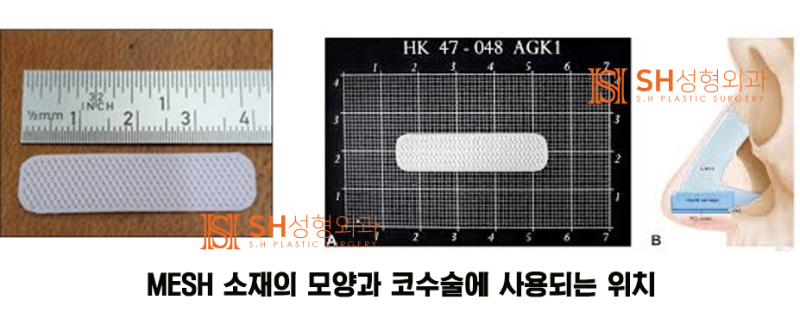
Mesh
Mesh, specifically a material called PCL (polycaprolactone),
started to be used very suddenly and widely in Korea around the late 2010s.
Since it is a biodegradable material that dissolves in the body,
there was an expectation that ‘it would be naturally absorbed and reduce inflammation.’
However, problems began to emerge one by one.
PCL takes a very long time to decompose.
And during the decomposition process, it can dissolve surrounding tissues as well.
In fact, there were quite a few cases where the nasal septum also dissolved.
Ultimately, the nasal tip collapses, and the internal structure of the nose itself is damaged.
Revision surgery creates even greater problems.
Because Mesh becomes hard or brittle,
it is difficult to remove cleanly, and the nasal septum often needs to be reconstructed.
Therefore, as of 2025,
Mesh is almost never used in nasal tip augmentation.
Even if it is used, it is desirable to use it only in very small amounts, as an auxiliary material, to reinforce other cartilage or tissues.
Silicone
Silicone is the easiest material for raising the nasal tip.
Especially L-shaped silicone, because it's quick to operate and easy to shape,
is widely used in places with low understanding of plastic surgery, like Southeast Asia.
But the problem is, it eventually shows through.
It protrudes, thins, and silicone often becomes visible through the columella or nasal tip,
and even adding ear cartilage has its limits.
Most importantly, L-shaped silicone has the highest risk of contracture.
Therefore, I recommend replacing it if possible, even if there seem to be no problems.
Ultimately, we must return to ‘human-derived components’ rather than artificial materials.
As I have mentioned so far,
artificial materials such as Medpor®, Mesh, and silicone
may seem attractive initially in terms of maintaining shape and surgical convenience.
However, recurring problems emerge over time:
Strong adhesion
Occurrence of contracture
Inflammatory reactions
Thinning of the skin layer
Visibility, deformation
Secondary damage that is difficult to remove
All of these ultimately leave the burden of revision surgery.
That's why I always ask,
‘Will your face be okay even after 10 or 20 years?’
The conclusion is clear: Human-derived materials, specifically a safe reconstruction strategy based on autologous tissue, is ultimately the longest-lasting and least problematic path.
Autologous costal cartilage, donated costal cartilage, and autologous septal cartilage
have no rejection reactions, allow for natural adhesion between tissues,
and can produce predictable results even in revision surgery.
I believe that the completion of surgery is not about ‘height’
but stems from a philosophy of anatomical restoration and naturalness.
SH Plastic Surgery is not just a place that performs surgery; it is a place that designs the time and changes in a patient's face together with them.
The perspective of Dr. Kim Sung-hoon, Face Designer at SH Plastic Surgery
‘Plastic surgery that takes responsibility for even the unseen parts, to the very end’
(20) #Rhinoplasty #NoseSurgery that doesn't fail! Success in one go is best! - YouTube
SH Plastic Surgery Clinic