2026-07-20
How and When Should You Take Lutein for Eye Health?
Learn how and when to take lutein for optimal eye health, including choosing the right supplements and understanding recommended dosages.

How and When Should You Take Lutein for Eye Health?

These days, many people are choosing various nutritional supplements for their health.
In the past, taking supplements might have made one feel ‘old’, but recently, it has become more associated with ‘self-care’, and many people in their early to mid-20s are consistently taking them.
Lutein, in particular, seems to be one of the supplements taken early on for dry eyes and overall eye health management.
Today, we will briefly look at lutein, known to be good for the eyes.
When should you start taking lutein?
Lutein in the eyes generally begins to decrease from age 25!
By age 60, it can drop to less than half!
Therefore, it is good to start taking it from age 25, and it is advisable to pay more attention to lutein intake as you get older.
How to choose lutein?
You probably check and consume many nutrients beneficial for your eyes, and lutein is always on that list.
So, how do you choose lutein?
It is crucial to check the content!
If the content is the same, it is good to check for additional ingredients.
Choosing a supplement that includes additional ingredients like beta-carotene and vitamin A, which help with visual adaptation in dark places, as well as astaxanthin, zeaxanthin, and omega-3, can further benefit eye health.
How to take lutein?
Usually, one pill per day.
However, with all medications, ‘too much is as bad as too little’!
Excessive intake can lead to an increase in blood carotene levels, potentially causing carotenemia, where hands and feet turn yellow.
Therefore, it is recommended to stick to the daily recommended dosage.
Also, remember that taking it after a meal is better for absorption than taking it on an empty stomach!
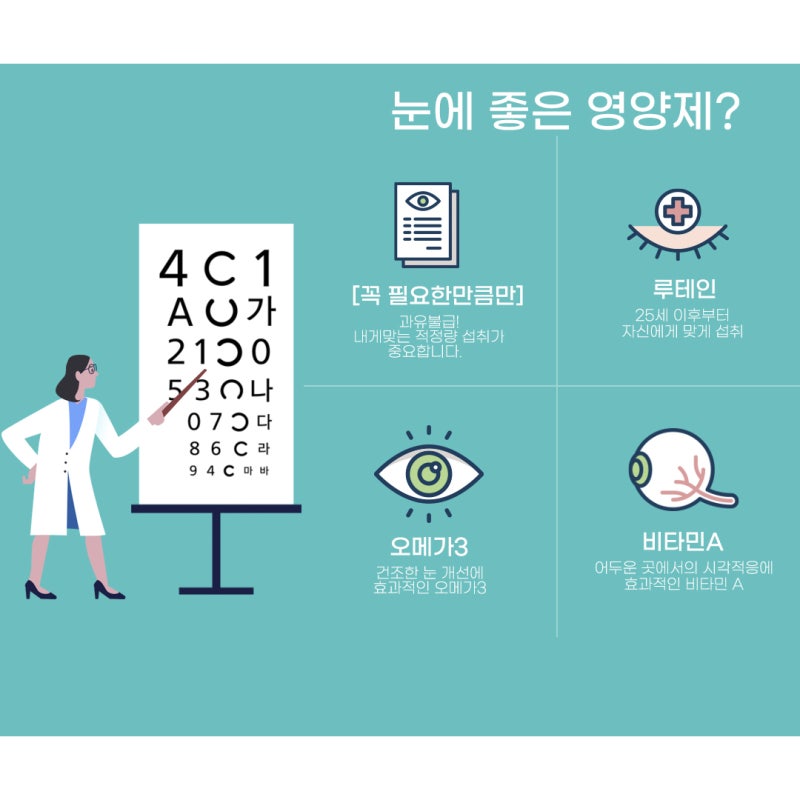
Foods good for your eyes to know about!
Vitamin A (Retinal): Important for maintaining visual function in dark places.
It combines with the protein ‘opsin’ in the rod cells of the eye to form ‘rhodopsin’, which is good for preventing night blindness and dry eyes.
Lutein & Zeaxanthin: Plays a role in increasing macular pigment density in the eyes, maintaining macular pigment density that can decrease with age.
It is good for improving vision and preventing cataracts and macular degeneration.
Beta-carotene, Anthocyanin, Astaxanthin: Act as antioxidants, supplying blood and nutrients to the eyes and improving eye fatigue.
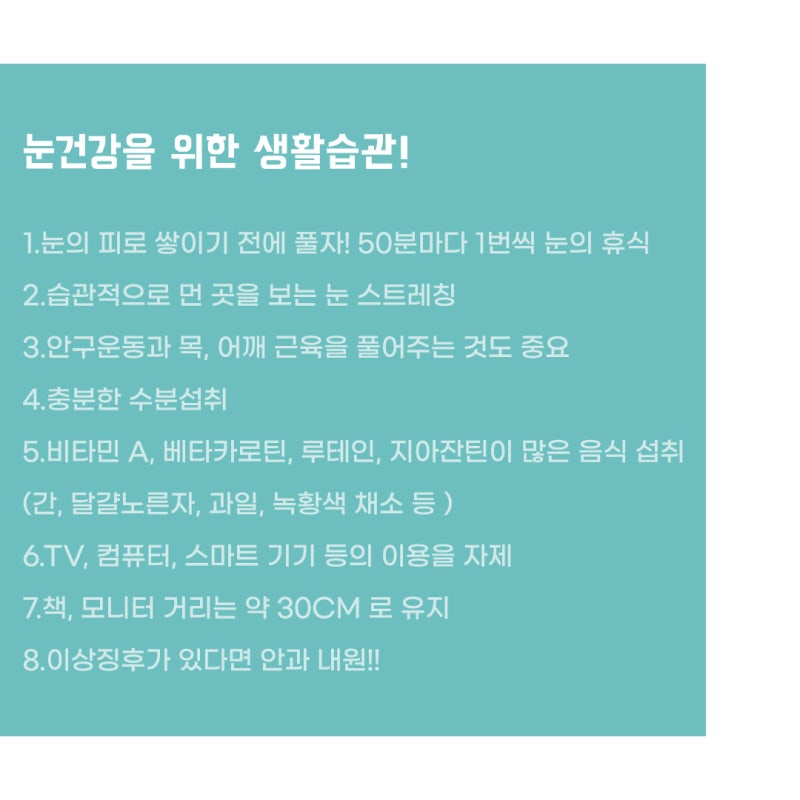
Lifestyle habits essential for eye health!
✅ Relieve eye fatigue before it builds up! Rest your eyes once every 50 minutes.
✅ Habitually stretch your eyes by looking at distant objects.
✅ Eye exercises and relaxing neck and shoulder muscles are also important.
✅ Drink plenty of water.
✅ Consume foods rich in Vitamin A, Beta-carotene, Lutein, and Zeaxanthin (liver, egg yolks, fruits, green and yellow vegetables, etc.).
✅ Limit the use of TVs, computers, and smart devices.
✅ Maintain a distance of about 30cm from books and monitors.
✅ Visit an ophthalmologist if you notice any unusual symptoms!
However, if you feel that lutein intake alone is not helping your vision or dry eyes,
it might be a good idea to accurately check your current condition and manage it with a suitable solution.
Gangnam Smile Eye Clinic, located in front of Gangnam Station Exit 10,
offers vision correction examinations, comprehensive eye check-ups tailored to age-specific concerns, and personalized dry eye care.
Their meticulous and delicate approach results in high patient satisfaction.
For those concerned about severe and recurring dry eyes, or those considering vision correction due to discomfort with glasses or contact lenses!
If you are looking into presbyopia care for your parents,
don't hesitate to visit 'Gangnam Smile Eye Clinic' for a comfortable 1:1 customized consultation and care : )
Gangnam Eye Clinic focused on people, Gangnam Smile with sincerity and dedication.
Frequently Asked Questions
When is the best time to start taking Lutein?
Yes, Lutein typically starts to decrease from the age of 25, so it's good to start taking it from that age. Paying more attention to Lutein intake as you get older helps maintain eye health.
How should I choose a Lutein supplement?
When choosing a Lutein supplement, you should first check the content. If the content is the same, it's good to check and choose based on additional ingredients like Beta-carotene, Vitamin A, Astaxanthin, Zeaxanthin, and Omega-3, which are good for visual adaptation in dark places.
Are there any precautions when taking Lutein?
Yes, it is generally best to take one Lutein capsule daily after a meal for better absorption. It is important to stick to the recommended daily amount, as excessive intake can lead to carotenemia, where hands and feet turn yellow due to increased blood carotene levels.
What other nutrients are good for eye health besides Lutein?
Yes, in addition to Lutein, Vitamin A (prevents night blindness, dry eyes), Zeaxanthin (maintains macular pigment density), Beta-carotene, Anthocyanin, and Astaxanthin (antioxidant action, improves eye fatigue) are known to be beneficial for eye health.
What lifestyle habits are good for eye health?
Yes, for eye health, it's good to take eye breaks every 50 minutes and do eye stretches by looking at distant objects. Also, sufficient hydration, consuming foods rich in Vitamin A and Lutein, refraining from using smart devices, and regular eye check-ups are important.