2026-07-20
[5th Generation LASIK] Smart vs. SMILE Pro: Which is better for astigmatism correction?
Comparing 5th-generation LASIK procedures, Smart LASIK (ATOS) and SMILE Pro (Visumax800), for astigmatism correction based on papers presented at the 2023 ESCRS conference. We analyze residual astigmatism and higher-order aberrations.
![[5th Generation LASIK] Smart vs. SMILE Pro: Which is better for astigmatism correction?](/uploads/smileeye2019/223531765519/2a4e6bfce1bb0f24.png)
Hello. This is Gangnam Smile Eye Clinic 😊

Today, we will compare astigmatism correction between Smart LASIK (=New SMILE) and SMILE Pro, both referred to as 5th-generation LASIK, based on papers presented at the 2023 ESCRS (European Society of Cataract & Refractive Surgeons) conference, where Dr. Hyo-Sung Yoon, director of Gangnam Smile Eye Clinic, was invited to speak.
(First presentation of SmartSight surgical results in Korea)
https://blog.naver.com/smileeye2019/223334600674?trackingCode=blog_bloghome_searchlist
What is 5th-generation LASIK?
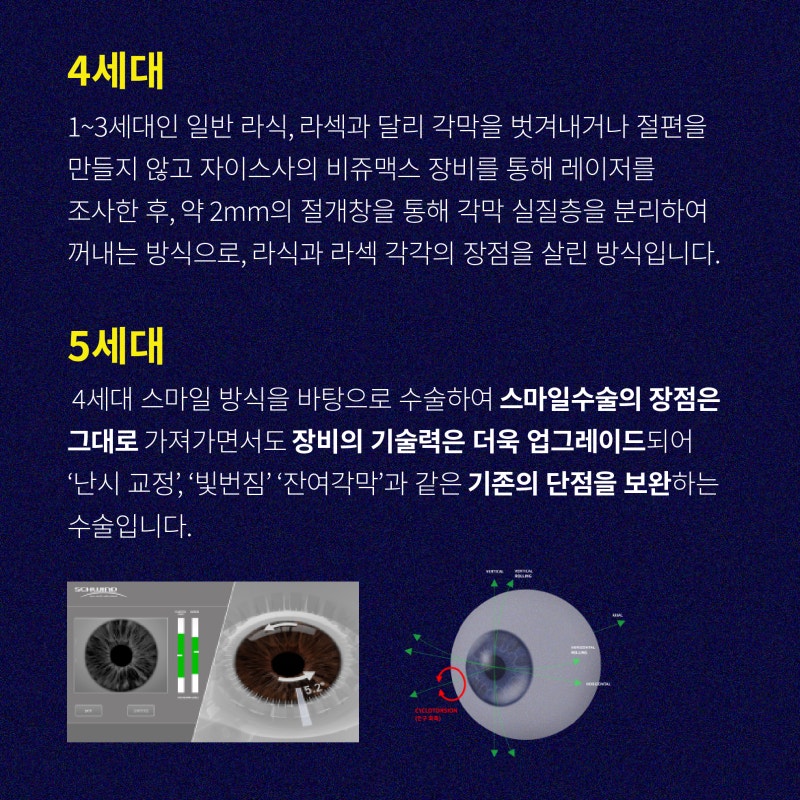
First, SMILE surgery, known as 4th generation, differs from 3rd generation LASIK and LASEK in that it minimally touches the corneal epithelium and corrects the stromal tissue. It combines the advantages of LASIK (fast recovery) and LASEK (safety due to no flap).
However, conventional SMILE also had drawbacks such as:
limited astigmatism correction for small amounts
halo and glare
5th-generation LASIK is a surgical procedure that adopts the already proven ‘SMILE’ method, ensuring safety as a foundation, while compensating for the aforementioned drawbacks with upgraded technological equipment.
Among the improvements over the 4th generation, the most significant is the ‘amount of astigmatism correction’.
Conventional SMILE surgery had the disadvantage of being difficult for eyes with high astigmatism.
Moreover, there were many results indicating that residual astigmatism after surgery was significantly inferior compared to LASEK.
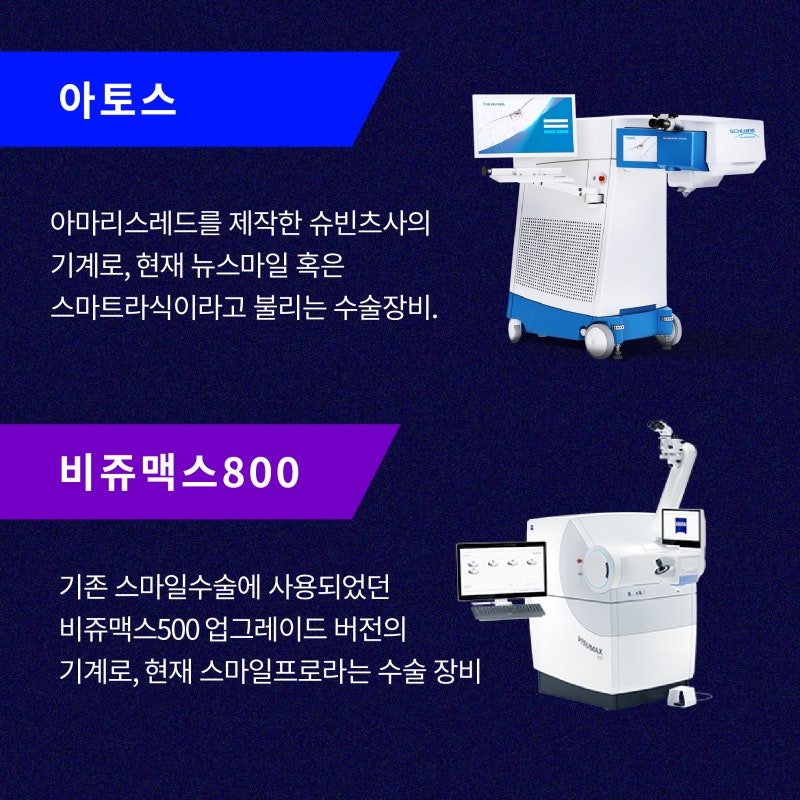
So, among the 5th-generation vision correction surgeries that are often compared these days, Schwindt Atos and Visumax800 (= Smart vs. SMILE Pro), which one is the winner for astigmatism correction when comparing post-operative results from papers?
First, residual astigmatism within +-0.25D after surgery is generally considered the best astigmatism correction.
Within +-0.5D is also considered a very good range for astigmatism correction.
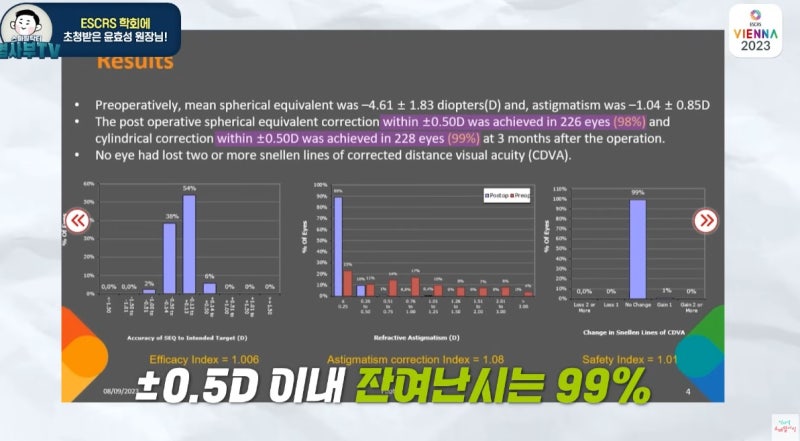
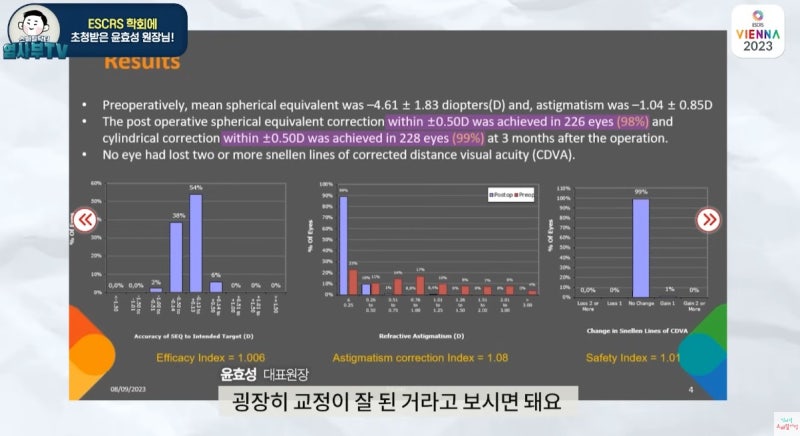
According to the paper presented by Chief Director Hyo-Sung Yoon at the conference, Smart LASIK performed with Atos showed a remarkable 99% of residual astigmatism within +-0.5D!
(= This means that 99% of patients after surgery have a residual astigmatism value within an error range of +-0.5D.)
(= The higher the percentage, meaning more patients are within a small error range, the better the result.)
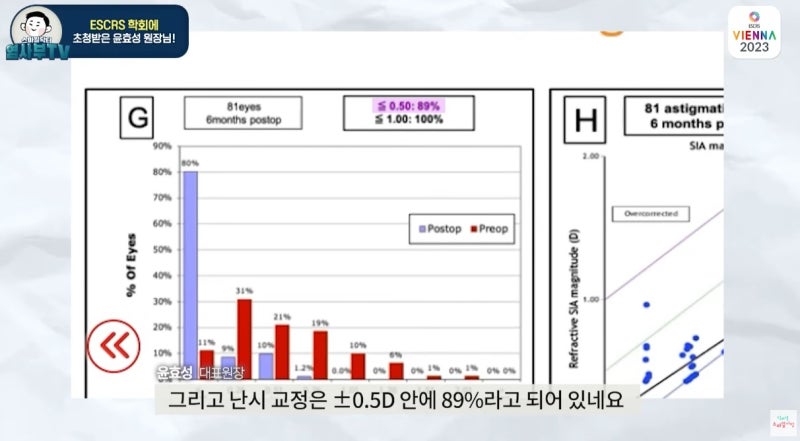
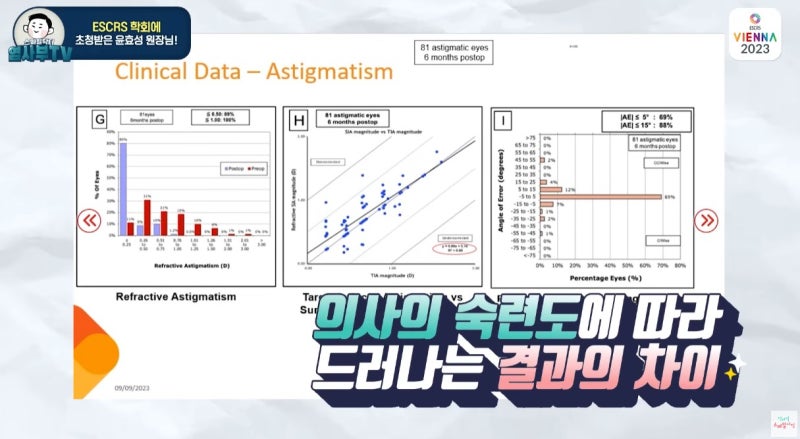
For reference, although the same Atos machine was used for surgery, the residual astigmatism within +-0.5D reported in China was 89%, indicating that the difference in results due to the surgeon's skill cannot be ignored.
(The surgical results from Gangnam Smile Eye Clinic in Korea are significantly higher, aren't they? 😊)
Now, let's look at the paper results for Visumax800.
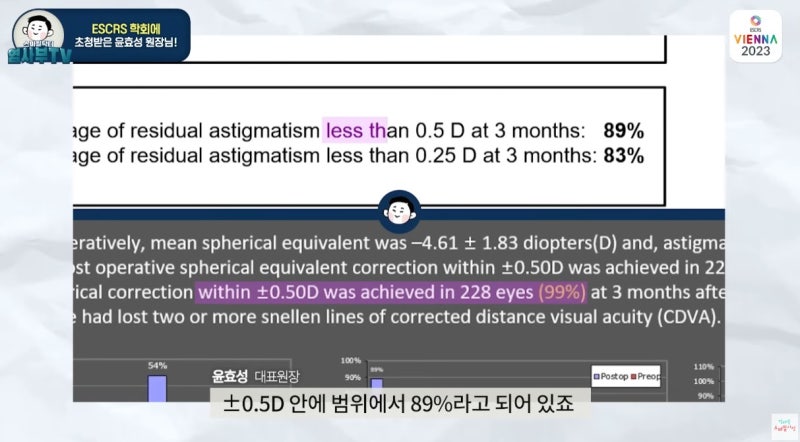
It was reported as 89% within the +-0.5D range.
As explained above, there may be differences due to the surgeon's skill, but comparing it to Gangnam Smile Eye Clinic's result of 99%, it would be difficult to consider the astigmatism correction result as good.
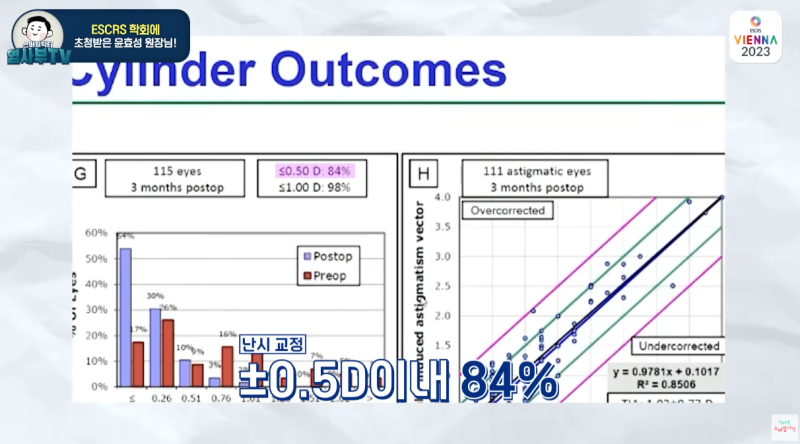
Additionally, residual astigmatism within +-0.5D for Visumax800, as presented by the famous Dr. Dan from London, also showed a value of 84%.
Comparing this to the previous Visumax500 (i.e., 4th-generation SMILE equipment) which showed similar 80% range within +-0.5D, these research results are even more disappointing.
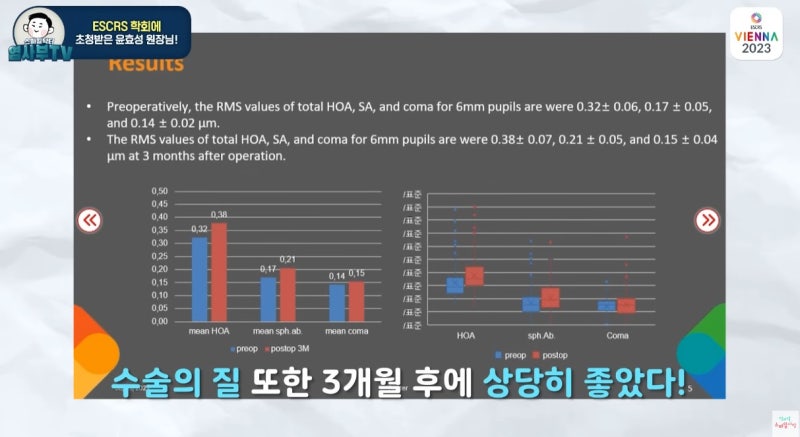
We also additionally compared higher-order aberrations before and after surgery, which is a criterion indicating the quality of vision after surgery.
According to the results presented by Director Hyo-Sung Yoon, our clinic using Atos showed a change from 0.32 to 0.38, indicating almost no difference before and after surgery.
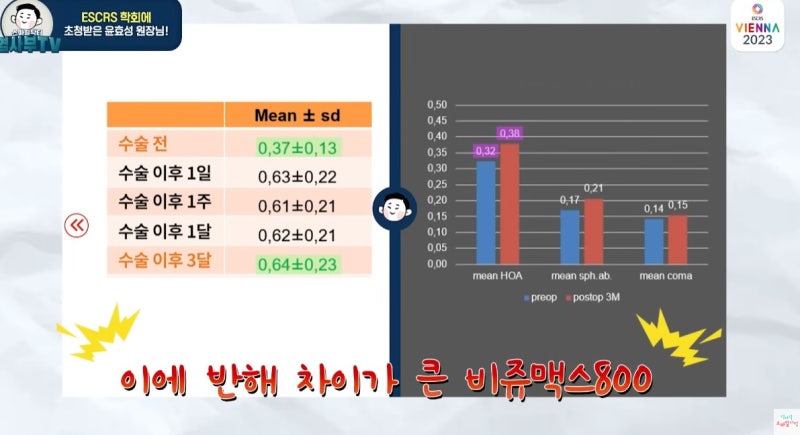
On the other hand, for Visumax800, the difference is very large, from 0.37 to 0.64.
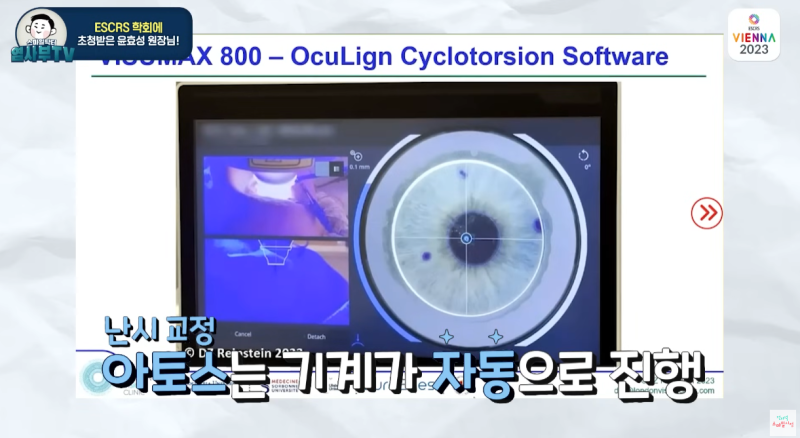
If the centration function during surgery works well, there is little change in higher-order aberrations.
In the case of Atos, the machine automatically tracks, but with Visumax800, the surgeon must manually mark the cornea and adjust the angle, which can lead to significant variations depending on the surgeon.
Conclusion: Although Visumax was introduced with excellent results, further observation of its progress will be necessary.
If you would like to see more detailed information about this post, please refer to the video content:
https://youtu.be/3oxqkfRKI04?si=JvO64x7v6GJvTWxc
Our next post will be: 'Why is Atos's laser irradiation time longer than Visumax Pro?'
Gangnam Smile Eye Clinic always puts patients first and prioritizes transparency and safety.
If you have any other questions, please feel free to contact the eye clinic anytime 😊
💙🤍 𝖦𝖠𝖭𝖦𝖭𝖠𝖬 𝖲𝖬𝖨𝖫𝖤 𝖤𝖸𝖤 𝖢𝖫𝖨𝖭𝖨𝖢💙🤍
𝗧𝗛𝗘 𝗟𝗜𝗚𝗛𝗧 𝗔𝗡𝗗 𝗧𝗛𝗘 𝗢𝗖𝗘𝗔𝗡 𝗜𝗡 𝗬𝗢𝗨𝗥 𝗦𝗠𝗜𝗟𝗘




Frequently Asked Questions
What is the difference between 5th generation LASIK and traditional LASIK?
5th generation LASIK is a vision correction surgery that addresses the shortcomings of 4th generation SMILE surgery. Unlike traditional LASIK and LASEK, it minimizes corneal epithelial manipulation for faster recovery and maintains the advantage of being flapless for safety, while improving astigmatism correction and visual quality.
Which surgery, Smart LASIK or SMILE Pro, has better astigmatism correction?
According to the study results presented in the main text, Smart LASIK (Atos) showed superior astigmatism correction compared to SMILE Pro (Visumax800). Smart LASIK had a 99% rate of residual astigmatism within ±0.5D, whereas SMILE Pro was reported at 89%.
What is the visual quality like after 5th generation LASIK surgery?
When comparing changes in higher-order aberrations, which indicate visual quality after surgery, Smart LASIK (Atos) showed almost no difference before and after surgery. In contrast, SMILE Pro (Visumax800) showed significant changes in higher-order aberrations.
Does the surgeon's skill affect the vision correction results?
Yes, the surgeon's skill can affect vision correction results. Even with the same Atos machine, there were differences in residual astigmatism results reported in Korea and China, which can be attributed to variations in the surgeon's proficiency.
Why is there a difference in higher-order aberration changes between Smart LASIK and SMILE Pro?
Smart LASIK (Atos) automatically tracks centralization, resulting in fewer changes in higher-order aberrations. In contrast, SMILE Pro (Visumax800) requires the surgeon to manually mark the cornea and adjust the angle, which can lead to variations depending on the surgeon.
What were the disadvantages of 4th generation SMILE surgery?
4th generation SMILE surgery had disadvantages such as limited astigmatism correction and glare. Especially for eyes with high astigmatism, surgery was difficult or the residual astigmatism results after surgery were reported to be inferior to LASEK.