2025-10-20
#11 Revision Rhinoplasty: Why Autologous Rib Cartilage? How to Avoid Side Effects _ Nose Surgery Materials 1/3
This article discusses the problems with artificial materials like silicone, Medpor®, and Mesh in revision rhinoplasty, emphasizing the benefits of autologous rib cartilage and other human-derived materials for safer, more stable results.
Revision Rhinoplasty for the Nasal Tip: What Materials are Safe?
In the past, artificial materials such as silicone, Medpor®, and Mesh were commonly used. However, side effects have been reported among revision surgery patients, leading to an emphasis on switching to human-derived autologous materials. Dr. Kim Sung-hoon of SH Plastic Surgery, through numerous revision cases, has concluded that ‘artificial materials should no longer be used for the nasal tip.’ This article will address the problems with silicone, Medpor®, and Mesh, compare the pros and cons of human-derived materials including autologous rib cartilage, and delve into why material selection is crucial for changing the entire outcome in revision surgery. – Dr. Kim Sung-hoon, Facial Designer at SH Plastic Surgery
Hello. I am Dr. Kim Sung-hoon, a facial designer at SH Plastic Surgery.
I feel a chill at the tip of my nose in the morning.
Autumn seems to have vanished, and winter has suddenly arrived.
When exposed to such cold air, many patients with implants in their nasal tips experience redness and pain first.
Sure enough, one afternoon, a woman in her 30s carefully lowered her mask and said:
Doctor, can’t I just have this removed...?
Her nasal tip was red and swollen, and the edge of the silicone was pushing up her thinned skin.
She said she was satisfied with the surgery seven years ago, but in the past few months, it had strangely become inflamed, and her nasal tip had become sensitive, even visible in the mirror.
She mentioned a tingling sensation every time she touched it, and her nasal tip would often turn red as if she had a cold.
The examination revealed that her skin was thinned by the pressure of the silicone, and her cartilage tissue was atrophying, causing her nasal tip to gradually collapse.
It was on the verge of inflammation, and if delayed further, her skin could have perforated.
In this situation, removal was a given, and the most important question I asked myself was this:
‘After removing this, how will I rebuild it?’
It’s not just about removal.
A collapsed structure must be redesigned, and ‘materials’ that will not collapse again must be chosen.
In this article today, I will discuss the criteria and direction for that ‘material selection.’
Artificial Materials vs. Autologous Tissue: Material Selection Changes Surgical Outcomes
In the past, artificial materials like silicone, Medpor®, and Mesh were frequently used in rhinoplasty to quickly achieve the desired shape.
However…
There are problems with artificial materials.
Material | Problem |
Silicone | High potential for visibility, protrusion, and contracture |
Medpor® | Difficult to remove due to tissue integration, high incidence of inflammation |
Mesh (PCL) | Absorbs and damages surrounding tissue, cases of septal cartilage melting are common |
Ultimately, while artificial materials may be convenient in the short term, the human body cannot tolerate them over time.
Tissue conflict, inflammation, contracture, and skin damage are not a matter of ‘if’ they will occur, but ‘when’ they will occur.
Therefore, I emphasize that for the nasal tip, surgery must be performed using human-derived components, materials that the body can accept on its own.
Order and Criteria for Selecting Autologous Tissue-Based Materials
For revision surgery, stronger and more stable materials are needed. Human-derived autologous materials are not absorbed and integrate with one's own tissue, offering much higher stability and retention.
The materials I recommend are as follows:
Autologous rib cartilage (rib cartilage) – Superior strength, excellent structural integrity
Donated rib cartilage – No donor site scar, lower cost, slightly higher absorption rate
Autologous septal cartilage – Can be harvested internally, good elasticity but limited quantity
Autologous ear cartilage – Soft and natural but limited in structural support
Why is Autologous Rib Cartilage the Top Priority?
‘Rib cartilage? You mean removing a rib. Isn’t that dangerous?’
Many people ask this, but in reality, stable harvesting is possible based on the following criteria:
Use of 6th-7th rib cartilage: For women, the scar is concealed below the inframammary fold.
Partial harvesting technique: The entire rib is not removed, so pain is significantly less.
Support and shape retention: Its rigid structure firmly supports the nasal tip, with almost no absorption.
Most importantly, because it’s ‘material from your own body,’ the risk of inflammation, foreign body reaction, and contracture is the lowest.
‘Where will the scar be?’
This is one of the most common questions patients have about rib cartilage surgery.
In fact, each surgeon has a different preferred location for rib cartilage, so the incision line may vary slightly.
I personally prefer the 6th and 7th rib cartilage.
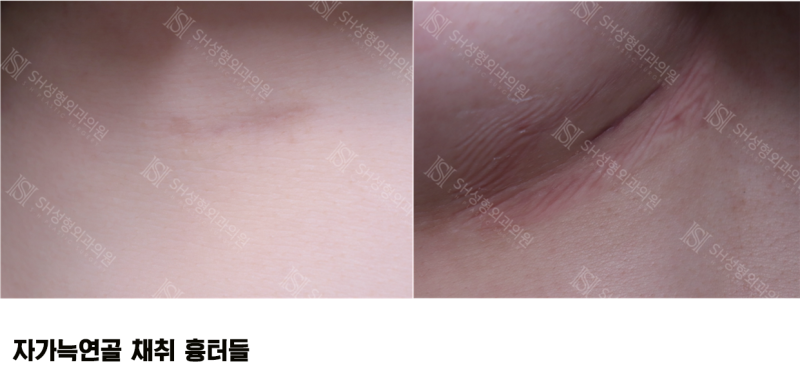
So, for women, I usually make the incision below the breast line, or the bra line.
This has the advantage that the scar is not visible unless you take off your underwear, and it does not show externally even when wearing a bikini in summer.
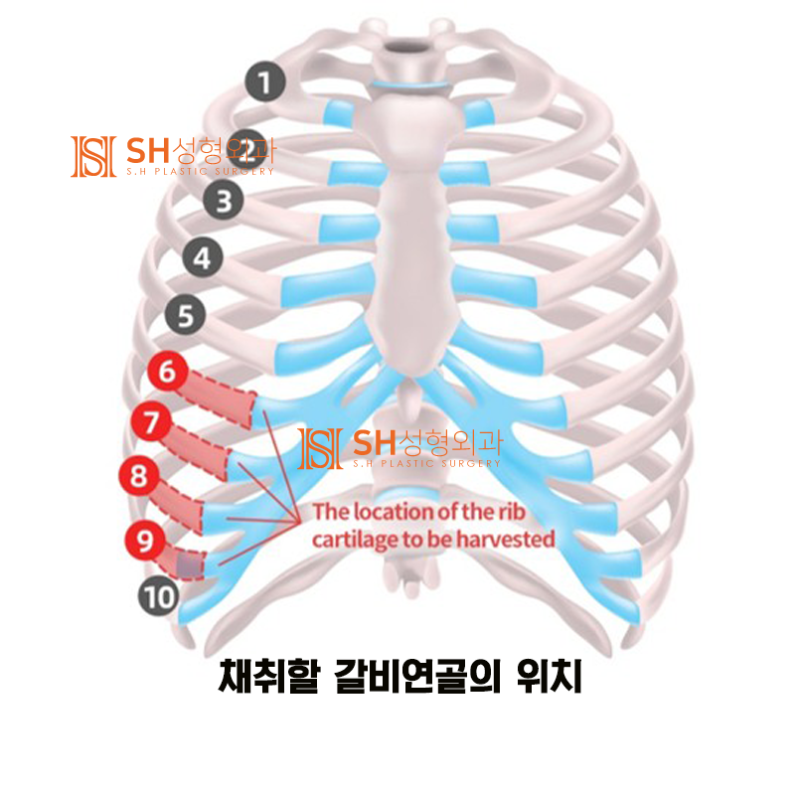
On the other hand, for men, the scar is inevitably visible.
Therefore, I sometimes harvest from the 8th and 9th rib cartilage.
This places the incision line slightly off the body's midline, making it only slightly visible from the side rather than the front.
During surgery, scars are meticulously designed to be as small and inconspicuous as possible, following the skin's natural lines.
However, the harvesting location and direction can vary depending on the individual's body type, skin condition, and surgical plan, so it is thoroughly explained and decided during consultation.
Why Partial Harvesting is More Advantageous Than Complete Harvesting
And another important aspect I consider during rib cartilage harvesting is prioritizing ‘partial harvesting’ whenever possible.
People often think that a whole piece of rib cartilage is removed, but if it’s completely harvested, pain can occur every time you breathe.
This is because our chest cavity moves with every breath.
When you inhale, the chest cavity expands, and when you exhale, it contracts, causing the rib cartilage area to repeatedly expand and contract.
So, every time you breathe, every time you move, irritation occurs, leading to a tingling pain.
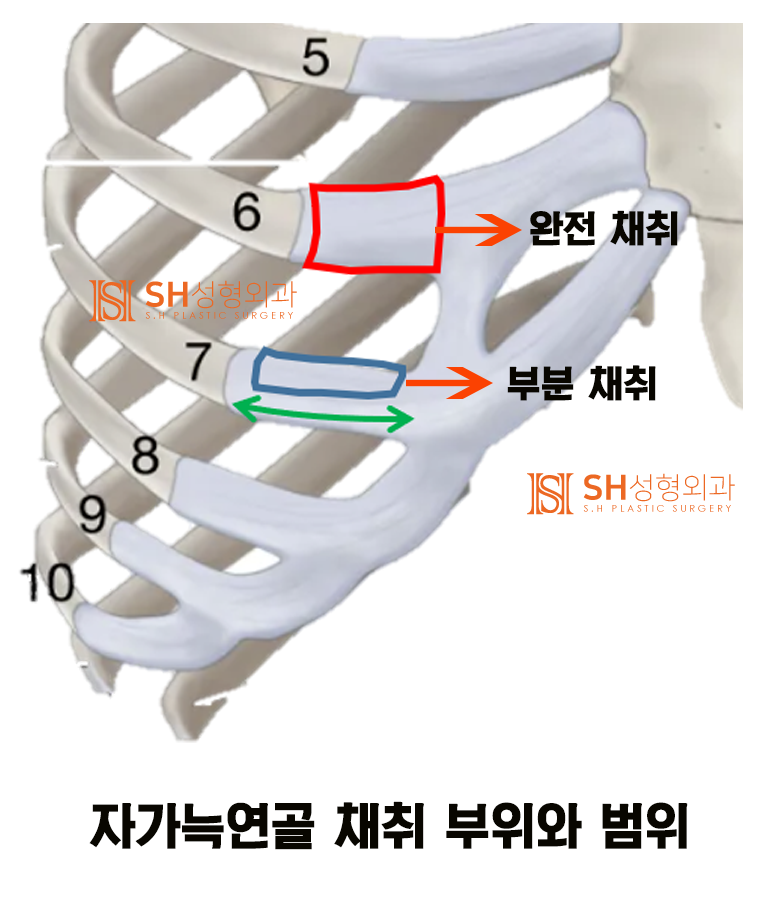
Therefore, I harvest cartilage using a ‘partial harvesting’ method whenever possible.
Only the necessary amount is resected, and the continuity of the rib cartilage is maintained as much as possible.
This reduces irritation when the chest cavity moves, resulting in much less pain and a faster return to daily life.
Surgery is not just about making the nasal tip beautiful.
Considering the patient's recovery process and daily life is the true essence of surgical design.
These small differences ultimately create a difference in the overall outcome.
Dr. Kim Sung-hoon’s Reflection
Through countless revision surgeries, what I have most keenly realized is that ‘material selection determines the fate of the surgery.’
Revision surgery is much more challenging than the initial surgery. After removing artificial materials, scar tissue, thinned skin, and asymmetry remain.
In such situations, autologous rib cartilage is the only material that is strong, not absorbed, and well-accepted by the human body.
I believe that any surgery must achieve both aesthetic beauty and function.
A nose that maintains its shape over a long time and is comfortable without inflammation.
That is the true purpose of surgery, and autologous rib cartilage is the material that best embodies that philosophy.

FAQ
Q. Is rib cartilage harvesting dangerous?
→ Partial harvesting is sufficient, and scars are mostly covered by underwear.
Q. Is rib cartilage too hard and noticeable?
→ It can be designed with soft ear cartilage to create natural curves.
Q. Is donated rib cartilage safe?
→ It is safe due to sterilization, but there may be differences in absorption rates.
Q. Can revision surgery be performed immediately after silicone removal?
→ It depends on the tissue condition; if there is no inflammation, reconstruction can be done immediately.
Q. Is it possible even if the nasal tip skin is thin?
→ In some cases, dermis or fascia can be used as auxiliary materials for restoration.
Q. Can autologous rib cartilage be used repeatedly for revision surgery?
→ It can be used repeatedly if there is a sufficient amount. However, structural design is more important.
(17) #Why is revision rhinoplasty needed? Are there any precautions? All about revision rhinoplasty! [feat. Dr. Kim Sung-hoon of SH Plastic Surgery] - YouTube
SH Plastic Surgery Clinic