2026-09-03
下眼瞼整形手術技巧:預防圓眼症 I
本文翻譯自PRS Global Open 2023年期刊文章,探討下眼瞼整形手術中預防圓眼症的技巧。內容涵蓋下眼瞼老化原因、Scleral Show與Ectropion的區別、手術策略(如矯正水平皮膚鬆弛、保護韌帶、保留神經、控制熱損傷)及術前評估,旨在提供安全有效的下眼瞼美容手術方法。
PRS Global Open, 2023年期刊文章
Surgical Tips for Aesthetic Lower Lid Blepharoplasty: Prevention of Round Eye
Klinger, Marco MD*; Vinci, Valeriano MD†,‡; Romeo, Maria Angela MD†; Battistini, Andrea MD*; Klinger, Francesco MD§; Bandi, Valeria MD*; Maione, Luca MD*; Vinciguerra, Paolo MD†,¶; Di Maria, Alessandra MD†,¶
INTRODUCTION
Lower eyelids are extremely predisposed to the effects of aging, such as skin laxity, loss of ligamentous support, atonia, and lower orbicularis-oculi muscle ptosis, as well as thinning of the orbital septum, which leads to orbital-fat prolapse.1,2
下眼瞼極易受到老化影響,例如皮膚鬆弛、韌帶支撐力喪失、張力減退、下眼輪匝肌下垂,以及眼眶隔膜變薄導致眼眶脂肪突出。
an overall evaluation of different orbital structures is paramount to optimize lower lid rejuvenation.
Lower eyelid malposition..
scleral show vs ectropion!!
項目 | 鞏膜暴露 (Scleral Show) | 眼瞼外翻 (Ectropion) |
定義 | 下眼瞼下方鞏膜 (sclera) 暴露的狀態 | 下眼瞼向外翻出,導致結膜暴露於外部的狀態 |
形態 | 下眼瞼輕微下垂,導致眼白顯露較多 | 下眼瞼完全翻轉,睫毛和結膜暴露於外部 |
嚴重程度 | 輕微或可能為解剖變異 | 可能引起功能性問題的病理狀態 |
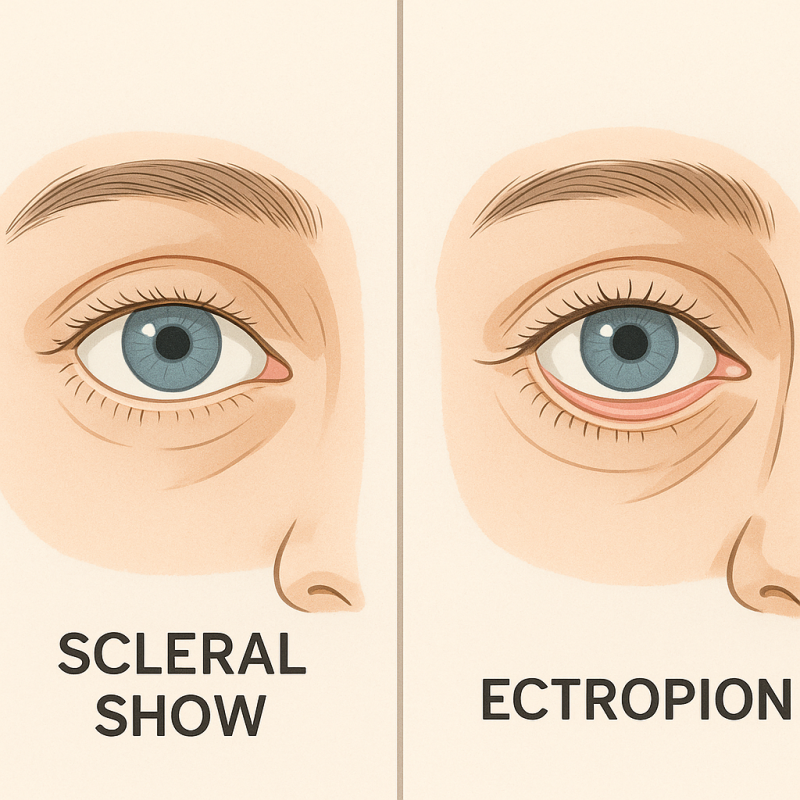
🔹 鞏膜暴露 (Scleral show) 是指下眼瞼輕微下垂,導致眼白顯露,影響美觀的狀態。
🔹 眼瞼外翻 (Ectropion) 是指下眼瞼完全翻轉,導致功能性問題的病理狀態。
MATERIALS AND METHODS
Clinical Assessment and Patient Selection
Between January 2016 and January 2020,
bilateral lower lid blepharoplasty on 280 patients at Humanitas Research Hospital (Rozzano, Milano, Italy)
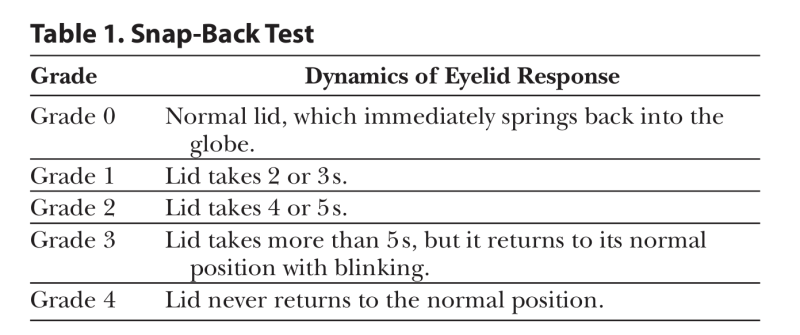
All patients were evaluated preoperatively in terms of ocular surface parameters: (a) lower eyelid retraction using “scleral show,” defined as the visible portion of the sclera between the upper rim of the lower eyelid and the inferior limbus; (b) lower eyelid laxity using the snap-back test (Table 1), the distraction test, and the assessment of eyelid margin malposition relative to the globe9; (c) amount of skin excess; (d) asymmetry; and (e) presence/ absence of orbital fat herniation (7.0.1. Adobe Photoshop Inc, California, was used to measure the distance).
Routine complete blood count and ECG were per formed in all patients. Preoperative standard photographs were collected, with the camera at a fixed 1-meter distance. Blinded-fashion preoperative and 10-month postoperative photograph analysis was performed by one independent plastic surgeon and one oculoplastic surgeon who did not execute the procedures to estimate both functional and aesthetic outcomes. Hence, postoperative photographs were scored from 1 (unsatisfactory outcome) to 5 (opti mal outcome).
Finally, at 10-month follow-up visit, a VAS from 0 to 10 was administered to all patients to assess patient sat isfaction in terms of lower lid appearance and symmetry compared to baseline. The VAS was shown to be less vul nerable to bias from confounding factors compared to other scales.10
Takeaways Question: How to prevent surgical complications in lower eyelid blepharoplasty? Findings: We highlight novel insights into a surgical technique for lower eyelid reconstructive surgery based on our 20-year experience in this specific field, which avoids the use of muscle flaps, thus preventing tarsal liga ment dystopia, limiting thermal spread, and preserving orbicularis-muscle innervation. We discuss clinical mani festations, such as epiphora, dry eye, blurred vision, eye discomfort, and photophobia, and their relation to lower lid displacement.
Meaning: Our technique helped us in preventing surgical complications, specifically lateral canthal dystopia, which ranges from round eye to ectropion. This improves post operative outcomes, revealing high patient and surgeon satisfaction over time.
A longstanding and satisfying experience with this technique let our group develop peculiar shrewdness crucial in the prevention of round eye. Particularly, our expertise focuses on the following strategical aspects:
1. The correction of horizontal skin laxity trough fixation of the lateral portion of the orbicularis oculi. Two possible surgical approaches, with or without the use of muscle flaps, can be used:
Reidy-Adamson technique: a triangular flap is harvested in the upper lateral portion of the lower orbicularis-oculi muscle. This is passed beneath a superolateral canthal tunnel and then fixed at the periosteum of the upper lateral orbital rim (above the Whitnall tubercle) to obtain optimal lower eyelid contour.
Our alternative technique, which does not imply the use of a muscle flap: during the skin excision, the orbicularis-oculi muscle is removed in a complementary fashion. Skin stitches are positioned to grasp skin-muscle-skin in an oblique fashion. This lateral vector puts into tension the muscle, compensating the horizontal skin laxity. As this approach has appeared to be very effective in a relatively short operative time, it has been used as our routine technique for more than 20 years now.
2. Sparing of tarsal ligaments, through a transcutaneous lower lid incision made 1 mm below the eyelashes line, directed to the prevention of dystopia following the tarsal ligament healing process and subsequent ectropion. In fact, misposition of tarsal ligament may lead to palpebral and bulbar conjunctiva detachment, altering the lateral final aesthetic profile of the patient.
3. Preserve the orbicularis innervation from the facial nerve by limiting inferolateral skin dissection within the orbital rim.11
4. Control of thermal spread by using cold blade dissection and diathermocoagulation in bipolar mode. We always avoid the use of cautery in monopolar mode, by preferring cold blade dissection that has been shown to be less traumatic and by avoiding histologic alteration of tissues, thus leading to less risk of conjunctival thermal injury. In case of punctate bleeding, coagulation is obtained by using bipolar forceps, which is more effective in limiting excessive thermal spread and reducing the risk of unintended injury and edema of collateral tissues, thus favoring and speeding up the healing process.
Complication rate was assessed during follow-up, made at 1 week, 2 months, and 10 months postoperatively. Specifically, patients were screened for lower eyelid malposition (including round eye, ectropion, and entropion), epiphora, dry eye, red eye, “foreign body sensation,” blurred vision, photophobia, and eye discomfort. Furthermore, the presence of infections, peribulbar hematoma/seroma, suture abscesses/cysts/granulomas, bad scarring and webbing, injury of inferior-oblique muscle or bulb, and relapse of the orbital fat were evaluated (Fig. 1A–C).
作者們下眼瞼手術的四大核心策略
目標:「圓眼症」(round eye,指眼睛無法完全閉合的症狀)預防 + 維持自然眼型
1️⃣ 水平皮膚鬆弛的矯正方法
· Reidy-Adamson 技術:
o 從下眼輪匝肌 (orbicularis oculi) 切取三角形肌瓣 (flap),
o 將其穿過上外側眼角隧道,然後固定於上外側眼眶緣的骨膜 (Whitnall 結節上方) → 提升下眼瞼輪廓。
· 作者們主要使用的技術:
o 不使用肌瓣,在切除皮膚時一併切除部分下眼輪匝肌。
o 皮膚縫合時,以斜向方式縫合「皮膚-肌肉-皮膚」→ 使肌肉收緊,以彌補水平皮膚鬆弛。
→ 這種方法已使用超過20年,更快速且有效。
2️⃣ 保護眼瞼支撐韌帶
· 切口位置:睫毛線下方1毫米處 → 預防支撐眼瞼的韌帶 (tarsal ligament) 受損。
o 若韌帶受損,可能導致眼瞼外翻 (ectropion) 或眼型扭曲。
3️⃣ 保留神經
· 皮膚剝離時,僅限於眼眶緣 (orbital rim) 內側下方
o 保護面部神經連接眼輪匝肌的部分。
4️⃣ 預防熱損傷
· 僅使用「冷刀」分離組織 → 最大限度減少熱造成的組織變性。
· 出血時,僅使用雙極電凝器 (bipolar) →
o 阻斷熱量擴散至周圍組織 (如結膜)。
📊 安全性驗證
· 術後1週、2個月和10個月進行追蹤觀察,檢查以下併發症:
o 眼瞼變形 (圓眼症、外翻、內翻)、感染、流淚/乾眼症、視力模糊、出血等。
常見問題
下眼瞼為何容易老化?
是的,下眼瞼極易受到各種老化現象的影響,例如皮膚彈性下降、韌帶支撐力喪失、眼輪匝肌下垂、眼眶隔膜變薄導致眼眶脂肪突出等。這些變化可能導致眼下出現美容和功能性問題。
鞏膜暴露 (Scleral Show) 和眼瞼外翻 (Ectropion) 有何不同?
鞏膜暴露 (Scleral Show) 是指下眼瞼輕微下垂,導致眼白顯露較多,是一種美觀上的狀態。而眼瞼外翻 (Ectropion) 則是下眼瞼完全翻轉,結膜暴露於外部,可能引起功能性問題的病理狀態。
下眼瞼整形後如何預防圓眼症?
是的,為預防圓眼症,關鍵在於固定眼輪匝肌外側部分以矯正水平皮膚鬆弛,並在睫毛線下方1毫米處進行切口,以最大程度減少韌帶損傷。此外,還需保留面部神經對眼輪匝肌的支配,並採用控制熱損傷的技術。
手術中如何控制熱損傷?
是的,手術中熱損傷的控制是透過使用冷刀進行剝離和雙極模式的電凝來實現的。我們避免使用單極電凝器,選擇創傷較小的冷刀剝離,以減少組織的組織學改變,從而降低結膜熱損傷的風險。
利用眼輪匝肌的手術技術有哪些?
是的,利用眼輪匝肌的手術技術包括Reidy-Adamson技術和本文介紹的替代技術。Reidy-Adamson技術使用三角形肌瓣,而替代技術則在皮膚切除時一併切除部分眼輪匝肌,並以斜向縫合方式矯正水平皮膚鬆弛,不使用肌瓣。
下眼瞼整形前會進行哪些評估?
是的,術前會綜合評估眼球表面參數、下眼瞼鬆弛度(如彈回測試)、皮膚多餘量、不對稱性以及眼眶脂肪脫垂情況等。透過這些評估,可以為患者制定最佳的手術方案。