2026-09-07
Yaksuyeok Dental Clinic: Treating Deep Cavities Without Root Canal (MTA Treatment)
Learn how Yaksuyeok Dental Clinic treats deep cavities without root canal therapy using MTA material, preserving the nerve.
Hello.
This is Dr. Kim Tae-young, the head director of Bareunyoung Dental Clinic at Yaksuyeok Station, personally explaining treatment cases.
Among patients who visit the dental clinic after a long time for scaling, there might have been cases where new cavities were discovered and required treatment.
For shallow cavities with a limited scope,
it's sometimes possible to simply remove the cavity and treat it with resin.
Occasionally, even if a cavity appears small, deep cavities inside
can progress to the nerve, especially in younger age groups where the nerve size is larger.
The case I'll introduce today
is a recently treated case where the nerve is alive,
but due to a deep cavity, the nerve was exposed.
I'll explain cases where treatment is possible without root canal therapy.
Narrow and Deep Cavity
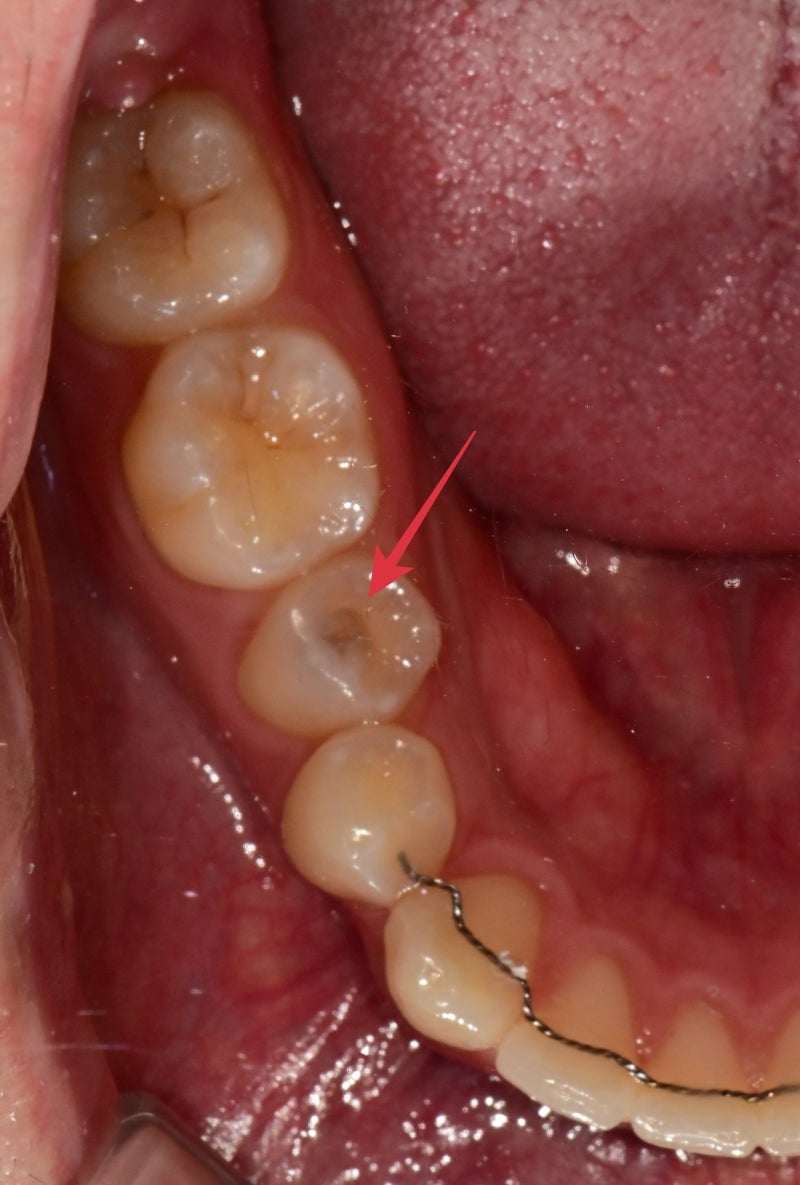
The patient visited for scaling and a check-up of other areas.
The examination revealed a dark-looking cavity progressing on the chewing surface of the small molar indicated by the arrow.
Pain is not always accompanied by cavities.
Due to slow progression or pain that we cannot notice,
self-discovery of cavities is not easy.
Tooth Shape Prone to Cavities
When we look at the anatomical structure of our teeth,
we imagine smooth and strong teeth like Go stones.
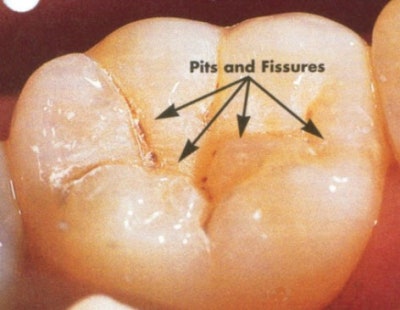
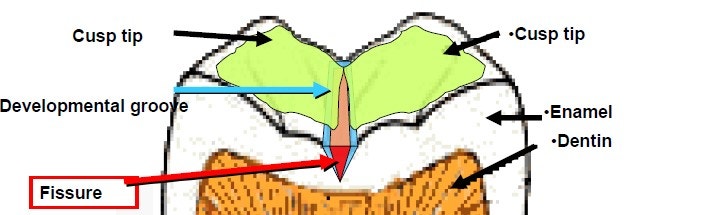
The chewing surface of molars has a wrinkled shape.
The wrinkled part is called a fissure, and sometimes this area
extends deep into the tooth like a canyon, as shown in the right picture.
If plaque accumulates in this area, it's difficult to manage, and the likelihood of cavities increases.
For this reason, children receive a treatment called sealant
to clean and fill this space, helping to prevent cavities.
Nerve Exposure, Use of MTA Material
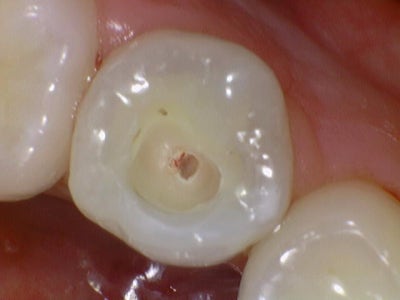
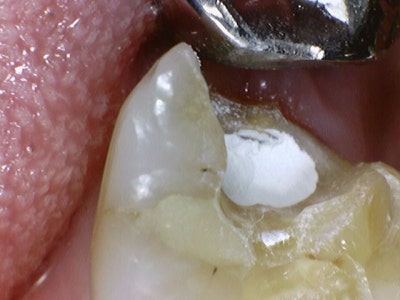
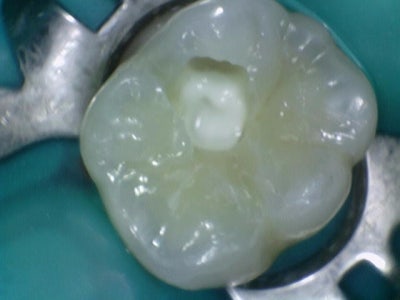
Since the nerve entrance is pointed,
the nerve entrance can be exposed during cavity removal.
In such cases, using a material called MTA can allow us to attempt to save the nerve without root canal treatment.
However, it cannot always be used, and even when used appropriately for symptoms, there's a low probability that root canal treatment may still be necessary.
The red part in the left photo is the nerve,
and MTA can only be used if the nerve is still alive.
MTA is known as a biocompatible material with high healing, regenerative, and antibacterial properties.
During the treatment process, additional time is required for hemostasis -> material application -> material hardening,
which means the scheduled treatment time will inevitably be extended.
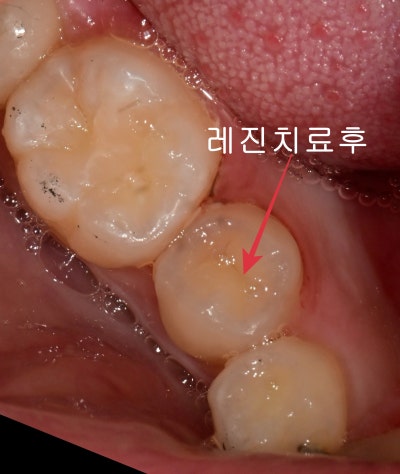
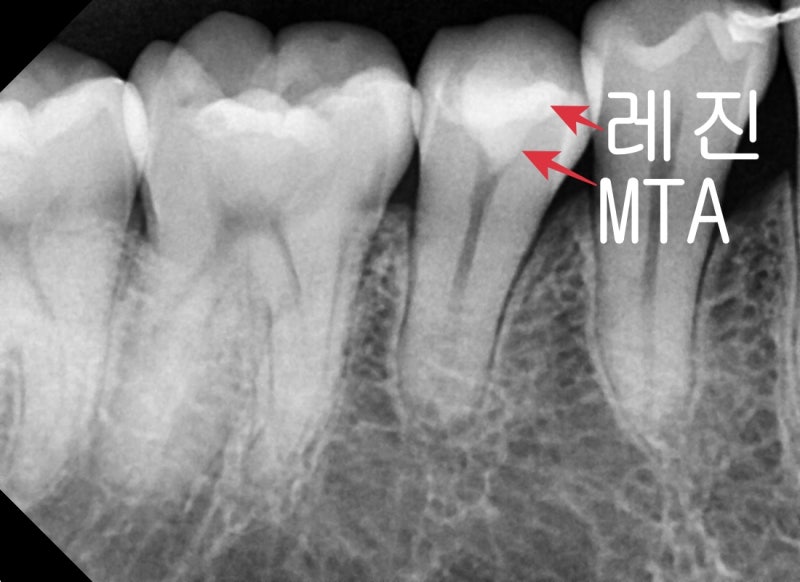
These are photos after treatment.
After building up MTA material on the exposed nerve canal entrance and allowing it to harden,
the treatment was completed with a strong and aesthetic resin filling on top.
Since the nerve is alive and the exposure range is not wide, this is a very good case for MTA material.
While root canal treatment should not be done unnecessarily, it is essential when truly needed.
However, by carefully selecting the indications and applying the correct material, more conservative treatment can be achieved.
Today, we learned about the MTA treatment method when a small nerve canal entrance is exposed during cavity treatment,
a situation that is ambiguous for proceeding directly to root canal treatment.
We recommend visiting a dental clinic for a detailed and accurate diagnosis.
I hope this information was helpful for your questions,
and I'll see you next time with another case.
Thank you^^
▼Related cases you might find helpful
We believe that proper treatment leads to proper results.My desired dental clinic is one that makes all patients who visit with worries leave feeling relieved and confident. – Bareunyoung Dental Clinic
DirectionsJYJ Building, 2nd Floor, 179 Dongho-ro, Jung-guRight in front of Exit 6 of Yaksuyeok Station, towards Yaksuyeok MarketVillage Bus 5 (Yaksuyeok)Village Bus 12 (Namsan Town, Yaksuyeok Police Station)Bus Stop (Yaksue Heights, Sindang Social Welfare Center, Gaon Library, Kumho Tunnel Entrance)From YuYu Pharma towards Kumho Station
This post was written directly by Bareunyoung Dental Clinic for the purpose of providing medical information and hospital advertising (in compliance with Article 56, Paragraph 1 of the Medical Service Act).
Frequently Asked Questions
Can deep cavities be treated without root canal therapy?
Yes, it is possible. In cases of deep cavities where the nerve is exposed but still alive, a biocompatible material called MTA can be used to attempt to preserve the nerve without root canal treatment. However, it is not applicable in all cases, and there is a low probability that root canal treatment may still be necessary.
When is MTA treatment used?
MTA treatment is used when the nerve entrance is exposed during cavity removal but the nerve is still alive. This material has high healing, regenerative, and antibacterial properties, which help to save the nerve.
What are the characteristics of MTA material?
MTA is a biocompatible material with high healing and regenerative properties that aid in the healing and regeneration of the tooth nerve. It also possesses excellent antibacterial capabilities, contributing to maintaining nerve health.
How is the MTA treatment process carried out?
The MTA treatment process involves hemostasis of the exposed nerve area, followed by the application of MTA material, and then waiting for the material to fully harden. Additional time may be required for the material to harden.
Are there any precautions after MTA treatment?
After MTA treatment, MTA material is built up on the exposed nerve canal entrance, hardened, and then finished with resin. Good results can be expected if the nerve is alive and the exposure range is not wide, but it is recommended to visit a dental clinic for a detailed examination.
Is sealant helpful for preventing cavities in children?
Yes, it is helpful. The chewing surfaces of children's molars have a wrinkled shape (fissure), and these areas are prone to plaque accumulation. Sealant treatment is effective in filling these spaces to prevent cavities.