2026-09-03
Surgical Tips for Aesthetic Lower Lid Blepharoplasty: Prevention of Round Eye I
This article summarizes key surgical tips for lower lid blepharoplasty, focusing on preventing complications like 'round eye' and ectropion. It details techniques for correcting skin laxity, preserving ligaments and nerves, and controlling thermal spread, based on a 20-year clinical experience.
PRS Global Open, a journal published in 2023
Surgical Tips for Aesthetic Lower Lid Blepharoplasty: Prevention of Round Eye
Klinger, Marco MD*; Vinci, Valeriano MD†,‡; Romeo, Maria Angela MD†; Battistini, Andrea MD*; Klinger, Francesco MD§; Bandi, Valeria MD*; Maione, Luca MD*; Vinciguerra, Paolo MD†,¶; Di Maria, Alessandra MD†,¶
INTRODUCTION
Lower eyelids are extremely predisposed to the effects of aging, such as skin laxity, loss of ligamentous support, atonia, and lower orbicularis-oculi muscle ptosis, as well as thinning of the orbital septum, which leads to orbital-fat prolapse.1,2
The lower eyelid is highly susceptible to aging, particularly skin laxity, loss of ligamentous support, atonia, and lower orbicularis-oculi muscle ptosis. Additionally, thinning of the orbital septum causes orbital fat to protrude.
an overall evaluation of different orbital structures is paramount to optimize lower lid rejuvenation.
Lower eyelid malposition..
scleral show vs ectropion!!
Item | Scleral Show | Ectropion |
Definition | A condition where the sclera is exposed below the lower eyelid. | A condition where the lower eyelid is everted outwards, exposing the conjunctiva. |
Appearance | The lower eyelid is slightly drooped, showing a lot of the white of the eye. | The lower eyelid is completely turned out, exposing the eyelashes and conjunctiva to the outside. |
Severity | Mild or may be an anatomical variation. | A pathological condition that can cause functional problems. |
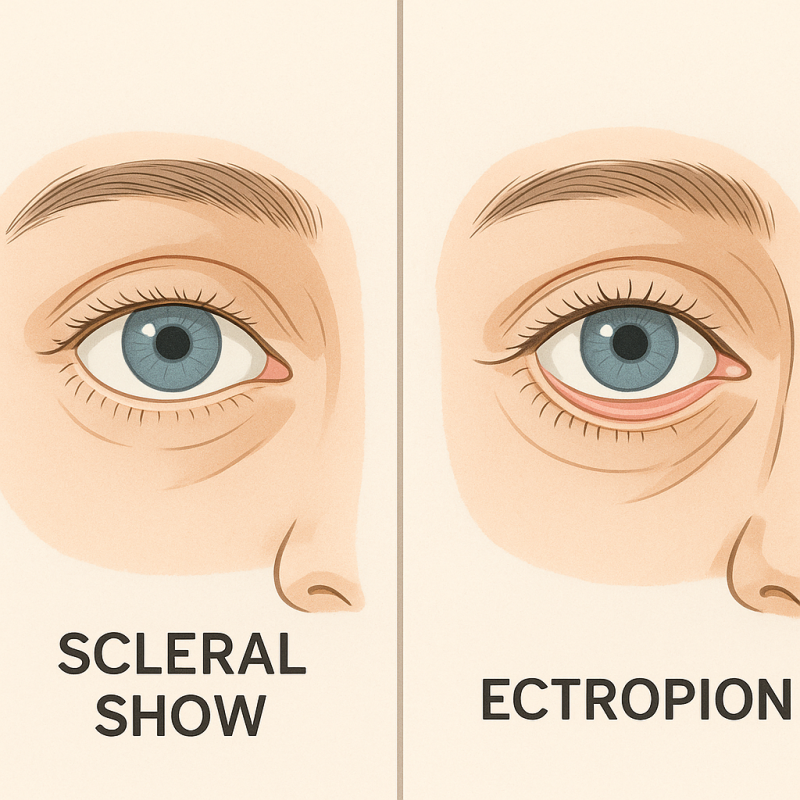
🔹 Scleral show is a cosmetic concern where the lower eyelid is slightly lowered, revealing the white of the eye.
🔹 Ectropion is a pathological condition where the lower eyelid is completely everted, causing functional problems.
MATERIALS AND METHODS
Clinical Assessment and Patient Selection
Between January 2016 and January 2020,
bilateral lower lid blepharoplasty on 280 patients at Humanitas Research Hospital (Rozzano, Milano, Italy)
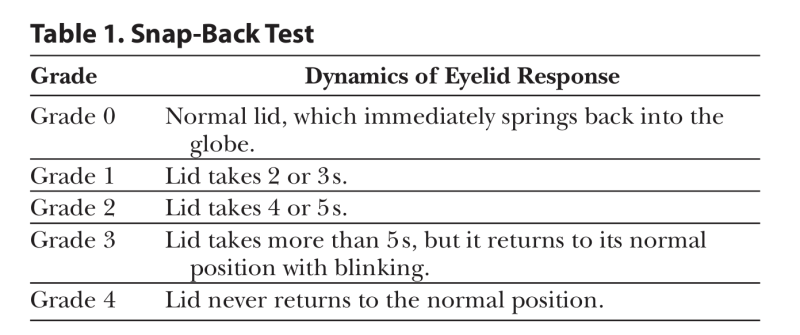
All patients were evaluated preoperatively in terms of ocular surface parameters: (a) lower eyelid retraction using ‘scleral show,’ defined as the visible portion of the sclera between the upper rim of the lower eyelid and the inferior limbus; (b) lower eyelid laxity using the snap-back test (Table 1), the distraction test, and the assessment of eyelid margin malposition relative to the globe9; (c) amount of skin excess; (d) asymmetry; and (e) presence/ absence of orbital fat herniation (7.0.1. Adobe Photoshop Inc, California, was used to measure the distance).
Routine complete blood count and ECG were per formed in all patients. Preoperative standard photographs were collected, with the camera at a fixed 1-meter distance. Blinded-fashion preoperative and 10-month postoperative photograph analysis was performed by one independent plastic surgeon and one oculoplastic surgeon who did not execute the procedures to estimate both functional and aesthetic outcomes. Hence, postoperative photographs were scored from 1 (unsatisfactory outcome) to 5 (opti mal outcome).
Finally, at 10-month follow-up visit, a VAS from 0 to 10 was administered to all patients to assess patient sat isfaction in terms of lower lid appearance and symmetry compared to baseline. The VAS was shown to be less vul nerable to bias from confounding factors compared to other scales.10
Takeaways Question: How to prevent surgical complications in lower eyelid blepharoplasty? Findings: We highlight novel insights into a surgical technique for lower eyelid reconstructive surgery based on our 20-year experience in this specific field, which avoids the use of muscle flaps, thus preventing tarsal liga ment dystopia, limiting thermal spread, and preserving orbicularis-muscle innervation. We discuss clinical mani festations, such as epiphora, dry eye, blurred vision, eye discomfort, and photophobia, and their relation to lower lid displacement.
Meaning: Our technique helped us in preventing surgical complications, specifically lateral canthal dystopia, which ranges from round eye to ectropion. This improves post operative outcomes, revealing high patient and surgeon satisfaction over time.
A longstanding and satisfying experience with this technique let our group develop peculiar shrewdness crucial in the prevention of round eye. Particularly, our expertise focuses on the following strategical aspects:
1. The correction of horizontal skin laxity trough fixation of the lateral portion of the orbicularis oculi. Two possible surgical approaches, with or without the use of muscle flaps, can be used:
Reidy-Adamson technique: a triangular flap is harvested in the upper lateral portion of the lower orbicularis-oculi muscle. This is passed beneath a superolateral canthal tunnel and then fixed at the periosteum of the upper lateral orbital rim (above the Whitnall tubercle) to obtain optimal lower eyelid contour.
Our alternative technique, which does not imply the use of a muscle flap: during the skin excision, the orbicularis-oculi muscle is removed in a complementary fashion. Skin stitches are positioned to grasp skin-muscle-skin in an oblique fashion. This lateral vector puts into tension the muscle, compensating the horizontal skin laxity. As this approach has appeared to be very effective in a relatively short operative time, it has been used as our routine technique for more than 20 years now.
2. Sparing of tarsal ligaments, through a transcutaneous lower lid incision made 1 mm below the eyelashes line, directed to the prevention of dystopia following the tarsal ligament healing process and subsequent ectropion. In fact, misposition of tarsal ligament may lead to palpebral and bulbar conjunctiva detachment, altering the lateral final aesthetic profile of the patient.
3. Preserve the orbicularis innervation from the facial nerve by limiting inferolateral skin dissection within the orbital rim.11
4. Control of thermal spread by using cold blade dissection and diathermocoagulation in bipolar mode. We always avoid the use of cautery in monopolar mode, by preferring cold blade dissection that has been shown to be less traumatic and by avoiding histologic alteration of tissues, thus leading to less risk of conjunctival thermal injury. In case of punctate bleeding, coagulation is obtained by using bipolar forceps, which is more effective in limiting excessive thermal spread and reducing the risk of unintended injury and edema of collateral tissues, thus favoring and speeding up the healing process.
Complication rate was assessed during follow-up, made at 1 week, 2 months, and 10 months postoperatively. Specifically, patients were screened for lower eyelid malposition (including round eye, ectropion, and entropion), epiphora, dry eye, red eye, ‘foreign body sensation,’ blurred vision, photophobia, and eye discomfort. Furthermore, the presence of infections, peribulbar hematoma/seroma, suture abscesses/cysts/granulomas, bad scarring and webbing, injury of inferior-oblique muscle or bulb, and relapse of the orbital fat were evaluated (Fig. 1A–C).
The authors' four core strategies for lower eyelid surgery
Goal: Prevention of ‘round eye’ (a condition where the eye cannot fully close) + maintenance of a natural eye shape
1️⃣ Method for correcting horizontal skin laxity
· Reidy-Adamson technique:
o A triangular muscle flap is harvested from the lower orbicularis oculi muscle,
o Fixed to the bone above the lateral canthus (upper orbital rim) → lifts the lower eye contour.
· The authors' commonly used technique:
o When excising skin without a muscle flap, the lower orbicularis oculi muscle is also removed in a complementary fashion.
o During skin suturing, ‘skin-muscle-skin’ is grasped obliquely → the muscle is tightened, firming up the sagging skin.
→ A faster and more effective method used for over 20 years.
2️⃣ Protection of eyelid support structures
· Incision location: 1mm below the eyelashes → prevents damage to the tarsal ligament that supports the eyelid.
o Damage to the ligament can lead to eversion of the eyelid (ectropion) or distortion of the eye shape.
3️⃣ Nerve preservation
· Skin dissection is limited to within the orbital rim
o Protects the facial nerve connection to the orbicularis muscle.
4️⃣ Prevention of thermal damage
· Tissue separation only with a ‘cold blade’ → minimizes thermal denaturation of tissues.
· In case of bleeding, only bipolar electrocoagulation is used →
o Prevents heat from spreading to surrounding tissues (conjunctiva, etc.).
📊 Safety verification
· Follow-up at 1 week, 2 months, and 10 months postoperatively to check for complications such as:
o Eyelid malposition (round eye, ectropion, entropion), infection, tearing/dryness, blurred vision, bleeding, etc.
Frequently Asked Questions
Why are lower eyelids susceptible to aging?
Yes, lower eyelids are highly susceptible to various aging phenomena, including decreased skin elasticity, loss of ligamentous support, orbicularis muscle ptosis, and thinning of the orbital septum leading to orbital fat prolapse. These changes can cause both aesthetic and functional problems in the lower eyelid area.
What is the difference between Scleral Show and Ectropion?
Scleral Show refers to a cosmetic condition where the lower eyelid is slightly lowered, revealing a significant portion of the white of the eye. In contrast, Ectropion is a pathological condition where the lower eyelid is completely everted, exposing the conjunctiva externally and potentially causing functional problems.
How can ‘round eye’ be prevented after lower eyelid blepharoplasty?
Yes, to prevent ‘round eye,’ it is crucial to correct horizontal skin laxity by fixing the lateral portion of the orbicularis oculi muscle and to minimize ligament damage by making an incision 1mm below the lash line. Additionally, techniques are used to preserve the facial nerve's innervation of the orbicularis muscle and to control thermal damage.
How is thermal damage controlled during surgery?
Yes, thermal damage control during surgery is achieved through cold blade dissection and bipolar mode electrocoagulation. The use of monopolar cautery is avoided, and cold blade dissection is preferred as it is less traumatic and prevents histological alteration of tissues, thereby reducing the risk of conjunctival thermal injury.
What surgical techniques involve the orbicularis muscle?
Yes, surgical techniques involving the orbicularis muscle include the Reidy-Adamson technique and the alternative technique described in the text. The Reidy-Adamson technique uses a triangular flap, while the alternative technique, without a muscle flap, involves complementary removal of the orbicularis muscle during skin excision and oblique suturing to correct horizontal skin laxity.
What evaluations are performed before lower eyelid blepharoplasty?
Yes, before surgery, a comprehensive evaluation is performed, including ocular surface parameters, lower eyelid laxity tests (such as the snap-back test), assessment of skin excess, asymmetry, and the presence/absence of orbital fat herniation. This helps in formulating an optimized surgical plan for the patient.