2025-09-20
#4 Upper Blepharoplasty? Causes and Analysis of Upper Blepharoplasty Failure
Dr. Kim Sung-hoon of SH Plastic Surgery anatomically analyzes the causes of upper blepharoplasty failure and explains the crucial differences from incisional double eyelid surgery. Learn about eyebrow compensatory movement, skin excision range, and the ZONE division concept.
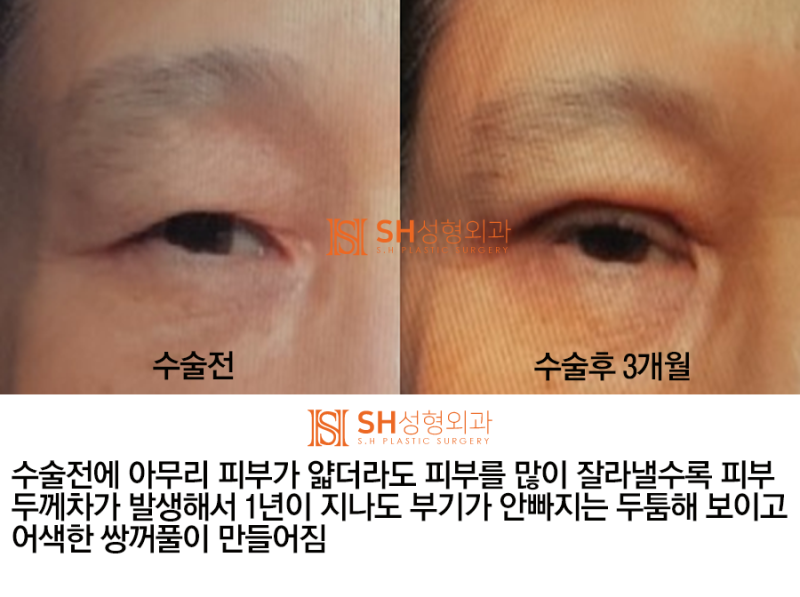
#4 Upper Blepharoplasty? Causes and Analysis of Upper Blepharoplasty Failure
Double eyelid surgery and upper blepharoplasty may seem similar, but their essence is different. Dr. Kim Sung-hoon of SH Plastic Surgery anatomically analyzes the causes of upper blepharoplasty failure and explains the crucial differences from incisional double eyelid surgery. He provides an in-depth explanation of ‘eyebrow compensatory movement,’ ‘skin excision range,’ and the ‘ZONE division concept’ that you must know before surgery. In the next part, we will follow up with successful cases. Face Designer Kim Sung-hoon
‘The surgery went well, so why does it look worse?’
A few days ago, a female patient in her 40s visited the clinic.
‘I was told the surgery went well… but people keep telling me I look scary…’
Upon careful examination of her face, the distance between her eyes and eyebrows had become too close, and her double eyelid line was thick and heavy.
She said she had undergone [upper blepharoplasty] at a previous hospital.
While the sagging was somewhat resolved, her eye impression became more stifling, and when looking at her overall impression, a heaviness around her eyes was prominent.
What was the problem? The surgery was successful, but the outcome was unsatisfactory.
Such cases are more common than one might think.
Today, I will explain the ‘essential difference between incisional double eyelid surgery and upper blepharoplasty’ and the reasons for failure, like this patient’s case.
Terminology Explanation
First, let me explain the terminology.
上 (sang: upper) 眼 (an: eye) 瞼 (geom: eyelid)
This literally refers to all surgeries performed on the upper eyelid.
Medically, it includes non-incisional, incisional double eyelid surgery, ptosis correction, sub-brow lift, epicanthoplasty, lateral canthoplasty, and even canthoplasty.
However, among patients, ‘upper blepharoplasty’ usually refers to incisional double eyelid surgery received by middle-aged and older individuals (40s and above) to improve sagging.
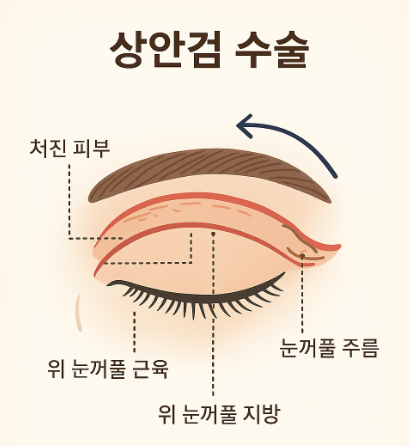
For example,
Incisional upper blepharoplasty, which excises sagging skin,
Ptosis correction, performed when the eye-opening muscle is functionally weak,
Aesthetically, incisional double eyelid surgery (incisional blepharoplasty) to create or adjust the height of double eyelids,
Or even ptosis correction, sub-brow lift, and in some cases, even forehead lift can be categorized under upper blepharoplasty.
In other words, simply calling ‘middle-aged incisional double eyelid surgery’ upper blepharoplasty is not medically precise.
However, generally, surgery to resolve discomfort caused by drooping eyelids in middle age or later,
That is, ‘incisional upper eyelid surgery’ that includes both skin excision and functional improvement, is often referred to as upper blepharoplasty.
So, when I explain it, I always summarize it this way:
‘It is not simply a surgery to create double eyelids. It is a complex reconstructive and aesthetic surgery that must simultaneously consider the complex functions and structures of the entire upper eyelid, including sagging, muscle function, fat structure, and skin thickness.’
‘In fact, it involves manipulating far more tissues than incisional double eyelid surgery. Because it is a delicate surgery that requires consideration of the skin, muscles, fat, and even eyebrow position, it should never be compared on the same level as simple aesthetic double eyelid surgery.’
Differences Between the Two Terms
Now, let's look at the differences between these two terms!
Incisional Double Eyelid Surgery | Upper Blepharoplasty | |
Age Group | 10s-30s | 40s and above |
Surgical Purpose | Change or create double eyelid height | Resolve eye sagging and often functional improvement |
Skin Excision Amount | Average 3-5mm | Average 5-8mm |
Wrinkle Improvement | Minimal impact | Wrinkles may worsen in some cases (especially at the inner corner) |
Eye-Opening Muscle | Mostly pseudoptosis | Higher incidence of true ptosis (senile) |
Upper Eye Fat | Often excessive | If insufficient, upper eye fat repositioning or fat grafting is needed |
It is so different from simply incising the skin for double eyelids.
To resolve eyelid sagging, not only the skin but also the muscles, fat, and even eyebrow movement must be considered.
There are many tissues that need to be handled carefully, and each one must be delicately adjusted to lead to a natural and comfortable result.
Therefore, this surgery requires even more meticulous planning and experience.
Three Reasons for Failure
1. Excision without considering skin thickness
Since this surgery aims to resolve eyelid sagging, the amount of skin to be excised is relatively large.
However, the skin of the eyelid is divided into Zone I, Zone II, and Zone III according to its thickness,
This classification is an important criterion that determines the success of the surgery.
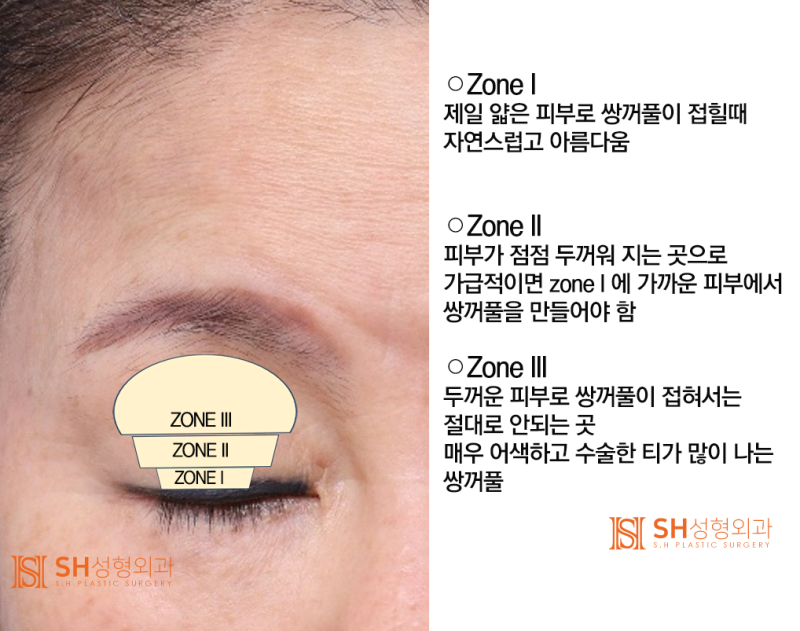
• Zone I is the thinnest skin, where the double eyelid naturally folds.
• Zone II is of intermediate thickness, where the skin gradually thickens, and generally, the double eyelid should be created closer to Zone I.
• Zone III has thick skin and lacks elasticity, so forming a double eyelid here can make the surgery look very obvious and unnatural.
Ideally, the double eyelid should be created in Zone I, but if too much skin is excised, Zone II is cut away, making it difficult for the double eyelid to fold, and eventually, Zone I and Zone III meet.
Consequently, the difference in skin thickness above and below the double eyelid crease becomes extremely large, leading to a double eyelid that does not fold or appears unnatural and thick.
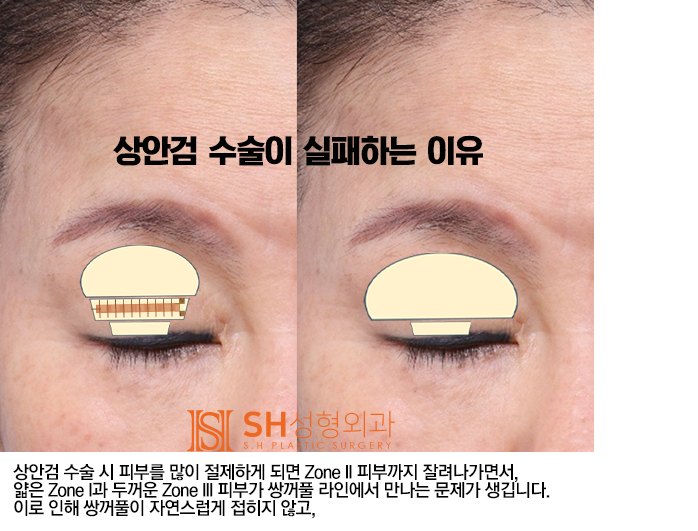
The uppermost part, directly below the eyebrow, is very thick, fatty, and firm.
If this area descends to the double eyelid line,
It can be difficult for it to fold, ultimately making the double eyelid appear unnatural and awkward.
Sometimes, even after 6 months or a year post-surgery,
This is precisely why it can still look like a thick swelling.

‘Excising a lot of skin does not necessarily lead to good results. Instead, by minimizing the amount of excision and considering what kind of skin will descend onto the double eyelid line, more natural and long-lasting results can be achieved. This is why more delicate anatomical judgment and technique are required than for simple incisional double eyelid surgery.’
2. Surgery without considering eyebrow compensatory movement
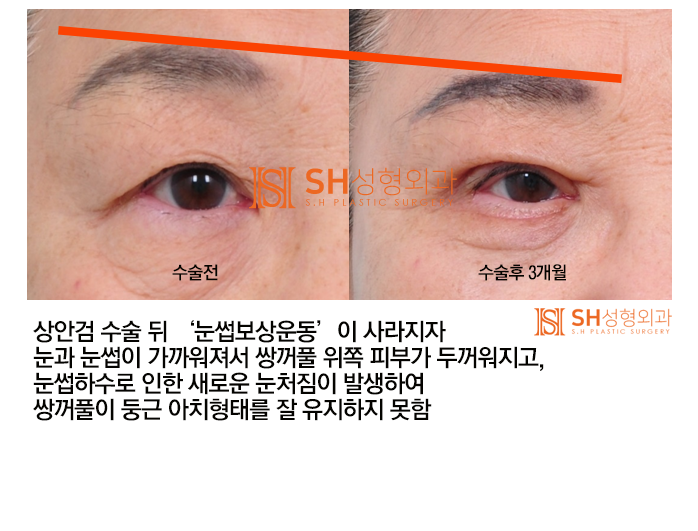
When eyelids sag, people instinctively raise their eyebrows to secure their vision.
This is called eyebrow compensatory movement, and if it continues for a long time, the forehead muscles become excessively activated,
And forehead wrinkles also worsen.
When eyelid sagging is resolved through surgery, there is no longer a need to raise the eyebrows.
Then, the eyebrows that were previously raised ‘drop’ to their original position, narrowing the distance between the eyes and eyebrows,
Consequently, side effects such as the eyes appearing smaller and the double eyelids being covered occur.
In many cases, patients actually say, ‘My eyes look smaller’ after surgery.
This is an optical illusion caused by drooping eyebrows, and ‘changes in eyebrow position’ must be predicted before surgery.
3. Design that does not consider the limitations of eyelid wrinkles
While it is an excellent method for excising upper eyelid skin and reconstructing double eyelids, there are limitations in improving wrinkles at the inner corner (medial) or outer corner (lateral) of the eye.
Especially, wrinkles at the inner corner of the eye are connected to the forehead, and simple upper blepharoplasty incision may leave wrinkles or even deepen them.
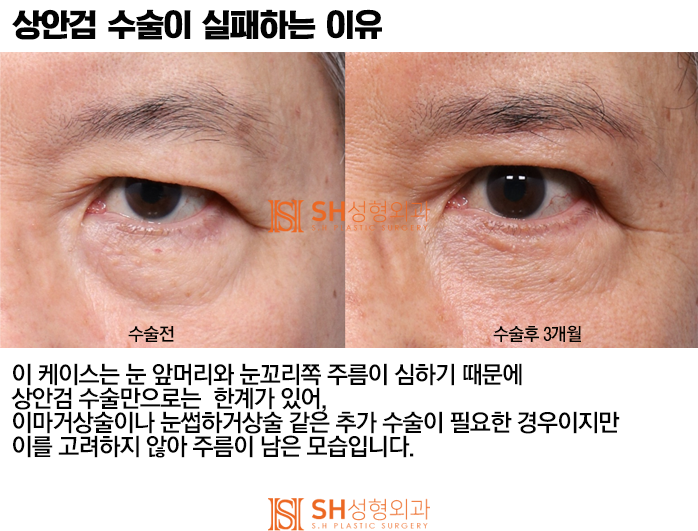
In such cases, combining it with a forehead lift or sub-brow lift can achieve more natural and balanced results.
Otherwise, the central part of the eye may be smoothed, but the inner and outer corners may still have wrinkles, leading to an unnatural result.
Before surgery, the direction and origin of wrinkles, as well as the condition of surrounding structures, must be comprehensively assessed to plan the surgery.
Face Designer Kim Sung-hoon's Reflection
‘It is more important to ‘design a good exit’ than to perform the surgery well.’
Surgery is a technique, but the result is a matter of anatomical design.
Especially, it is not simply about ‘creating double eyelids,’
It is a design process that must consider the organic balance of the eyes, forehead, eyebrows, fat, and skin.
You should understand it not as a surgery that pulls the eyes,
But as a surgery that ‘re-tunes’ the structure of the eyes.
FAQ
Q1. Does swelling last long after surgery?
A. It varies depending on the case, but swelling generally lasts longer than incisional double eyelid surgery due to the larger amount of skin excised.
Q2. Which is more natural, incisional double eyelid surgery or upper blepharoplasty?
A. It depends on the purpose and anatomical condition. If there is no eye sagging, incisional double eyelid surgery is more suitable; if there are functional problems, the latter is more appropriate.
Q3. Do I also need a forehead lift?
A. If the eyebrows are significantly lowered, upper blepharoplasty alone may not be sufficient. The necessity of combining procedures is determined through precise consultation.
Q4. Does incision leave a lot of scars?
A. Scars around the eyes heal relatively quickly and are often covered by natural wrinkles or lines.
Q5. Can ptosis correction also be done with this surgery alone?
A. Some correction is possible. However, if the eye-opening muscle function is weak, a separate ptosis correction may be necessary.
Q6. How often is revision surgery typically performed?
A. Generally, results last for more than 10 years. However, supplementary surgery may be needed due to aging or changes in eyebrow position.
In the next part, I will introduce a successful case where eye sagging and wrinkles were completely improved by combining it with a forehead lift.
We will examine the pre- and post-procedure changes and the reasons behind them, from the perspective of Face Designer Kim Sung-hoon.
SH Plastic Surgery Clinic
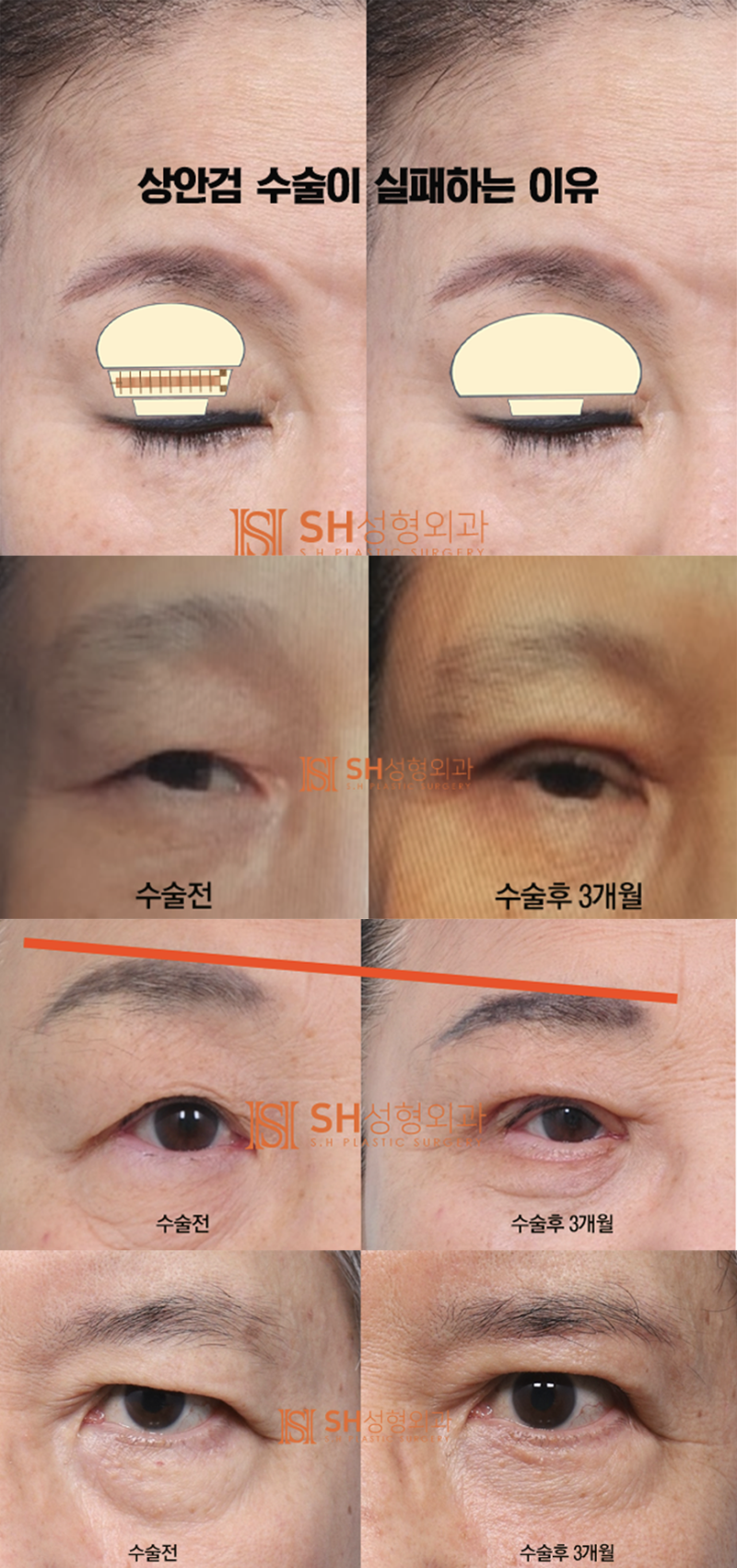
※ This article discloses actual pre- and post-surgery appearances for accurate information delivery.
These photos are published with the patient's consent, and bruising and swelling may vary and differ among individuals.