2026-09-07
Yaksuyeok Dental Clinic: Retreatment of Old Root Canal Therapy
Learn why root canal therapy may need retreatment and what the process involves. This article from Yaksuyeok Dental Clinic explains the causes of recurrence, treatment procedures, and common questions.
Hello,
I'm Dr. Kim Tae-young, director of Bareunyoung Dental Clinic at Yaksuyeok Station.^^
Today, I'd like to talk about root canal retreatment.
Patients often ask, ‘Why can a root canal-treated tooth relapse later?’
There are cases where a root canal-treated tooth relapses due to various reasons, and I'd like to introduce one of them.
The photo below is one I often show during consultations:
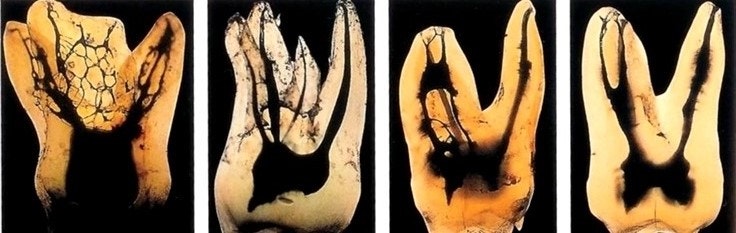
This photo shows the nerves of a large molar. (The black areas indicate where the nerves are distributed.)
We usually think of nerves as single strands, but as shown in the photo above, there are many dense accessory canals around the thick main nerve canal, like tree roots.
While we can mechanically remove the main nerve canal, for the remaining areas where nerves are distributed,
we thoroughly clean the inside of the nerve canal as much as possible through chemical disinfection and then seal the canal while monitoring symptoms.
For this reason, there is no fixed number of visits for root canal treatment, and this is why patients with symptoms often need multiple appointments.
However, there are nerve branches that cannot be reached even with root canal treatment.
Usually, the treatment finishes without symptoms, but over time, an inflammatory cause can develop in these areas, leading to a relapse.
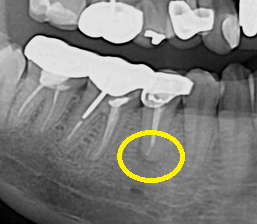
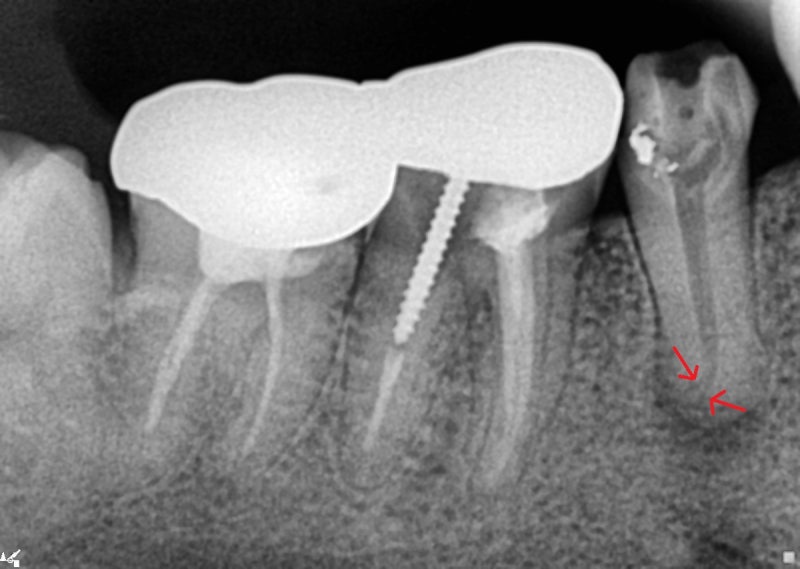
This patient visited us because they had received root canal treatment a long time ago but started experiencing pain at some point.
Percussion test results indicated that the second premolar was the source of the pain.
An X-ray showed inflammation at the root apex, so we decided to remove the existing crown and begin retreatment.
Generally, if inflammation recurs at the root apex, retreatment is the principle.
However, not all problematic teeth can undergo retreatment.
For example, if the inflammation is too severe and has caused bone loss around the tooth, if the nerve canal is blocked and further progress is impossible, or if the tooth is fractured due to secondary decay, etc.
The success rate of retreatment for very old root canal-treated teeth is significantly lower.
Nevertheless, in this case, the patient agreed to attempt it and expressed a desire for extraction later if symptoms did not improve, so we proceeded.
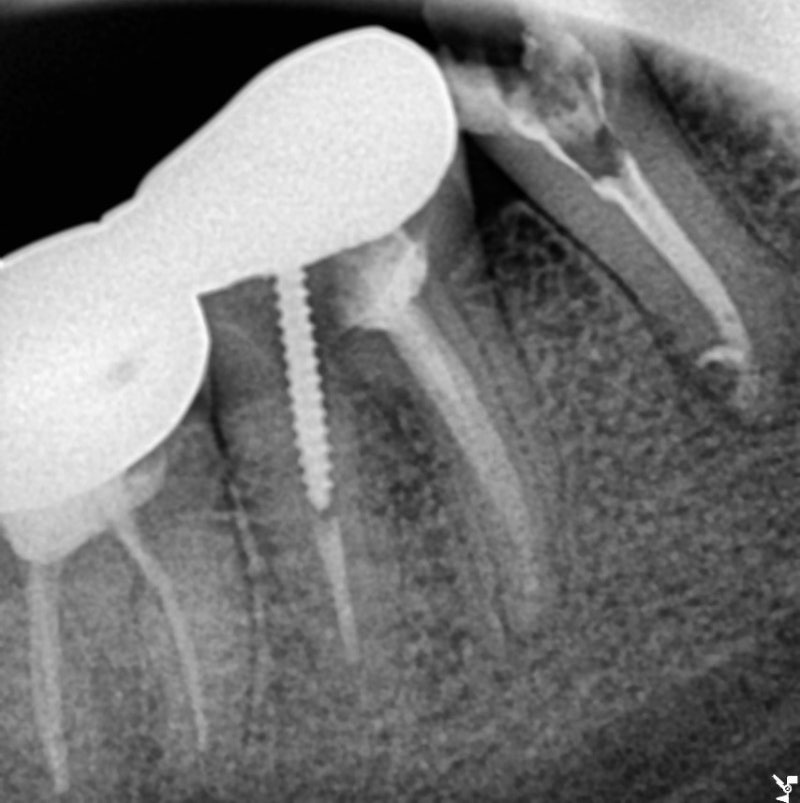
After thoroughly removing the filling materials inside the nerve canal, we observed that the canal split into two branches at the end.
In such cases, more chemical disinfection is performed to ensure thorough sterilization of the root tip.
This patient visited for root canal treatment 6 times, but their excellent cooperation allowed for sufficient disinfection time.
(Sometimes, patients may visit up to 10 times, as there is no fixed number of visits for root canal treatment...)
Despite the numerous visits, the patient was very cooperative, and as a result of multiple disinfections, the pain decreased.
On the final day of root canal treatment, luckily, the medication filled even the accessory canals.
The initial, albeit subtle, wobbly sensation also disappeared, so we proceeded with prosthetic treatment for smooth chewing function.^^
It would be good to have follow-up checks and photos to monitor symptoms, but the patient hasn't come for regular check-ups to see if there are any discomforts.
I hope they continue to use their tooth without pain for a long time.
Frequently Asked Questions
Why does pain recur after root canal treatment?
Yes, it can recur. In addition to the main nerve canal, there are many dense accessory canals like tree roots. Inflammation can develop in these accessory canals that were unreachable during the initial root canal treatment, causing pain to recur.
When is root canal retreatment necessary?
Retreatment is generally indicated when inflammation recurs at the root apex. It may also be necessary if pain begins in a tooth that received root canal treatment a long time ago.
Can all teeth undergo root canal retreatment?
No, it's not possible in all cases. Retreatment may be difficult if the inflammation is too severe, causing bone loss around the tooth, if the nerve canal is blocked and further progress is impossible, or if the tooth is fractured due to secondary decay.
How many visits are required for root canal retreatment?
There is no fixed number of visits for root canal retreatment. Depending on the patient's symptoms and tooth condition, multiple visits may be necessary, sometimes up to 10 times.
How is root canal retreatment performed?
The existing crown is removed, and the filling materials inside the nerve canal are thoroughly cleaned. The inside of the nerve canal is then chemically disinfected as much as possible to treat the inflammation. After sufficient disinfection, the nerve canal is sealed.
Does pain disappear after root canal retreatment?
Yes, pain can decrease. With sufficient disinfection and treatment, pain can be alleviated, and symptoms like wobbling can disappear, helping to restore chewing function.