2025-09-30
#6 The Truth About Undereye Wrinkles, Puffiness, and Lower Blepharoplasty
Lower blepharoplasty isn't just about removing fat or injecting fillers. For lasting satisfaction, a comprehensive approach including fat repositioning, septal reinforcement, and midface lifting is essential to fundamentally improve undereye wrinkles, puffiness, and hollow tear troughs. Dr. Kim Sung-hoon, a board-certified plastic surgeon, explains why simple fillers or fat grafting are ineffective and reveals the true nature of surgical treatment through real cases and anatomical explanations.
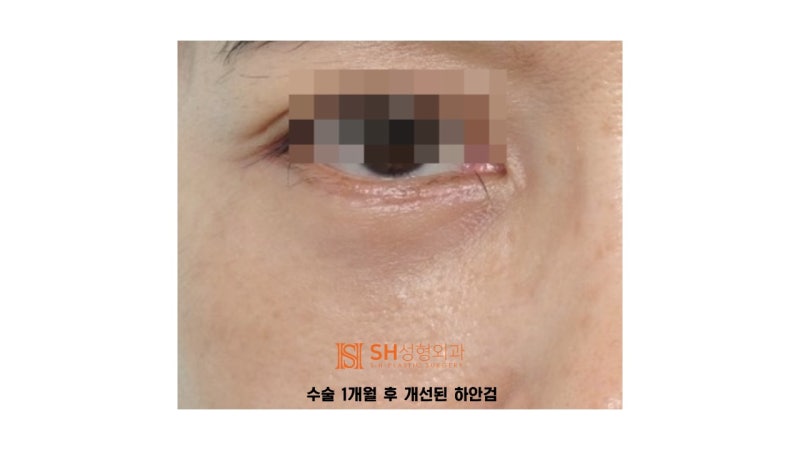
Lower blepharoplasty isn't simply resolved by removing fat or injecting fillers. To fundamentally improve undereye wrinkles, puffiness, and hollow tear troughs, a comprehensive approach including fat repositioning, septal reinforcement, and midface lifting is necessary to achieve long-term satisfaction. Dr. Kim Sung-hoon, a board-certified plastic surgeon, explains why simple fillers or fat grafting are ineffective and reveals the true nature of surgical treatment through real cases and anatomical explanations. Dr. Kim Sung-hoon, Face Designer at SH Plastic Surgery.
Hello, I'm Kim Sung-hoon, a board-certified plastic surgeon and face designer.
My greetings are a little late this time. Summer's heat has already receded, and it feels like deep autumn has arrived with cool breezes.
Autumn is often called the ‘season of mirrors’. Small changes in the face, which were not fully noticed under the strong summer sun,
become more apparent under the soft yet honest autumn sunlight.
In particular, the eye area, which plays the biggest role in our impression, is where these changes are felt most quickly and significantly.
Do you ever look in the mirror and feel that your undereyes look more hollow than before, your dark circles have deepened, or that they appear puffy, making you look tired and older? I, too, often notice the traces of aging under my eyes.
Recently, a patient came in expressing concerns about her undereyes, and through her story, I'd like to discuss lower blepharoplasty today.
‘Doctor, my undereyes looked hollow, so I had fillers several times. At first, it seemed a little better, but over time, my wrinkles deepened, and people told me I looked more tired.’
This is one of the stories I frequently hear in the consultation room.
One of the first changes that appear with age is in the undereye area.
Many people feel stressed because their undereyes look sunken every morning, dark circles aren't covered even with makeup, and they look older in every photo. This often leads them to choose relatively simple options like fillers or fat grafting first.
Initially, it might look fine. The hollow undereyes appear filled, and dark circles seem somewhat alleviated.
However, the problem emerges over time. The tear troughs appear deeper,
and fillers can clump or become uneven, making the impression look tired and older.
This is because the undereye area is not simply a matter of ‘filling a hollow space’, but rather due to its anatomical structure.
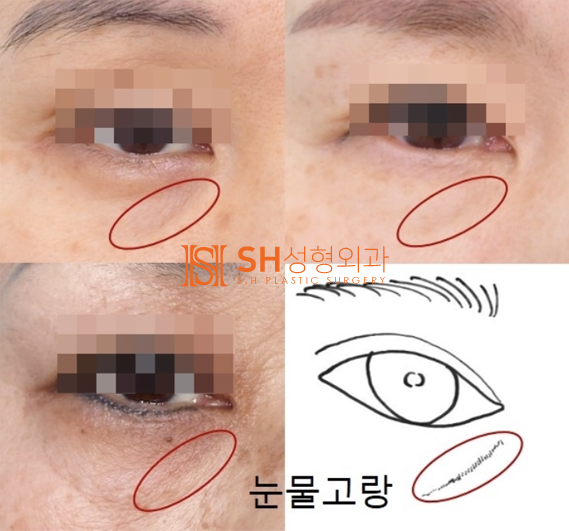
The tear trough is a structural wrinkle caused by the pulling of a strong ligament (tear trough ligament) that extends from the bone to the skin.
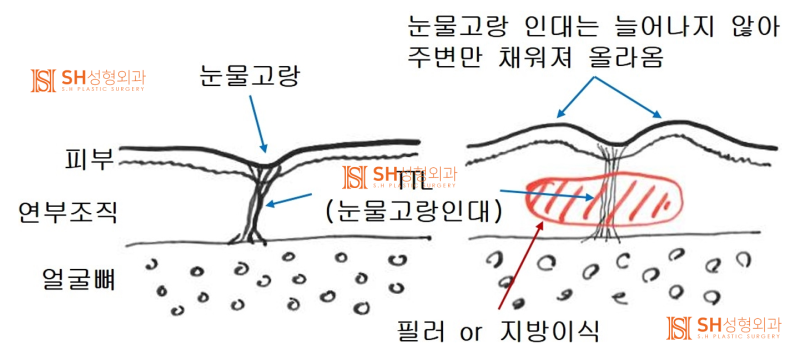
Since this ligament does not stretch easily, simply filling it with fillers or fat grafting does not provide a fundamental solution.
On the contrary, overfilling can create a counterproductive effect, making the surrounding area more prominent and the hollow part appear deeper.
For these reasons, many people repeatedly undergo fillers or fat grafting, only to eventually realize, ‘Surgery is the only answer,’ and seek surgical treatment.
To properly resolve the issue of puffy and hollow undereyes, a comprehensive approach is needed: releasing the ligament, repositioning fat,
and, if necessary, reinforcing the septum and lifting the midface.
Simply removing fat or filling with fillers can actually worsen the condition.
Today, I'd like to delve deeply into this very aspect: the true essence and principles of lower blepharoplasty.
Definition and Explanation of Lower Eyelid
1. Definition of Lower Eyelid
The lower eyelid (下眼瞼, lower eyelid) refers to the lower eyelid and its surrounding structures.
Clinically, it includes the skin, orbicularis oculi muscle, subcutaneous fat, orbital fat, retaining ligaments, and the connected bone structures.
The lower eyelid is not just skin, but a complex space where multiple layers of anatomical elements interact.
2. Tear Trough and Lower Eyelid Anatomical Structure
The core concern of the lower eyelid is the ‘tear trough’.
The tear trough is formed by the tear trough ligament, a strong ligamentous structure extending from the bone to the skin.
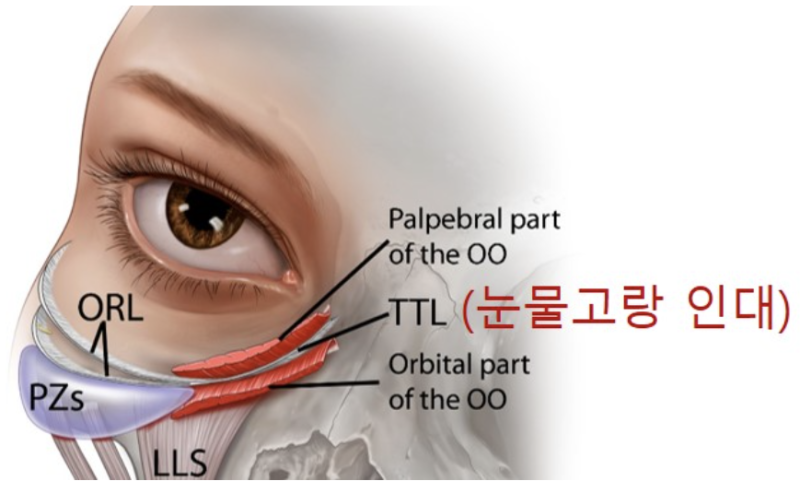
Wong et al.'s anatomical paper (PRS, 2012) revealed through cadaver studies that this ligament actually exists and is the cause of undereye wrinkles and hollowness.
Furthermore, Haddock et al. (2009) explained that the lid-cheek junction is not merely a skin problem or lack of fat,
but rather due to an anatomical structure where muscles and ligaments interlock.
Superficially, the boundary between the palpebral and orbital parts of the orbicularis oculi muscle coincides with the tear trough.
Deeply, ligaments directly connecting the bone and skin pull, creating hollowness.
Because of this, even if the hollow area is simply filled with fillers or fat grafting, the pulling force of the ligament remains, and overcorrection can actually make wrinkles appear deeper or uneven.
3. Aging and Lower Eyelid Changes
Changes that occur with aging are as follows:
- Skin elasticity decreases and thins.
- Orbital fat protrudes forward, creating a ‘puffy’ appearance.
- The septum weakens, causing fat to push out and worsen wrinkles.
- Loss of midface volume emphasizes relative undereye hollowness.
These changes combine to cause dark circles, wrinkles, hollowness, and puffiness simultaneously.
4. Necessity of Surgical Approach
Ultimately, to improve the lower eyelid, a comprehensive surgery is required, involving releasing the ligament, repositioning fat, reinforcing the septum, and, if necessary, lifting the midface.
Simple fat removal increases the risk of 100% recurrence and complications, and fillers or fat grafting alone cannot resolve the pulling of the ligament.
Recent surgical trends also emphasize a ‘volume-preserving strategy’, meaning preserving and repositioning tissues rather than unnecessarily removing them.
Lower blepharoplasty combining fat repositioning, septal reinforcement, and lifting provides long-term satisfaction and natural results.
The term ‘lower eyelid’ is generally used as a broad term referring to the lower eyelid area,
that is, the eyelid and periorbital structures including the lower eyelid up to the upper cheek area.
Clinically, it often includes the following elements:
- Eyelid skin and subcutaneous tissue
- Orbicularis oculi muscle
- Subcutaneous fat or preseptal fat, orbital fat
- Boundary structures (e.g., ligaments, retaining structures)
- Aging changes such as soft tissue sagging, hollowness, wrinkles, and fat protrusion
In plastic surgery and blepharoplasty, the term ‘lower eyelid blepharoplasty / infraorbital rejuvenation’ is commonly used to refer to cosmetic and functional corrective surgery of the lower eyelid and immediately adjacent areas.
For example, it may include excision of sagging skin, fat excision or repositioning, ligament release or strengthening, and adjustment of the lid-cheek junction.
According to the StatPearls literature on ‘Lower Eyelid Blepharoplasty’, blepharoplasty is a surgical procedure to improve lower eyelid deformities or cosmetic factors, including skin and fat excision, muscle reinforcement, and tissue repositioning.
EyeWiki literature also explains that while lower eyelid surgery historically focused on simple tissue removal, it now emphasizes tissue preservation and repositioning methods.
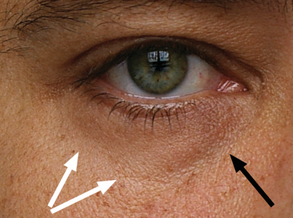
A paper analyzing the anatomical structure of the tear trough and lid/cheek junction in cadaver experiments.
It explains that the junction of the palpebral vs orbital parts of the orbicularis oculi muscle is superficially related to the tear trough.
The Anatomical Truth of Lower Blepharoplasty
1. Why do tear troughs form?
Many people think that tear troughs form because their ‘undereyes are hollow’, but in fact, it's not simply due to sunken skin.
The tear trough has a structure called the **Tear Trough Ligament (TTL)**.
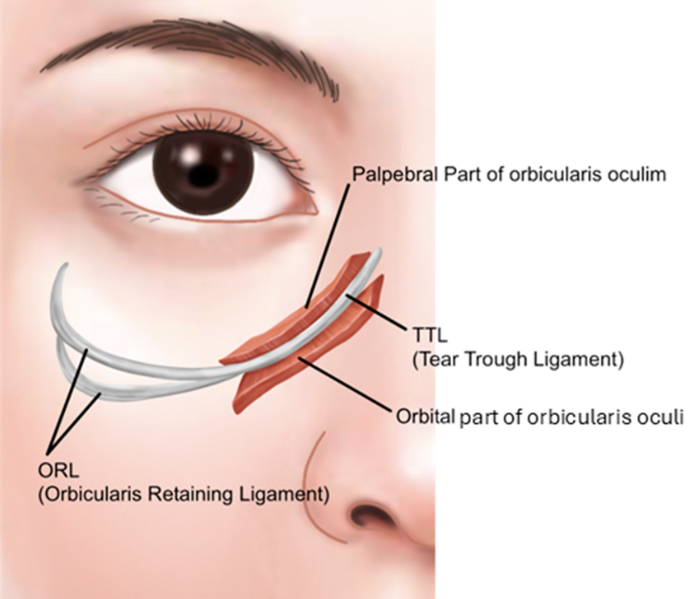
It is firmly connected from the bone to the skin, pulling the skin, which is the main reason why the undereye area appears hollow.
This ligament does not stretch easily.
Therefore, simply filling it with fillers or fat does not fundamentally improve it.
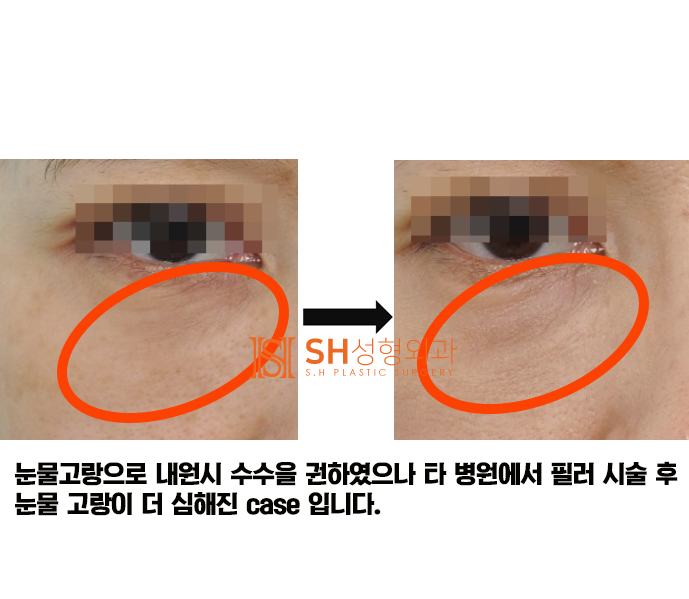
On the contrary, if too much is injected, the surrounding area can become prominent, making the hollow part appear deeper, which is literally counterproductive.
2. Why is simply removing fat dangerous?
In the past, if the undereye area was puffy, surgery to simply remove fat was common. On the surface, it seemed simple and straightforward.
However, the problem lies in what happens afterward. Indiscriminately removing fat can lead to recurrence or make the undereye area look empty, giving a more aged impression.
Therefore, this method often results in low long-term satisfaction and frequently requires revision surgery.
3. The most effective method is a ‘comprehensive approach’
That's why I always emphasize a comprehensive approach when discussing lower eyelid improvement.
It's not about solving just one thing.
Releasing the ligament, repositioning fat, reinforcing the septum, and, if necessary, lifting the midface is the most reliable method.
In some cases, a small amount of fat removal may also be necessary.
Here's what kind of changes occur:
- The tear trough is naturally smoothed out.
- The aegyo-sal (undereye fat roll) becomes plump and vibrant.
- The protruding puffy fat is tidied up.
- The midface is lifted, making the face look much younger and more vibrant.
4. What are the actual changes after surgery?
Even after just about a month post-surgery, patients are often surprised.
The aegyo-sal is beautifully restored, and the undereye puffiness is gone.
The previously hollow-looking tear trough and midface are smoothly connected, making the entire face appear brighter and younger.
That's why I always say that the undereye area should not be approached by simply filling it if it's hollow, or removing fat if it's puffy.
A fundamental improvement is possible only by addressing the structural cause.
Reflections by Face Designer Kim Sung-hoon
Approaching the lower eyelid merely as a matter of filling hollow areas or removing puffy fat will never yield satisfactory results.
The undereye area is a structure that protects the sensory organ of the eye, and it is also a delicate area that dictates the overall impression of the face.
The skin, fat, muscles, ligaments, and bones are all intimately connected, so touching just one part will not create overall harmony.
The most common conversation I have with patients in the consultation room is, ‘You must look at the whole, not just the part.’
Undereye hollowness is not simply due to a lack of fat, nor is puffiness solely due to excess fat.
It is the pulling of ligaments, weakening of the septum, and hollowing of the midface that collectively disrupt the balance.
Therefore, a surgical approach must consider all these factors simultaneously.
Whether to reposition fat, reinforce the septum, lift the midface, or remove a small amount of fat depends on each patient's individual anatomical conditions.
Calling lower blepharoplasty simply ‘undereye surgery’ is insufficient.
In fact, it is a surgery that addresses the harmony of the midface.
When the undereye area is smoothly refined, it not only improves a tired impression but also changes the impression when smiling, the naturalness of expressions, and ultimately the overall balance of the face.
Many patients give feedback after surgery, saying, ‘People stopped telling me I look tired’ and ‘My face looks much brighter.’
This is the result of considering not just a single layer of skin, but also the anatomical structure and the function of expressions.
I do not consider the title ‘Face Designer’ as mere marketing language.
I believe design is not about creating something new, but about bringing out the inherent beauty that already exists.
Lower blepharoplasty is no different.
It's not about artificially making someone look younger, but about correcting structural imbalances in the undereye area to restore the naturalness and health of the original face.
Plastic surgery should not be exaggerated.
This is especially true for undereye surgery. Even a slight exaggeration can quickly result in an unnatural and forced appearance.
Therefore, the surgeon must possess both anatomical understanding and a restrained aesthetic sense.
Where one draws the line between ‘removing’ and ‘filling’ determines the outcome.
I always view each patient's face as a canvas.
And I believe I am not drawing lines on that canvas, but rather bringing out the hidden lines that were already there.
Lower blepharoplasty is not just a surgery to look younger, but a surgery to restore vitality to life.
I wish to continue being a face designer who revives the inherent vibrancy in my patients' eyes.
Unexaggerated truth, anatomical truth, and natural beauty. That is the philosophy I always pursue.
My reflections today turned out a bit long as I spoke from the heart.
Thank you for reading to the end.
If you have any questions, please schedule a consultation and let's have a more detailed and in-depth discussion together.
I will help you with a customized plan.
Sincerely, Dr. Kim Sung-hoon, Face Designer

FAQ
Q1. Can't fillers ever improve it?
A1. For young individuals with mild conditions, temporary improvement is possible. However, since the structural cause of ligament pulling cannot be resolved, long-term satisfaction is lower.
Q2. Should fat not be completely removed?
A2. Simple removal carries a high risk of recurrence and complications. It is preferable to utilize fat through repositioning and septal reinforcement.
Q3. Are surgical scars very visible?
A3. The lower eyelid incision line is located just below the eyelashes and becomes almost unnoticeable over time.
Q4. How long is the recovery period?
A4. Stitches can usually be removed in about 1 week, and swelling and bruising naturally subside over 2-3 weeks.
Q5. Is there a possibility of recurrence?
A5. Compared to simple fat removal, fat repositioning + septal reinforcement + lifting offers excellent long-term maintenance.
Q6. Is this surgery possible regardless of age?
A6. It is possible for individuals from their 30s to 60s. However, the method varies depending on skin elasticity and wrinkle condition.
Q7. Why is midface lifting necessary?
A7. If the midface is hollow, the undereye area appears more sunken. Combining it with lifting enhances overall facial harmony.
Q8. Can failed filler procedures be corrected?
A8. Yes, it is possible. If the area has become uneven due to fillers, it can be corrected with fat repositioning and septal reinforcement.
Q9. Are there specific scar management methods?
A9. Ointments, lasers, and scar injections are used in combination to manage scars so they are almost invisible.
Q10. Will the undereye aegyo-sal disappear after surgery?
A10. On the contrary, the aegyo-sal becomes plump and vibrant.
This is because the core of the surgery is not to remove unnecessary fat, but to correct its position.
In the next installment, I will explain the secret to achieving long-term satisfaction with lower blepharoplasty ^^
If you're curious, please refer to the video above ^^
※ This article discloses actual before and after photos for accurate information delivery.
These photos are published with the patient's consent, and please note that bruising and swelling may vary for each individual, and there may be differences.