2026-09-07
Yaksuyeok Dental Clinic: Maxillary Sinus Implant Procedure After Rhinitis Surgery
Learn about maxillary sinus implant procedures at Yaksuyeok Dental Clinic, especially for patients who have undergone rhinitis surgery. We cover cases from mild to severe chronic rhinitis, emphasizing the importance of collaboration with ENT specialists for optimal outcomes.
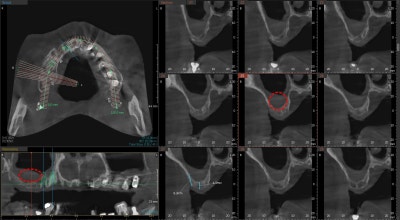
Maxillary Sinus Implant After Rhinitis Surgery at Yaksuyeok Dental Clinic
Hello,
I am Dr. Kim Tae-young, the head director of Bareunyoung Dental Clinic at Yaksuyeok, where the head director directly explains treatment cases.
When teeth are missing, our bones continuously shrink over time, making it impossible to maintain sufficient bone width and height for implant placement.
Consequently, individuals who have been missing teeth for a long time often require extensive alveolar bone grafting in the maxillary sinus (paranasal sinus) area of the upper jawbone.
Is implant surgery possible if I have chronic rhinitis?
To answer directly, yes, surgery is possible.
If only a slight thickening of the membrane is observed with mild rhinitis, only the membrane needs to be elevated. If the inflammation is not extensive, the inflammation can be removed, disinfected, and space secured simultaneously with the surgery, followed by alveolar bone grafting in the affected area.
However, if the thickened membrane is too thick or the internal space is completely blocked by inflammation, surgery must proceed only after the inflammation has subsided, either through medication or an ENT surgical procedure.
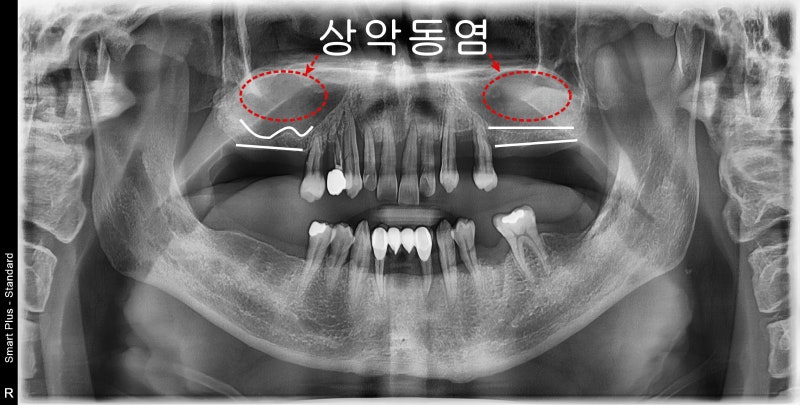
The patient had been missing molars for a long time and primarily ate with their front teeth, leading to severe mobility in areas with poor periodontal health.
Before diagnosis, a cloudy inflammatory finding was observed in the maxillary sinus space.
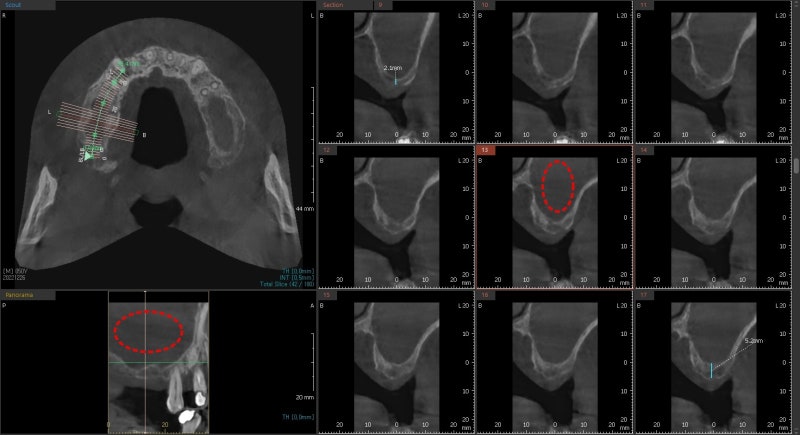
On the CT scan, the gray area indicates not only membrane thickening due to chronic rhinitis but also the presence of inflammation.
This specific area requires alveolar bone grafting through maxillary sinus lift surgery.
Given the current condition, it was not possible to adequately elevate the membrane, so we decided to proceed with upper jaw implant surgery after completing rhinitis surgery in collaboration with an ENT specialist.
Initiating Sequential Implant Surgery
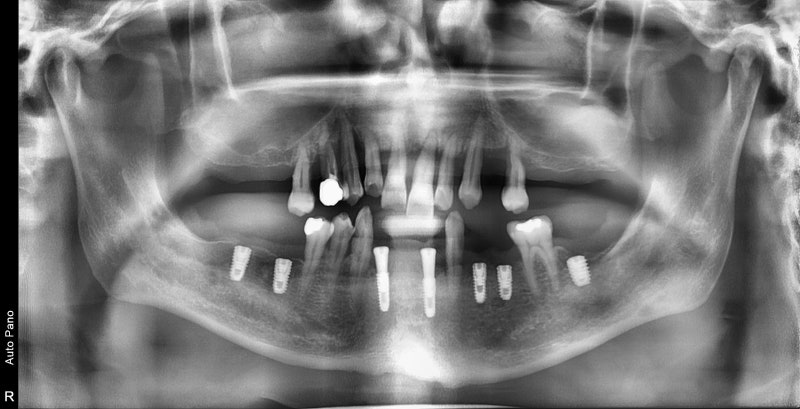
During the period when the rhinitis removal surgery was performed and the membrane was stabilizing, we decided to first perform surgery on the lower implants and proceed with necessary treatments.
Since the fixation between the bone and implant was weak, temporary dentures had to be worn during the surgery period. To minimize this period, we decided to complete the lower implants first, and the upper occlusion would be completed after surgery.
The plan was to preserve as many teeth as possible that had relatively no mobility and strong roots.
Progress After ENT Surgery
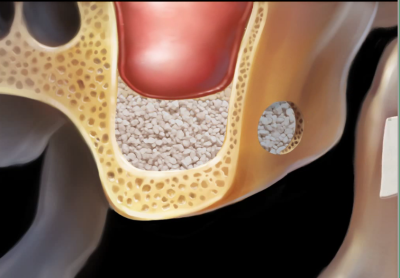
These photos were taken approximately 3 months after the rhinitis surgery at the ENT clinic.
The cloudy inflammation that previously filled the maxillary sinus has disappeared, but the membrane is still swollen due to chronic inflammation. However, this level of swelling does not impede maxillary sinus lift surgery.
Since the patient had a very small amount of remaining bone, we performed alveolar bone grafting and implant surgery simultaneously using the lateral approach, which involves accessing from the side.
Full Arch Implant Surgery of the Maxilla
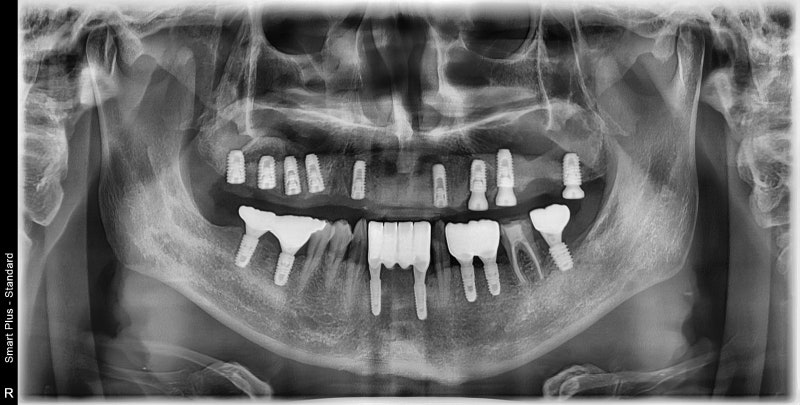
The teeth in the upper jawbone had mobility to the extent that extraction was required, and the surrounding bones were thin. Therefore, we decided on full extraction and proceeded with surgery involving alveolar bone grafting around the existing solid bone.
Due to the extensive bone grafting, the period for temporary dentures would be prolonged. Fortunately, the lower teeth were completed up to the crowns during the waiting period, so there was no significant difficulty with eating.
After approximately 6 months, the collapsed molar occlusion needed to be restored.
Since there was no existing occlusion, the temporomandibular joint had to adapt. We periodically checked the occlusion and used temporary teeth, going through an adaptation phase until the final prosthetics were placed.
Final Prosthetic Fabrication After Occlusion Stabilization
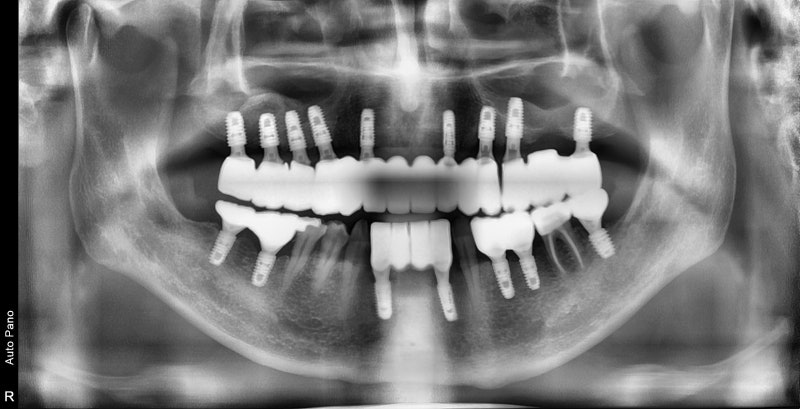
After stabilizing the unstable temporomandibular joint and occlusion, and when no further changes in occlusion occurred, we proceeded with fabricating the temporary prosthetics into final prosthetics.
Although the entire treatment is complete, periodic checks of the prosthetics and recurrence of maxillary sinusitis within the maxillary sinus will be necessary.
Points to Note for Full Arch Implants
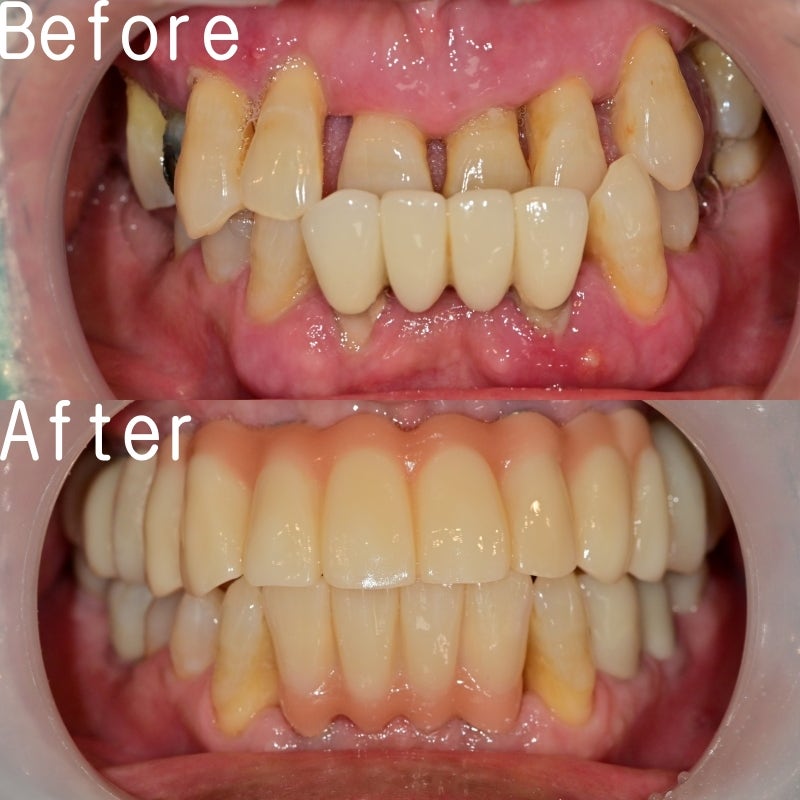
Points to note for full arch implants are:
First, when performing the initial surgery, it is crucial to check the implant placement path through appropriate bone grafting in the correct position.
Second, it is to achieve a complete prosthetic occlusion.
Looking at the before/after photos, this was a malocclusion case with a protruding lower jaw. When fabricating the prosthetics, the occlusion must be designed so that the upper teeth cover the lower teeth.
Depending on the degree of jaw protrusion and the amount of sunken alveolar bone, the prosthetic design can adequately compensate.
Since this involves changing an occlusion that has been maintained for decades, patients initially feel discomfort during adaptation, but gradually adapt. The final prosthetics were fabricated by reflecting the patient's discomfort as much as possible.
Today, at #YaksuyeokDentalClinic, we looked at an implant surgery case involving ENT surgery for severe chronic maxillary sinusitis.
I hope your questions have been answered.
Since diagnoses can vary by individual, please visit a nearby dental clinic for a diagnosis.
Thank you.
Treatment start: 2022.12.22
Treatment end: 2023.02.24
▼ Related cases you might find helpful ▼
We believe that proper treatment leads to proper results. My ideal dental clinic is one where everyone who visits with worries can leave feeling reassured and confident. – Bareunyoung Dental Clinic
Directions: 2nd floor, JYJ Building, 179 Dongho-ro, Jung-gu. Right in front of Exit 6 of Yaksuyeok (towards Yaksuyeok Market). Use Village Bus 5 (Yaksuyeok), Village Bus 12 (Namsan Town, Yaksuyeok Police Station), Bus Stop (Yaksu Heights, Sindang Social Welfare Center, Gaon Library, Geumho Tunnel Entrance). From Yuyu Pharmaceutical towards Geumho Station.
This post was written directly by Bareunyoung Dental Clinic for the purpose of providing medical information and hospital advertising (in compliance with Article 56, Paragraph 1 of the Medical Service Act).
Frequently Asked Questions
Is implant surgery possible even with chronic rhinitis?
Yes, surgery is possible. If only mild rhinitis with membrane thickening is observed, alveolar bone grafting is performed after membrane elevation. If the inflammation is not extensive, it is removed and disinfected simultaneously, space is secured, and then surgery is performed.
What should be done if maxillary sinus inflammation is severe?
If maxillary sinus inflammation is severe, with a thick membrane or blocked space, implant surgery must proceed only after the inflammation has subsided through medication or ENT surgery. Collaboration with an ENT specialist is necessary.
When is implant surgery performed after ENT rhinitis surgery?
After ENT rhinitis surgery, there is a waiting period for the membrane to stabilize. In this case, implant surgery with maxillary sinus lift was performed approximately 3 months after the rhinitis surgery.
What is the maxillary sinus implant surgery method when there is insufficient residual bone?
If the amount of residual bone is too small, alveolar bone grafting and implant surgery can be performed simultaneously using the lateral approach, which involves accessing from the side. This method combines bone grafting and implant placement in one procedure.
What are the points to note for full arch implants?
For full arch implants, it is crucial to accurately determine the implant placement path through appropriate bone grafting in the correct position, and the key is to achieve a stable prosthetic occlusion.
Is an adaptation period for the temporomandibular joint necessary after implant surgery?
Yes, it is necessary. Especially when there is no existing occlusion or when it changes significantly, the temporomandibular joint needs to adapt. This requires periodic occlusion checks and the use of temporary teeth, going through an adaptation phase until the final prosthetics are placed.