2026-09-07
Cheonggu Station Dental Clinic: Multiple Loose Teeth Due to Periodontitis (Extraction, Implants)
This article discusses periodontitis, its progression, and treatment options like extraction and implant surgery with bone grafting for multiple loose teeth.
Hello,
This is Dr. Kim Tae-young, the head director of Bareunyoung Dental Clinic at Cheonggu Station, who personally explains the cases we have treated.
Periodontitis, also known as gum disease, is a condition where gum inflammation progresses without significant symptoms, dissolving the bone around the teeth. This causes the teeth to lose support from the surrounding bone, eventually leading to loose teeth and even requiring extraction.
Periodontitis occurs when plaque accumulates on the calculus attached to the teeth. The bacteria within the accumulated plaque cause gum inflammation. Initially, gingivitis progresses with only swelling and bleeding of the surrounding gums. If appropriate treatment is delayed, the inflammation can extend beyond the gums to the bone supporting the teeth, developing into periodontitis.
Periodontal disease often progresses without major symptoms. In environments where regular dental visits are not made, management can be difficult, leading to rapid periodontal inflammation. Sometimes, patients visit us complaining of sudden tooth looseness and pain, making it difficult to eat.
Unfortunately, in such cases, even with gum treatment, bone regeneration is not possible, and teeth may be so loose that eating becomes difficult.
Today, I would like to discuss a case where multiple teeth became loose due to severe chronic periodontitis, and how bone grafting was performed during implant surgery after extraction.
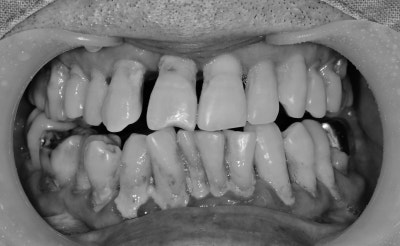
My teeth are generally loose. My right side is particularly uncomfortable.
The patient was someone who frequently traveled between the city and the countryside.
They did not have much time to visit the dentist, but one day, their teeth started to feel loose, and they experienced pain when chewing, making it impossible to eat.
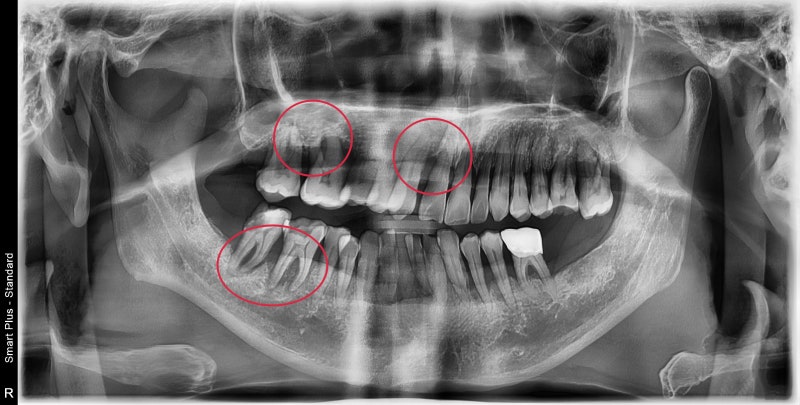
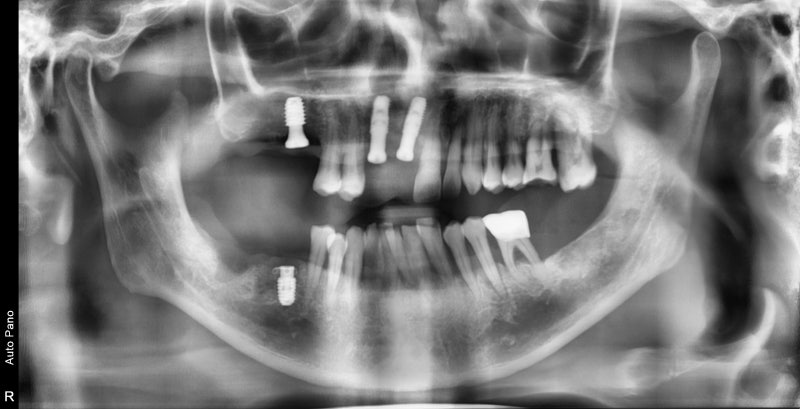
This is the initial examination photo.
The areas marked with red circles showed significant bone loss and were particularly loose. The remaining teeth also had general mobility.
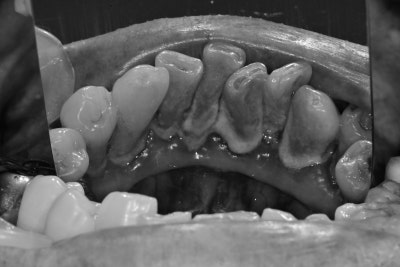
Upon examining the intraoral photos,
the gums had receded significantly from the normal gum level due to the progression of gingivitis, and it was difficult to brush deeply, so periodontitis had already progressed.
Extraction of multiple teeth was necessary, but along with the treatment, gum management was crucial.
Periodontal treatment must precede other treatments to be meaningful.
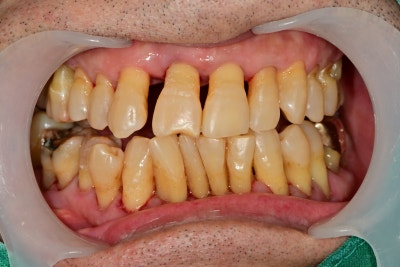
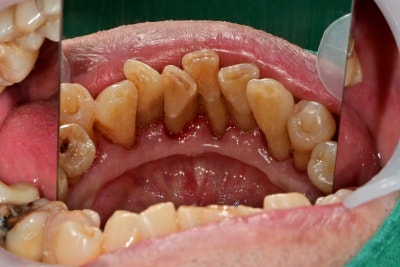
These are photos after general scaling and periodontal treatment.
Although the receded gums cannot be restored, preventing further inflammation and reducing gum swelling improves the prognosis for implants and other treatments.
Both molars were loose, but since the patient needed to eat on at least one side, we started by treating the most uncomfortable area.
Implant surgery for spaces absorbed due to severe periodontal disease.

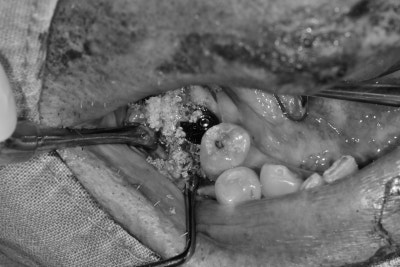
This shows the bone condition during implant surgery on the lower right side.
Generally, in cases of severe periodontitis, inflammation dissolves the outer bone, making it difficult to embed the implant within the bone, and some part of the implant inevitably becomes exposed.
In such cases, the absorbed bone needs to be restored using bone graft material.
Bone graft material is applied to the exposed area, and a membrane is placed over it to fix the graft material in place.
Typically, after applying the membrane, the gums are neatly sutured and the procedure is finished. However, because the defect was large, an additional new instrument was used.
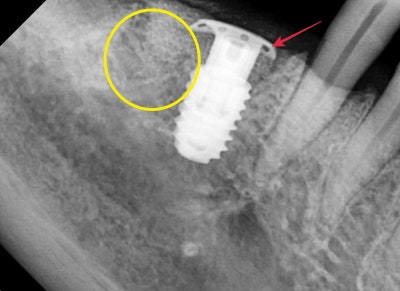
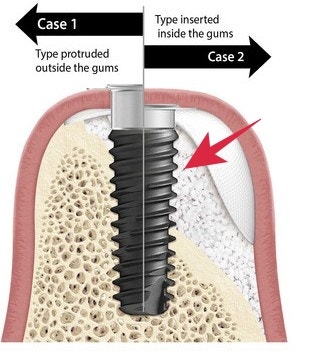
In this case, in addition to applying a membrane, a cover shaped like a roof on top of a cap, as indicated by the arrow, was used to provide enhanced stability.
This helps secure the space for the bone graft material below it.
Bone graft material is applied underneath to restore the deficient bone, ensuring space and stability for the graft.
As seen in the photo, the lower cap area has an additional structure like a roof, and its shape is slightly different from others.
Generally, for patients with poor periodontal health, implant surgery is recommended to restore all molars to match the number of natural teeth. However, in this case, due to the given circumstances, the very last molar could not be restored.
The reason why it is important to restore the full number of teeth is that when the opposing teeth also have mobility, two implants are more advantageous than one for distributing concentrated chewing forces, and this can also affect the lifespan of the remaining implants.
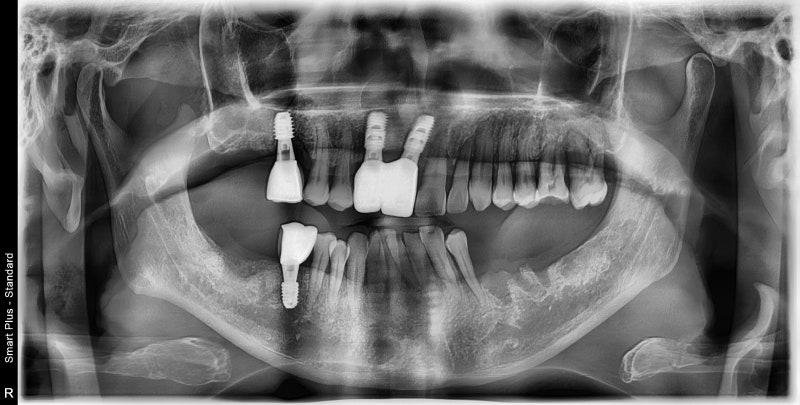
By the time the implant was completed, the lower left molar, which had become severely loose, unfortunately required extraction.
Since the occlusion on the right side was somewhat completed, the mobility of the surrounding teeth would decrease. To complete the occlusion on the opposite side, treatment must proceed in the same manner as the previous treatment.
As such, periodontitis often approaches quietly without special noticeable symptoms.
When symptoms are noticed, it usually means that moderate to severe periodontitis has already progressed, leading to longer treatment periods and more complex treatment methods.
While treatment methods like implants are good,
even better is to regularly visit the dentist for scaling and periodontal treatment to manage periodontal disease and start treatment early, so that you can save your natural teeth without having to extract even one. I believe there is no better treatment than that.
Today, we looked at one of the bone grafting methods applied in implant surgery when extracting teeth severely affected by periodontitis.
I hope your questions have been answered,
and if you have any further questions,
please visit Bareunyoung Dental Clinic at Cheonggu Station,
and we will provide more detailed consultation.
I will see you next time with another case.
Thank you^^
▼ Related cases to read together
We believe that proper treatment leads to proper results. My ideal dental clinic is one where everyone who visits with worries can leave feeling relieved and confident. - Bareunyoung Dental Clinic
Directions: Dongho-ro 179 JYJ Building, 2nd floor. Right in front of Exit 6 of Yaksu Station, towards Yaksu Market. Use Village Bus 5 (Yaksu Station), Village Bus 12 (Namsan Town, Yaksu Police Station), Bus Stop (Yaksu Heights, Sindang Social Welfare Center, Gaon Library, Kumho Tunnel Entrance). From Yuyu Pharmaceutical towards Kumho Station.
This post was written directly by Bareunyoung Dental Clinic for the purpose of providing medical information and hospital advertising (in compliance with Article 56, Paragraph 1 of the Medical Service Act).
Frequently Asked Questions
Why does periodontitis occur?
Periodontitis occurs when bacteria in plaque and calculus attached to the teeth cause gum inflammation. If the initial gingivitis stage is not treated in time, the inflammation progresses beyond the gums to dissolve the bone supporting the teeth, developing into periodontitis.
How are loose teeth due to periodontitis treated?
In cases of severe periodontitis where teeth are so loose that eating is difficult, gum treatment alone cannot regenerate bone. In such cases, extraction is necessary, followed by implant surgery to restore the lost teeth.
Is bone grafting always necessary for implant surgery?
Yes, if significant bone loss has occurred due to severe periodontitis, bone grafting may be necessary for stable implant placement. Bone graft material is used to restore the absorbed bone, and a membrane is placed over it for stable fixation.
What is the best way to prevent periodontitis?
Periodontitis often progresses without specific noticeable symptoms, so it is most important to regularly visit the dentist for scaling and periodontal treatment. This helps prevent the progression of periodontal disease and preserve your natural teeth for a long time.
How is the number of implants determined after periodontitis treatment?
Generally, implant surgery is recommended to restore all molars to match the number of natural teeth. This helps distribute chewing forces and can positively impact the lifespan of the remaining implants.