2025-11-23
#20 Contracted Nose Revision Surgery: Can a Collapsed Nose Be Restored?
Contracted nose is a severe complication after rhinoplasty, characterized by an upturned nose, hardened bridge, and exposed nostrils. This article explains the causes, reconstruction process, and materials used for revision surgery, offering practical guidance for those considering contracted nose revision, reconstruction, scar tissue removal, rib cartilage-based reconstruction, and columellar extension.
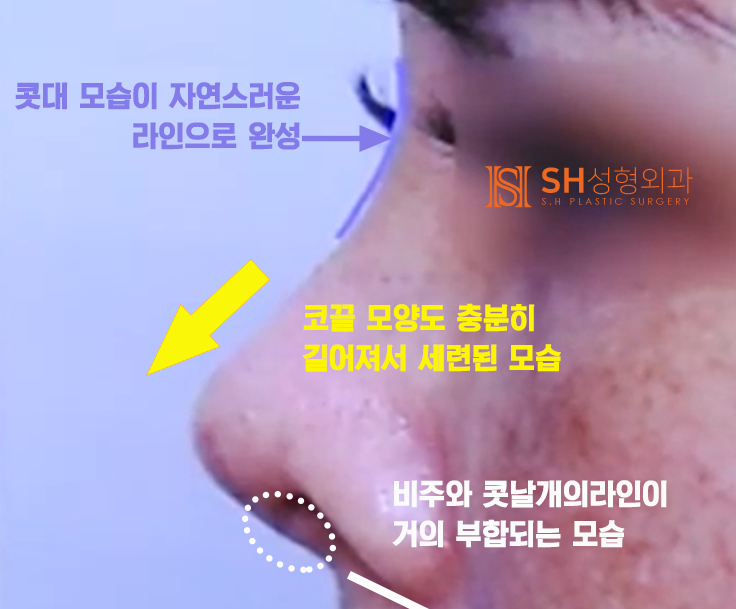
Contracted nose is one of the most severe complications that can occur after rhinoplasty. It is characterized by the nasal bridge becoming firm and pulled upwards, the nasal tip curling upwards (upturned nose), and the nostrils becoming excessively visible, resulting in an upturned nose shape. Additionally, the columella may rise above the alar rim, the nasal tip may become thick and blunt, and the nasal bridge may deviate to one side, moving away from the midline. Contracted nose revision surgery is closer to reconstruction than simple aesthetic restoration. It requires advanced techniques to dissect and remove all scar tissue, capsules, and contracted tissue, lengthen the shortened tissue, and rebuild the nasal structure with human-derived cartilage. In this Doctors' Blog, Dr. Sung-Hoon Kim of SH Plastic Surgery explains, through an actual case of a contracted nose patient, why contracture occurs, how it can be restored, and what materials and principles are used. This will be the most practical guide for those considering contracted nose revision surgery, nasal reconstruction, nasal scar tissue removal, rib cartilage-based reconstruction, and columellar extension. - Dr. Sung-Hoon Kim, Facial Designer at SH Plastic Surgery
‘As time passed after the surgery, my nose kept curling upwards.’
A few months ago, a 29-year-old woman from Thailand visited the clinic.
This was her second visit to Korea, and she came back because of the rhinoplasty she had received during her first visit.
The first thing she said as she sat down in the chair was:
‘Doctor… as time goes by, my nose keeps lifting. It was fine at first, but now it feels very awkward when I smile. My nasal tip is lumpy, and my nasal bridge is crooked.’
Looking at her frontal photo, it was a typical appearance of contracture already beginning.
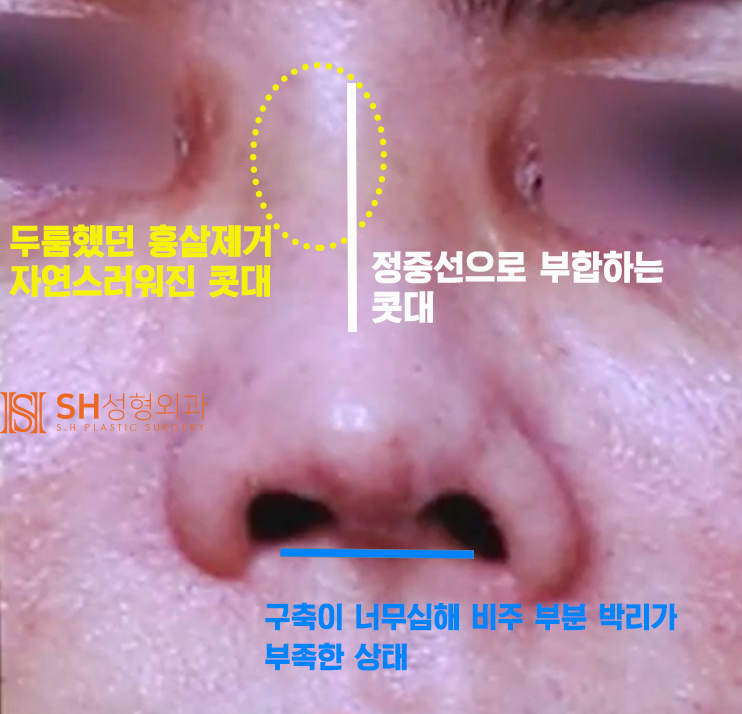
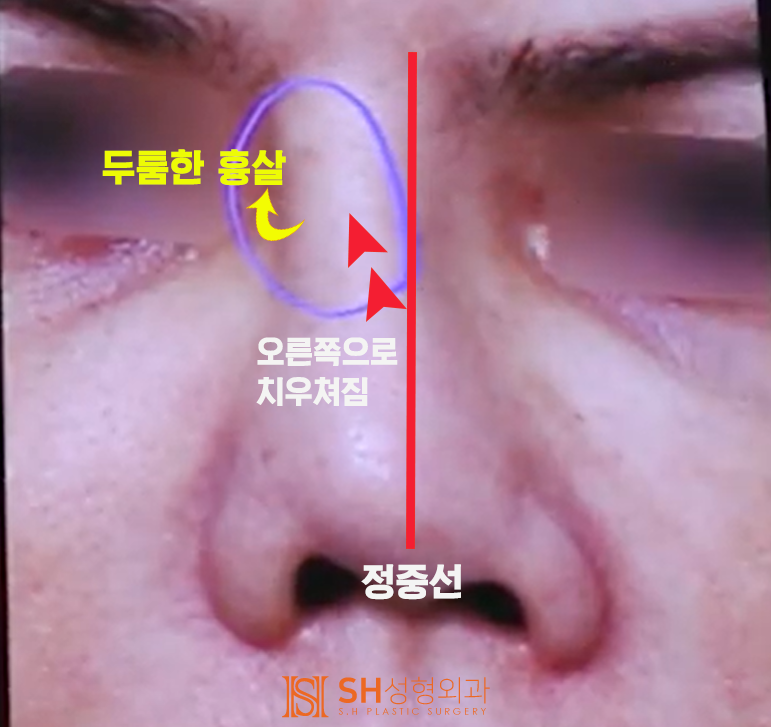
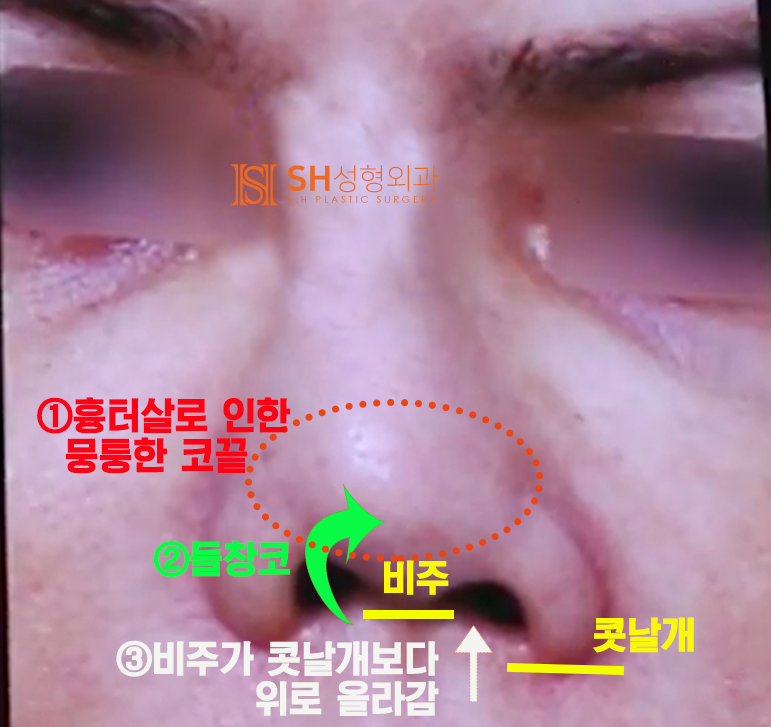
Scar tissue clumped up on the nasal bridge.
Nasal bridge deviated to the right, off the midline.
Nasal tip thick and blunt.
Columella positioned higher than the alar rim.
Clearly an upturned nose.
Upon checking her profile, I saw:
The nose was curled upwards, with the nasal tip pulled up.
The columella was pushed back and pulled up, higher than the alar rim, a typical contracture.
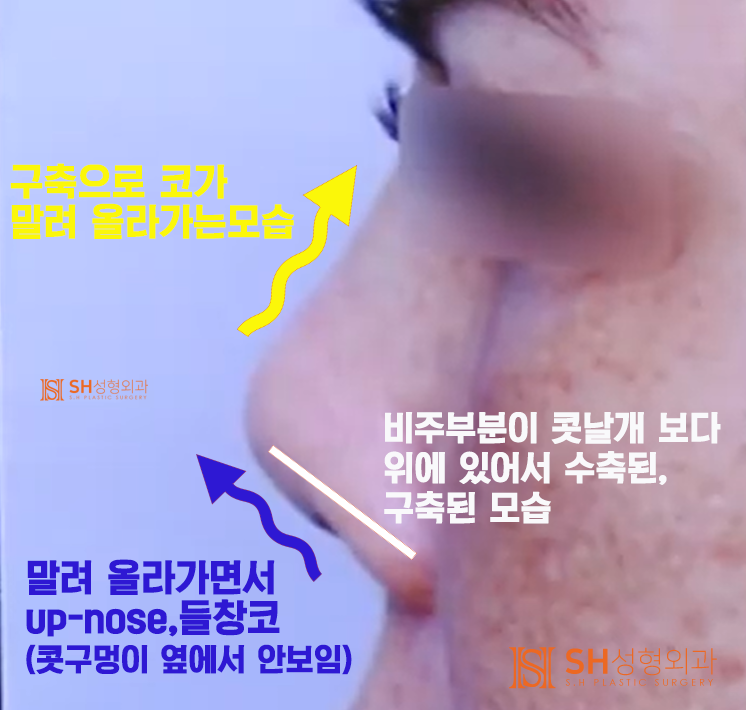
Her concern was clearly a serious situation.
The patient asked:
‘Can a nose like this truly be restored?’
What is a contracted nose?
Contracture is a phenomenon where tissues shrink and harden, pulling the nose upwards.
Key causes of contracture:
Post-inflammatory scar tissue overgrowth.
Insufficient dissection range or implant pressure.
Atrophy of skin, cartilage, and soft tissues.
Excessive dissection or over-elevation in previous surgeries.
Implant visibility or displacement.
Typical changes when contracture worsens:
Nose gradually lifts upwards.
Nasal tip becomes blunt and thick.
Columella curls backward and is pulled upwards.
Nasal bridge becomes crooked and firm.
Accompanied by a shortened nose (Short Nose) + Upturned nose + Alar retraction.
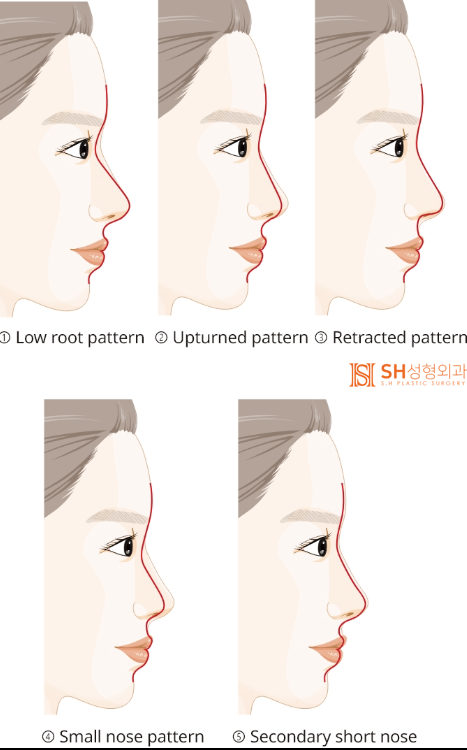
How can it be restored? Actual reconstruction approach. Contracted nose is not just ‘revision surgery’ but 'reconstruction'. It must follow these steps:
1. Removal of the causative contracted tissue.
Complete dissection of scar capsule.
The core cause of contracture.
Hard scar tissue pulls the nose upwards.
Adhesions between scar tissue and implant are also removed.
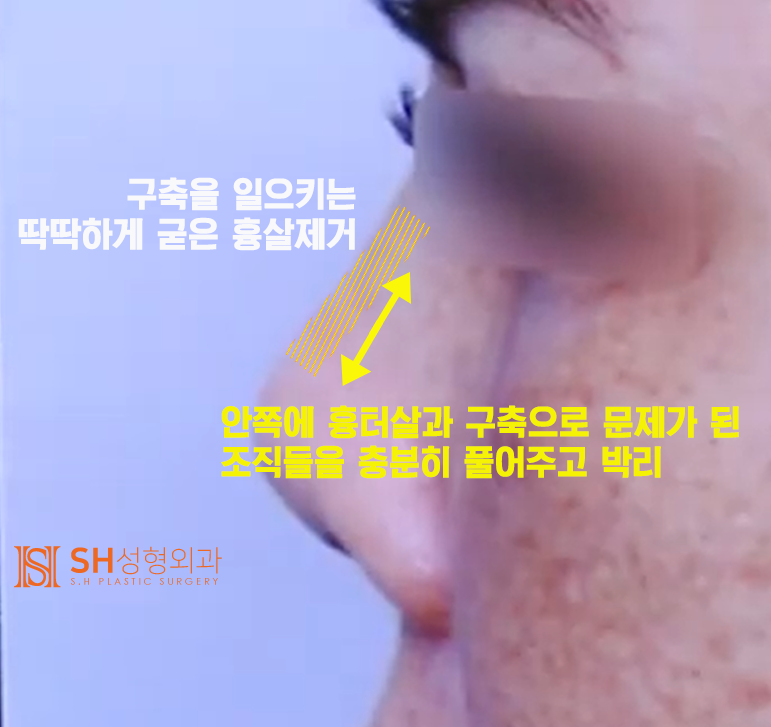
Process of ‘lengthening’ shortened tissue.
Making tiny incisions in the shortened internal tissue to lengthen it (Release technique).
Restoring the columella and medial cartilage to their original length.
If this step is insufficient, contracture will recur even after revision surgery.
2. Nasal structure reconstruction (Foundation work).
Building a pillar with rib cartilage (donated or autologous).
Since the columella and nasal tip support structures are collapsed due to contracture,
Strong pillars (Columellar strut + Extended spreader graft) are used to secure downward support.
Nasal tip finished naturally with ear cartilage.
Maintaining a rounded shape.
Reducing firmness.
Ensuring natural luster and movement.
Columella extension.
The columella, which is higher than the alar rim, is ‘pulled down’ to restore its original position.

3. Nasal bridge reconstruction.
Adding cartilage to induce ‘derotation’ to prevent it from moving upwards.
This process is crucial.
It prevents the nose from being pulled upwards again, as in previous contractures.
Implant (silicone) can be reused.
Many people ask this question:
‘If contracture occurred, shouldn’t silicone be avoided?’
→ Not necessarily.
Rather than silicone itself being the problem,
Incorrect placement.
Insufficient dissection.
Inadequate management after inflammation.
These are often the real causes.
If necessary, silicone, or
Rib cartilage / donated dermis / dermal fat is used for the nasal bridge.
There is no single correct answer; it is case-by-case.
After contracted nose surgery.
Frontal view changes:
Removal of the blunt scar tissue on the nasal bridge.
Nose returned to the midline.
Columella lowered below the alar rim, restoring its normal position.
Reduced bulging and blunt volume of the nasal tip.
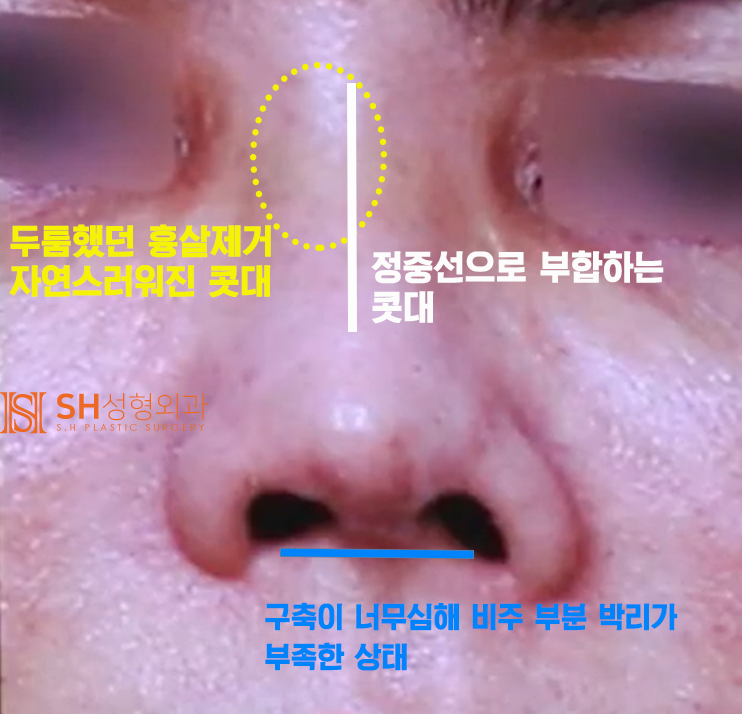
Side view changes:
No longer upturned.
Nasal tip lengthened and natural angle (Projection) formed.
Upturned nose, a characteristic of contracture, disappeared.
As a result:
The nose is restored to a structure close to ‘the last normal nose seen’.
Dr. Sung-Hoon Kim, Facial Designer's Reflection.
‘Contracted nose is not a matter of surgical technique, but of anatomical understanding and reconstructive philosophy.’
Instead of forcibly rebuilding a collapsed structure,
By loosening hardened areas, lengthening shortened areas,
And supplementing deficient parts with precise materials,
The nose becomes one that will not collapse again.
I always say this:
‘Contracture is not the end. Within the limits of what the tissue allows, it can be fully restored.’
The more difficult the nose, the more delicately and deeply we examine it,
The path becomes clear.
FAQ
Q1. Can a contracted nose return to its original state?
Yes. It is fully possible with scar tissue removal + tissue lengthening + structural reconstruction.
Q2. Can silicone be used again even with severe contracture?
It is possible in some cases. Often, the problem was not the silicone itself, but how it was used.
Q3. When is contracted nose revision surgery possible?
The standard is 6 months after the tissue softens, but the ‘tissue condition’ is more important.
Q4. Is there no possibility of contracture recurring?
With proper cartilage reconstruction and scar tissue removal, the recurrence rate is significantly lowered.
Q5. Can an upturned nose with a significantly lifted tip be improved?
Yes. It can be sufficiently corrected with columellar extension + cartilage pillar reconstruction + skin lengthening.
Q6. My nose is very crooked; can it be reconstructed?
A significant portion can be corrected through midline adjustment, scar tissue removal, and cartilage repositioning.
SH Plastic Surgery Clinic