2025-11-01
#12 Donated Costal Cartilage for Revision Rhinoplasty: If You're Worried About Pain at the Autologous Rib Harvest Site _ About Nose Surgery Materials 2/3
This post details the pros and cons of donated costal cartilage, autologous septal cartilage, and autologous ear cartilage from an anatomical and functional perspective, based on Dr. Kim Sung-hoon's criteria and surgical cases.
One of the biggest concerns for patients considering revision rhinoplasty is, ‘Which cartilage should I use?’ It's well-known that autologous costal cartilage is the strongest and most stable, but its use may be difficult or undesirable depending on the situation. In such cases, which cartilage should be chosen? In this post, Dr. Kim Sung-hoon explains in detail the advantages and disadvantages of donated costal cartilage, autologous septal cartilage, and autologous ear cartilage from an anatomical and functional perspective, based on his actual clinical criteria for cartilage materials and surgical cases. Beyond simple comparisons, we'll explain why certain cartilages are best in specific situations, supported by research. Dr. Kim Sung-hoon, SH Plastic Surgery. Dr. Kim Sung-hoon, Face Designer.
Hello, I'm Dr. Kim Sung-hoon, director of SH Plastic Surgery and a face designer.
In my previous blog post, I discussed ‘why autologous costal cartilage is the best choice for revision rhinoplasty.’
This is because it offers superiority in various factors such as strength, durability, and engraftment rate, and particularly in revision surgery, it can provide the most stable results.
However, through consultations with numerous patients in the examination room, I am once again reminded of a clear fact:
‘No matter how good the material, it cannot be applied equally to everyone.’
For some, concerns about scars, for others, age and pain, and for yet others, past illnesses,
autologous costal cartilage may be burdensome.
And indeed, for such individuals,
a different path (using different materials) is necessary.
‘Doctor, I want to have surgery with costal cartilage, but I'm too worried about the scar.’
‘I'm in my 60s, and removing a rib sounds a bit scary.’
‘I've exercised for a long time, and I heard my ribs aren't in good condition.’
Many people who are considering autologous costal cartilage rhinoplasty say these things.
While autologous costal cartilage indeed has the highest strength and provides stable results, it cannot be applied to all patients.
For those sensitive to scars, those with a history of pleurisy or costochondritis, the elderly, or those with high pain sensitivity, other alternatives are needed.
So, if costal cartilage isn't used, what's the best option?
Now, let's discuss these alternatives one by one.
Types and Criteria of Rhinoplasty Materials You Must Know Before Surgery
First, cartilage materials used for tip plasty are categorized as follows:
Material Category | Type | Primary Use |
Autologous Cartilage | Costal cartilage, Septal cartilage, Ear cartilage | Functional structural reinforcement, Naturalness |
Donated Cartilage | Donated Costal Cartilage | Alternative when autologous cartilage is not possible |
Artificial Materials | Medpor®, Mesh, Silicone | Recently avoided for nasal tip |
‘It is a principle not to use artificial materials for the nasal tip.’ Dr. Kim Sung-hoon, Director of SH Plastic Surgery, Face Designer.
[CASE 1] When autologous costal cartilage cannot be used
Autologous costal cartilage is ideal because it is the hardest, has a low absorption rate, and maintains its shape for a long time without deformation, even in revision surgery. However, its use is limited in the following cases:
History of previous costal cartilage harvesting
Calcification of costal cartilage or thin ribs (CT confirmation required)
Patients sensitive to pain or elderly patients
Occupations sensitive to scars (models, actors, etc.)
Athletes or individuals with high activity levels where maintaining costal cartilage fixation is deemed difficult
In these cases, alternative cartilage is needed.
[CASE 2] Donated Costal Cartilage – An Alternative Without Tissue Rejection
Advantages:
Reduced surgery time (rib harvesting process omitted)
No scar (no additional incision needed)
Productized for safety management
Disadvantages:
Donor's age/bone density cannot be confirmed → possibility of absorption
Increased risk of absorption in patients with high activity levels
Slight decrease in elasticity after a certain period
Case Study:
‘A male patient in his 50s underwent surgery with Medpor® at another hospital and was referred for revision due to inflammation. He did not want a chest scar, so donated costal cartilage was used for reconstruction, and it has been stably maintained for 2 years.’
[CASE 3] Autologous Septal Cartilage – Harvested from Inside the Nose, Increased Naturalness
Advantages:
Harvested from inside the nose → no scar
Short and simple surgery time
Good elasticity, advantageous for creating natural lines
Disadvantages:
Small harvest volume
Possibility of warping if septal deviation is present
Weak support if warped or thin
Case Study:
‘A female patient in her 20s wanted only tip correction after incisional double eyelid surgery. Her tissue was thin, and sufficient height and shape could be achieved with only septal cartilage. No scar and fast recovery.’
[CASE 4] Autologous Ear Cartilage – The Softest and Most Flexible Material
Advantages:
Softest cartilage
Allows for natural movements, such as a ‘pig nose’ expression
High tissue engraftment rate and minimal scarring
Disadvantages:
Weak support → unsuitable for increasing nose height
Left and right cartilages often differ in shape and are frequently curved
More suitable as an auxiliary material than for standalone use
Case Study:
‘Ear cartilage is primarily used to add ‘naturalness.’ It is used as an auxiliary attachment for alar expansion, columellar reinforcement, etc.’
What is Donated Costal Cartilage, its Advantages and Disadvantages
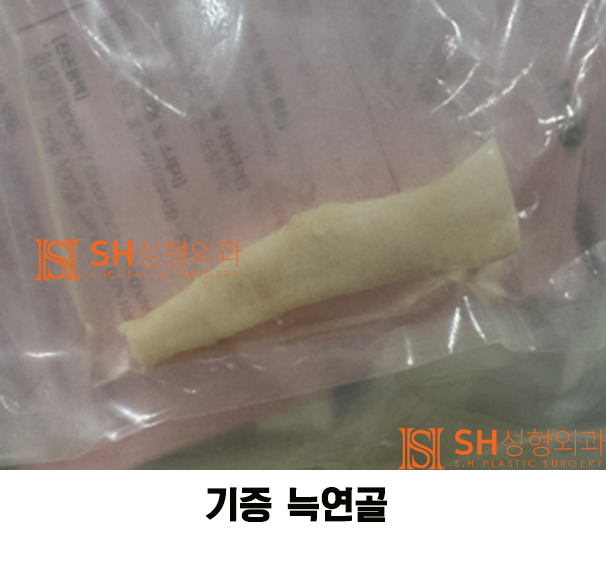
Donated costal cartilage, as the name suggests, is a medical implant material made from another person's rib cartilage, sterilized and with all cells removed, then packaged.
Since the cells are not alive, there is no immune rejection.
The body won't recognize it as ‘not mine.’
The biggest advantage of this material is that ‘you don't need to harvest your own rib cartilage.’
This means no scar on the chest, no additional surgery for costal cartilage harvesting,
and you can proceed directly with the surgery, resulting in shorter surgery time and faster recovery.
Donated costal cartilage is also relatively more affordable.
There are also disadvantages.
First, the donor's age cannot be known.
Older cartilage is more likely to be absorbed easily,
which can lead to the nasal tip dropping over time.
In other words, if the cartilage is not firm, it cannot withstand the test of time.
Second, the patient's own constitution also plays a role.
Especially for individuals with high metabolic rates, like athletes,
meaning those with fast body recovery or regeneration speeds,
the cartilage can be absorbed quickly regardless of the donor's age.
In this case, the nasal tip may drop faster than expected.
Dr. Kim Sung-hoon's Reflection
I always tell my patients after a detailed consultation:
‘Donated costal cartilage is certainly a good alternative, but it must be decided carefully based on the case.’
Especially in revision surgery, where the durability of the nasal tip is most crucial,
if possible, autologous costal cartilage should be the first choice,
if that's difficult, then donated costal cartilage should be carefully planned and used.
The important thing is that ‘every material has a reason.’
It's not simply about what's inserted, but anatomical design tailored to one's structure is key.
I always comprehensively analyze the patient's history, skin thickness, cartilage condition, and past surgical experiences to propose the best combination.
I neither insist solely on costal cartilage nor compromise unconditionally with artificial materials.
Understanding the structure of my body and designing surgery that fits my face. That is the true philosophy of a face designer.
In the next part, I will discuss what artificial materials like Medpor®, Mesh, and silicone are for the nasal tip,
and how to perform revision surgery for side effects caused by rhinoplasty using artificial materials.
#Must-Watch Q&A Video Before Rhinoplasty! #Solving Questions Up to Revision Rhinoplasty! [#SHPlasticSurgery] - YouTube
SH Plastic Surgery Clinic