2026-07-27
Lower Blepharoplasty, Under-Eye Fat Repositioning, Midface Lift: Which Under-Eye Anti-Aging Procedure is Right for Me? (Plastic Surgeon Woo-Hyun Tak)
Explore the differences between lower blepharoplasty, under-eye fat repositioning, and midface lift to determine the best anti-aging solution for your under-eye concerns.
Hello. I am Woo-Hyun Tak, a board-certified plastic surgeon at Tailor Plastic Surgery.
Even with a full facelift, one of the most extensive anti-aging surgeries, certain areas remain challenging to improve significantly. These are under-eye wrinkles and sagging under-eye skin.
This is why lower blepharoplasty and midface lift have recently seen an increase in inquiries and garnered significant attention.
While some individuals undergo these procedures concurrently with a facelift for synergistic effects, many patients inquire about them as standalone surgeries, finding a full facelift too burdensome and wishing to focus solely on improving under-eye and midface sagging.
Since the anatomical areas addressed by these two methods partially overlap, patients may be confused about which surgery is suitable for them.
Today, I would like to explain the differences and step-by-step characteristics of lower blepharoplasty, midface lift, and under-eye fat repositioning, which are key to under-eye anti-aging.
1. What exactly is a lower blepharoplasty procedure?
If I had to name the most representative under-eye anti-aging surgery, it would undoubtedly be lower blepharoplasty. Its formal name is ‘lower eyelid blepharoplasty’, but it is commonly shortened to lower blepharoplasty.
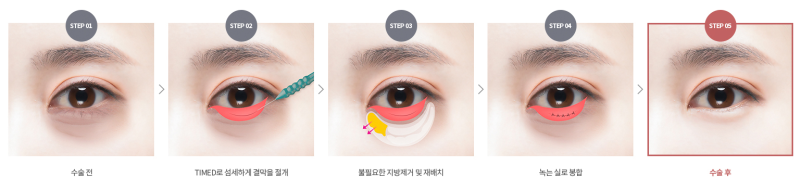
Many people find it difficult to distinguish from under-eye fat repositioning. Unlike under-eye fat repositioning, which is performed through the inner conjunctiva of the eye without external skin incision, lower blepharoplasty involves a delicate incision along the skin line just below the eyelashes. This procedure encompasses various techniques to excise loose skin and generally make the under-eye area appear younger and more vibrant.
The typical lower blepharoplasty procedure performed in plastic surgery clinics today involves very precise steps depending on the patient's condition. The sequence of these steps is as follows:
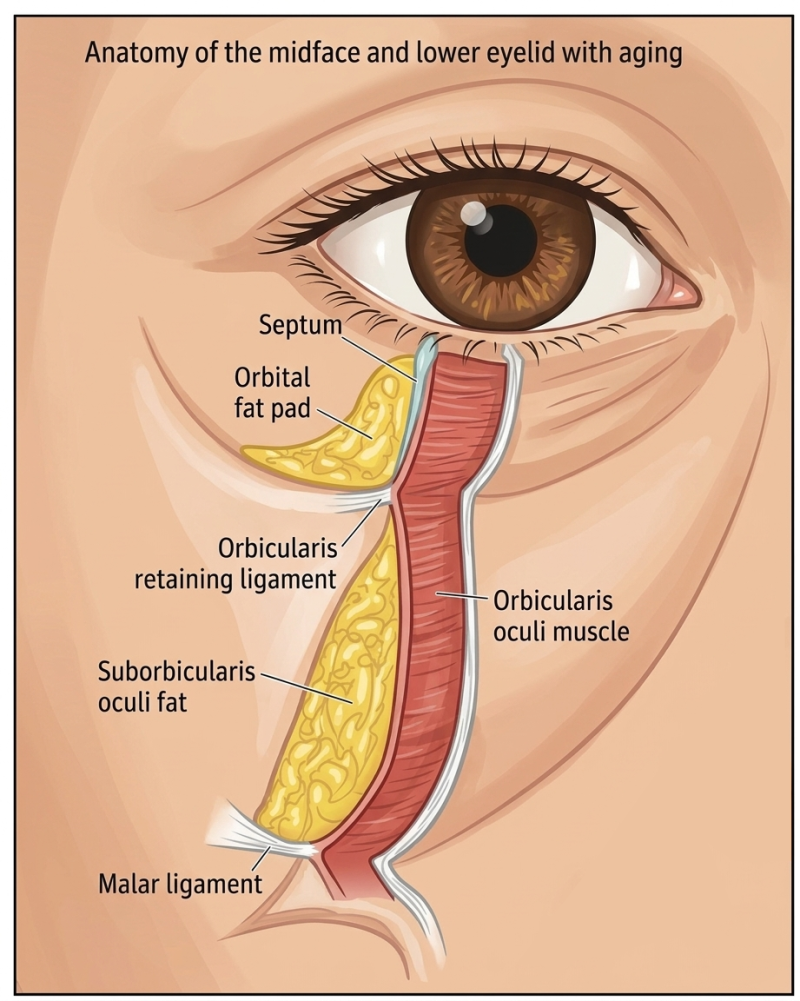
Incision and Dissection followed by Midface Lift (SOOF Lift): Sagging fatty tissue above the nasolabial folds and in the midface area is lifted and secured towards the anterior malar region, which lacks volume. (This step is performed selectively depending on the patient's anterior malar volume and expected results.)
Under-Eye Fat Repositioning: Bulging fatty tissue under the eyes is repositioned to create a smoother contour.
Septal Reinforcement: The weakened orbital septum, which encloses the fat, is tightened to prevent future recurrence.
Lateral Canthopexy: The lateral canthus (outer corner of the eye) is secured to prevent ectropion, a condition where the lower eyelid or muscle sags and turns outward.
Orbicularis Oculi Suspension: The under-eye muscle (orbicularis oculi), which has sagged due to aging, is tightened and secured.
Skin Excision: Finally, any excess loose skin is precisely measured, excised, and then sutured.
Consequently, lower blepharoplasty should be understood not as a single surgical technique, but as a highly comprehensive anti-aging surgery that organically combines six stages: midface lift, fat repositioning, septal reinforcement, lateral canthopexy, orbicularis oculi suspension, and skin excision.
2. Lower Blepharoplasty Method that Preserves Aegyosal (Under-Eye Fat Rolls)
During consultations with patients, I frequently receive questions like, ‘Will my existing aegyosal disappear after lower blepharoplasty?’ or ‘Is it possible to perform the surgery while preserving my aegyosal?’
To answer directly, anatomically, aegyosal is not composed of fat but of ‘muscle’ (orbicularis oculi). Among the stages of lower blepharoplasty explained earlier, the ‘orbicularis oculi suspension’ process is the key point for precisely shaping the muscle that supports this aegyosal.
However, it is not about artificially creating new muscle, but rather ‘gathering’ the existing muscle that has lost elasticity and spread out due to aging. Therefore, the natural aegyosal structure that one had in youth is restored by being clearly gathered again.
If the aegyosal appears excessively flat after surgery, it is possible that the surgery was performed without considering muscle preservation or that too much skin was excised. Modern surgical techniques are evolving to prevent such side effects, so this is not a common occurrence.
However, in revision cases where muscle tissue has already been lost from previous surgeries, separate complementary measures such as dermal grafting or filler injections may be necessary later.
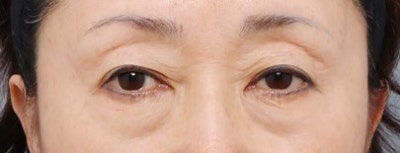
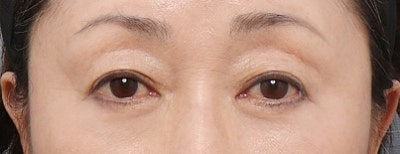
Before Lower Blepharoplasty > 1 Year Post-Surgery
These are post-operative photos of lower blepharoplasty, showing under-eye fat repositioning, aegyosal reconstruction through orbicularis oculi suspension, and removal and suturing of excess skin.
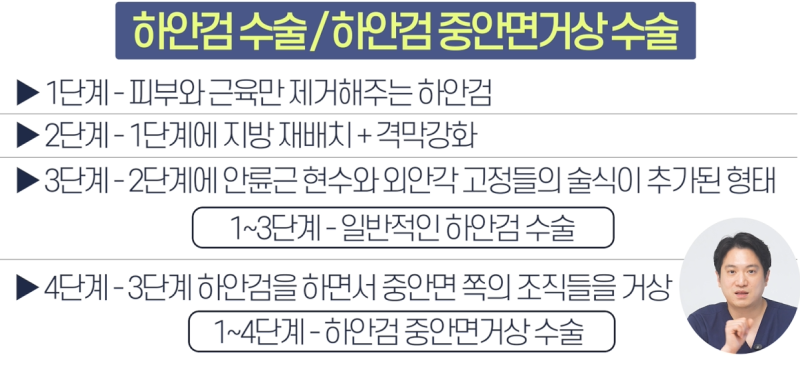
3. Four-Stage Classification of Lower Blepharoplasty
In terms of surgical methods, lower blepharoplasty can be broadly classified into four stages based on the extent of the procedure. Understanding these stages can be very helpful during consultations, as surgical approaches may vary between clinics.
Stage 1: Basic lower blepharoplasty, involving simple removal of only loose skin and some muscle.
Stage 2: Includes under-eye fat repositioning and septal reinforcement in addition to Stage 1.
Stage 3: A refined stage that adds orbicularis oculi suspension for aegyosal preservation and lateral canthopexy to Stage 2.
Stage 4: The most advanced stage, building upon Stage 3 lower blepharoplasty, and also lifting and elevating sagging midface tissue.
4. Finding the Right Surgery for You: Case-by-Case Guide
The necessary surgery varies completely depending on each patient's skin elasticity, amount of fat, and anterior malar structure. We have established criteria to help you determine which surgery is right for you.
[CASE 1] When only under-eye fat repositioning is sufficient
This applies to individuals who do not have sagging under-eye skin or muscle, but have shadows caused by the tear trough ligament and fat.
In this case, a clear and bright eye area can be achieved simply by performing under-eye fat repositioning through the inner conjunctiva of the eye, without external skin incision.
[CASE 2] When standalone lower blepharoplasty is appropriate
This applies to individuals with age-related sagging of the under-eye skin and muscle, who need to tighten and gather the aegyosal muscle. If the under-eye hollowness is not severe, these individuals typically undergo lower blepharoplasty, which usually includes a fat repositioning process.
[CASE 3] When both lower blepharoplasty and midface lift are needed simultaneously
This case involves sagging under-eye muscles and skin, along with insufficient volume in the anterior malar (midface) area. If only lower blepharoplasty is performed in this state, there may be insufficient fat to reposition, making the under-eye area appear hollow. Therefore, to maximize the anti-aging synergistic effect, lower blepharoplasty should be combined with a midface lift to move the sagging midface tissue upwards and restore volume.
If there is insufficient midface volume, fat grafting may also be needed in conjunction with lower blepharoplasty, so it is advisable to check these aspects during consultation.
Today, we have meticulously examined the differences and anatomical stages of lower blepharoplasty, midface lift, and under-eye fat repositioning, which are key solutions for improving under-eye aging.
Under-eye surgery is not a one-dimensional procedure that simply cuts away sagging areas. Only by comprehensively analyzing an individual's anatomical structure and the progression of aging to establish a precise, customized surgical plan can natural and unawkward results be achieved.
I hope the information provided today serves as a proper guide for those who have been considering under-eye anti-aging. For a more detailed and accurate diagnosis, I will personally examine your condition during a visit.
Below is a video about lower blepharoplasty, so please refer to it as well.
Thank you for reading this long article. This was Woo-Hyun Tak, a board-certified plastic surgeon at Tailor Plastic Surgery.
https://tv.naver.com/v/102450846
#하안검수술 #눈밑지방재배치 #중안면거상 #눈밑성형 #테일러성형외과 #탁우현원장 #눈밑주름개선 #중안부거상 #안티에이징성형 #성형외과전문의
Frequently Asked Questions
What exactly is lower blepharoplasty?
Lower blepharoplasty is a complex anti-aging surgery that involves making an incision below the eyelashes to excise loose skin and rejuvenate the under-eye area. It is a procedure that organically combines several stages, including midface lift, fat repositioning, septal reinforcement, lateral canthopexy, orbicularis oculi suspension, and skin excision.
Does lower blepharoplasty remove aegyosal (under-eye fat rolls)?
No, aegyosal is not removed. Aegyosal is tissue composed of muscle (orbicularis oculi), and the ‘orbicularis oculi suspension’ process in lower blepharoplasty gathers the muscle that has spread due to aging, restoring the natural aegyosal structure clearly.
What is the difference between under-eye fat repositioning and lower blepharoplasty?
Under-eye fat repositioning involves repositioning fat through the inner conjunctiva of the eye without an external skin incision, whereas lower blepharoplasty involves an incision below the eyelashes to excise loose skin and perform various other procedures, including fat repositioning.
When should lower blepharoplasty and midface lift be performed together?
It is advisable to perform them together when there is sagging under-eye muscle and skin, along with insufficient volume in the anterior malar (midface) area. Lower blepharoplasty alone may result in an insufficient amount of fat to reposition, making the under-eye area appear hollow. Therefore, combining it with a midface lift helps to fill the volume by moving the sagging midface tissue upwards, maximizing the synergistic anti-aging effect.
How many stages are there in lower blepharoplasty?
Lower blepharoplasty can be broadly classified into four stages based on the extent of the surgical method. Stage 1 involves simple removal of loose skin and muscle, Stage 2 includes fat repositioning and septal reinforcement, Stage 3 adds orbicularis oculi suspension and lateral canthopexy, and Stage 4 is the most advanced stage, also including a midface lift of the midface tissue.