2026-09-07
Oksu-dong Dental Clinic: Gum inflammation and pus pockets on a root-canaled tooth won't subside even with medication. (Causes and Treatment Methods)
Learn why root-canaled teeth can develop gum inflammation and pus pockets that don't respond to medication, and explore the causes and treatment options available at Oksu-dong Dental Clinic.
Hello.
I'm Dr. Kim Tae-young, director of Bareunyoung Dental Clinic in Oksu-dong.^^
The nerves in our teeth
have very diverse structures.
Even within one person, the nerve structures of different teeth vary slightly.
You might find it helpful to read my previous post about re-root canal treatment.
While we approach all treatments with care,
root canal treatment
is a process of thoroughly cleaning the unseen nerve pathways inside the tooth,
so we always strive to be focused and meticulous.
‘It's been a few years since my root canal, and my gums swell every time I'm tired, and they don't go down easily.’
We often have patients visit us who received root canal treatment
and then, years later, when they're tired or their immunity is low,
experience swollen gums or pus pockets
that don't subside even with medication.
This is a phenomenon caused by the recurrence of inflammation in the root-canaled area.
Root canal treatment
aims to mechanically and chemically remove contaminated nerve canals
from within the pulp chamber,
disinfect them, and block external contamination.
However, over time, in some teeth,
exposure to external contamination
or structural defects within the tooth
can unfortunately lead to
a recurrence of inflammation in the root area.ㅠㅠ
What are the treatment options when inflammation recurs in a root-canaled tooth?
Simply put, re-treatment or extraction.
Because I also understand the importance of natural teeth,
for patients who had root canal treatment not long ago,
I often suggest trying again
to save the tooth.
However,
for teeth that have been treated a long time ago,
it's not easy to perform a clean re-root canal treatment,
and for large lesions,
the prognosis may not be good even after treatment completion.
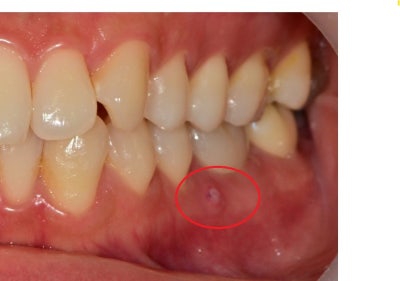
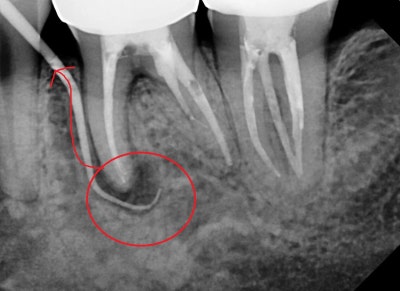
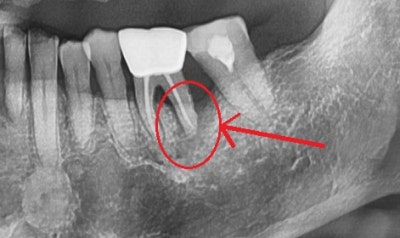
The photo on the left shows symptoms of a pus pocket on the gum,
which indicates that the root inflammation has eroded the outer bone and is exposed externally.
To confirm this, we used an X-ray through the pus pocket
to identify the source of the inflammation.
A considerable amount of time had passed since the root canal treatment,
so difficulties were anticipated, but
we decided to attempt re-root canal treatment as a last resort before extraction.
Here's another case.
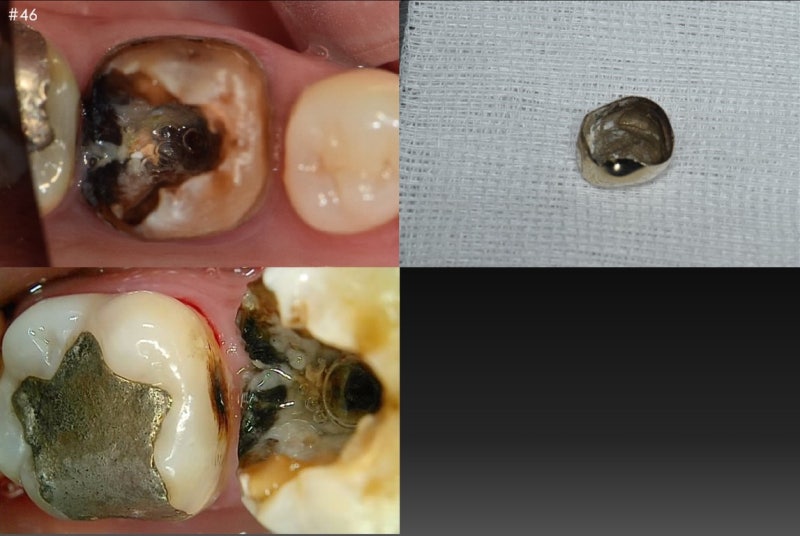
Although the patient had received root canal treatment in the past,
internal contamination due to secondary decay in the upper part of the tooth progressed,
and the inflammation spread to the root area,
so re-root canal treatment was performed.
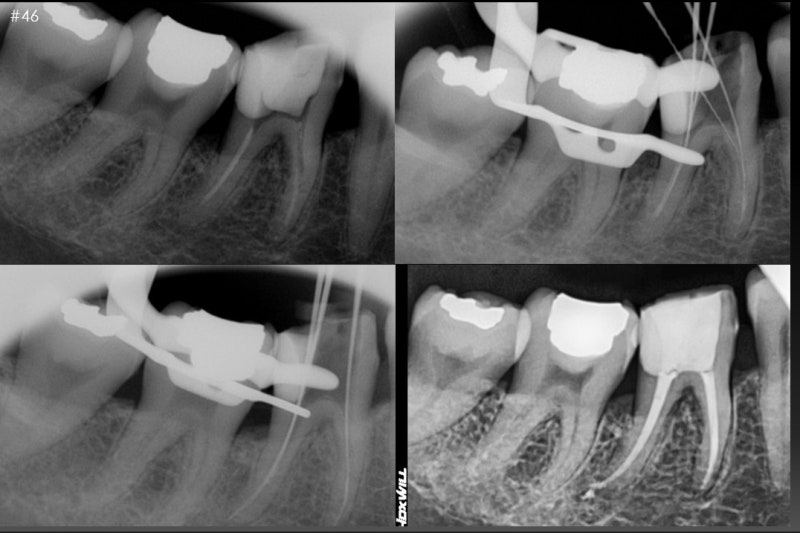
The upper left photo is the initial examination photo.
After removing the materials inside the root canal and disinfecting it several times,
and confirming symptom relief,
as shown in the lower right photo, the root was re-sealed with clean material all the way to the apex,
and then prosthetic treatment was typically performed.
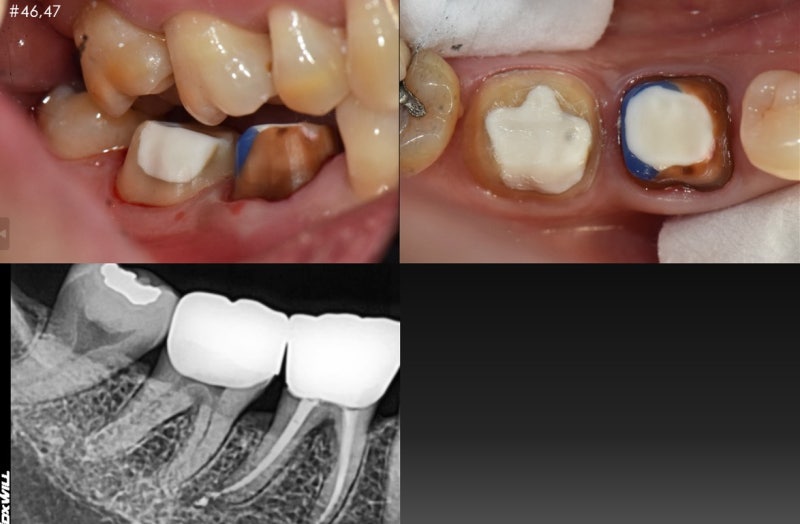
The adjacent tooth also had internal contamination from an old restoration,
so after removing the decay, prosthetic treatment was completed.^^
Treatment start: 2023.11.23
Treatment end: 2023.12.20
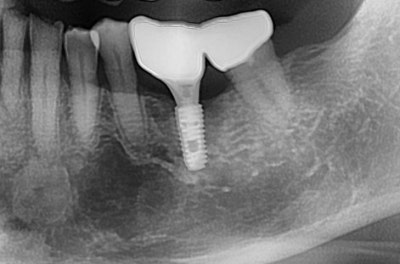
This case
is my father.
In the past, the root-canaled area had recurred once,
and I performed re-root canal treatment and prosthetic work for him.
Now, almost 10 years later,
he developed a complex of root inflammation and periodontal inflammation.
Since the root was already dissolving,
unfortunately, I had to explain extraction to my father,
and instead, I performed a robust bone graft around the alveolar bone, which was extensively dissolved due to inflammation,
and completed the implant.^^
As such,
when inflammation recurs
in a root-canaled tooth,
there are various factors that determine whether to perform re-root canal treatment.
These include the timing of treatment, root structure, size of inflammation, presence of mobility, etc.
It would be ideal if symptoms could be alleviated by performing re-root canal treatment as much as possible,
but currently, there are some limitations to treatment.
Today, we looked into the recurrence of root canal inflammation.
I hope this was helpful to those who were curious.
Thank you.^^
Treatment start: 2022.06.13
Treatment end: 2022.11.26
This post was written directly by Bareunyoung Dental Clinic for the purpose of providing medical information and hospital advertising (in compliance with Article 56, Paragraph 1 of the Medical Act). The photos are taken from the same patient, and treatment methods and other side effects (pain, prosthetic detachment) may vary for each patient.
Frequently Asked Questions
Why does gum inflammation occur after root canal treatment?
Yes, gum inflammation can recur in root-canaled teeth. This is because, over time, the root area can become re-inflamed due to exposure to external contamination or structural defects within the tooth. Symptoms are more likely to appear when you are tired or your immunity is low.
How is recurrent inflammation in a root-canaled tooth treated?
There are two main treatment methods: re-root canal treatment and extraction. Since preserving natural teeth is important, if the root canal treatment was performed not long ago, re-root canal treatment can be attempted first. However, if a long time has passed or the lesion is large, extraction may be considered.
Is re-root canal treatment always possible?
No, it is not always possible. The success of re-root canal treatment depends on various factors such as the timing of treatment, root structure, size of inflammation, and tooth mobility. Especially for teeth that have been treated a long time ago or have large lesions, the prognosis may not be good even after re-root canal treatment, indicating limitations in treatment.
What does it mean if a pus pocket forms on the gum?
A pus pocket on the gum indicates that root inflammation has eroded the outer bone and is exposed externally. In such cases, it is crucial to accurately identify the source of the inflammation through X-rays and other means to formulate an appropriate treatment plan.
What happens if inflammation recurs even after re-root canal treatment?
If inflammation recurs even after re-root canal treatment or if treatment is difficult, extraction may be considered. After extraction, bone grafting can be performed around the alveolar bone damaged by inflammation, and implant treatment can restore function.