2026-09-07
Yaksu-dong Dental Clinic: Is full-mouth implant possible for those who have used full dentures for a long time? (Alveolar bone absorption patterns and shapes)
This article discusses the possibility of full-mouth implants for long-term denture wearers, even with significant bone loss, thanks to advanced implant technology. It details a case study, emphasizing the importance of bone grafting and post-surgical care.
Hello.
This is Dr. Kim Tae-young, director of Bareunyoung Dental Clinic near Yaksu Station.^^
Sometimes, we have patients in their 50s and 60s who still wear dentures.
‘Doctor, why did you get dentures instead of implants?’
When I ask, they say, ‘In the past, they told me I couldn't get implants because my bone condition was bad.’
they tell me.
Then, after taking a CT scan,
‘It must have been true back then~’
I answer and tell them that nowadays, even more difficult cases can be operated on.
They say they thought they could never get implants,
and they bravely proceed with the surgery.
Nowadays, implants have developed a lot compared to the past,
and surgical techniques are advancing day by day,
so most cases can be operated on without going to a university hospital.
My lower gums hurt
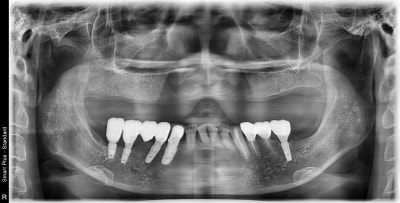
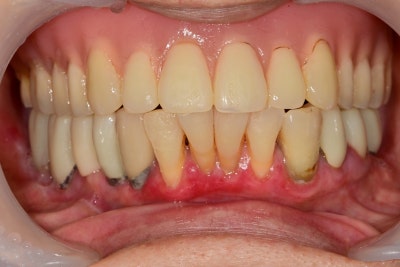
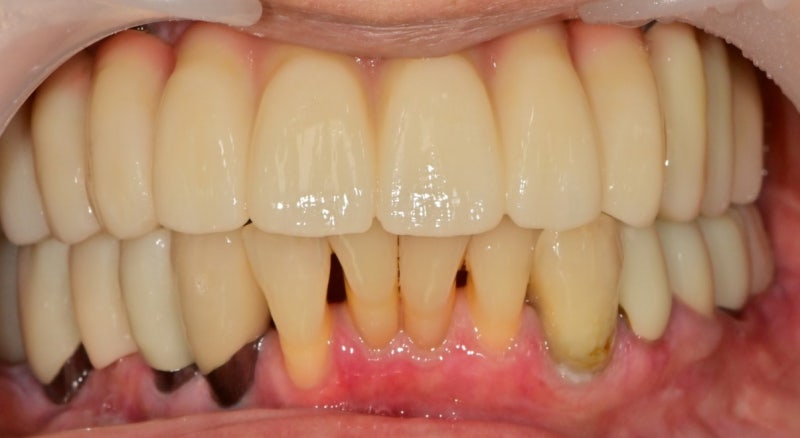
The initial visit was due to pain in the gums around the lower teeth.
For the upper jaw, the patient had previously had teeth extracted
and was using full dentures.
First, since the gums around the implants and front teeth were swollen,
we proceeded with gum treatment first, and then diagnosed for implants.
The patient said they thought they couldn't get implants,
but even without looking at the CT, it seemed entirely possible.
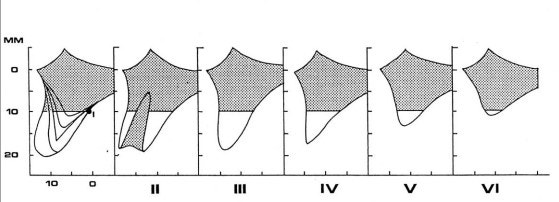
When a long time passes after extraction, the jawbone, as shown in the picture above,
tends to become pointed at the end and absorb inwards.
The CT scan showed that the bone was being absorbed.
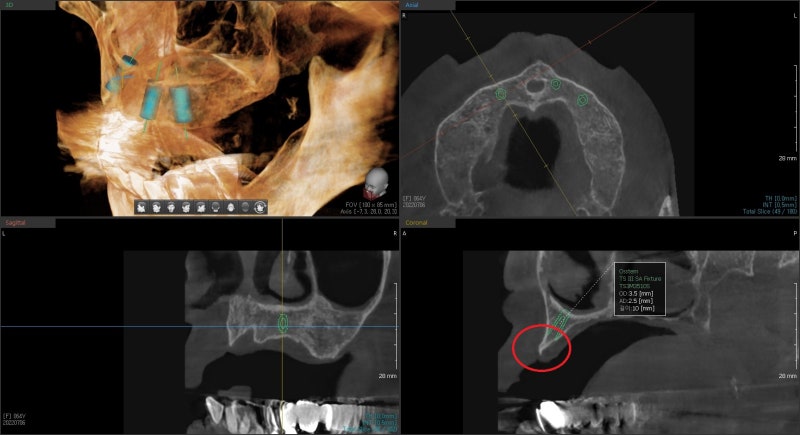
We performed a simulation for the position, number, and direction of the implants.
When the end of the bone becomes pointed, to place implants,
it is good to trim the upper bone, place the implants,
and then secure sufficient bone thickness around the implants through alveolar bone grafting.
After the surgery, the patient temporarily uses their existing dentures
and waits until the bone and implants become stable.
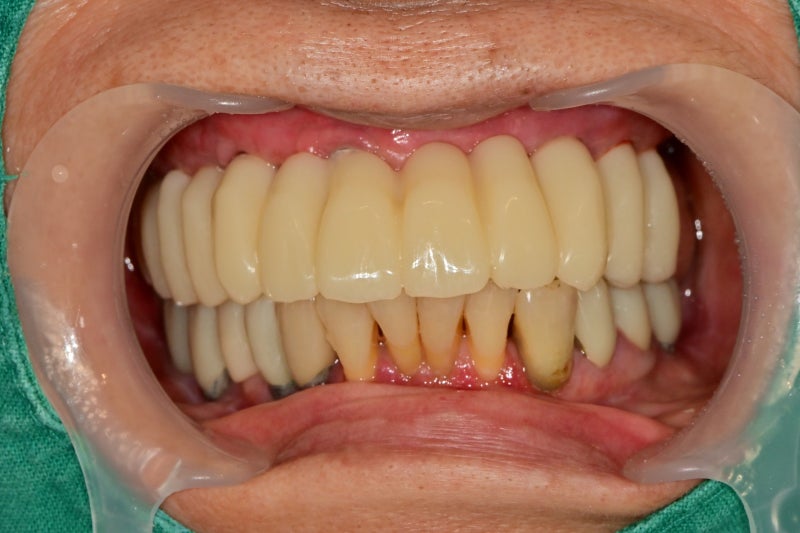
Finally, this is the stage where the abutments are placed and temporary teeth are used.
This period is quite tedious and bothersome.
Since the patient had used dentures for a long time, to stabilize the temporomandibular joint,
I tell the patient to visit frequently!!!
Each time they came, the position of the jaw changed, and thus the occlusion changed,
so we repeated the process of adjusting and using them.
This period is important for designing the final prosthesis, observing the shape of the teeth and facial profile.
After a few months, once the temporomandibular joint is stable,
we start fabricating the final prosthesis by dividing the areas.
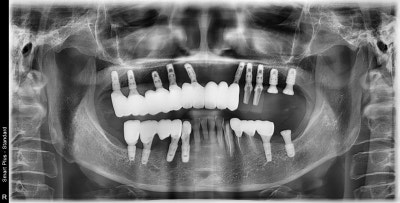
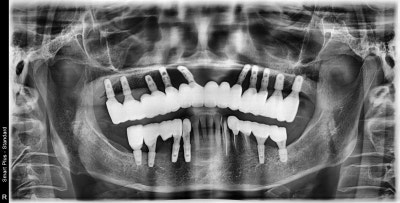
By fabricating the prostheses one side at a time, and through revisions and applications of the final prosthesis,
we achieved a satisfactory result in terms of both function and aesthetics.
Not only the upper implants, but also the lower implants and the areas around the natural teeth are well-managed for inflammation.
Although briefly introduced with photos,
it took almost 10 months.
The patient cooperated extremely well during the treatment period,
which I believe contributed to the good outcome.
For cases like long-term full denture use
or full-mouth implants, not only the surgery
but also the temporary tooth stage requires at least 2-3 months of observation,
so it takes more than twice as long as typical implant cases.
Nevertheless, when I hear patients say they no longer need uncomfortable dentures
and are very satisfied with their meals,
I feel a sense of accomplishment and pride in the long-term effort.
After implant surgery, management is much more important.
We will continue to manage it responsibly.
Thank you^^
Frequently Asked Questions
Is full-mouth implant possible for those who have used full dentures for a long time?
Yes, it is possible. In the past, it was said that implants were difficult due to poor bone conditions, but nowadays, implant technology and surgical techniques have advanced significantly, making surgery possible in most cases.
Is implant possible even if a lot of bone has been absorbed?
Yes, it is possible. Even if a long time has passed after extraction and the jawbone has absorbed, becoming pointed at the end, surgery can be performed by trimming the upper bone, placing implants, and then securing sufficient bone thickness through alveolar bone grafting.
How long does a full-mouth implant surgery process take?
It takes more than twice as long as typical implant cases. For the patient in this article, it took almost 10 months, and after surgery, a period of at least 2-3 months of observation with temporary teeth is required.
Are final prostheses worn immediately after implant placement?
No, they are not worn immediately. After surgery, the existing dentures are used temporarily while waiting for the bone and implants to stabilize. Subsequently, abutments and temporary teeth are used to stabilize the temporomandibular joint and adjust the occlusion, after which the final prostheses are fabricated.
Is post-treatment care important after full-mouth implant treatment?
Yes, it is very important. It is emphasized that post-surgical management is much more crucial for implant treatment, and the clinic states that they will continue to manage it responsibly.