2026-07-14
VAVA Plastic Surgery: Eye and Nose Surgery One Month Update (Winter, Karina Nose)
Discover a real case of combined eye and nose surgery at VAVA Plastic Surgery, showcasing a natural yet striking transformation one month post-op.
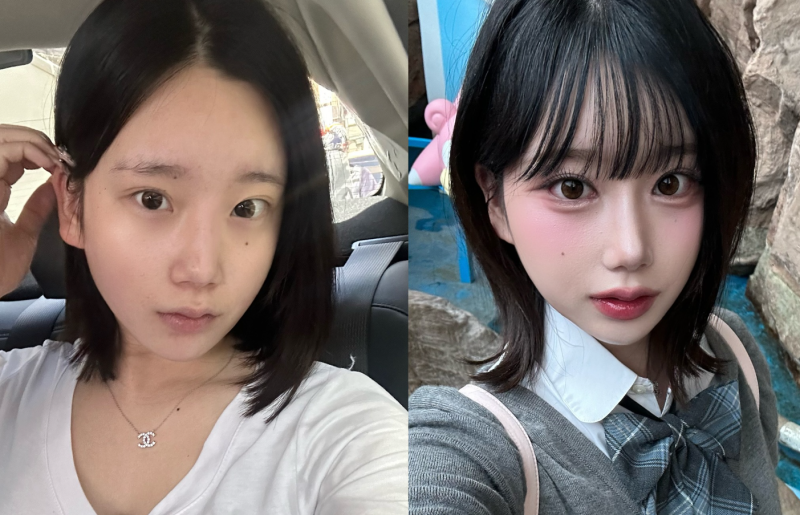
Hello, this is VAVA Plastic Surgery.
Today, we would like to introduce a real case of a patient one month after undergoing their first eye and nose surgery simultaneously.
Many people are curious about how much their impression can change with simultaneous eye and nose surgery.
In this case, the surgery aimed for an image of a ‘naturally glamorous everyday person’,
and we will show you the recovery process along with the results.
Surgical History / Desired Image
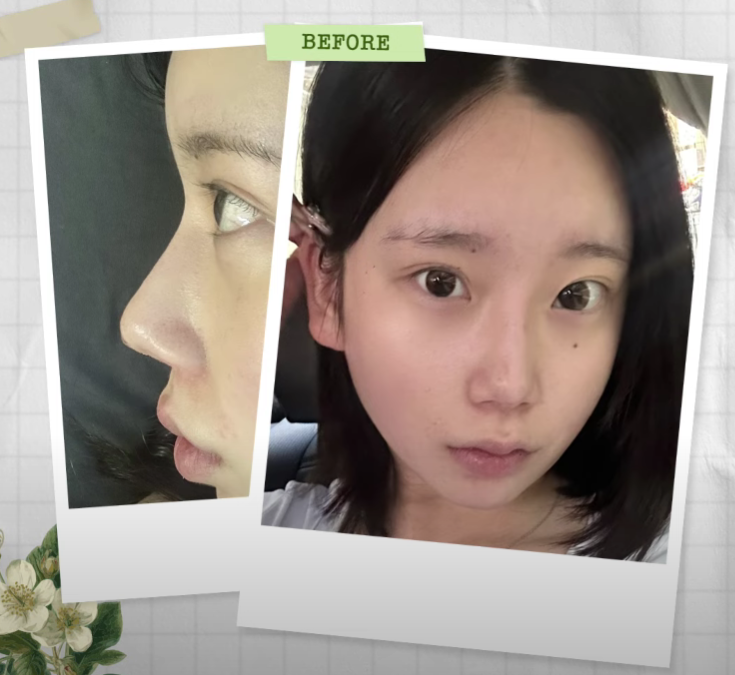


As of the consultation date, this model had a history of forehead filler one year prior and Hiko (nose thread lift) two months prior.
She had a habit of raising her eyebrows due to faint double eyelids and her forehead, which caused discomfort.
She also wished to improve the appearance of a slight dorsal hump on her nasal bridge and a wide, bulbous nose when viewed from the front.
Surgical Plan


Before surgery, the overall image featured indistinct facial features and a slight dorsal hump, lacking dimension and appearing flat.
Considering these characteristics, the surgical plan was designed to expand the eye shape and refine the nose line.
Eyes: Natural adhesion (semi-out) + Quadruple epicanthoplasty (upper, inner, outer, lower)
*For outer epicanthoplasty, due to the high possibility of re-adhesion, the procedure was performed to the safest extent possible after assessing the model's eye structure.
Nose: Bulbous nose correction + Dorsal hump correction + Columellar lengthening (straight-to-upturned line)
Surgical Preparation
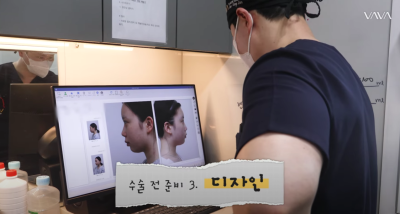
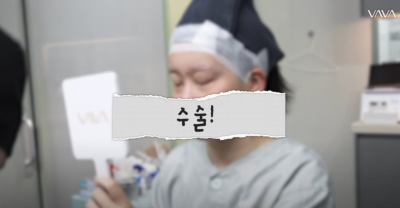
Step-by-Step Changes After Eye and Nose Surgery
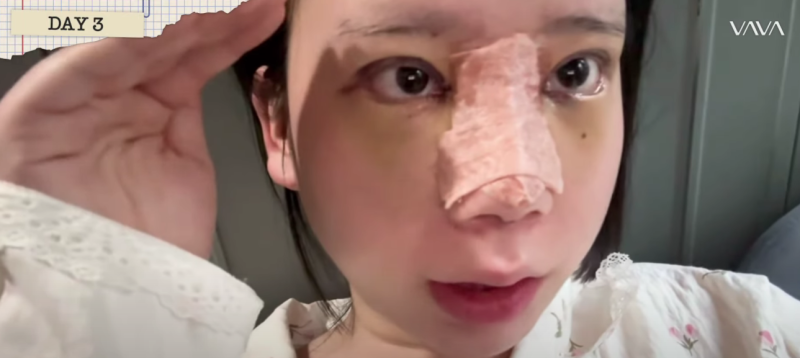
Days 1-3
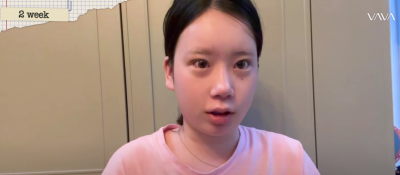
Immediately after surgery, swelling primarily starts in the upper face (eyelids, forehead, glabella, etc.) and may be accompanied by slight bleeding.
During this period, the eyes may feel heavy and difficult to open.
Due to the cotton placed inside the nose after nose surgery for hemostasis and support, a feeling of stuffiness may occur.
The cotton inside the nose is removed during a follow-up visit the day after surgery.
In the early stages of surgery, cold compresses can help alleviate swelling by constricting blood vessels to suppress bleeding and inflammatory reactions.
Additionally, when sleeping, it is recommended to keep the upper body slightly elevated with a high pillow.
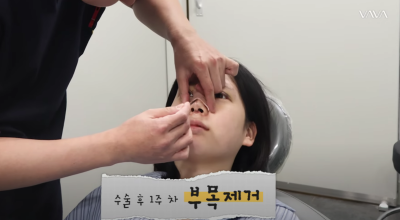
Weeks 1-2
After the acute swelling around the eyes and nose significantly subsides, it may move downwards due to gravity,
showing a pattern where swelling descends primarily to the lower face, such as below the cheekbones, cheeks, and jaw area, rather than the upper face.
At this time, the type of compress transitions from cold to warm.
Warm compresses can help promote blood circulation and accelerate the absorption of residual swelling and bruising.
Light walks are also recommended.

Month 1
Four weeks after surgery, most of the overall swelling has subsided, revealing the eye shape and nose line.
Most patients can return to daily life and makeup routines without discomfort at this stage.
However, depending on individual constitution, a small amount of residual swelling may remain at the outer corners of the eyes or the nasal tip.
In such cases, it is best not to rush and to observe the progress after sufficient consultation with a specialist and allowing for a recovery period.
Post-Surgery Result Changes
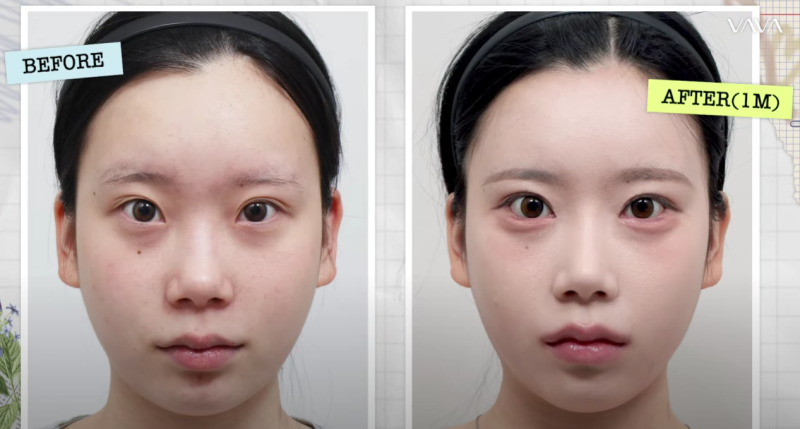
Eyes: Before surgery, due to eyelid ptosis, there was a habit of using forehead muscles excessively to open the eyes.
After surgery, the power to open the eyes was no longer restricted by the forehead, allowing for comfortable vision and reduced forehead tension.
Additionally, the previously constricted eye shape was improved to a more open and refreshed look through quadruple epicanthoplasty, simultaneously correcting the sleepy impression.
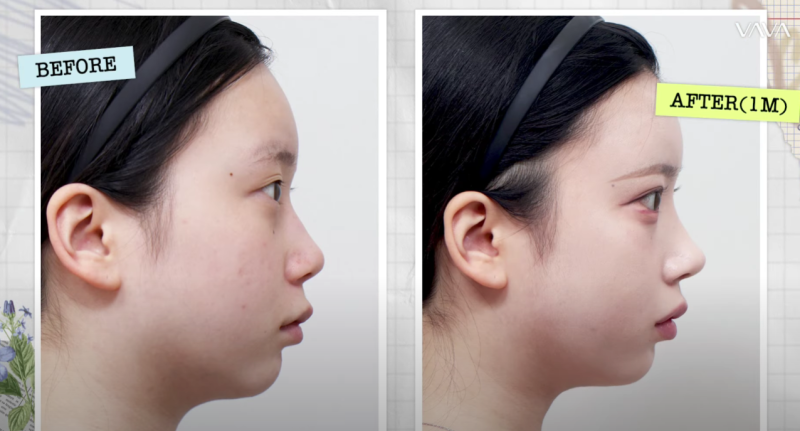
Nose: When viewed from the side, the uneven contour of the nasal bridge tended to give a strong impression,
and from the front, the blunt nasal tip created a stuffy and dull image.
By performing dorsal hump correction and bulbous nose correction simultaneously, the bridge line became smooth and refined, and the nasal tip became sophisticated and dimensional.
This enhanced the overall facial dimension and improved the impression to be more balanced.

The reason why a natural and highly satisfying transformation is possible even for a first-time surgery, as in this case,
is due to VAVA Plastic Surgery's unique design planning and detailed surgical methods.
If you are considering combined eye and nose surgery,
we recommend consulting based on stable cases that show good recovery processes and surgical results.
Thank you.