2025-05-06
Skin Sagging Surgery: Did You Lose Weight Too Quickly?
Learn why skin sags after rapid weight loss and how to manage it through gradual weight loss, exercise, nutrition, and, if necessary, surgical options.

Many people attempt
to lose weight through dieting.
However, even after successfully
losing weight, they may face an unexpected
problem: sagging skin.
Let's explore why this skin sagging occurs
and how it can be managed.
1. Understanding the Causes of Sagging Skin
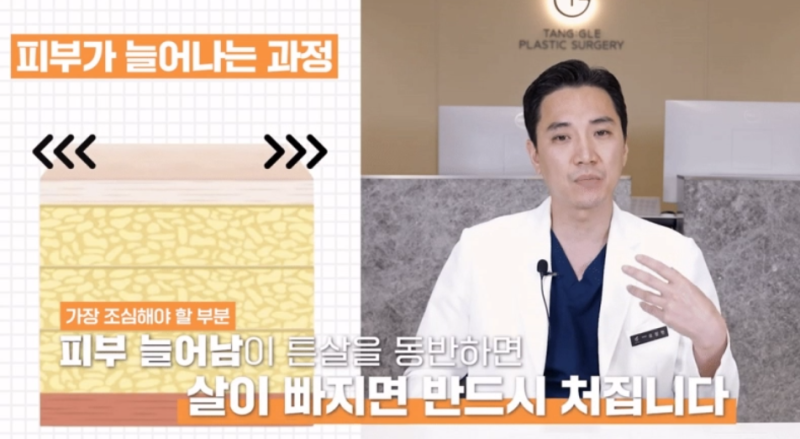
Our skin has elasticity,
allowing it to stretch as body weight increases.
However, if weight is lost rapidly,
the stretched skin may not return to its original state
and will sag.
You can compare it to a balloon.
When a balloon is inflated with a lot of air
and then deflated, its surface becomes wrinkled,
which is the same principle.
During weight gain, the skin gradually
expands, and in this process, the skin
tissue may experience microscopic damage (stretch marks).
If weight is lost in this state,
elasticity cannot be restored,
resulting in sagging skin.
2. Methods for Managing Sagging Skin
While it's difficult to completely prevent
skin sagging due to rapid weight loss,
the phenomenon can be minimized or improved
through the following methods:
1. Gradual Weight Loss
Losing weight slowly allows
the skin to adapt to the new body shape.
Typically, a weight loss of about 0.5-1 kg per week
is appropriate.
This speed allows the skin to naturally
adjust to the new body shape.
2. Incorporate Strength Training
Strength training helps maintain or increase
muscle mass during the weight loss process,
which can reduce skin sagging.
Even if fat decreases, muscles support the skin,
giving it a more toned appearance.
For example, if you're concerned about sagging skin
in the arm area, exercises that strengthen the triceps
and biceps can be helpful.
Similarly, if you're concerned about abdominal sagging,
abdominal exercises are recommended; for the thigh area,
quadriceps and hamstring exercises are advised.
3. Nutritional Management
Consuming foods rich in protein
and collagen helps maintain skin health.
Collagen plays a crucial role in maintaining skin elasticity,
and its production in the body decreases with age.
Foods rich in collagen include
bone broth, fish,
and eggs.
Vitamin C is necessary for collagen synthesis,
so you should consume fruits and vegetables.
3. Methods for Improving Already Sagging Skin
If your skin has already sagged,
you can consider the following methods:
1. Consistent Strength Training
Developing muscles beneath sagging skin
can lead to an improvement in appearance.
As muscles grow,
they push the skin from within,
making the sagging less noticeable.
2. Non-Surgical Elasticity Improvement
Some non-surgical procedures can
help improve elasticity.

However, these procedures are more effective
for mild skin sagging, and their efficacy may be limited
for severe skin sagging after significant weight loss.
3. Consider Skin Sagging Surgery
In cases of severe skin sagging,
skin sagging surgery (body contouring surgery)
may be considered.
Skin sagging surgery surgically removes
excess skin and tightens the remaining skin
to create a more toned appearance.
Skin sagging surgery can be applied to
various areas such as the abdomen, arms, thighs, chest, and back.
Skin sagging surgery is typically performed
under general anesthesia, and a recovery period is required after surgery.
Before considering skin sagging surgery,
it is important to gather information and consult with medical professionals.

Skin sagging after weight loss is a natural phenomenon
that many people experience.
While it's difficult to prevent completely,
it can be minimized through gradual weight loss, regular
exercise, and a balanced nutritional intake.
If skin sagging is already severe,
skin sagging surgery may be a solution, but surgery should be considered as a last resort.
Prioritizing weight management and healthy lifestyle habits
and seeking advice from medical professionals when necessary
is advisable.