2026-07-20
Low Energy Explained (Feat. So, is it good or bad?)
Understanding 'low energy' in SMILE/New SMILE surgery: its benefits, challenges, and why optimal energy levels are crucial for safe and effective vision correction.
Hello, this is Gangnam Smile Eye Clinic 😊
As you research SMILE/New SMILE LASIK, you’ve probably seen a lot of mentions of ‘low energy’.
Some places say low energy is good,
while others say it’s not good,
which can be very confusing for someone preparing for and researching vision correction surgery.
Low energy, as the name suggests, means using a low level of energy,
implying that vision correction is performed using low energy when applying the laser during surgery.
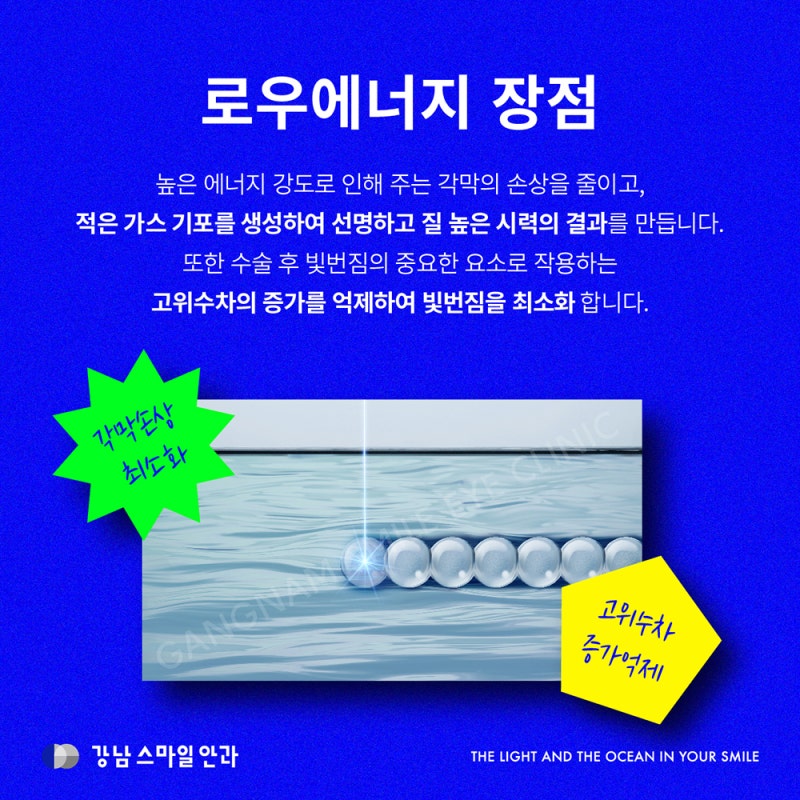
The advantage of vision correction with low energy is that the lenticule surface is created more smoothly, leading to faster recovery,
and there is less impact on the remaining tissues.
So, in what respect is low energy considered not good?
To understand this, you first need to understand the surgical method of SMILE/New SMILE.
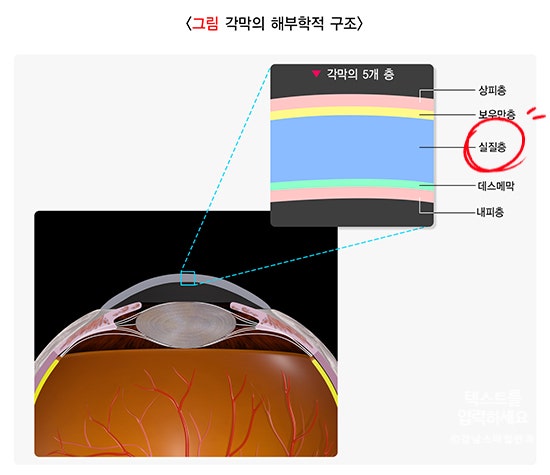
Vision correction is a surgery that reshapes the stromal layer, the inner part of the cornea, by the required diopter.
The surgical methods are differentiated into LASIK, LASEK, and SMILE based on how the laser reaches this stromal layer.
LASIK involves creating a flap on the outer surface of the cornea, opening it,
reshaping the stromal layer, and then closing the flap again.
LASEK involves removing the entire epithelial layer, reshaping the stromal layer,
and then waiting for the epithelium to regrow.
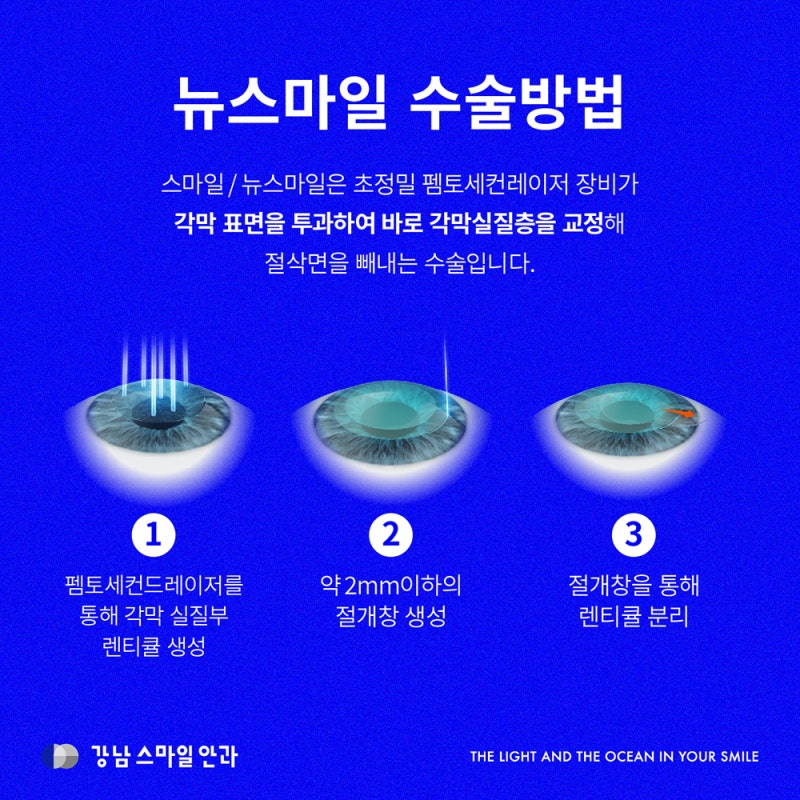
SMILE/New SMILE is the latest vision correction method,
where the laser penetrates the epithelial layer to directly correct the stromal part.
The corrected part is called a ‘lenticule’,
and the surgery is completed by making a micro-incision of about 2mm in the cornea
and removing the lenticule.
When surgery is performed with low energy, due to the low power,
lenticule creation can be relatively difficult,
and its removal requires a high level of skill.
It is in this context that the opinion ‘low energy is not good’
has emerged.
Therefore, is using low energy always good?
Of course not.
However, it is true that when surgery is performed using appropriate energy,
there are advantages such as fast recovery, less pain, excellent initial vision,
and no corneal haze.
Thus, the ideal low energy standard is to apply energy
within the lowest range that does not make the surgery difficult.
If the surgical machine has a wide range for energy adjustment,
the range for setting energy during surgery also widens,
which is advantageous for low energy control.
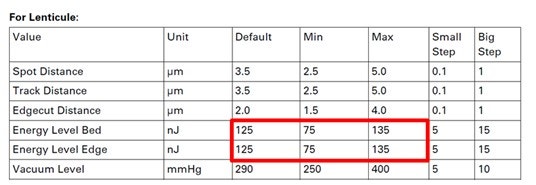
The ATOS femtosecond laser, the New SMILE surgical equipment used in our clinic,
can adjust energy levels from 75nJ to 135nJ.
(This level is significantly lower than what other femtosecond lasers can adjust to.)
Gangnam Smile Eye Clinic reviews patients’ examination results
and sets the appropriate energy level for surgery using the ATOS equipment,
performing the surgery cleanly and safely with the lowest possible energy.
We also always prioritize the patient
and place transparency and safety first.
If you have any other questions,
we are always happy to provide friendly consultation.
Please feel free to contact us anytime 😊
Thank you.
💙🤍 𝖦𝖠𝖭𝖦𝖭𝖠𝖬 𝖲𝖬𝖨𝖫𝖤 𝖤𝖸𝖤 𝖢𝖫𝖨𝖭𝖨𝖢💙🤍
𝗧𝗛𝗘 𝗟𝗜𝗚𝗛𝗧 𝗔𝗡𝗗 𝗧𝗛𝗘 𝗢𝗖𝗘𝗔𝗡 𝗜𝗡 𝗬𝗢𝗨𝗥 𝗦𝗠𝗜𝗟𝗘




Frequently Asked Questions
What exactly is low-energy vision correction?
Low-energy vision correction refers to a method of correcting vision by using low energy when irradiating a laser during surgery. This involves adjusting the intensity of the laser used in the process of ablating the corneal stroma.
What are the advantages of low-energy SMILE LASIK?
The advantages of low-energy SMILE LASIK are that the lenticule surface is created smoothly, leading to faster recovery, and there is less impact on the remaining corneal tissue. Additionally, with appropriate energy use, less pain and excellent early vision can be expected.
Is low energy always good?
No, it is not always good. Using excessively low energy can make lenticule creation difficult or require high difficulty during removal. Therefore, it is important to use appropriate energy within the lowest range that does not make the surgery difficult.
What is the appropriate standard for low energy?
The appropriate standard for low energy is to irradiate energy within the lowest range that does not make the surgery difficult. The wider the range of energy adjustment available on the surgical equipment, the more advantageous it is for low-energy control.
What equipment does Gangnam Smile Eye Clinic use?
Gangnam Smile Eye Clinic uses the ATOS femtosecond laser, a new SMILE surgical device. This device allows energy level adjustment from 75nJ to 135nJ, setting the optimal energy level according to each patient's examination results.