2026-07-20
LASIK/LASEK Surgery: Is Corneal Cross-Linking Really Necessary?
Learn about corneal cross-linking (corneal collagen cross-linking) and its importance in preventing complications like corneal ectasia after vision correction surgery.
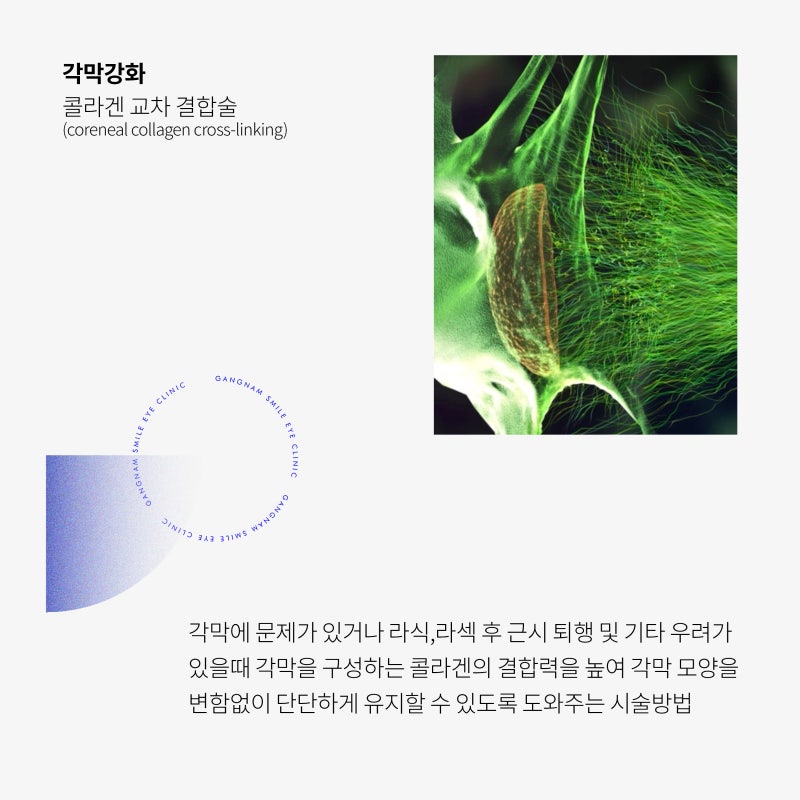

If you're considering vision correction surgery or have already had a consultation, you might have wondered:
Is corneal cross-linking really necessary for vision correction?
Hello, this is Gangnam Smile Eye Clinic. In this article, we'll briefly explore corneal cross-linking :)
When you decide on vision correction surgery and undergo examination or consultation, corneal cross-linking may be recommended depending on the condition of your cornea.
Patients might wonder, ‘Hmm, is it truly necessary, or are they recommending something unnecessary?’
First, let's delve into corneal cross-linking. The word ‘cross-linking’ itself probably brings to mind something that adds strength and makes it more rigid.
That's right. Corneal cross-linking is also known as corneal collagen cross-linking.
It's a procedure that strengthens the bonding of collagen, which makes up the cornea, to maintain its shape and firmness. This helps prevent myopia regression and other side effects after vision correction surgeries like LASIK or LASEK, or if there are existing corneal issues.
Our cornea is often described as a very robust and well-structured tissue.
Corneal cross-linking is necessary for the safety of your eyes in the following cases:
-
1. If the cornea is thin.
2. In cases of high myopia or high astigmatism (when a large amount of corneal tissue is ablated during vision correction).
3. If you have an asymmetrical cornea.
4. As a preventive measure for unforeseen circumstances.
Corneal cross-linking is generally recommended in these situations.

One of the side effects that absolutely must not occur after vision correction surgery is ‘corneal ectasia’ (keratoconus).
Corneal ectasia occurs when the cornea, a robust structure that withstands both external and internal eye pressure, becomes too thin.
It loses its round shape, and the peripheral part bulges forward.
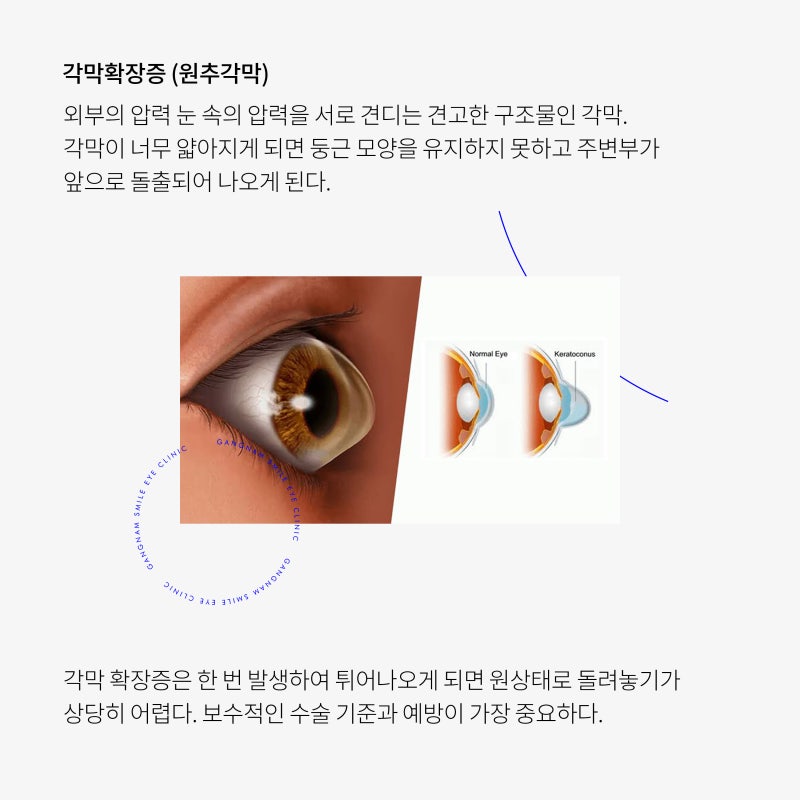
Once corneal ectasia occurs, it is extremely difficult to restore the cornea to its original state.
That's why at Gangnam Smile Eye Clinic, we prioritize safety and prevention, adhering to conservative surgical standards based on thorough examination results before proceeding with surgery.
Our standard for reoperation-eligible corneal thickness is 400㎛ or more, which is higher than the ASCRS (American Society of Cataract and Refractive Surgery) safety standard of 250㎛. This also reflects our commitment to conservative surgical standards, safety, and prevention.
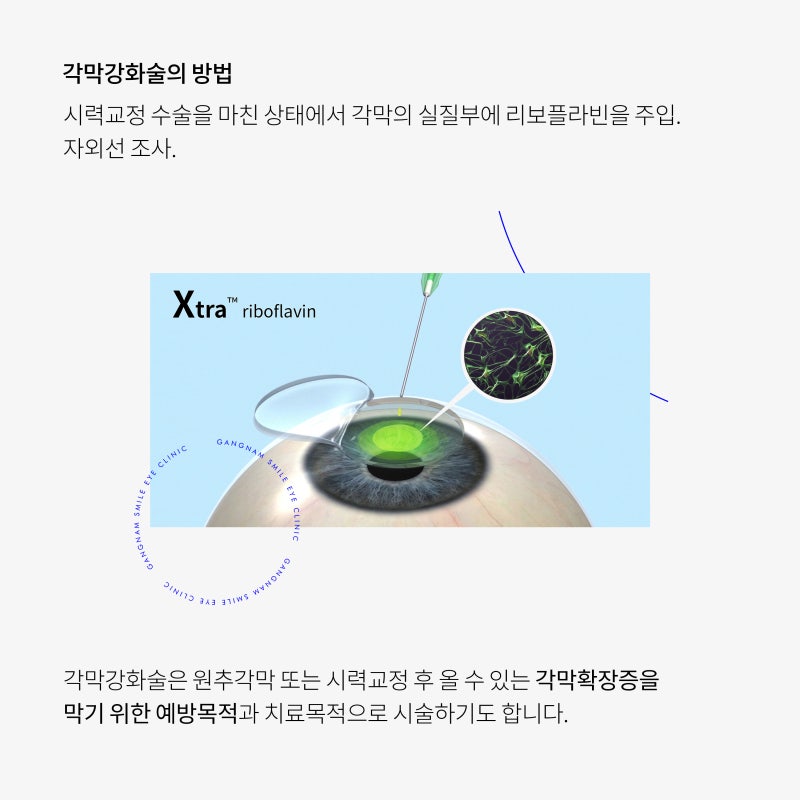
The corneal cross-linking procedure is quick and doesn't take long.
After successful vision correction surgery, riboflavin (B2) is injected into the corneal stroma, and then ultraviolet light is applied for a certain period.
This process enhances the effect of the surgery, strengthening the collagen bonds in the cornea and ensuring its stability.

At Gangnam Smile Eye Clinic, corneal cross-linking is only recommended when necessary.
Corneal cross-linking is a procedure recommended for safety and to prevent side effects after vision correction surgery.
It is performed to prevent corneal ectasia and myopia regression in cases where the patient's cornea is thin, or there is high myopia or high astigmatism requiring significant tissue ablation.
Corneal cross-linking is a choice for excellent outcomes for your precious eyes.
Was this information about corneal cross-linking helpful?
If you have any questions or need a consultation, we'll be happy to assist you at any time.
💙🤍 𝖦𝖠𝖭𝖦𝖭𝖠𝖬 𝖲𝖬𝖨𝖫𝖤 𝖤𝖸𝖤 𝖢𝖫𝖨𝖭𝖨𝖢💙🤍
𝗧𝗛𝗘 𝗟𝗜𝗚𝗛𝗧 𝗔𝗡𝗗 𝗧𝗛𝗘 𝗢𝗖𝗘𝗔𝗡 𝗜𝗡 𝗬𝗢𝗨𝗥 𝗦𝗠𝗜𝗟𝗘




Frequently Asked Questions
What is corneal cross-linking?
Corneal cross-linking is also known as corneal collagen cross-linking. It is a procedure that strengthens the bonding of collagen, which makes up the cornea, to maintain its shape and firmness after vision correction surgery, preventing myopia regression and side effects.
Why is corneal cross-linking necessary?
Corneal cross-linking is necessary to prevent serious side effects such as corneal ectasia that can occur after vision correction surgery. It helps ensure the safety of the cornea when it is thin or when a large amount of corneal tissue is ablated due to high myopia or high astigmatism.
In what cases is corneal cross-linking recommended?
Corneal cross-linking is recommended when the cornea is thin, when a large amount of corneal tissue is ablated due to high myopia or high astigmatism, when there is an asymmetrical cornea, and as a preventive measure against potential side effects.
How is corneal cross-linking performed?
Corneal cross-linking is performed by injecting riboflavin (Vitamin B2) into the corneal stroma after vision correction surgery, and then applying ultraviolet light for a certain period to strengthen the collagen bonds in the cornea.
What is corneal ectasia and why is it dangerous?
Corneal ectasia is a phenomenon where the cornea becomes too thin after vision correction, losing its round shape and bulging forward. Once it occurs, it is very difficult to restore it to its original state, so prevention is crucial.
Is corneal cross-linking essential for all vision correction surgery patients?
No, it is not essential for all patients. At Gangnam Smile Eye Clinic, corneal cross-linking is only recommended when necessary, based on thorough examination results of the patient's corneal condition and the conservative judgment of the medical staff.