2025-09-30
#7 Lower Blepharoplasty Choices – Fat Removal vs. Under-Eye Fat Repositioning: Differences and Limitations
Explore the debate between fat removal and under-eye fat repositioning in lower blepharoplasty. Dr. Kim Sung-hoon explains the differences, limitations, and the comprehensive approach of fat repositioning + septal reinforcement + malar lifting for lasting results.
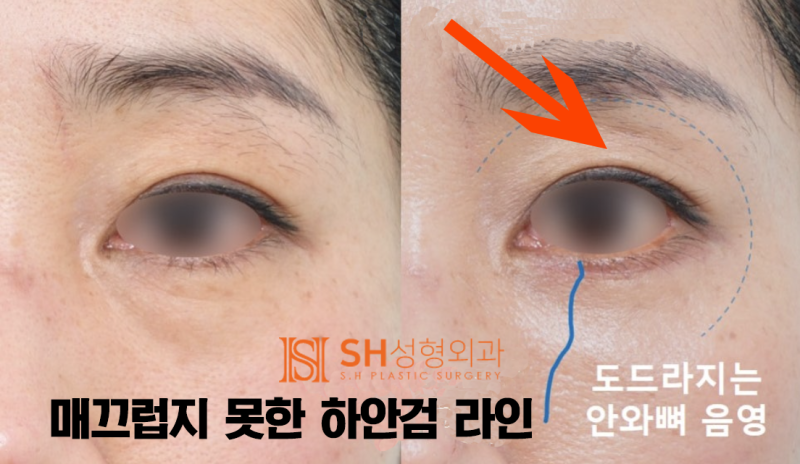
The most controversial topic in lower blepharoplasty is ‘fat removal’ versus ‘under-eye fat repositioning’. Some doctors advocate for fat removal, while others strongly advise against it. So, what is the correct approach? Dr. Kim Sung-hoon of SH Plastic Surgery explains the differences and limitations of these two methods, along with the necessity of a fundamental solution involving under-eye fat repositioning + septal reinforcement + malar lifting, using actual patient cases and anatomical evidence. – Dr. Kim Sung-hoon, Facial Designer at SH Plastic Surgery
‘Doctor, some clinics say the fat must be removed, while others say it should never be removed. What on earth is the right answer?’
This was said by a female patient in her early 40s who visited the clinic due to puffiness under her eyes.
For several years, her under-eyes had become increasingly prominent, and people around her started commenting that she looked tired, like she had dark circles, even with makeup.
Initially, she dismissed it as fatigue, but seeing her perpetually tired reflection in photos eventually led her to seek consultation.
The problem was that each clinic offered different explanations.
Some said, ‘The protruding fat is the problem, so it must be completely removed,’ while others insisted, ‘You should never remove the fat; it must be repositioned.’
From the patient's perspective, this was naturally confusing.
She couldn't figure out what was right or which method was the safest and most effective.
I first explained to the patient, step by step, why lower eyelid fat becomes puffy and why it shouldn't be judged solely by the fat itself. The under-eye area doesn't just protrude because there's ‘too much fat’.
The septum that holds the fat in place stretches and can no longer support it, causing the fat to push forward through the gap.
Furthermore, as the fat in the anterior cheek (malar area) sags and hollows, both the puffy and hollow areas become simultaneously apparent, creating an even more tired and aged impression.
This patient had also heard about her friend's experience with previous fat removal surgery.
Her friend said, ‘It looked fine at first, but over time, my eyes became sunken and I looked even more tired,’ which frightened the patient.
Conversely, a friend who underwent fat repositioning expressed regret, saying that while it looked better initially, her overall impression hadn't changed dramatically.
So, I told her:
‘Both fat removal alone and fat repositioning alone are 2% short. Ultimately, the key lies in a comprehensive approach that not only manages the fat well but also reinforces the septum and lifts the anterior cheek.’
After hearing my explanation, the patient expressed relief, saying, ‘It feels like the puzzle pieces have finally come together.’
Today, I will discuss the differences and limitations of fat removal and under-eye fat repositioning, which confuse many people, just like in this case.
Reasons for Under-Eye Fat Formation
Many people ask, ‘Why do my under-eyes keep looking puffy?’
Eye bags, or under-eye fat, don't just appear with age.
They result from a complex interplay of various factors.
Firstly, the muscles and tissues supporting the eye area weaken, losing their ability to hold the fat in place effectively.
Consequently, the fat gradually pushes forward, leading to the puffy appearance under the eyes.
Decreased skin elasticity and sagging with age also play a role.
As the skin stretches, it forms a pouch-like area.
Another important factor is the fat pad that supports the eyeball.
If this fat protrudes instead of staying in place, it creates a swollen appearance under the eyes.
Additionally, if fluid accumulates due to lifestyle factors like allergies or excessive salt intake, the swelling and puffiness worsen, making the under-eye fat much more prominent.
In other words, under-eye fat is not simply caused by ‘gaining weight’ or ‘being tired’. You should understand it as a complex result influenced by muscles, septum, fat, skin, and even lifestyle habits.
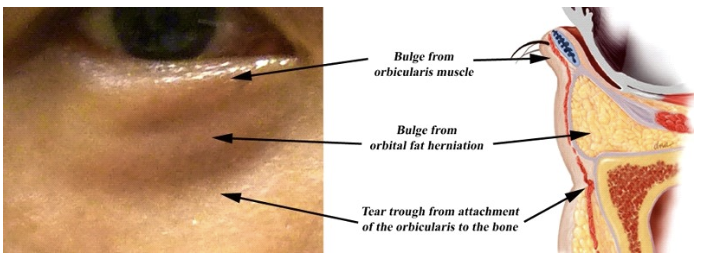
Reasons for Lower Eyelid Fat Protrusion
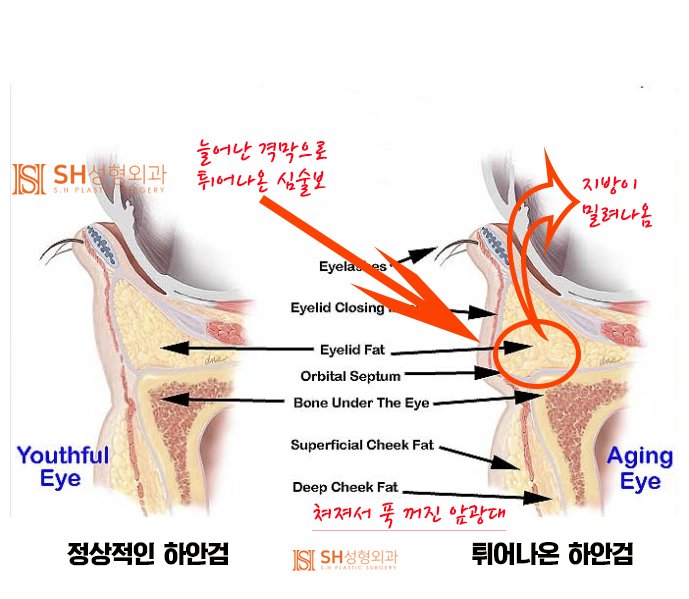
Dr. Siew's anatomical diagram from Singapore makes it easy to understand.
Stretched septum – The septum, which originally prevented fat from protruding, stretches and loses its function.
Orbital fat protrusion – As the septum weakens, fat pushes forward.
Malar fat sagging – As the anterior cheek (malar area) hollows, under-eye hollowing and nasolabial folds worsen simultaneously.
This means it's not just a fat problem, but a complex structural change involving the septum, fat, and anterior cheek simultaneously.
Only by performing fat repositioning + septal reinforcement + malar lifting (± minor fat removal if necessary) can lower eyelid improvement be achieved.
1. Under-Eye Fat Removal
On the surface, the method seems simple.
It's easy to think that if the under-eye area is puffy, the solution is to remove the fat causing it.
In fact, this method was the most commonly used in the past.
Immediately after surgery, the under-eye bags disappear, and the appearance looks smooth, which initially satisfies patients.
However, problems emerge over time.
The fat that protects and supports the eyeball is not just a ‘useless lump’.
It's an important structure that acts as a cushion, and if it's removed, the support around the eye weakens.
As a result, the eyelids become sunken, the double eyelids appear smaller, and the bones become prominent, creating a gaunt and tired impression.
Furthermore, it can make one appear prematurely aged.
Especially in areas where fat is deficient, the skin around the eyes can thin, making blood vessels visible and worsening dark circles.
In other words, fat removal alone not only fails to solve the fundamental problem but can also create new issues. Therefore, I do not recommend unnecessarily removing fat.
2. Under-Eye Fat Repositioning
As explained above, fat removal alone not only fails to solve the fundamental problem but can also create new issues.
Due to these problems, a method of repositioning fat rather than simply removing it has become widely practiced recently.
Instead of extracting fat, the fat from the prominent area is spread and filled into the hollow tear trough area.
This reduces the puffy area and fills the hollow area, making the under-eyes smoother and more even.
This is certainly a much better approach than fat removal.
However, it also has limitations.
Even if the tear trough is improved, if the anterior cheek (malar area) is hollow, the overall impression can still look tired.
That is, while the under-eye area is tidied up, the effect of making the entire face look younger is insufficient.
Patients often say, ‘It's a bit better, but I don't feel a definite change,’ and this feedback stems from this limitation.
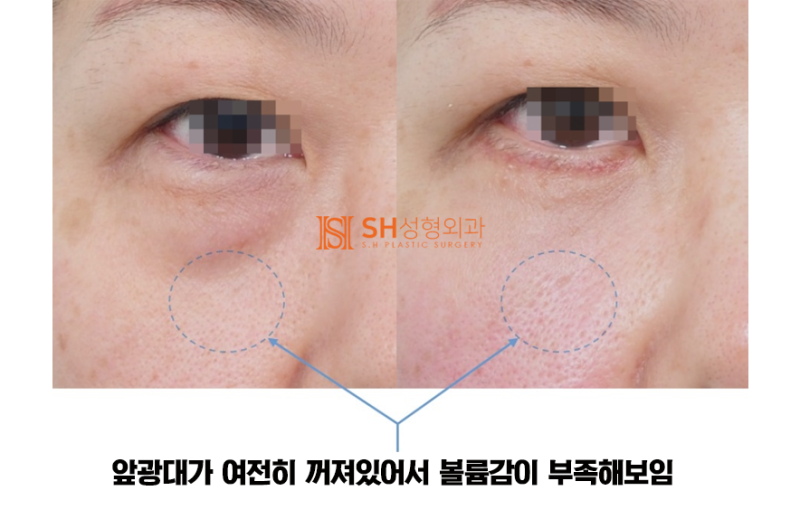
Furthermore, fat repositioning alone does not address the problem of a stretched septum.
The septum is a ‘wall-like’ structure that holds the fat in place.
If it is weakened and only the fat is moved, the area may become puffy or uneven again over time.
Ultimately, while ‘fat repositioning’ is certainly an improvement over ‘fat removal’, long-term satisfaction will inevitably decrease if anterior cheek hollowing and septal reinforcement are not addressed simultaneously.
Dr. Kim Sung-hoon's Insights as a Facial Designer
The lower eyelid is an area that cannot be simply defined by words like ‘puffy’ or ‘hollow’.
Because fat, septum, muscles, bones, and the anterior cheek are all interconnected, an incorrect approach can actually harm one's impression.
I always emphasize to my patients:
‘There isn't just one correct answer in surgery. The facial structure and condition must be comprehensively assessed.’
Neither unconditionally removing fat nor simply repositioning it is the correct answer.
If the septum is weakened, it needs reinforcement, and if the anterior cheek is hollow, lifting is necessary.
Only when that balance is achieved do natural and long-lasting results emerge.
This is also why I use the title ‘Facial Designer’.
Design is not about forcibly creating something that doesn't exist, but about restoring the harmony that was originally present.
Lower blepharoplasty is not a surgery to make one look younger, but a surgery to restore the face's original vitality.
In fact, many patients say that after surgery, they no longer hear comments like ‘You look tired’.
They also give feedback like ‘My face looks brighter’ or ‘I look naturally younger’ rather than ‘I look younger’.
This is not just an external change but a restoration of expression and impression.
The lower eyelid represents the balance of the midface.
It may seem like a small change, but correcting this balance transforms the entire impression.
Therefore, I always design surgeries based on anatomical truth, without exaggeration.
I consider each patient's face a canvas, and instead of forcibly adding colors, I work to bring out the original lines.
I will continue to uphold my philosophy as a facial designer, ensuring that patients hear comments like ‘You don't look tired, you look natural’ rather than ‘You had plastic surgery’.

Sincerely, Facial Designer Kim Sung-hoon
FAQ
Q1. Can't the fat be completely removed?
A1. It is absolutely not recommended. Recurrence, orbital hollowing, and accelerated aging can occur.
Q2. Is fat repositioning alone sufficient?
A2. It improves in the short term, but satisfaction decreases because anterior cheek hollowing is not resolved.
Q3. Is septal reinforcement essential?
A3. Yes, reinforcement is essential because the septum stretches, causing fat to protrude.
Q4. Why is malar lifting necessary?
A4. If anterior cheek hollowing is not corrected, an overall youthful impression cannot be created.
Q5. Are surgical scars very visible?
A5. The incision line is located just below the eyelashes and becomes almost invisible over time.
Q6. How long is the recovery period?
A6. Stitches are usually removed after 1 week, and swelling and bruising gradually disappear over 2-3 weeks.
Q7. Is surgery possible even if I have already received fillers or fat grafting?
A7. Yes, it is possible. Even if previous procedures have resulted in an uneven appearance, it can be corrected.
Q8. How difficult is revision surgery?
A8. The difficulty increases in cases of simple fat removal or overcorrection, but it is fully correctable.
Q9. Is this surgery suitable for all ages?
A9. It is possible for individuals from their 30s to 60s, and the approach is designed differently for each age group.
Q10. Are the results long-lasting?
A10. When fat repositioning + septal reinforcement + malar lifting are performed together, stable long-term results are observed.
※ This article discloses actual before and after photos for accurate information delivery.
These photos were published with the patient's consent, and please note that bruising and swelling may vary for each individual, and there may be differences.