2025-09-24
#5 Upper Blepharoplasty Success Story: 'It All Comes Down to the Details!'
Dr. Kim Sung-hoon shares his expertise in upper blepharoplasty, highlighting the difference from double eyelid surgery, anatomical considerations, and strategic approaches for natural results.
Upper blepharoplasty is a completely different procedure from simple incisional double eyelid surgery. In this article, along with three successful cases, Dr. Kim Sung-hoon shares his expertise in achieving natural double eyelids through detailed surgical design, including the differences from incisional double eyelid surgery, anatomical considerations, eyebrow compensatory movements, and strategic approaches based on skin thickness distribution. He provides clear criteria and an honest perspective for those considering the surgery. Dr. Kim Sung-hoon, Facial Designer at SH Plastic Surgery.
The condition for success is not missing the details. Facial Designer Kim Sung-hoon
‘Doctor, can I really look much different if I get upper blepharoplasty?’
It was a female patient in her mid-40s who cautiously spoke from behind her mask. She had a bright impression at first glance, but
she expressed concerns that her eyes looked heavy and tired due to drooping eyelids.
Her biggest worry before the surgery was ‘getting unnatural double eyelids.’
‘Actually, my friend had incisional double eyelid surgery, and the swelling didn't go down for over a year... her eyes looked like a doll's... so I've been too scared to go through with it since then.’
Like this patient, those who have already experienced failed cases around them have a much greater fear of ‘obvious double eyelids’ than of the surgery itself. I certainly understand this.
Even though incisional double eyelid surgery and upper blepharoplasty are completely different procedures, many people confuse them or misunderstand them as surgeries of ‘the same type.’
However, that's not actually the case!
While incisional double eyelid surgery is primarily for aesthetic purposes, mainly for adjusting the height of the double eyelid in people aged 10-30,
upper blepharoplasty is a surgery that needs to address both functional improvements and complex anatomical issues.
Especially for middle-aged and older individuals aged 40-60 and above, good results require considering the strength of the eye-opening muscles (levator function), skin thickness and elasticity, eyebrow position, fat distribution, and even habits of using the forehead muscles.
That day, I carefully observed the patient's eyes.
Her skin was thin, and the distance between her eyes and eyebrows was above average,
however, the fat in her upper eyelids was slightly sunken, and subtle wrinkles appeared on her forehead when she opened her eyes, indicating mild eyebrow compensatory movement.
‘To get straight to the point, you have suitable conditions for upper blepharoplasty. However, the slightly sunken fat in your upper eyelids would look more natural if we consider fat grafting along with the surgery.’
The patient's expression finally seemed a little relieved.
Thus, it's not simply ‘if the eyes are drooping, just cut them off.’ Nor is it a surgery performed ‘the same way for everyone.’
Today, I'd like to explain what factors contributed to successful outcomes, focusing on cases that achieved satisfactory results in the actual clinic.
Ultimately, details determine the outcome of the surgery.
Now, let's get serious!
I will analyze and explain three successful cases of upper blepharoplasty.
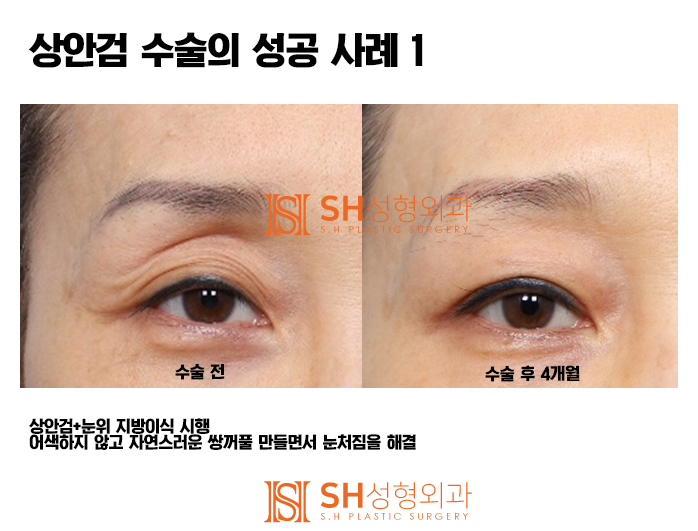
SUCCESS CASE 1
Thin skin + minimal eyebrow compensatory movement
When the skin is thin, the distance between the eye and eyebrow is sufficient, eyebrow compensatory movement is not severe, and the upper eyelid is not excessively thick, good results can be expected with upper blepharoplasty alone.
This patient also underwent a small amount of fat grafting to her sunken upper eyelids.
As a result, we were able to resolve the drooping eyelids while creating a very natural and soft double eyelid line without looking unnatural.
Because the skin and fat surrounding the eyelids were organically reconstructed, the result was not artificial,
and three months after the surgery, it was others, not the patient herself, who first commented that her ‘eyes looked clearer.’
SUCCESS CASE 2
Short distance between eye and eyebrow
For individuals who naturally have a short distance between their eyes and eyebrows, simply resolving eyelid drooping is difficult.
In this patient's case, the procedure was performed along with sub-brow lift surgery,
and the position of the eyebrows was also adjusted.
As a result, a much wider field of vision and a natural double eyelid line were achieved, but
the patient said she ‘felt a slightly neutral look remained.’
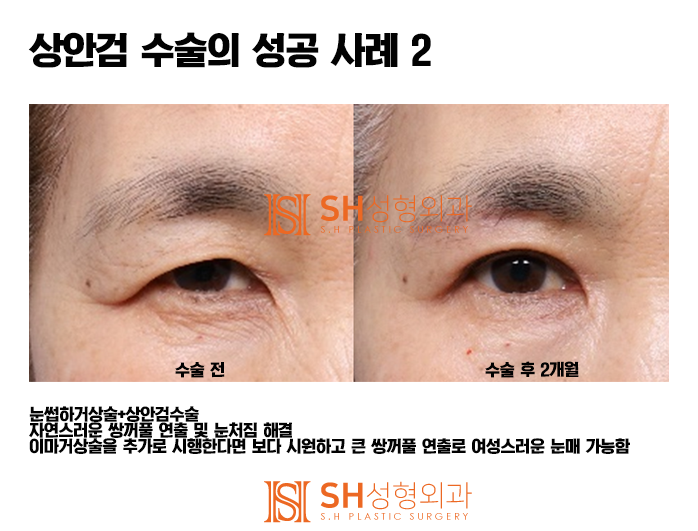
This was a limitation where the distance between the eyebrow and eye could make her appear less feminine, given her specific characteristics,
and if desired, a forehead lift could be performed later to create brighter and larger double eyelids.
SUCCESS CASE 3
Severe eyebrow compensatory movement
The last case was a patient with severe eyebrow compensatory movement, meaning they strongly used their forehead muscles when opening their eyes.
This was a typical presentation with many forehead wrinkles, which made the eyelids appear thick.
If upper blepharoplasty were performed alone in a case like this,
there would be a high risk of creating unnatural double eyelids due to the eyebrows dropping after surgery, excessively narrowing the space between the eyes and eyebrows, and the thick upper eyelids.
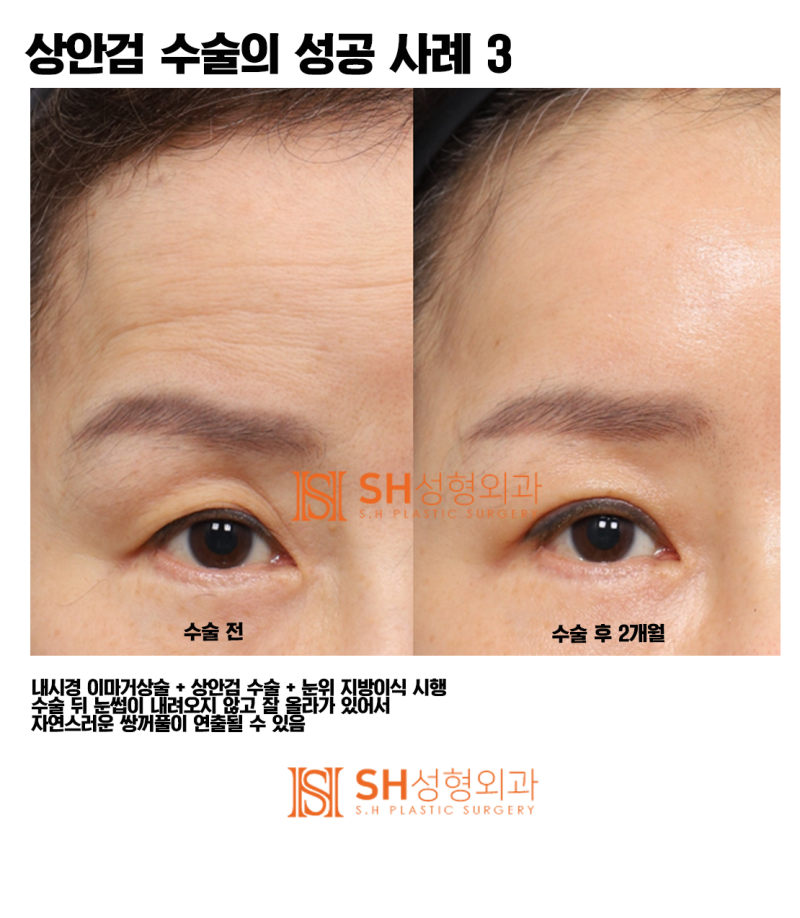
Therefore, endoscopic forehead lift + upper blepharoplasty + fat grafting to the upper eyelids were performed together,
and after the surgery, the eyebrow position remained stable, forehead wrinkles decreased, and the double eyelid line appeared clear and distinct.
Conclusion
If you are middle-aged and considering this procedure, you must undergo a diagnosis for the following factors:
Skin thickness and elasticity
Eye-opening strength (levator function)
Presence of eyebrow compensatory movement
Distribution of fat above the eyes
Distance between the eye and eyebrow
Distribution of eyelid wrinkles
Especially if eyelid drooping is severe, do not try to solve it with upper blepharoplasty alone;
you must consider a forehead lift or sub-brow lift together to create natural and clear double eyelids.
Dr. Kim Sung-hoon's Reflection, Facial Designer
For double eyelids to appear beautiful, simply ‘making a good incision’ is never enough.
The mere technique of cutting skin and creating a good line cannot change a person's impression.
The distance between the eye and eyebrow, the strength of the eye-opening muscles, the fat distribution and wrinkle direction of the eyelid,
and even the compensatory movement of the forehead that moves the eyebrows…
Only when all these elements are intertwined does a natural and harmonious result emerge.
A much more precise and three-dimensional plan is needed.
Skin thickness or elasticity, fat distribution, eye size and eyebrow position, and even the way one opens their eyes…
Being able to interpret all of this during the pre-operative evaluation is essential to create the most suitable line for that person.
Double eyelid design is not just about drawing a line.
It must be a ‘three-dimensional design’ that calculates the person's facial bone structure, the position of their pupils, their expression when smiling,
and even the movement when they open their eyes.
Ultimately, success comes down to the details.
Looking a little deeper, judging a little more carefully, and adjusting a little more finely is
the key to transforming a person's overall facial impression beyond just the double eyelids.
FAQ
Q1. Will there be a scar?
A. The incision is made along the eyelid's wrinkles and skin texture, and most of it is hidden by the hair below the eyebrow and fades.
Eventually, it becomes almost invisible.
Q2. Does it take longer to recover than incisional double eyelid surgery?
A. Since the incision area is larger and deals with complex anatomical structures, the recovery period can be relatively longer.
However, a well-designed surgery often results in a more natural look and smoother recovery.
Q3. What should I do if I have severe forehead wrinkles?
A. Forehead wrinkles can be a result of eyebrow compensatory movement.
If performed alone, the eyebrows may drop, making the eyes appear more tired, so it is recommended to combine it with a forehead lift.
Q4. How exactly are upper blepharoplasty and incisional double eyelid surgery different?
A. The former is an aesthetic surgery for younger individuals, only adjusting the double eyelid line.
The latter, however, is a complex surgery for middle-aged or older individuals that evaluates and resolves eyelid drooping, muscles, and fat.
Q5. Can double eyelids remain asymmetrical after surgery?
A. Differences can arise depending on the eye's anatomical asymmetry or muscle usage habits,
so pre-operative evaluation and fine-tuning are very important.
Q6. Can my eyes look smaller after surgery?
A. If the thickness of the upper eyelid or the eyebrow position is miscalculated, the eyes may actually appear smaller and more tired.
This also requires harmony with procedures like a forehead lift.
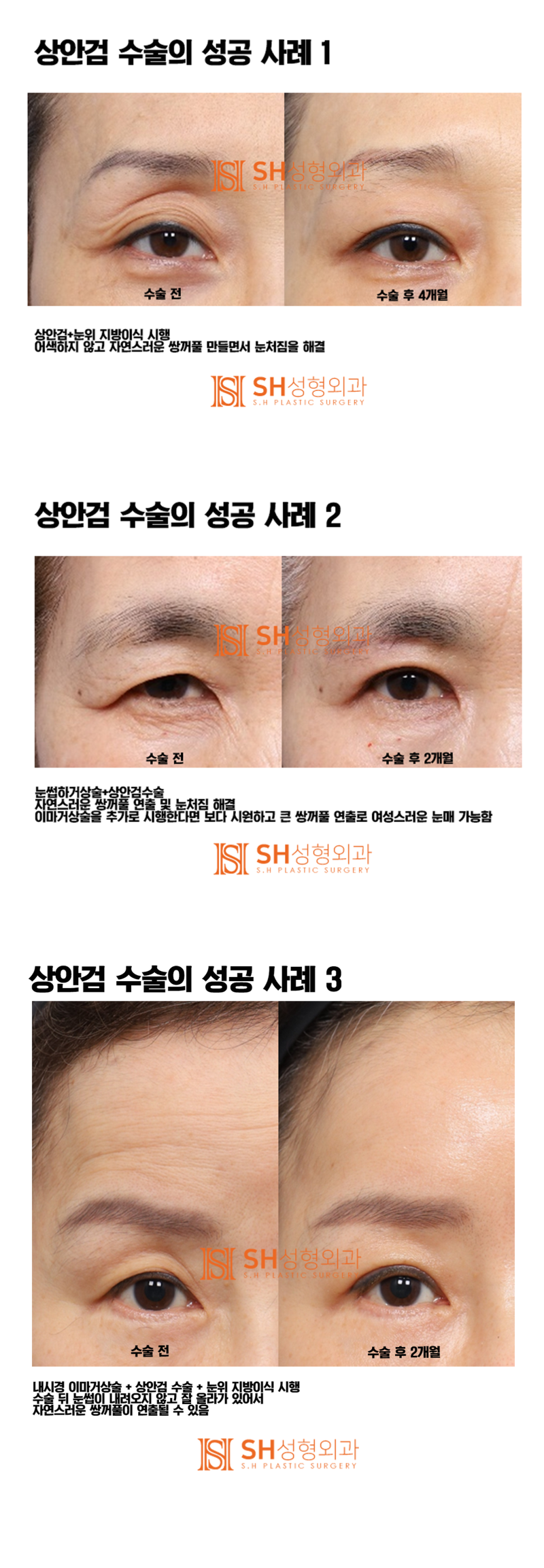
※ This article discloses actual before and after photos for accurate information delivery.
These photos were published with the patient's consent, and please note that bruising and swelling may vary for each individual, and there may be differences.