2025-11-02
#14 Rhinoplasty, Tip Plasty Materials: Understanding Nasal Structure First
Rhinoplasty's core is 'structure,' not 'height.' Understanding nasal anatomy and function ensures natural, lasting results. This post details the roles of bone, cartilage, and soft tissue, surgical methods, and the pros/cons of various cartilage grafts based on clinical experience, emphasizing biocompatibility over mere safety.
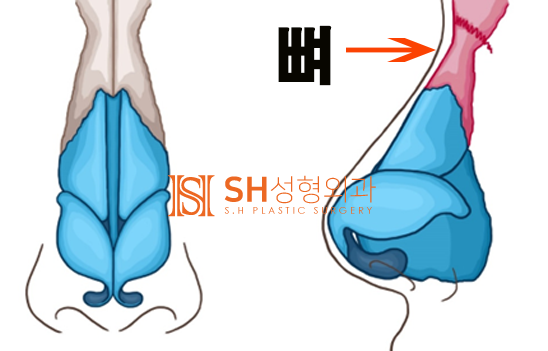
The true essence of rhinoplasty is ‘structure,’ not ‘height.’ It’s not simply about raising the nasal tip or building up the bridge; understanding the anatomical structure and function of the nose is crucial for natural and long-lasting surgical results. In this post, SH Plastic Surgery anatomically examines the roles of bone, cartilage, and soft tissue—the basic structures of the nose—and the purpose and limitations of each surgical method (closed, open, revision). Based on cases of side effects from artificial materials (Medpor®, silicone, Mesh, etc.), we explain the advantages and disadvantages of autologous rib cartilage, donated rib cartilage, septal cartilage, and ear cartilage—frequently used in revision surgery—through actual clinical experience. The reason for using human-derived components is not merely for ‘safety,’ but because they are ‘biocompatible’ in all aspects, including inflammation, deformation, absorption rate management, and reconstructive potential. This article informs all patients considering rhinoplasty that ‘understanding the structure of your nose’ is the beginning of the safest surgery. — Dr. Kim Sung-hoon, Facial Designer, SH Plastic Surgery
‘Rhinoplasty is a surgery that deals with ‘structure,’ not ‘shape.’’
Many people who come for rhinoplasty consultations ask us:
‘Doctor, is my nose too low and needs to be built up? Is my nasal tip droopy and needs to be lifted?’
However, the nose is not a structure that can be evaluated simply by its height.
Medically, the nose is a complex organ where bone, cartilage, and soft tissue interlock to form a ‘framework.’
If this structure collapses, even a highly built-up nose can deform over time, cause breathing difficulties, or lead to a drooping nasal tip.
International plastic surgery journals clearly emphasize this point.
Aesthetic Plastic Surgery, a journal of the American Society of Plastic Surgeons, published a paper titled *‘Evidence-Based Nasal Analysis for Rhinoplasty: The 10-7-5 Method,’ which states:
‘Systematic pre-operative analysis of the patient’s nose from frontal, lateral, and basal views provides the foundation for identifying and restoring changes in aesthetic proportions. Corrections made without understanding the major structural relationships of the nose can overlook the cascading effects of small changes on the overall structure.’
Furthermore, the paper ‘Surgical Anatomy of the Nose: A Fundamental Pillar in Modern Plastic and Reconstructive Surgery’ states:
‘The nose is a complex structure where bone, cartilage, skin, soft tissue, blood vessels, and nerves are organically interlocked. Without this structural understanding, neither aesthetic results nor functional stability can be guaranteed in rhinoplasty, and it is difficult to achieve aesthetic harmony without functional damage.’
Ultimately, understanding ‘structure’ in rhinoplasty is not just about anatomical study.
It changes the surgical design, the choice of materials, and the longevity of the results.
That’s why at SH Plastic Surgery, when consulting for nasal tip plasty or revision surgery, we always explain the structure first.
This is because it helps us decide which cartilage needs reinforcement and which human-derived components are necessary.
In this chapter, we will examine each of these structures one by one.
We will look at how the bone, cartilage, and soft tissue of the nose should harmonize,
and why human-derived components are the most reliable solution for maintaining that structure.
Nasal Structure: Bone + Cartilage + Soft Tissue
Upper 1/2 of the nose: Nasal bone
Composed of bone, with two nasal bones fused in the middle.
Supports the upper nasal bridge.
Since bone is hard, it is not easy to manipulate, making it difficult to create large deformations.
Lower 1/2
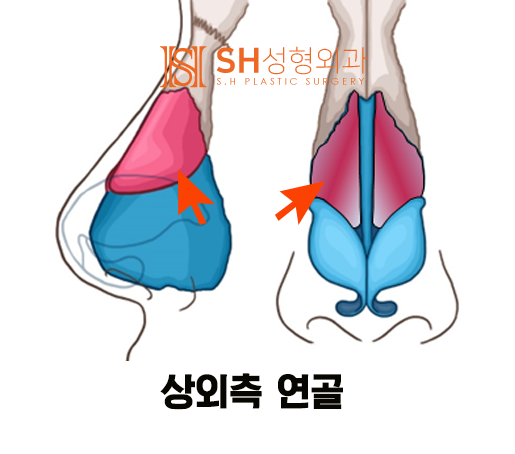
— Upper lateral cartilage
This is an important structure that maintains the airway (nasal valve).
Excessive manipulation of this area can lead to nasal obstruction or a deviated nose.
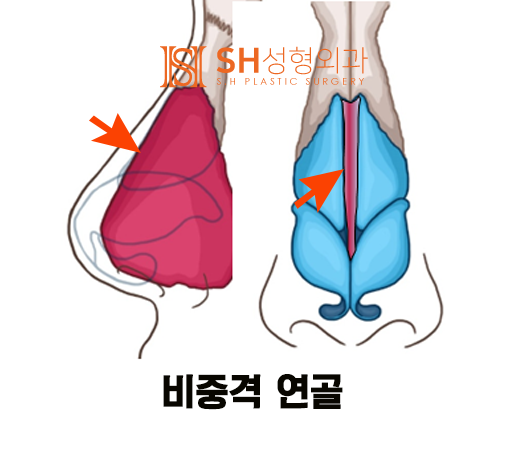
— Septal cartilage
This cartilage plays the most important role as a pillar supporting the nasal tip.
If the septum collapses, it can result in a ‘saddle nose,’ where the nose sinks in.
— Alar cartilage
This cartilage forms the nasal ala or nostril and is crucial in determining the shape and direction of the nose.
It is the cartilage where various modifications are made during rhinoplasty.
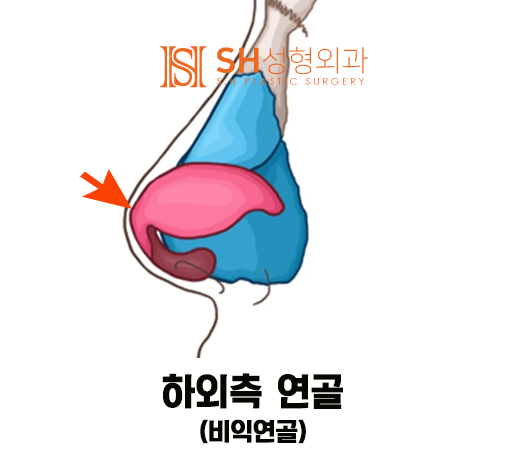
If these three do not maintain balance, over time, the nasal tip may droop or deviate to one side, or functional problems such as difficulty breathing may arise.
Therefore, the essence of rhinoplasty is not merely sculpting, but the restoration and reinforcement of structure.
Direction of Rhinoplasty in Asians
For Asians, rhinoplasty should not be approached simply as ‘building up the nose.’
Most people want to improve a low nose, but the truly ideal nose is one where ‘height’ and ‘length’ are harmonized.
If the nasal tip is simply lifted upwards, it can easily appear upturned.
Therefore, both raising the height of the nasal tip and naturally extending the length of the nose at the same time—
satisfying both of these conditions completes a beautiful and balanced nose line that complements the facial proportions.
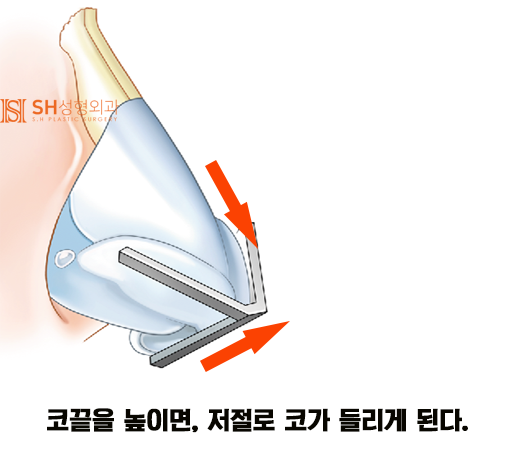
‘Building up the nose’ = The height of the nasal tip increases. X
-> The nose naturally lengthens and rises without appearing upturned. O
To achieve a beautiful and balanced nose line that complements the facial proportions, both of the above must be satisfied.
What’s important here is not just ‘how much to build up,’ but ‘how’ and with ‘what materials’ to build it up.
Since the length of the nose is ultimately supported by the cartilage structure,
an incorrect surgical approach or reliance on artificial implants can lead to the nasal tip drooping or appearing upturned over time.
Especially for Asians, who often have thicker skin and weaker cartilage,
a surgical approach that builds up the structure (open approach, focused on structural correction) and
the selection of human-derived materials with sufficient support (autologous rib cartilage, septal cartilage, etc.)
determine the stability and longevity of the results.
Comparison of Main Cartilage Materials Used in Surgery
Material | Characteristics | Advantages | Disadvantages | Recommended Cases |
Autologous Rib Cartilage | Harvested from ribs | High strength, maintains shape | Scar, donor site pain | Revision surgery requiring structural reconstruction |
Donated Rib Cartilage | Sterilized, decellularized human tissue | No scar, shorter surgery time | Variable absorption rate | Patients concerned about scars |
Septal Cartilage | Harvested from inside the nose | Easy access, low absorption rate | Insufficient quantity, weak strength | Minor corrections, primary surgery |
Ear Cartilage | Harvested from behind the ear | Maintains soft curve | Weak strength | Nasal tip augmentation, supplementary use |
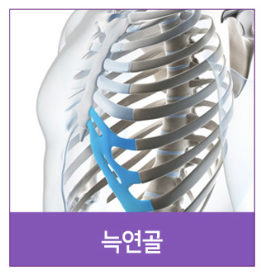
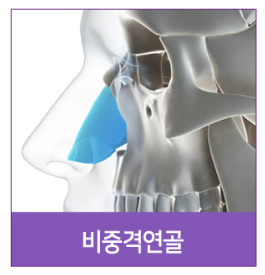
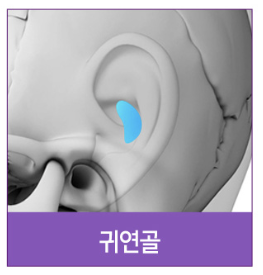
Why Human-Derived Components are Important, Not Artificial Materials
The nose is not merely an organ for external appearance.
Because it is a complex structure where skin, cartilage, and mucous membranes interlock,
when a foreign substance enters, the body immediately reacts with ‘this is not mine.’
Thus, the nose is an organ highly sensitive to foreign substances.
Artificial materials like silicone, Medpor®, or Mesh may initially provide shape,
but over time, they often cause problems such as inflammation, contracture, deformation, and absorption.
As a result, inflammation, contracture (tissue shrinkage), absorption, and in severe cases, deformation due to impaired blood flow to the skin can occur.
On the other hand, human-derived components (autologous tissue, donated tissue, etc.) have high biocompatibility.
Furthermore, the incidence of inflammation is significantly lower.
Reduced risk of inflammation: Almost no foreign body reaction.
Predictable absorption rate: Engraftment rate can be calculated for autologous tissue.
Minimized tissue damage: No secondary damage occurs when removing artificial materials.
Flexibility in revision surgery: Easy to reconstruct, less deformation.
Ultimately, the reason human-derived components are important in rhinoplasty is due to their ‘natural restorative power.’
In other words, human-derived components are not simply ‘because they are safe,’ but are the most fundamental choice for preserving structure and maintaining results long-term.
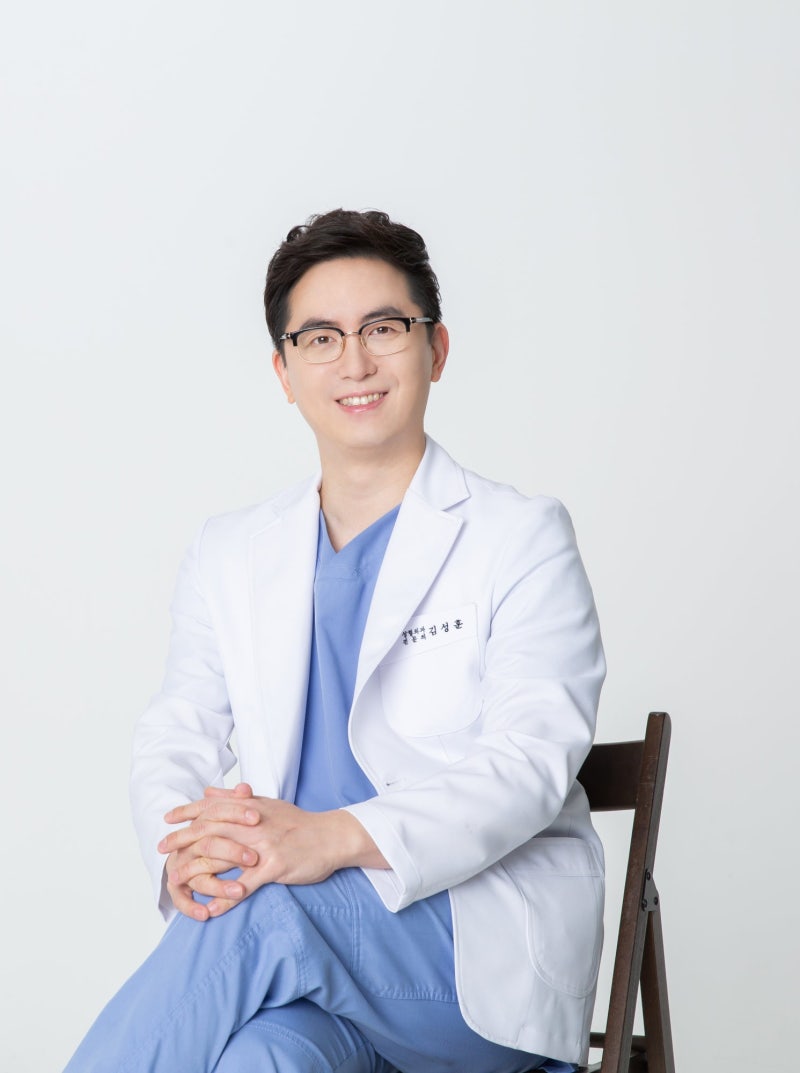
Reflections by Facial Designer, Dr. Kim Sung-hoon
When performing rhinoplasty, I always prioritize ‘structural restoration.’
This is because the nose is not just an organ for aesthetics,
but a central axis that allows breathing and determines facial balance.
Autologous rib cartilage is superior in terms of structural strength and engraftment stability,
but it cannot be applied to all patients.
Donated rib cartilage is a good alternative,
but results can vary depending on the absorption rate or the donor’s age.
Therefore, a comprehensive evaluation is absolutely necessary before surgery.
The core is anatomical understanding.
‘A natural nose’ is only created when considering the direction of tissues, the tension of cartilage, and the thickness and elasticity of the skin.”
FAQ
Q1. Will autologous rib cartilage leave a scar?
It is harvested through a minimal incision below the areola or near the armpit, so it is mostly unnoticeable.
Q2. Is donated rib cartilage safe?
It undergoes sterilization and decellularization processes, so rejection reactions are rare. However, there is individual variation in absorption rates.
Q3. Isn’t ear cartilage structurally weak?
That’s correct. However, it is very suitable for areas requiring a curve or for supplementary grafting.
Q4. When can revision surgery be performed after removing artificial implants?
It depends on the inflammatory state, but reconstruction surgery is usually performed after 3-6 months in a stable period.
Q5. What are the criteria for choosing between autologous rib cartilage and donated rib cartilage?
It is determined by comprehensively considering scar burden, body type, tissue condition, and surgical difficulty.
Q6. Why should artificial implants not be used?
Infection, contracture, and visibility (showing through the skin) can occur, and tissue damage is significant upon removal.
Q7. How long does pain last after rib cartilage surgery?
Most pain subsides within 3 days, and daily activities can be resumed within 1 week.
Q8. What if donated rib cartilage is absorbed later?
It can be sufficiently re-corrected with autologous tissue supplementation if necessary.
Q9. Can breathing become difficult after rhinoplasty?
This is due to nasal valve damage, and functional correction must be performed concurrently.
Q10. What is most important in revision surgery?
Accurately analyzing the structure damaged by previous surgery and selecting anatomically reconstructible materials.
(22) #When can I get revision rhinoplasty? Let’s also check out #alarreduction for a perfect nose! - YouTube
Is #alarreduction possible without surgery?
SH Plastic Surgery Clinic