2026-09-07
Yaksu Station Dental Clinic: Sinus Lift for Implants – When is it Absolutely Necessary?
Learn about sinus lifts for upper molar implants: what the maxillary sinus is, why the procedure is needed, and the different techniques.
Hello,
I’m Dr. Kim Tae-young, chief director of Bareunyoung Dental Clinic at Yaksu Station.^^
In my previous post, I discussed implant bone grafting and briefly mentioned cases where ‘the original bone thickness is thin, such as in the upper jaw molars.’
The upper jaw molar area is unique compared to other areas, with a slightly different environment for implant placement.
The most common questions from those who need upper jaw molar implants are:
‘What is a sinus lift?’ ‘Is it a very complicated surgery?’ ‘Why do you say upper jaw implants are more challenging?’
These are some of the concerns.
A sinus lift is a procedure frequently encountered in upper jaw molar implants, but it can feel somewhat unfamiliar to patients.
Today, I will clarify common patient questions, including:
- What is the maxillary sinus?
- Why is a sinus lift necessary?
- Can implants be placed without a sinus lift?
What is the maxillary sinus?
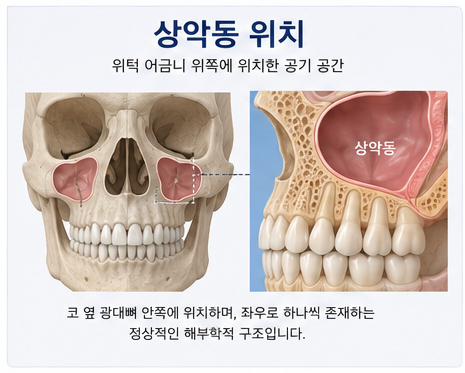
The maxillary sinus is an air-filled hollow space located above the upper jaw molars.
It is situated inside the cheekbone next to the nose, with a pair on each side.
The maxillary sinus is one of the spaces where air resides when we breathe or vocalize, and it is a normal anatomical structure that everyone possesses.
The root tips of the upper jaw molars are often located close to the floor of the maxillary sinus.
Due to this anatomical characteristic, when placing implants in the upper jaw molar area, the distance to the maxillary sinus often needs to be considered.
Why are upper jaw molar implants challenging?
There are several reasons why upper jaw molar implants are considered more challenging than those in other areas.
First, it’s due to the location of the maxillary sinus.
The maxillary sinus is situated above the upper jaw molars, which can limit the height of the alveolar bone needed for implant placement.
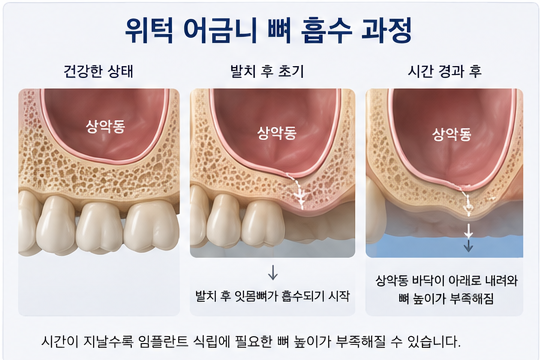
Second, as bone resorption progresses after extraction, the floor of the maxillary sinus tends to descend.
If upper jaw molars are left extracted for a long time, the bone height available for implant placement can become even more insufficient over time.
Third, the upper jaw bone is relatively less dense than the lower jaw, which can affect achieving initial stability during placement.
Due to these anatomical features, procedures to secure sufficient bone height are often performed concurrently with upper jaw molar implants, and the most representative method is the sinus lift.
What is a sinus lift?
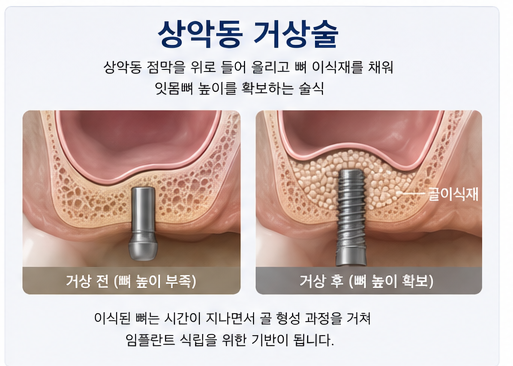
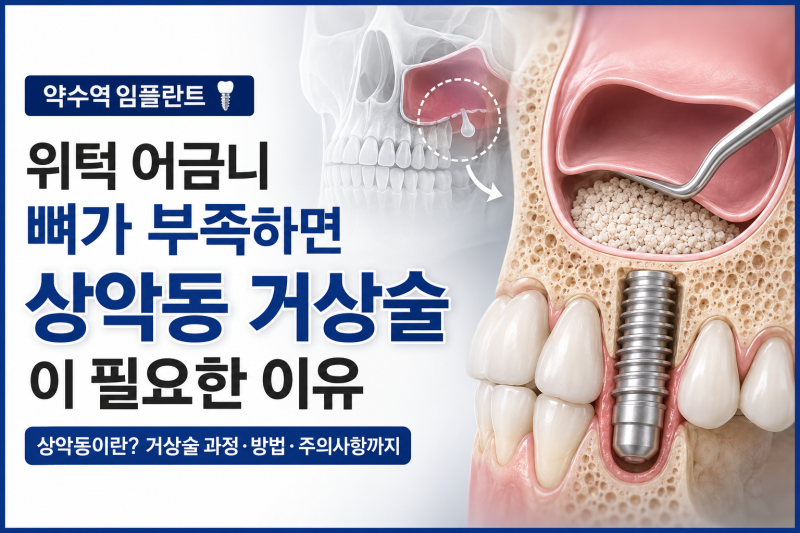
A sinus lift is a procedure that involves lifting the membrane of the maxillary sinus floor upwards and then filling that space with bone graft material to secure the necessary bone height for implant placement.
Simply put, it’s easier to understand it as a process of creating space for new bone to form in an area where the bone is thin due to an empty space above.
In some cases, only the lift is performed without bone graft material.
The filled bone graft material gradually integrates with the patient's own bone over time, creating an environment suitable for implant placement.
Can’t I just get an implant without a sinus lift?
Some patients facing upper jaw molar implants ask, ‘Do I really need to touch the sinus? Can’t I just get the implant?’
Regarding this, if there is sufficient bone height, it may be possible to proceed with only the implant without a sinus lift.
However, if implants are placed when bone height is insufficient, the following concerns arise:
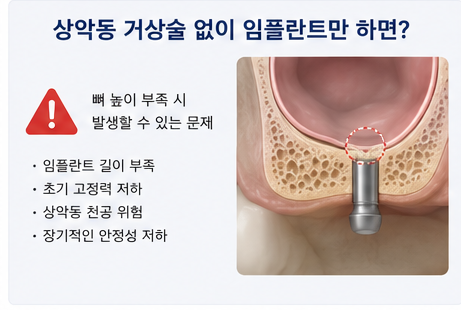
A very short implant length can lead to reduced long-term stability.
If the bone around the implant is not stable over time, these issues often necessitate considering a sinus lift in the upper jaw molar area where bone height is insufficient.
To reiterate, a sinus lift is not required for all upper jaw molar implants; the appropriate method is determined by the bone height.
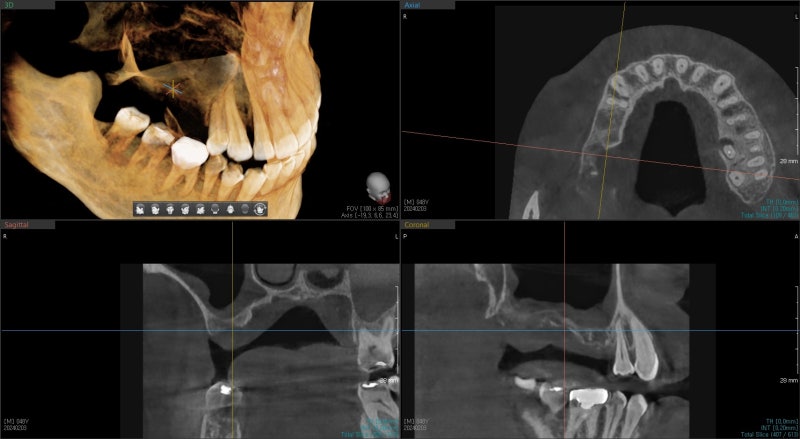
After precisely measuring the bone height with a 3D CT scan, it is determined whether the procedure can proceed without a lift or if it is more appropriate to perform it concurrently.
Two types of sinus lift procedures
Sinus lifts are broadly divided into two types based on the approach.
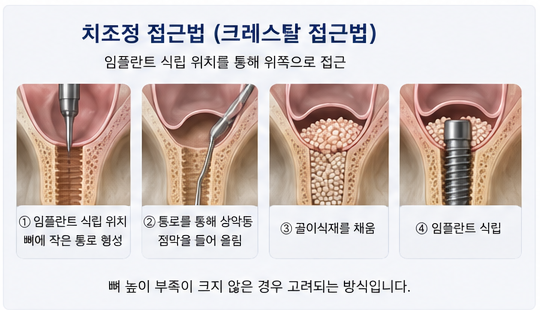
Crestal Approach
This method involves approaching from the implant placement site in an upward direction.
The membrane of the maxillary sinus floor is gently lifted through the implant placement channel, and then bone graft material is often filled, and the implant is placed simultaneously.
This method is considered when bone deficiency is relatively minor, and the incision area is limited.
Lateral Approach
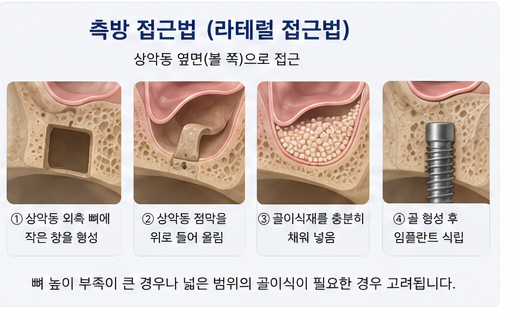
This method involves direct access through the side (cheek side) of the maxillary sinus.
A small window is made in the outer bone of the maxillary sinus to lift the sinus floor membrane, and then the necessary amount of bone graft material is filled.
This method is considered when there is significant bone deficiency or when a large area of bone grafting is required.
Both methods are used in clinical practice, and which method is appropriate is determined by factors such as bone height, degree of deficiency, and placement location.
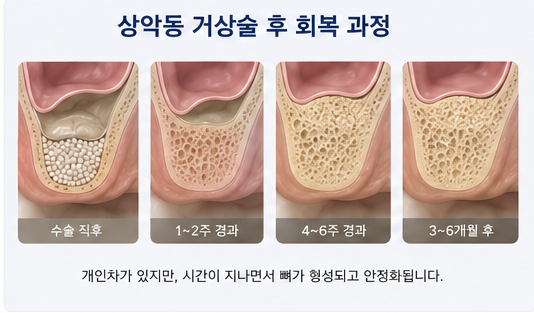
When are implants placed?
The timing of implant placement after a sinus lift can vary depending on the case.
Simultaneous sinus lift and implant placement
This is considered when a certain amount of remaining bone height is secured, allowing for initial implant stability.
Performing a sinus lift first
If bone height is severely insufficient, a sinus lift is performed first, followed by a healing period before implant placement.
The appropriate method is determined in consultation with the medical staff, based on the patient's bone condition.
Is a sinus lift very painful?
Many people worry about pain from a sinus lift.
A sinus lift is generally performed under local anesthesia.
While there are differences depending on the approach and scope of the procedure, swelling or discomfort may occur for a few days after surgery, and it typically subsides gradually over time.
The crestal approach involves a limited incision area, so the recovery pattern is relatively less burdensome.
The lateral approach, due to its wider scope, may require more time for recovery.
The exact recovery process can vary depending on the patient's condition and the scope of the procedure, so it is best to receive individualized guidance.
Precautions after a sinus lift

Unlike general bone grafting, a sinus lift is a procedure connected to the maxillary sinus, a space that requires several precautions during the recovery period.
The following points are advised for a certain period after surgery:
- Do not blow your nose forcefully.
- Sneeze with your mouth open.
- Avoid activities with significant pressure changes, such as flying or diving.
- Refrain from using straws.
- Avoid irritating the graft site.
- Take prescribed medication as directed.
Since the maxillary sinus is connected to the nose, pressure changes can affect the lifted membrane, so these precautions are advised during the recovery period.
Detailed instructions will be provided individually after the procedure.
In conclusion,
As I perform implant treatments at Yaksu Station Dental Clinic, whenever I encounter upper jaw molar cases, I often realize how much the treatment process can differ based solely on location, even for the same molar implant.
A sinus lift is a procedure used in clinical practice to compensate for insufficient bone conditions in the upper jaw molar area.
To summarize today's content:
- The maxillary sinus is an air-filled space located above the upper jaw molars.
- The maxillary sinus above the upper jaw molars can limit the bone height needed for implant placement.
- A sinus lift is a procedure to secure bone height.
- If bone height is sufficient, it may be possible to proceed without a sinus lift.
- There are two approaches: the crestal approach and the lateral approach.
- After surgery, precautions related to pressure changes, such as not blowing your nose forcefully, are necessary.
You can determine which method is suitable for your upper jaw molar condition through a precise diagnosis, including a 3D CT scan.
This has been Bareunyoung Dental Clinic at Yaksu Station.^^
We believe that proper treatment leads to proper results. We strive to provide care so that all who visit can leave with a more comfortable feeling. Bareunyoung Dental Clinic. This post was written in compliance with Article 56, Paragraph 1 of the Medical Service Act for the purpose of providing medical information.
Frequently Asked Questions
What is the maxillary sinus?
The maxillary sinus is an air-filled hollow space located above the upper jaw molars. It is situated inside the cheekbone next to the nose and is a normal anatomical structure where air resides during breathing or vocalization.
Why are upper jaw molar implants challenging?
Upper jaw molar implants are challenging due to the location of the maxillary sinus, which limits bone height. Additionally, bone resorption progresses after extraction, and the bone density is lower than in the lower jaw, making initial stability difficult.
What is a sinus lift?
A sinus lift is a procedure that involves lifting the membrane of the maxillary sinus floor upwards and then filling that space with bone graft material to secure the necessary bone height for implant placement. It creates space for new bone to form in an area where the bone is thin.
Is a sinus lift necessary for all upper jaw molar implants?
No. If there is sufficient bone height, it may be possible to proceed with only the implant without a sinus lift. The necessity is determined after precisely measuring the bone height with a 3D CT scan.
What are the different types of sinus lift procedures?
Sinus lifts are broadly divided into two types. The crestal approach, accessed through the implant placement channel, is used when bone deficiency is minor. The lateral approach, accessed through the side of the maxillary sinus, is used when bone deficiency is significant.
What are the precautions after a sinus lift?
After a sinus lift, it is important not to blow your nose forcefully, sneeze with your mouth open, and avoid activities with significant pressure changes like flying or diving. Refraining from using straws and taking prescribed medication are also crucial.