2026-09-07
Yaksu-dong Dental Clinic: Why Gums with Advanced Periodontal Disease Always Swell and Bleed (Brushing, Waterpik, Gum Treatment)
Learn why gums with advanced periodontal disease swell and bleed, and how proper brushing, Waterpik use, and professional gum treatments can help manage this condition.
Hello.
This is Dr. Tae-young Kim, director of Bareunyoung Dental Clinic near Yaksu Station.^^
Among patients who visit the dental clinic after a very long time,
some come in because they suddenly started bleeding while brushing their teeth recently, even though they had no issues before,
and are experiencing throbbing pain.
Periodontal disease often progresses without significant discomfort or pain, until one day, sudden pain prompts a dental visit. At this point, it's common to find that a significant amount of alveolar bone around the teeth has been absorbed, or the surrounding gums are severely swollen due to inflammation.

There is a small pocket space at the border where our teeth and gums meet.
Normally, this area is a small gap of about 3mm. If this area is not effectively brushed, plaque repeatedly accumulates,
along with the deposition of calculus around it,
leading to repeated inflammatory reactions in the surrounding gums,
which results in gingivitis, the initial symptom of periodontal disease.
In fact, in the state of gingivitis, one does not feel pain or severe bleeding.
At this stage, if calculus and plaque around the gums are removed through regular scaling and check-ups,
since it is early gingivitis,
recovery to healthy gums is possible.
However,
when this gingivitis recurs and the inflammation extends beyond the gums
to cause absorption of the underlying alveolar bone,
it is called periodontitis.
Since alveolar bone destroyed by periodontal disease does not regenerate even with periodontal treatment,
if periodontitis has progressed, regular scaling and periodontal treatment must be combined
to prevent further destruction of the alveolar bone.

The patient who visited our clinic
initially came to resolve issues with a tooth that had been treated in the past.
Later, on their next visit, they came in complaining of something appearing and disappearing on the gum near their molar.
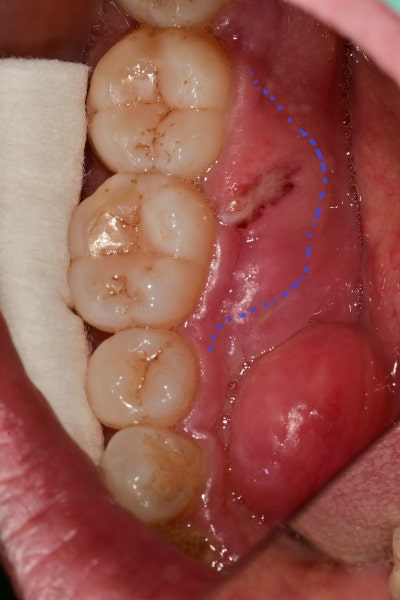
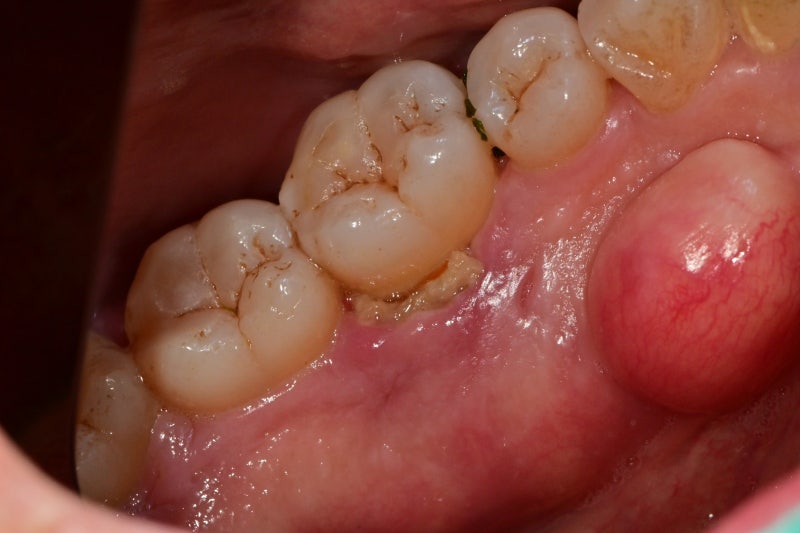
The gum on the tongue side was swollen and ulcerated.
Before taking an X-ray, I thought it was a gum injury,
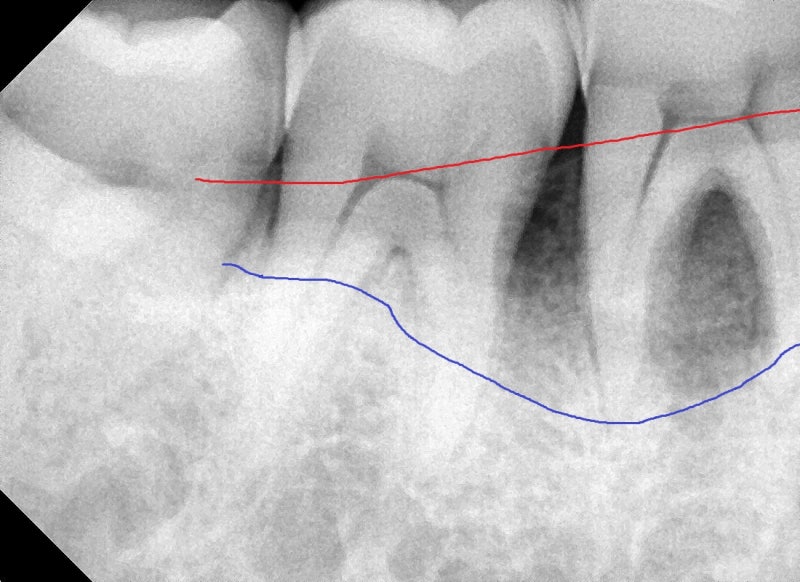
but after taking an X-ray, it was unusual to see that the inner bone, not the outer, was destroyed up to the blue line.
As mentioned earlier, the space between the tooth and gum should normally be around 3mm,
but in this case, it was already advanced periodontitis, exceeding 10mm.
The patient also said they hadn't experienced much discomfort until then.
In such cases, it is a priority to first administer anesthesia to the inner area,
scrape out calculus, plaque, and food debris from inside,
and then insert antibiotics to first reduce the gum swelling.
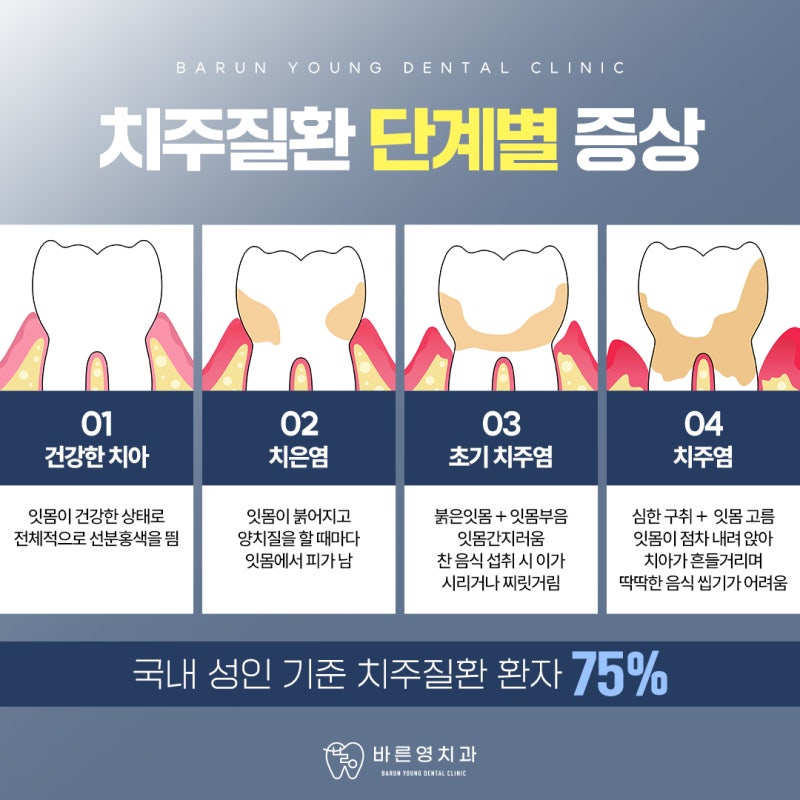
Although periodontal disease is categorized into stages, in reality,
it is difficult to divide it into exact stages, and once the alveolar bone around the teeth begins to be affected,
it is important to receive regular periodontal treatment.
The patient, who had been fine until suddenly experiencing discomfort and visiting the dental clinic, was quite surprised to hear that their periodontitis was significantly advanced. However, by shortening the visit cycle and receiving toothbrushing education for effective daily brushing, along with using auxiliary tools like interdental brushes and Waterpiks, we decided to continuously monitor the condition to prevent worsening by managing the surrounding gums to avoid swelling.
One month after completing periodontal treatment, the patient revisited due to discomfort in the same area.
The ulcerated gum and surrounding gum swelling had significantly subsided, becoming a normal pink color,
but because the gum in the deep pocket space created by destroyed alveolar bone is weak,
hard foods can easily get stuck in the gum, causing discomfort.
In particular, this patient's case involved periodontitis in the inner alveolar bone, where the tongue makes contact, rather than the outer side.
Since it's a difficult area to manage even if food gets stuck,
frequent visits are necessary to manage it with us and continuously check the tooth condition.
As such, once periodontitis progresses,
it is almost impossible to return to the healthy periodontal state of the past.
To prevent this, although it's a simple treatment,
receiving regular scaling
and regular check-ups with X-rays
can help maintain much healthier gums and teeth.^^
To help maintain healthy gums,
we at Bareunyoung Dental Clinic will also do our best.
Thank you^^
Frequently Asked Questions
Why do my gums bleed and swell?
Bleeding and swollen gums can be symptoms of periodontal disease. This occurs because plaque and calculus accumulate at the tooth-gum border, leading to repeated inflammatory reactions in the surrounding gums. It initially starts as gingivitis, progressing without pain, and if severe, can lead to alveolar bone damage.
What is the difference between gingivitis and periodontitis?
Gingivitis is the initial stage where inflammation is confined to the gums. At this stage, regular scaling to remove calculus and plaque can restore healthy gums. In contrast, periodontitis is a condition where inflammation extends beyond the gums, causing absorption of the alveolar bone. Since destroyed alveolar bone does not regenerate, continuous management is necessary.
Can periodontal disease be completely cured after treatment?
No, once periodontitis progresses, it is almost impossible to return to the healthy periodontal state of the past. Since alveolar bone destroyed by periodontitis does not regenerate, continuous management through regular scaling and periodontal treatment is necessary to prevent further destruction.
What efforts are needed to prevent periodontal disease?
To prevent periodontal disease, regular scaling and check-ups are very important. Additionally, receiving education on effective daily brushing and using auxiliary tools like interdental brushes and Waterpiks to keep the gum area clean can prevent worsening and maintain healthy gums.
Can periodontal disease progress without pain?
Yes, it can. Periodontal disease often progresses without significant discomfort or pain, until one day, sudden pain prompts a dental visit, at which point a significant amount of alveolar bone may have already been absorbed or the gums severely swollen. Especially in the early gingivitis stage, pain or severe bleeding may not be felt.