2026-05-18
Double-Fold Eyelid Revision Surgery: Why Adhesion Release Is the Key
This post covers a double-fold (multiple crease) case where, after a previous eyelid surgery lowered the line, neither the original nor the new line folds properly. These cases often involve skin shortage, surrounding tissue adhesion, and scarring, so thoroughly releasing adhesions and preventing re-adhesion is the core technique. Initial success means no double fold is visible immediately after surgery, and if folding occurs outside the incision line, early correction may be required.
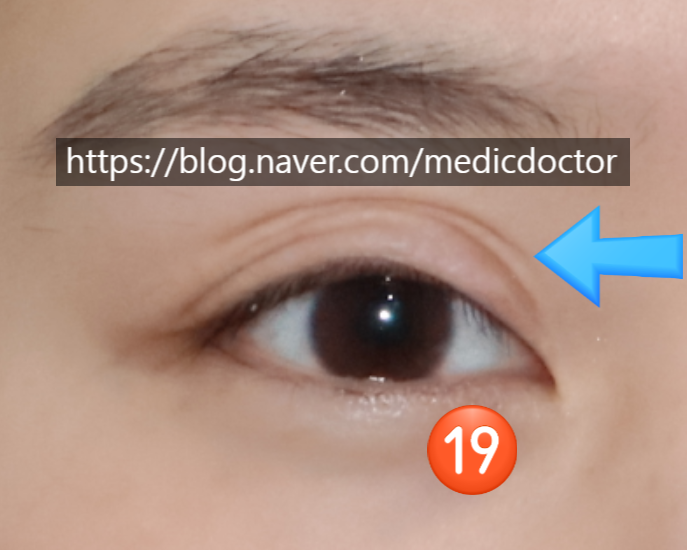
I haven't been able to post much lately because I've been busy, but I'd like to share posts focused on patients I operated on last winter and other memorable cases.
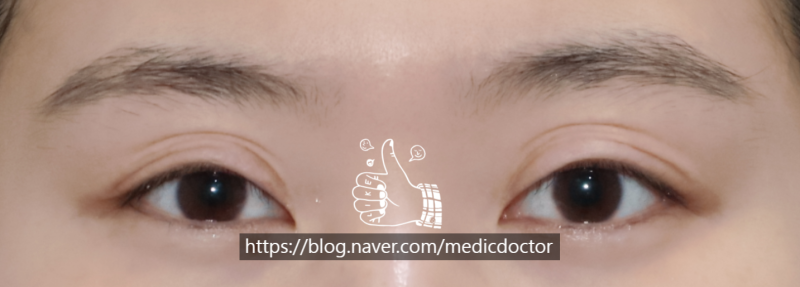
Pre-operative appearance
This is a case with a clear double fold. The patient had previously had a double eyelid surgery done too high, and the line was lowered afterward. The issue is that neither the original line nor the newly created line folds properly.
In these cases, there is very often a shortage of skin, along with significant adhesion of surrounding tissue and severe scarring.
For this kind of surgery, the key technique is naturally to release the adhesions thoroughly and to prevent them from re-forming.
When re-adhesion occurs, the triple-fold eyelid can actually become more pronounced.
The first criterion for judging whether the surgery was performed well is that no double fold should be visible at all immediately after surgery — that's stage one success.
However, in very rare cases where the skin is quite thin, there may be a slight tendency to fold. In most cases, there is no folding at all, and even if there is some slight folding, it's acceptable as long as it folds entirely along the incision line and only appears as a minor crease. But if it doesn't fold like a crease and instead folds back the way it did originally, the surgery has failed.
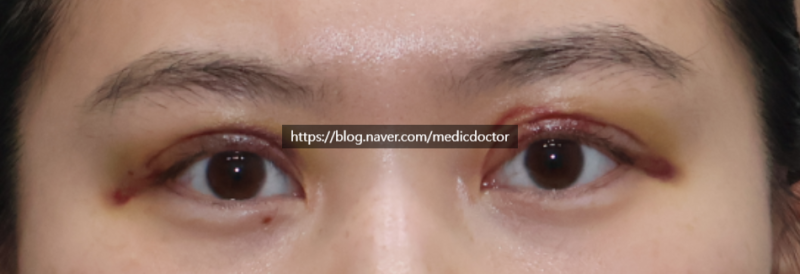
It's still only one week post-op, so there's swelling, and in the photo the right side is a bit more swollen.
This will improve over time. But the key point is that no double fold appears right away.
Occasionally, though rarely, a slight crease-like fold can appear right after surgery. Sometimes the fold becomes more prominent when the patient squeezes the eyes. This can worsen between 1–3 months due to swelling around the incision line and firm scarring. The area around the incision line itself won't fold, but folding that appears elsewhere will not improve. Such cases need to be released through early correction.
https://blog.naver.com/medicdoctor/223561267266
The related post can be found here.
For double-fold eyelid revision, releasing adhesions well and preventing re-adhesion is the core technique and know-how.
This is generally where results diverge.
https://youtu.be/YWWFFSayUzQ
Frequently Asked Questions
What causes a double-fold eyelid?
It occurs when, after a previous double eyelid surgery was done too high and the line is then lowered, neither the original line nor the new line folds properly. It often involves a shortage of skin, surrounding tissue adhesion, or significant scarring.
What is the key technique in double-fold eyelid surgery?
The core technique and know-how is to release the adhesions well and to prevent them from re-forming. If re-adhesion occurs, the triple-fold eyelid can become even more pronounced, which is where results often diverge.
How do you tell whether the surgery was successful?
If no double fold is visible at all immediately after surgery, it is considered stage one success. In cases of very thin skin, slight folding may occur, but folding along the incision line or just a minor crease is acceptable; folding back the way it did originally is considered a failure.
What if a slight crease appears right after surgery?
In rare cases, a slight crease-like fold may appear immediately after surgery or become more visible when squeezing the eyes. This may worsen at 1–3 months due to swelling around the incision and firm scarring, but the area around the incision itself won't fold again.
When is early correction needed?
When folding occurs in areas other than the incision line, it will not resolve on its own over time. In such cases, early correction is needed to release the adhesions.
Is a difference in swelling between the two sides normal after surgery?
At one week post-op, swelling is still present and there can be asymmetry between the two sides. It gradually improves over time, and the key point is whether or not a double fold appears immediately.