2026-05-18
Canthoplasty Results: Do Eyelid Widening Procedures Really Enlarge Eyes? Complete Guide
Medial and lateral canthoplasty are not simply procedures to widen eyes horizontally. Medial canthoplasty's core purpose is to correct Mongolian folds and transform inline double eyelids into outline double eyelids, while lateral canthoplasty adjusts lateral canthal tendon tension—not everyone needs it. Younger patients see limited results, and simple skin excision lacks durability.

Hello.
This is Snuplastic Cosmetic Surgery.
Today, we're covering procedures that are
essential in cosmetic surgery,
especially eye surgery:
Medial canthoplasty
and lateral canthoplasty.

Many people believe that
"canthoplasty = widening eyes horizontally
to make them appear larger."
However, the actual medical purpose
is entirely different.
Did you know that lateral canthoplasty
is a procedure to consider only in
very limited cosmetic situations?
Today, based on domestic and international literature
and academic resources, we'll thoroughly examine
the purposes and misconceptions surrounding
medial and lateral canthoplasty.
Common Misconception: Canthoplasty lengthens horizontal eye width dramatically?

Many people understand medial and lateral canthoplasty
simply as procedures to lengthen the
'horizontal eye width.'
Of course, horizontal eye length can increase
somewhat after surgery.
However, the actual change is typically
within 1-2mm, making it difficult to view
as the fundamental purpose of
'enlarging the eyes.'
Eye aesthetics are determined not by horizontal length alone,
but by complex factors including corneal exposure,
eye shape angle, and double eyelid line.
Therefore, experts agree that simply extending
length through canthoplasty alone
makes it difficult to achieve the desired
'larger eye' effect.
The Truth: The Real Purpose Behind the Commercial Term 'Canthoplasty'
Terms like 'medial canthoplasty' and 'lateral canthoplasty'
are primarily commercial terms designed for
general familiarity.
Medically, they are called
Medial Canthoplasty
and Lateral Canthoplasty,
and were originally developed to treat
eyelid conditions or solve structural problems
of the eyelids.

As these medical techniques were adapted
for cosmetic purposes,
many people began to focus on
'enlarging the eyes' rather than the original intent.
The essence of cosmetic medial and lateral canthoplasty
lies in "altering the shape and tension
of the double eyelid crease (upper fold)."
Medial Canthoplasty: Converting 'Inline' to 'Outline' Double Eyelids
The primary purpose of medial canthoplasty
is to correct the inner eye crease—
the medial epicanthal fold (Mongolian fold).
This fold, common in East Asians,
covers the inner corner of the eye,
making it appear smaller, and also
hides the starting point of the double eyelid line,
creating 'inline' double eyelids.

✅ Inline Double Eyelid
The double eyelid line doesn't extend to the eye corner
but instead disappears into the inner fold.
✅ Outline (Out-Fold) Double Eyelid
The line extends cleanly to the eye corner,
appearing distinct and open.
.
.
Multiple academic papers clearly state
that the core goal of medial canthoplasty is
to convert 'inline' double eyelids
to 'outline' double eyelids.
In fact, one study showed that of 112 patients
who underwent medial canthoplasty with double eyelid surgery,
110 achieved outline double eyelids.
Simply put,
medial canthoplasty releases tension in the medial epicanthal fold
and repositions the inner eye structure so that
the double eyelid line opens naturally outward
rather than caving inward toward the nose.
Lateral Canthoplasty: Not Everyone Needs This Surgery

Lateral canthoplasty corrects the structure
and tension of the outer eye corner—
the lateral canthus.
Medically known as Lateral Canthoplasty,
it was originally developed to treat
functional problems such as lower eyelid laxity,
lateral canthus ptosis, ectropion, and entropion.
To be honest, many experts say that
unlike medial canthoplasty, the cosmetic use
of lateral canthoplasty is very limited.
.
.
Why is that?
The Real Purpose of Lateral Canthoplasty: Tightening the Lateral Canthal Tendon
The core purpose of lateral canthoplasty is
to adjust the angle and tension of the lateral canthus,
creating a smoother, more resilient eye appearance.
Specifically, tightening the lateral canthal tendon,
located on the outer side, makes the outer skin
firmer and provides support.
This can result in the eye shape appearing lifted
and more defined.
Who Sees Results? Selective Application Is Key
Lateral canthoplasty can be selectively applied
to those whose lateral canthal tendon is already
naturally loose or slack.
That is, in younger patients, the lateral canthal tendon
is usually already taut and healthy,
so the benefits from lateral canthoplasty are minimal.
However, in cases of congenital
loose lateral canthal tendons or
ptosis from aging,
surgery can result in a more defined outer eye appearance
and more prominent lateral contours.
Important Note: Limitations of Simple Skin Excision

There's an important point we must address.
Simply excising outer skin alone
produces minimal or temporary results.
In many cases, procedures called 'lateral canthoplasty'
involve only simple skin excision,
but since this doesn't change the tension of the
lateral canthal tendon itself, only temporary effects
can be expected.
Research comparing multiple surgical techniques shows that
simply lifting skin and muscle provides poor durability
and commonly results in post-operative ptosis.
True lateral canthoplasty means
not simple excision, but precisely identifying
the lateral canthal tendon and reattaching it
with appropriate tension—a sophisticated procedure.
Medial and Lateral Canthoplasty: Understand the Truth, Not the Misconception
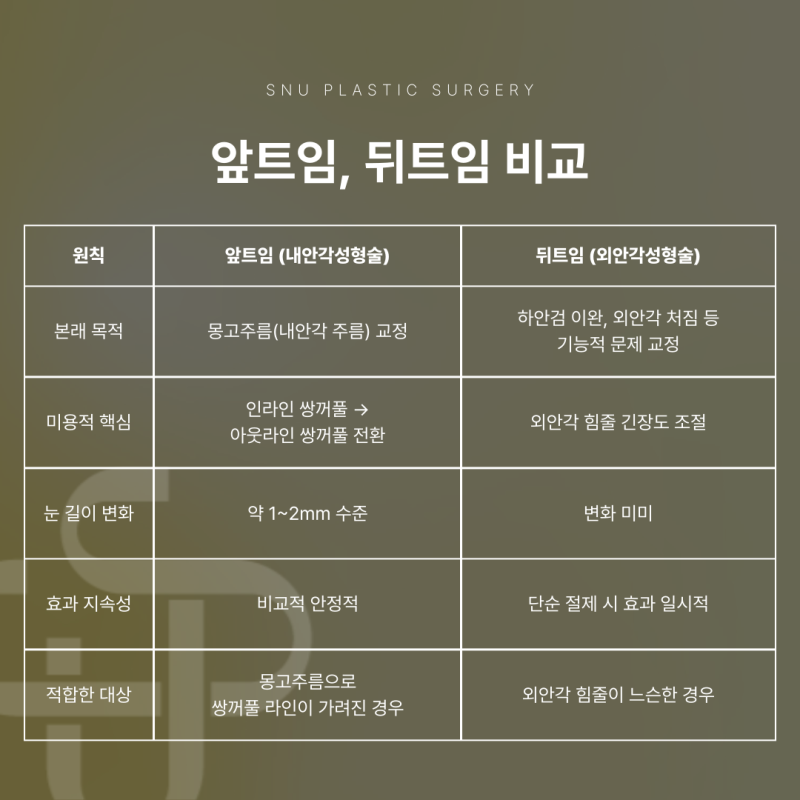
We've now thoroughly summarized
the misconceptions and truths about medial and lateral canthoplasty
based on scientific literature.
👉🏻 Medial Canthoplasty:
Not simply 'lengthening' eyes, but a sophisticated procedure
that transforms the double eyelid to an outline shape.
👉🏻 Lateral Canthoplasty:
Not necessary for everyone,
and especially ineffective for younger patients.
Moreover, tendon tightening—not simple skin excision—is key,
and even that must be applied selectively.
If you're considering cosmetic surgery,
don't be swayed by commercial terms or social media reviews.
Be sure to have a thorough consultation with a specialist
in orbital and eyelid surgery to develop an accurate
diagnosis and plan suited to your unique anatomy.
This post is informational content based on medical literature
and academic resources. Individual surgical results vary,
and surgery decisions must be made through consultation
with your medical team.
Website
📌 KakaoTalk Channel (Click image below to access)



Frequently Asked Questions
How much will my eyes enlarge after medial canthoplasty?
Post-operative horizontal eye length change is typically within 1-2mm, which is minimal. Since eye aesthetics depend on multiple factors—corneal exposure, eye shape angle, and double eyelid line—rather than length alone, the effect of simple lengthening is limited.
What is the real purpose of medial canthoplasty?
The core purpose of medial canthoplasty is to correct the epicanthal fold common in East Asians and convert the inline double eyelid (which disappears into the inner fold) into an outline/out-fold double eyelid (which extends cleanly to the eye corner).
Is lateral canthoplasty effective for everyone?
No. Most younger patients have taut lateral canthal tendons, so the benefits of lateral canthoplasty are minimal. Results are best in cases of congenitally loose tendons or age-related ptosis, where it's applied selectively.
Can't we just excise skin for lateral canthoplasty?
Simple skin excision fails to change lateral canthal tendon tension, producing minimal or short-lived results. Research shows that skin-and-muscle lifting alone has poor durability and commonly causes post-operative ptosis.
What are the medical names for these procedures?
Medial canthoplasty is called Medial Canthoplasty, and lateral canthoplasty is called Lateral Canthoplasty. These were originally developed to treat eyelid diseases or structural problems and were later adapted for cosmetic purposes.
What should I watch for when considering canthoplasty?
Don't be swayed by commercial terms or social media reviews. Consult thoroughly with a specialist in orbital and eyelid surgery to receive an accurate diagnosis and plan tailored to your unique anatomy. Results vary individually.