2026-07-20
You Must Undergo Endothelial Cell Examination Before Gangnam ICL Surgery!
Learn why endothelial cell examination is crucial before ICL surgery in Gangnam, especially for high myopia or thin corneas, to ensure safety and prevent complications.


Hello, this is Gangnam Smile Eye Clinic😊
As the proportion of people with myopia increases,
many are becoming interested in vision correction surgery.
Since vision correction surgeries have different pros and cons depending on the type,
it's crucial to choose the most suitable method for yourself.
Especially for those with very poor vision, such as high myopia, high astigmatism, or ultra-high myopia, or if the cornea is thin,
Gangnam ICL (Implantable Collamer Lens) surgery may be safer than traditional LASIK or LASEK procedures.
Gangnam ICL Surgery
ICL surgery involves inserting a custom-power artificial lens
between the iris and the natural lens.
This lens can be used semi-permanently,
and offers the advantage of excellent quality of corrected vision.
Furthermore, because it preserves the existing cornea,
it is primarily suitable for patients with thin corneas or high myopia
who are concerned about corneal tissue removal.
Gangnam ICL surgery is broadly divided into anterior chamber lenses and posterior chamber lenses.
The characteristics of each type are as follows:
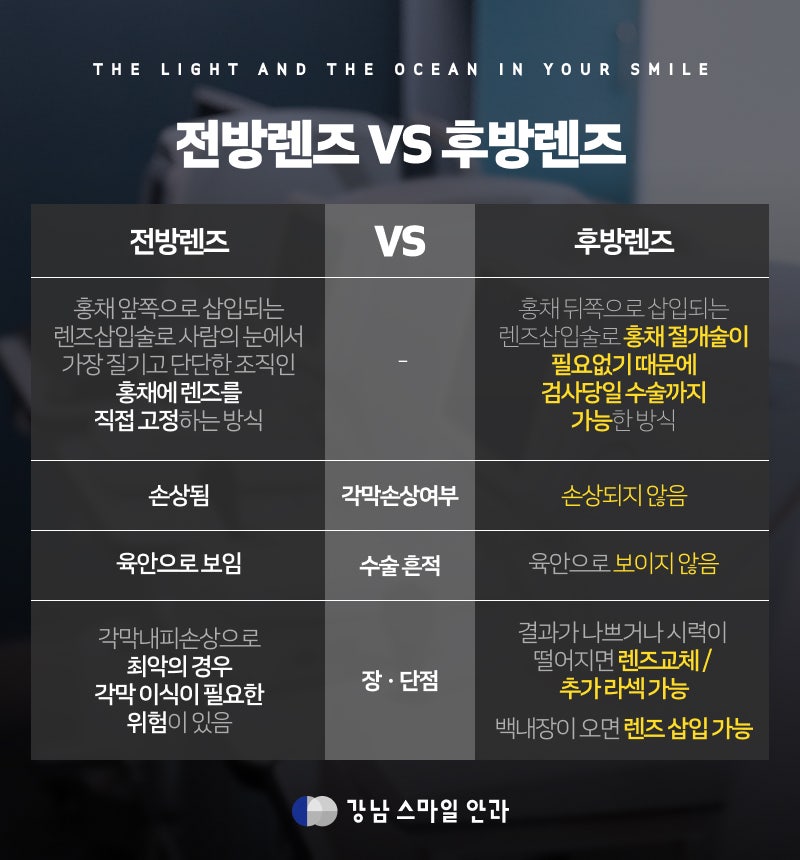
Anterior chamber lenses are inserted between the iris and the cornea,
fixed to the iris to minimize displacement, and a corneal incision is made
to allow for astigmatism correction and rapid recovery.
The likelihood of cataracts or complications is lower compared to posterior chamber lenses,
but caution is needed against external impacts.
On the other hand, posterior chamber lenses are inserted between the iris and the natural lens,
with EVO ICL being a representative example.
This method has a low risk of corneal endothelial cell damage, making it resistant to external impacts,
and the lens material is soft and thin, reducing strain on the eye, which are its advantages.
Additionally, it does not require an iridotomy, lowering the risk of increased intraocular pressure.
However, because the lens position is close to the natural lens,
careful selection of the lens size is crucial.
Otherwise, the two structures may rub against each other, damaging the natural lens,
increasing the risk of cataracts.
The Importance of Corneal Endothelial Cells
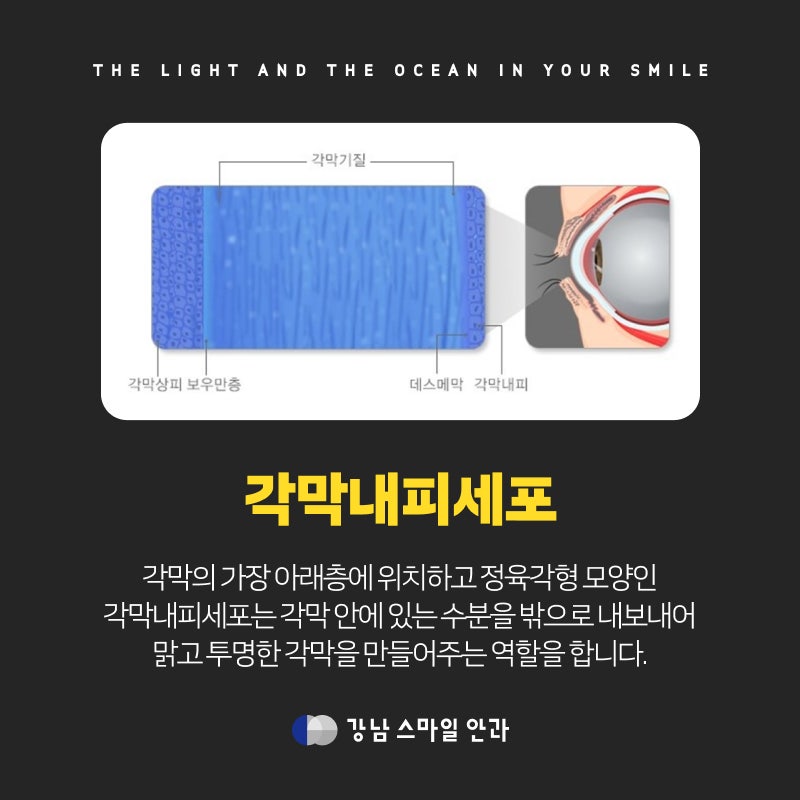
The cornea is a dry, transparent,
protein tissue without moisture.
Corneal endothelial cells play a key role
in maintaining this transparency
by preserving the internal moisture balance of the cornea,
keeping it clear.
However, as we age, the number of corneal endothelial cells
naturally decreases.
On average, they decrease by about 0.6% per year,
eventually leading to an insufficient cell count, causing corneal swelling
and vision deterioration.
In addition, trauma or ophthalmic surgery can also reduce the cell count.
In such situations, inserting an anterior chamber lens is not recommended as it can cause
additional damage to the corneal endothelial cells.
Conversely, posterior chamber lenses have a relatively smaller impact on corneal endothelial cells,
making them more stable compared to anterior chamber lenses.
Corneal Endothelial Cell Examination
For Gangnam ICL surgery, selecting the appropriate lens for the eye's condition
and ensuring safety through precise pre-operative examinations are paramount.
The U.S. FDA recommends:
For posterior chamber ICL surgery, an anterior chamber depth of 3.0mm or more,
and for anterior chamber ICL surgery, 3.2mm or more.
Furthermore, the corneal endothelial cell count must meet the criteria for the procedure to proceed.
Our clinic performs pre-operative corneal tomography to
meticulously check the number, density, and size of corneal endothelial cells before surgery.
Corneal endothelium, once damaged, does not regenerate.
If the damage is severe, it can lead to corneal diseases, so it should not be taken lightly.
Be careful with daily habits, such as frequently rubbing your eyes
or sleeping face down.
Also, even after surgery, it is recommended to have regular check-ups at least once a year
to monitor endothelial cell density, cataract progression, lens position, and distance from the cornea.
If the lens does not settle precisely after surgery,
its position may subtly change, requiring management through regular check-ups.

Gangnam Smile Eye Clinic
is equipped with the latest technology and a systematic examination system,
providing personalized 1:1 consultations and
sincerely treating and operating on each patient.
We always prioritize the patient,
and place transparency and safety above all else.
If you have any other inquiries,
please feel free to contact our eye clinic at any time.
💙🤍 𝖦𝖠𝖭𝖦𝖭𝖠𝖬 𝖲𝖬𝖨𝖫𝖤 𝖤𝖸𝖤 𝖢𝖫𝖨𝖭𝖨𝖢💙🤍
𝗧𝗛𝗘 𝗟𝗜𝗚𝗛𝗧 𝗔𝗡𝗗 𝗧𝗛𝗘 𝗢𝗖𝗘𝗔𝗡 𝗜𝗡 𝗬𝗢𝗨𝗥 𝗦𝗠𝗜𝗟𝗘


Gangnam Station Eye Clinic Gangnam ICL Surgery Gangnam Station ICL Surgery Gangnam Station Eye Clinic Gangnam ICL Surgery Gangnam Station ICL Surgery Gangnam Station Eye Clinic Gangnam ICL Surgery Gangnam Station ICL Surgery











Frequently Asked Questions
In what cases is ICL surgery suitable?
ICL surgery may be safer for patients with very poor vision, such as high myopia, high astigmatism, or ultra-high myopia, or those with thin corneas for whom LASIK or LASEK is difficult. It offers the advantage of preserving the cornea.
What are the advantages of ICL surgery?
ICL surgery can be used semi-permanently and provides excellent quality of corrected vision. It also preserves the natural cornea, making it suitable for patients with thin corneas or concerns about corneal tissue removal.
How do anterior and posterior chamber lenses differ?
Anterior chamber lenses are inserted between the iris and the cornea, allowing for astigmatism correction and quick recovery, but require caution against external impacts. Posterior chamber lenses are inserted between the iris and the natural lens, have a lower risk of corneal endothelial cell damage, and are resistant to external impacts.
Why are corneal endothelial cells important?
Corneal endothelial cells play a crucial role in maintaining the transparency of the cornea by preserving its internal moisture balance. A deficiency in these cells can lead to corneal swelling and vision deterioration.
Is corneal endothelial cell examination mandatory before ICL surgery?
Yes, it is mandatory. Corneal endothelial cells do not regenerate once damaged, so a pre-operative corneal tomography is essential to meticulously check the number, density, and size of endothelial cells to ensure safety.
How should I manage my eyes after ICL surgery?
After surgery, it is recommended to have regular check-ups at least once a year. This helps monitor endothelial cell density, cataract progression, lens position, and the distance from the cornea, ensuring proper management.