2026-09-07
Yaksuyeok Dental Clinic: Efficient Implant Surgery and Benefits Using Digital Equipment
Learn about digital implants at Yaksuyeok Dental Clinic, including their features, process, and advantages like precision planning and reduced discomfort.
Hello,
This is Dr. Kim Tae-young, chief director of Baryeunyoung Dental Clinic at Yaksuyeok Station.^^
Lately, when conducting implant consultations,
unlike in the past,
many people are increasingly curious about digital implants first.
‘What exactly are digital implants?’
‘What is the process?’
‘Is it possible to get a temporary tooth on the same day?’
It seems that interest and questions about digital implants
have grown significantly.
In the field of dentistry,
the use of various digital equipment such as oral scanners, 3D CT, and digital guide systems
is increasing.
At Baryeunyoung Dental Clinic at Yaksuyeok Station,
we also utilize these digital systems in our treatments.
Today, we will take the time to explain step-by-step
what digital implants are,
what characteristics they have,
and what stages they involve.
If you read until the end,
any questions you had about digital implants
will be more comfortably clarified.
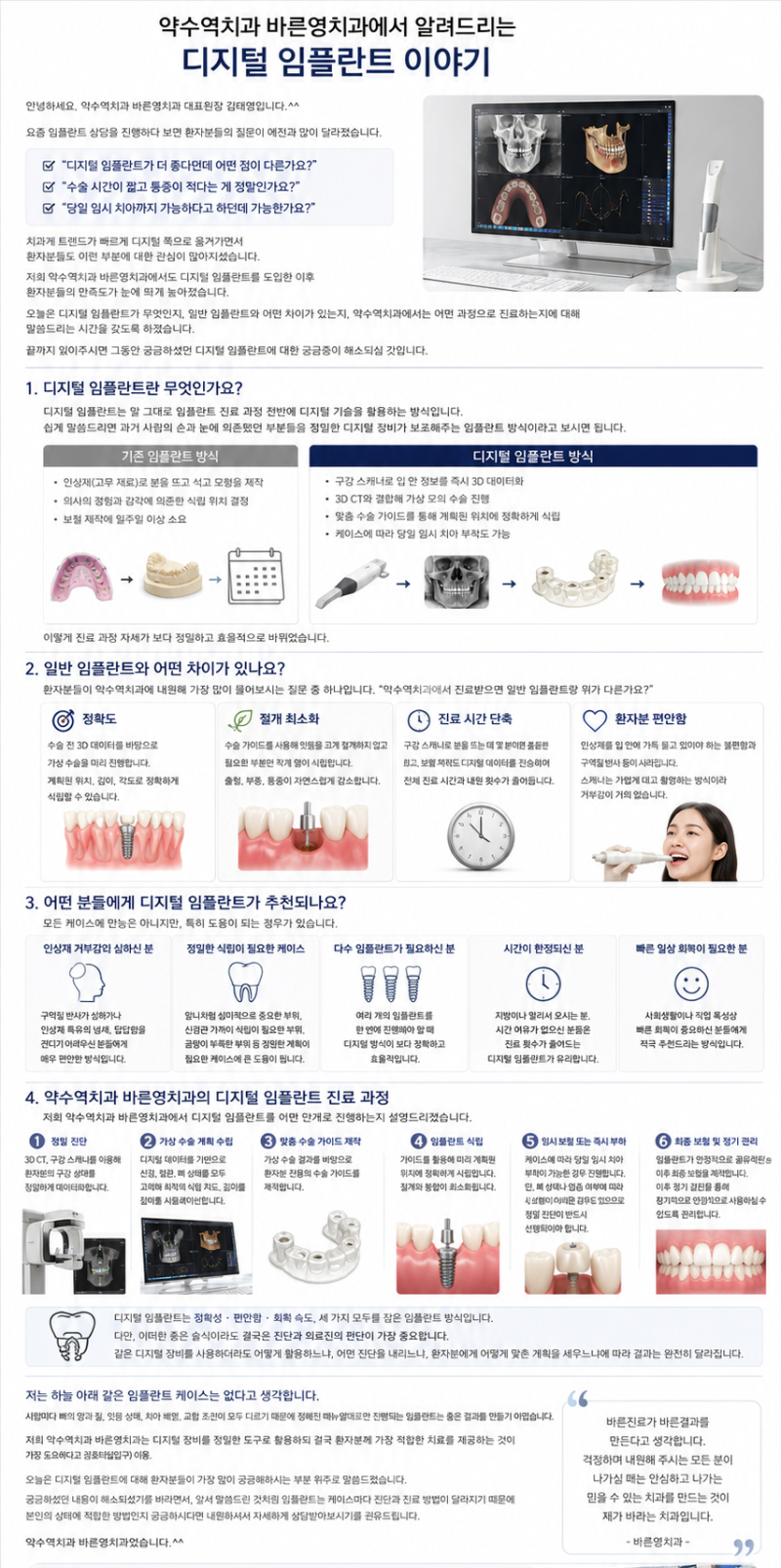
What are digital implants?
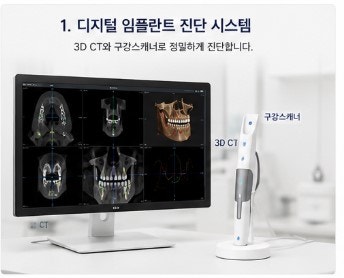
Digital implants
are a method that utilizes digital equipment and data in the implant treatment process.
Simply put,
you can think of it as a system where digital tools are used together in the diagnosis, planning, and placement stages
required for implant treatment.
To summarize the flow of treatment:
Information inside the mouth is acquired as 3D data with an oral scanner,
combined with 3D CT data to create a virtual surgical plan in advance,
a surgical guide is produced based on the planned data,
and then the implant is placed at the planned position using the guide.
In some cases,
it is possible to connect a temporary tooth on the same day.
The case below is a full-arch implant case (upper and lower) that was performed at our clinic.
Full-Arch Implants
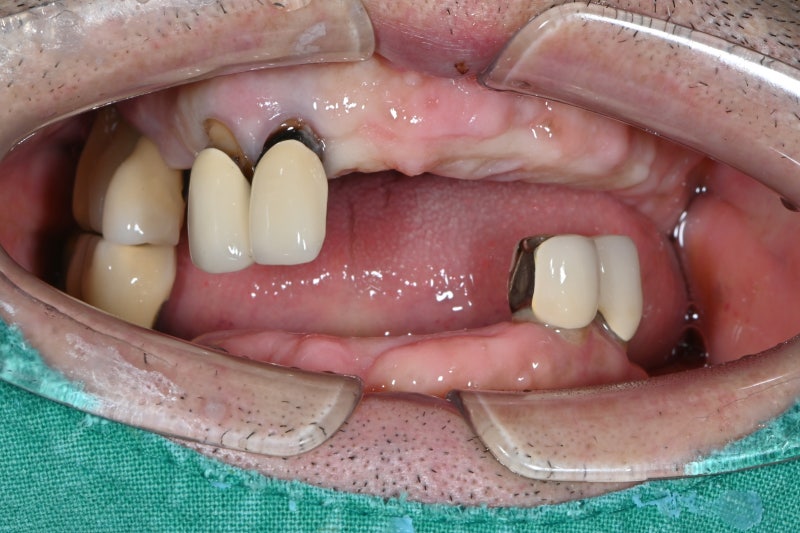
When the patient first visited, they had no molars for chewing, except for the right molar.
Since they were taking antithrombotic agents, the surgery time and number of sessions had to be minimized.
A guide was created using 3D CT and a scanner, and surgery was performed. Fortunately, the patient's alveolar bone was strong, so a temporary tooth could be made immediately after surgery, allowing them to eat without discomfort.
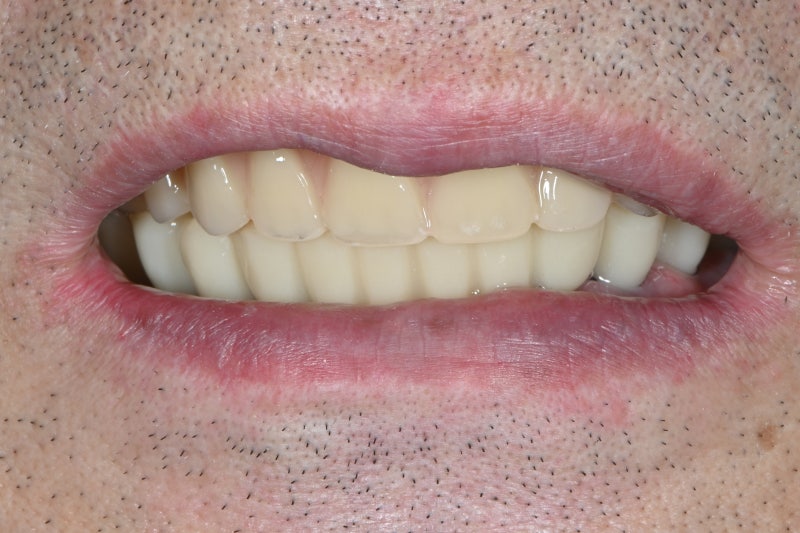
In such cases, using digital equipment
and especially fixed temporary teeth for the lower jaw,
allows for eating immediately after surgery.
Characteristics of Digital Implants
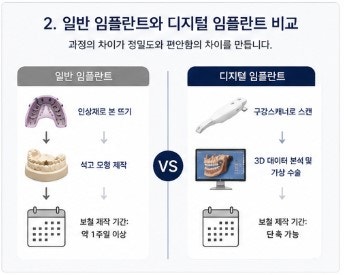
This is one of the questions patients frequently ask
when they visit our Yaksuyeok Dental Clinic.
‘What are the characteristics of digital implants?’
The main characteristics are as follows:
1. Data-based Diagnosis and Planning
Digital implants involve virtual simulations
based on 3D data before surgery.
After comprehensively checking the nerve position, bone quantity and direction, gum condition, etc.,
a plan for the placement position and angle is established.

2. Placement using a Guide
When a digital guide is used,
it helps ensure that the implant is placed at the planned position.
While this method can affect the incision area depending on the case,
it is not uniformly applied to all cases
and may vary depending on the patient's gum and bone condition.
3. Digital Data-based Treatment Flow
By utilizing an oral scanner,
information inside the mouth can be acquired as 3D data without using impression material.
Since the acquired data is directly transferred to the laboratory process,
the treatment flow continues based on digital data.
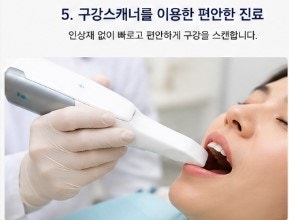
4. Reduced Burden of Impression Material Use
For those who found the traditional impression material method uncomfortable
or experienced gag reflexes,
some patients find the oral scanner method more comfortable.
However, this may vary depending on the individual's oral condition and state.
Situations Where Digital Implants Are Highly Useful
Digital implants
are not necessarily applicable to all cases.
However, they can be highly useful in the following situations,
and determining the most suitable method should first be confirmed through a diagnosis by the medical staff.
If you have difficulty with impression material:
Those who have a gag reflex or found impression taking difficult
may consider digital scanning methods.
When precise placement planning is required:
In cases where precise planning is crucial, such as aesthetically important areas like front teeth,
or locations close to nerves,
digital systems are often utilized.
When diagnosis for multiple implants is needed:
In cases requiring the evaluation of multiple implants together,
digital data-based diagnosis can be highly effective.
If there are restrictions on treatment schedule:
Patients with limited time or those visiting from afar
may benefit from discussing their treatment schedule with the medical staff.
The treatment method combining these situations varies
depending on the patient's oral condition and
the diagnosis results from the medical staff.
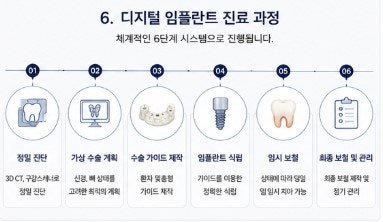
What are the stages of digital implant treatment?
Here's a summary of the general stages of digital implant treatment:
1️⃣ Precise Diagnosis
Using 3D CT and an oral scanner,
the patient's oral condition is converted into data.
2️⃣ Digital Virtual Planning
Comprehensive review of nerve position, gum condition, bone quantity, etc.,
to establish a plan for placement position and direction.
3️⃣ Surgical Guide Production
A guide is produced based on the virtual planning data.
4️⃣ Implant Placement
The implant is placed at the planned position using the guide.
5️⃣ Temporary Prosthesis Review
In some cases, a temporary tooth can be connected on the same day,
but this is decided after a comprehensive review of bone condition and fixation strength.
6️⃣ Final Prosthesis and Maintenance
After stable osseointegration, the final prosthesis is made,
and maintenance is performed through regular check-ups.
Having performed implant treatments for a long time,
I have clearly realized one thing:
Even for the same implant,
since each patient's bone condition, gum condition, and occlusal conditions are all different,
one method cannot be the right answer for everyone.
‘Director, then is digital implant right for me?’
I always say that the priority is to jointly decide through diagnosis
which method is most suitable for the patient's oral condition.
It means that while equipment aids in planning for diagnosis and surgery, it does not mean that treatment cannot be performed without digital equipment.
Since each person's bone quantity and quality,
gum condition, tooth alignment, and occlusal conditions are all different,
rather than proceeding with treatment based solely on a fixed manual or specific equipment,
I believe it is important to thoroughly examine each patient's condition
and find the most suitable direction together.
At Baryeunyoung Dental Clinic at Yaksuyeok Station,
we also strive for highly efficient treatment using digital systems, but we do not rigidly adhere to only one method.
Ultimately, the outcome of an implant
depends not on what equipment is used,
but on how it is diagnosed and how it is planned.
Today, I explained digital implants
focusing on the questions patients frequently ask.
Since implant treatment can vary in diagnosis and treatment direction for each case,
we recommend confirming which method is suitable for your tooth condition
through a thorough consultation.
This was Baryeunyoung Dental Clinic at Yaksuyeok Station.^^
We believe that proper treatment leads to proper results. My goal is to create a dental clinic where all patients who visit with worries can leave feeling more comfortable and reassured. - Baryeunyoung Dental Clinic
This post was written in compliance with Article 56, Paragraph 1 of the Medical Service Act for the purpose of providing medical information.
Frequently Asked Questions
What are digital implants?
Digital implants are a method that utilizes digital equipment and data, such as oral scanners and 3D CT, in the implant treatment process. Digital tools are used throughout the diagnosis, planning, and placement stages to enhance precision.
What are the characteristics of digital implants?
The main characteristics of digital implants are precise diagnosis and planning based on data, placement using digital guides, and reduced burden of impression material use through oral scanners.
When are digital implants highly useful?
Digital implants can be highly useful when there is a burden with impression material, when precise placement planning is required (e.g., for front teeth), when diagnosis for multiple implants is needed, or when there are restrictions on the treatment schedule.
What are the stages of digital implant treatment?
Digital implant treatment proceeds through the stages of precise diagnosis, digital virtual planning, surgical guide production, implant placement, temporary prosthesis review, and final prosthesis and maintenance.
Are digital implants the best option in all cases?
No, digital implants are not necessarily applicable to all cases. Since each patient's bone condition, gum condition, and occlusal conditions are different, it is important to determine the most suitable method through a diagnosis by the medical staff.