2026-09-07
Yaksu-dong Dental Clinic: Treatment for Cracked Teeth (Cracked Tooth) After Removing Old Restorations (MTA, Deep Cavity)
This article discusses the treatment of a cracked tooth with a deep cavity under an old gold inlay, utilizing MTA to calm the nerve and prevent root canal treatment, followed by a crown.
Hello.
I am Dr. Kim Tae-young, director of Barunyoung Dental Clinic in Yaksu-dong.
The treatment using MTA, which I explained earlier, can be used in various cases.
It can also be used when treating an area close to the nerve, even if the nerve is not exposed, or to calm the nerve.
I have sensitivity on both sides, and I'm here for a scaling and check-up!
The patient visited for a scaling, check-up, and examination of uncomfortable areas.
The treatment area I will explain today is a site previously treated with a gold inlay, which has cracked, and secondary decay has occurred beneath it.
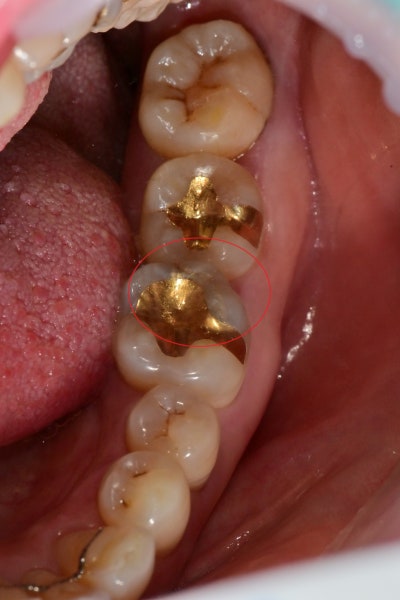
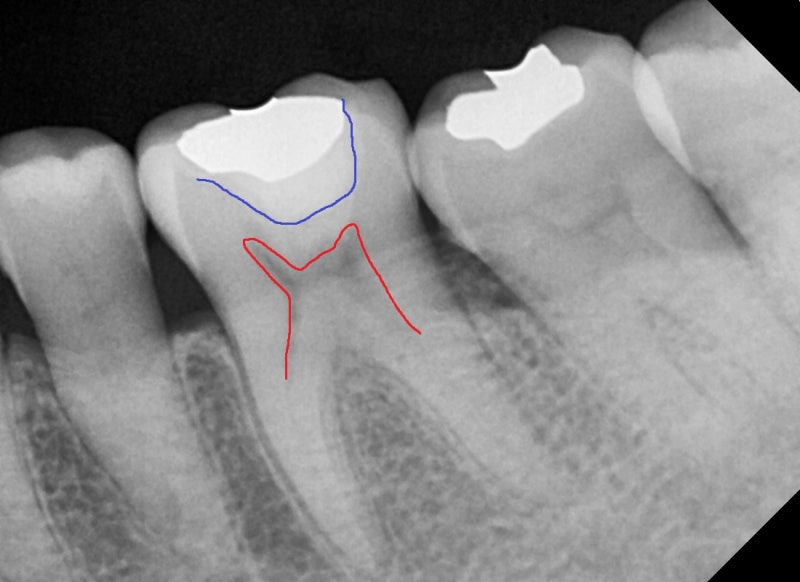
Looking at the photo on the right, it appears that a deep cavity was treated when the patient first received treatment in the past.
The red line indicates the upper boundary of the tooth nerve, and the blue line shows the boundary of the filling material beneath the gold inlay.
From the image, it is estimated that about 1mm of distance would remain after removing the old filling material.
I explained to the patient that we would remove the gold inlay and the underlying decay, and if it was too deep, we would first use MTA to calm the area close to the nerve and treat the tooth with a crown without root canal treatment.
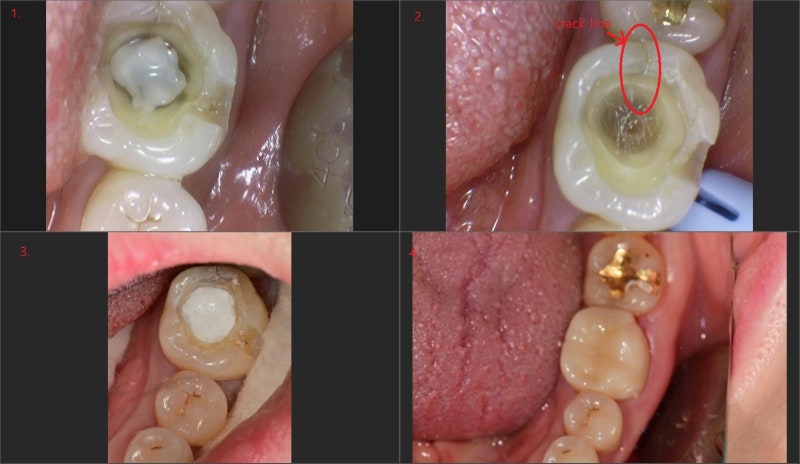
This photo shows the area after removing the old gold inlay and all the underlying decay.
Photo 1 is before removing the old restorative material that filled the underlying base space.
After thorough removal and inspection, we could see that the crack had progressed from the distal side of the tooth to the center.
Fortunately, the nerve was not exposed when only clean tooth structure remained, but because the distance to the nerve was close, we performed a procedure using MTA to calm the nerve.
Finally, since there was no sensitivity or pain when the final prosthesis was placed, we bonded the prosthesis without any special additional treatment.
For a cracked tooth, crown treatment is recommended in most cases to slow down the progression, and in some cases, root canal treatment may also be necessary.
While crown prosthetic treatment does not guarantee permanent soundness, it is a necessary treatment to delay the onset of symptoms as much as possible.
Frequently Asked Questions
How are cracked teeth treated?
For cracked teeth, crown treatment is recommended in most cases to slow down the progression. In some cases, root canal treatment may also be necessary.
When is MTA used?
MTA can be used when treating an area close to the nerve, even if the nerve is not exposed, or for the purpose of calming the nerve.
Can cavities develop under old gold inlays?
Yes, secondary decay can occur beneath old gold inlays. In this case, a deep cavity was found under the gold inlay and was removed before proceeding with treatment.
Does sensitivity disappear after cracked tooth treatment?
Yes, in this case, after MTA treatment, there was no sensitivity or pain when the final prosthesis was placed, and the prosthesis was bonded without any special additional treatment.
Does crown treatment make a cracked tooth permanently sound?
No, crown prosthetic treatment does not guarantee permanent soundness. However, it is a necessary treatment to delay the onset of symptoms as much as possible.