2026-07-20
Why Do Pre-LASIK Exams Determine Surgical Success Rates? Gangnam Station Eye Clinic Recommendation | Event in Progress
Pre-LASIK exams are crucial for surgical success, ensuring safety and satisfaction by precisely analyzing eye conditions and preventing complications.

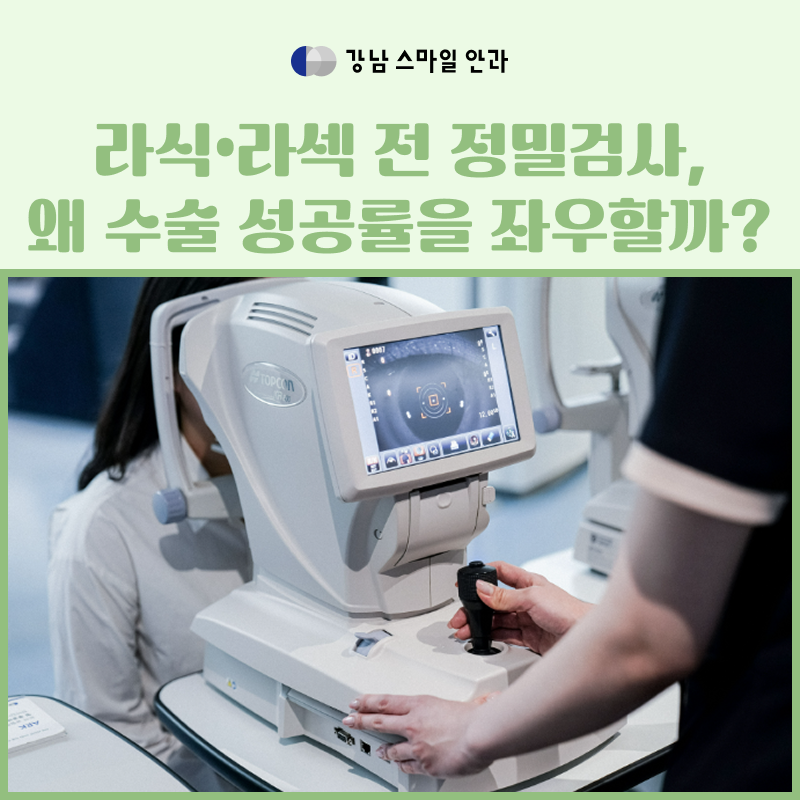
Hello, this is Gangnam Smile Eye Clinic 😊💙
When deciding on vision correction surgery,
many people experience both anticipation and worry.
‘What if the surgical results don’t meet my expectations?’
‘What if I experience side effects?’
‘What if it hurts a lot?’ etc.
Anxiety is a natural emotion that anyone can feel.
To reduce this anxiety,
the most crucial step to enhance surgical safety and satisfaction is
a precise pre-operative examination.
Surgery is not merely a procedure to improve vision based on preference,
but rather, it must be performed in a manner most suitable for the individual’s eye condition
after a precise analysis.
Therefore, a precise pre-operative examination goes beyond a simple preliminary check;
it is a core process that determines the direction of the surgery and significantly impacts the outcome.
Today, we will delve into why precise examinations are important,
and how they relate to the success rate of surgery,
step by step.
Gangnam Station Eye Clinic Recommendation: The Importance of Precise Pre-LASIK/LASEK Exams

Since everyone’s eye structure and condition are different,
when considering vision correction surgery, it is essential to undergo a precise examination to
meticulously measure corneal thickness and shape, degree of refractive error, pupil size, presence of optic nerve diseases, etc.
Through these tests, we can determine if surgery is possible and
decide on the most suitable surgical method for the individual’s eyes.
Since vision correction surgeries like SMILE LASIK and LASEK differ in their methods,
choosing the surgery that matches your eye condition is paramount.
Precise examinations do not just determine whether surgery can be performed;
they also play a key role in enhancing surgical safety.
For example, through corneal thickness examination, rare post-operative side effects like
‘corneal ectasia’ can be prevented in advance, and by precisely analyzing the anterior and posterior corneal shapes,
various complications that may arise after surgery can be predicted and prevented.
Especially in cases of hereditary corneal diseases like ‘Avellino corneal dystrophy’,
side effects such as corneal opacity or vision loss may occur after surgery,
so prior confirmation is absolutely necessary.
Since this disease sometimes has no external symptoms and is difficult to detect with the naked eye,
it is very important to determine its presence through genetic testing.
Only by undergoing these procedures can the safety and effectiveness of the surgery be enhanced,
and a more precise surgical plan tailored to each individual can be established.
Gangnam Station Eye Clinic Recommendation: Items to Check During Pre-Operative Examination

To ensure the safety of vision correction surgery, a variety of precise examinations are conducted to
comprehensively evaluate the overall condition of the eye.
Instead of merely judging the possibility of surgery based on vision or refractive status,
a precise examination is performed across the entire internal structure of the eye, including the cornea, lens, optic nerve, and macula.
This allows for the early detection and treatment of any ophthalmic diseases.
In fact, among patients who visit Gangnam Smile Eye Clinic, recommended near Gangnam Station,
it is not uncommon for eye diseases to be discovered when they come for vision correction surgery.
MONSTA X’s Shownu was diagnosed with ‘left retinal detachment’ during a pre-LASIK examination and underwent emergency surgery. His agency, Starship Entertainment, announced this via official SNS (social networking service) on the 3rd. Starship explained, “Shownu underwent a preliminary examination at an ophthalmology clinic on the 2nd for his scheduled LASIK surgery, and after a finding of an abnormality in his retina, he underwent a precise examination. The precise examination diagnosed ‘left retinal detachment,’ and as surgery was unavoidable, an emergency operation was performed this afternoon (3rd).” Retinal detachment is a common condition occurring in about 1 in 10,000 people annually, referring to a pathological state where the retina separates and lifts from the inner wall of the eyeball. When the retina detaches, nutrient supply is impaired, leading to a decrease in photoreceptor function. If this condition persists, permanent retinal atrophy can occur, leading to eyeball shrinkage or even blindness. CBS Nocut News Reporter Kim Su-jeong _ Idol’s Retinal Detachment Case
Refractive errors such as myopia, astigmatism, and hyperopia
directly affect the location and extent of corneal ablation.
By accurately identifying the degree of refractive error through precise examination,
the depth and extent of corneal tissue to be ablated by the laser can be safely determined.
Furthermore, pupil size is also an important factor,
as it helps predict the possibility of night glare or
halo phenomena after surgery.
*Halo phenomenon: Primarily occurs during night driving, where streetlights and vehicle lights appear diffused,
or when looking at bright lights, a circular halo appears.
In other words, to minimize post-operative side effects and
achieve stable vision correction results,
it is an essential process to establish a surgical plan based on individual eye data obtained from precise examinations.
Therefore, if you are considering vision correction surgery,
it is advisable to first undergo a precise examination to accurately understand your eye condition,
and then consult with medical staff to determine the most suitable surgical method.
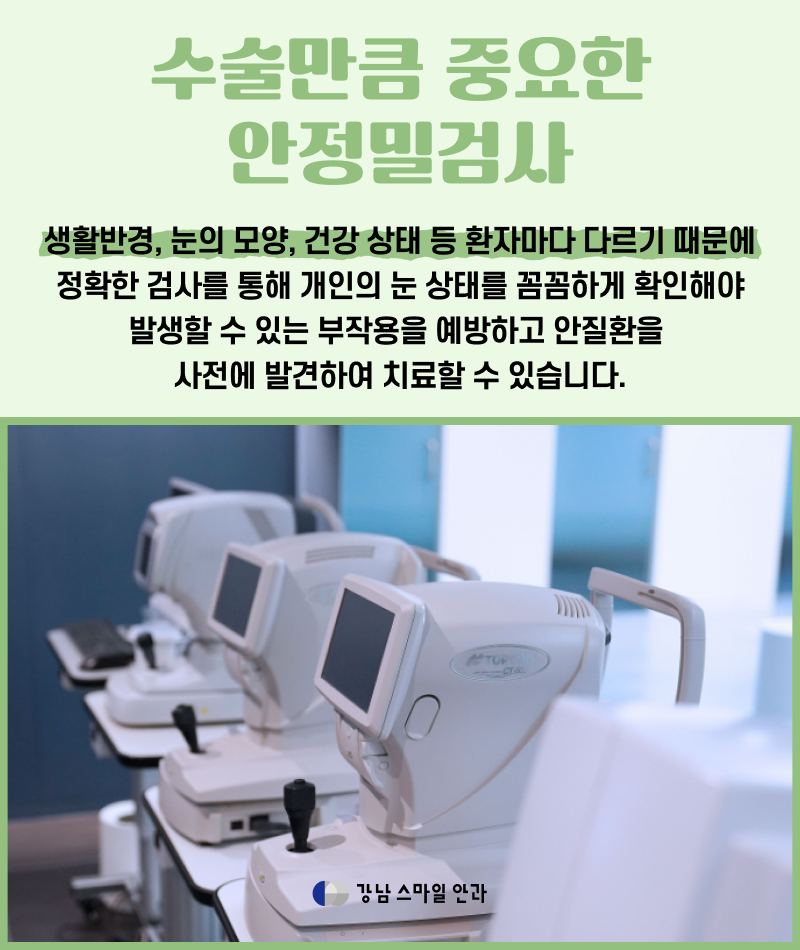
Surgery can resolve inconvenient vision problems in daily life,
but its starting point is an accurate precise examination.
If a precise pre-operative examination is not thoroughly conducted,
it can lead not only to unsatisfactory results,
but also to long-term side effects.
Conversely, if a thorough precise examination is performed
and a suitable surgical method is found for you,
you can expect safe and satisfactory results.
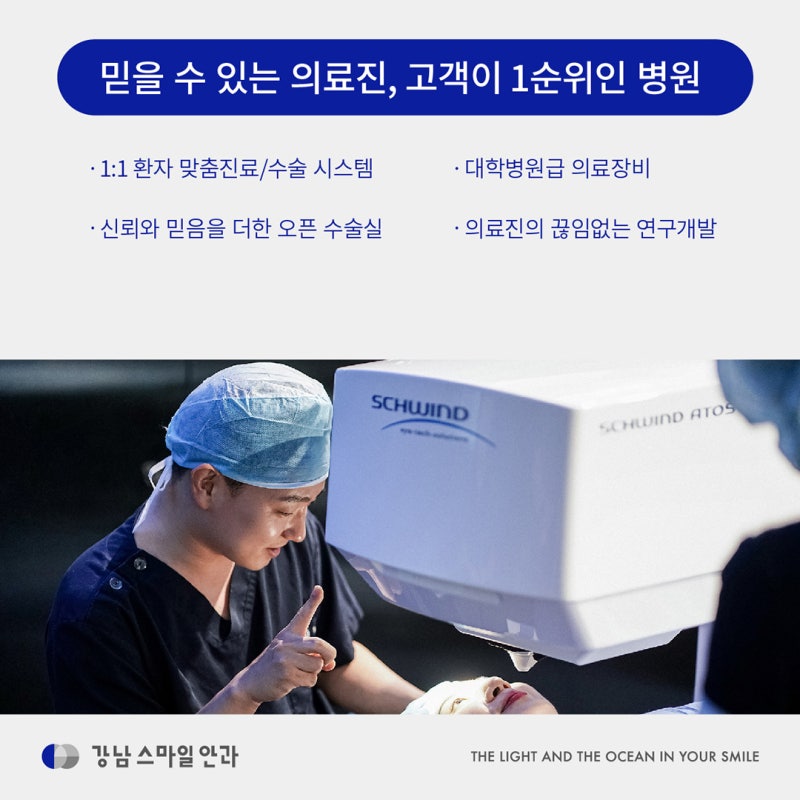
At Gangnam Smile Eye Clinic, recommended near Gangnam Station,
we conduct over 70 precise examinations using university hospital-level equipment.
(Event in progress)
If you are considering vision correction surgery,
we recommend that you first accurately assess your eye condition through a precise examination before surgery,
and have a thorough consultation with the medical staff.
Our clinic is equipped with the latest equipment and a systematic examination system,
and we treat each patient with sincerity through 1:1 customized consultations and surgeries.
Furthermore, we always prioritize the patient
and place transparency and safety above all else.
If you have any questions about LASIK/LASEK examinations/consultations at Gangnam Station Eye Clinic,
please feel free to ask in the comments at any time.
💙🤍 𝖦𝖠𝖭𝖦𝖭𝖠𝖬 𝖲𝖬𝖨𝖫𝖤 𝖤𝖸𝖤 𝖢𝖫𝖨𝖭𝖨𝖢💙🤍
𝗧𝗛𝗘 𝗟𝗜𝗚𝗛𝗧 𝗔𝗡𝗗 𝗧𝗛𝗘 𝗢𝗖𝗘𝗔𝗡 𝗜𝗡 𝗬𝗢𝗨𝗥 𝗦𝗠𝗜𝗟𝗘


Gangnam Station Eye Clinic Recommendation Gangnam Station Eye Clinic Recommendation Gangnam Station Eye Clinic Recommendation Gangnam Station Eye Clinic Recommendation Gangnam Station Eye Clinic Recommendation Gangnam Station Eye Clinic Recommendation











Frequently Asked Questions
Why are precise pre-operative examinations important for vision correction surgery?
Precise pre-operative examinations are the most crucial step in enhancing the safety and satisfaction of vision correction surgery. They play a key role in precisely analyzing an individual's eye condition to determine the most suitable surgical method and prevent potential post-operative side effects.
What items are checked during a precise examination?
During a precise examination, we meticulously measure corneal thickness and shape, degree of refractive error, pupil size, and the presence of optic nerve diseases. Additionally, we evaluate the overall internal structure of the eye, including the cornea, lens, optic nerve, and macula, to check for any ophthalmic diseases.
What side effects can be prevented through a precise examination?
A precise examination can prevent side effects such as ‘corneal ectasia’ through corneal thickness measurements, and predict and prevent various complications through corneal shape analysis. Specifically, it can reduce side effects by identifying hereditary conditions like ‘Avellino corneal dystrophy’ in advance.
Can eye diseases be discovered during a precise examination?
Yes, it is possible. In fact, it is not uncommon for eye diseases to be discovered in patients who visit for vision correction surgery. There have been cases, like MONSTA X’s Shownu, where retinal detachment was diagnosed, highlighting the importance of checking for diseases before surgery.
Why is pupil size examination necessary?
Pupil size examination helps predict the possibility of night glare or halo phenomena that may occur after surgery. This allows for the development of a surgical plan that minimizes side effects and achieves stable vision correction results.