2026-09-10
Who is PanOptix Pro Recommended For? Differences Between Monofocal and Multifocal IOLs
Compare monofocal and multifocal intraocular lenses for cataract surgery and discover who benefits most from the next-generation PanOptix Pro trifocal IOL by Alcon at Gangnam Smile Eye Clinic in Seoul, South Korea with comprehensive surgical guidance and lens comparisons for informed decisions and clear outcomes today without hesitation or delay anytime soon for clarity today throughout life entirely everywhere effortlessly altogether seamlessly right now always consistently flawlessly every day


Hello, this is Gangnam Smile Eye Clinic :)
If you have cataract surgery ahead,
you will face surprisingly many choices.
“Doesn’t cataract surgery simply improve eyesight?”
“Are there really several types of intraocular lenses (IOLs)?”
“Between monofocal and multifocal lenses, which one suits me best?”
In particular, interest has recently grown around PanOptix Pro,
an advanced iteration of existing multifocal intraocular lenses.
However, rather than simply picking the newest product on the market,
it is crucial to choose an IOL based on your daily lifestyle, desired vision range,
and overall ocular condition.
Today, let’s explore the differences between monofocal and multifocal IOLs,
and examine who might be an ideal candidate for PanOptix Pro.
Why do we choose an intraocular lens during cataract surgery?
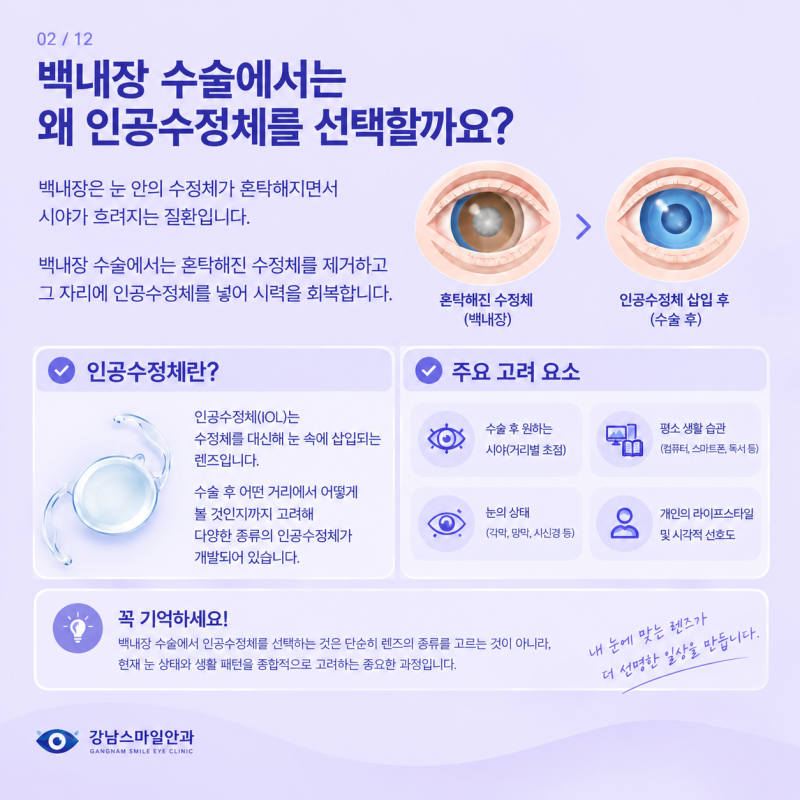
A cataract is a condition where the natural crystalline lens inside the eye becomes cloudy, causing blurry vision.
During cataract surgery, this clouded natural lens is removed,
and an artificial intraocular lens (IOL) is inserted in its place to restore clear sight.
Therefore, cataract surgery is not merely about removing the clouded lens;
it involves selecting an IOL based on the distances and visual clarity you wish to achieve post-surgery.
At this stage, the two primary options compared
are monofocal and multifocal intraocular lenses.
Monofocal vs. Multifocal IOLs: What is the difference?

① Monofocal Intraocular Lens
As the name suggests, a monofocal IOL
is a lens designed to correct vision at a single primary focal distance.
Typically, it is focused on distance vision.
In this case, while distant objects can be seen relatively comfortably without glasses after surgery,
reading glasses are usually required for near tasks
such as looking at books or smartphones.
Key characteristics include:
Focused on sharp clarity at a single distance
Considered when everyday life primarily revolves around distance tasks
Glasses may be necessary when viewing nearby objects
Relatively economical surgical cost
② Multifocal Intraocular Lens
On the other hand, a multifocal IOL is engineered not for just one distance,
but to provide functional vision across multiple distances.
Typically, it incorporates distance, intermediate, and near vision concurrently.
Hence, patients seeking to minimize post-operative dependence on glasses
often consider multifocal IOLs.
For instance, if your routine regularly involves viewing objects across various ranges such as:
Watching TV at a distance
Viewing a computer screen at intermediate distance
Looking at smartphones or reading books up close,
a multifocal IOL can serve as a viable option.
However, multifocal lenses are not suitable for everyone.
Due to their optical design, some patients may experience
visual phenomena such as glare or halos around lights,
and perceived outcomes vary depending on individual eye conditions and adaptation capacity.
Consequently, one should never simplify the choice as ‘multifocal is unconditionally better than monofocal.’
What kind of lens is PanOptix Pro?
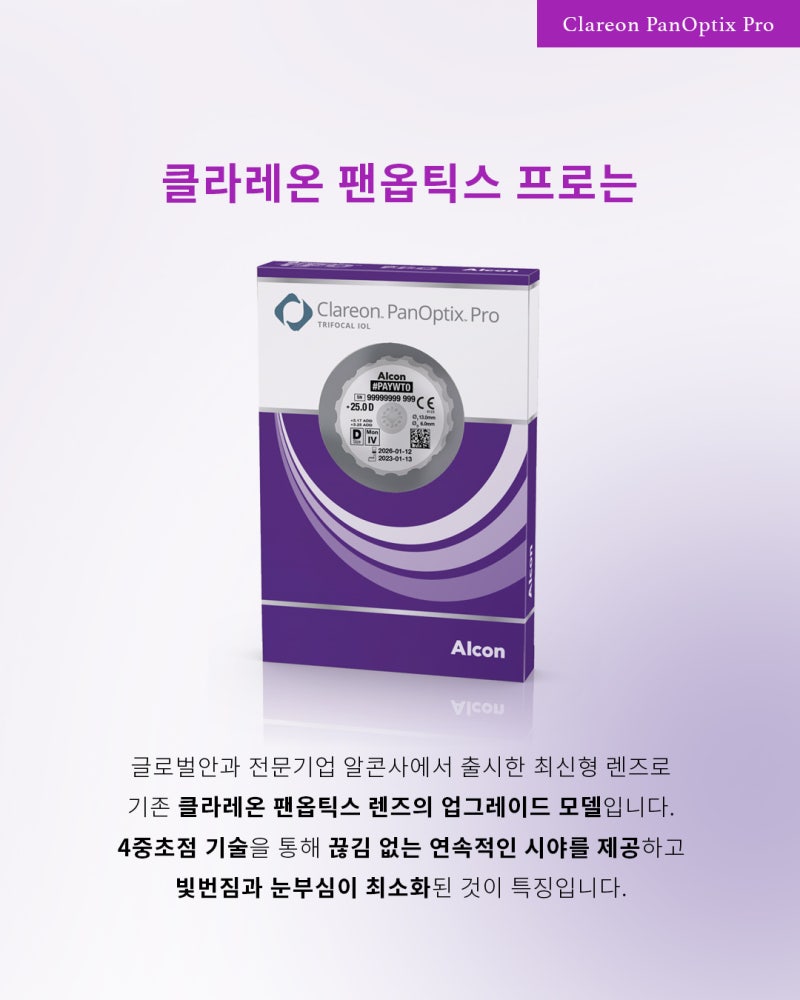
PanOptix Pro is
a quadrifocal-based design multifocal IOL developed by Alcon.
Belonging to the multifocal family, it is engineered
to provide an expansive visual range encompassing distance, intermediate, and near vision post-cataract surgery.
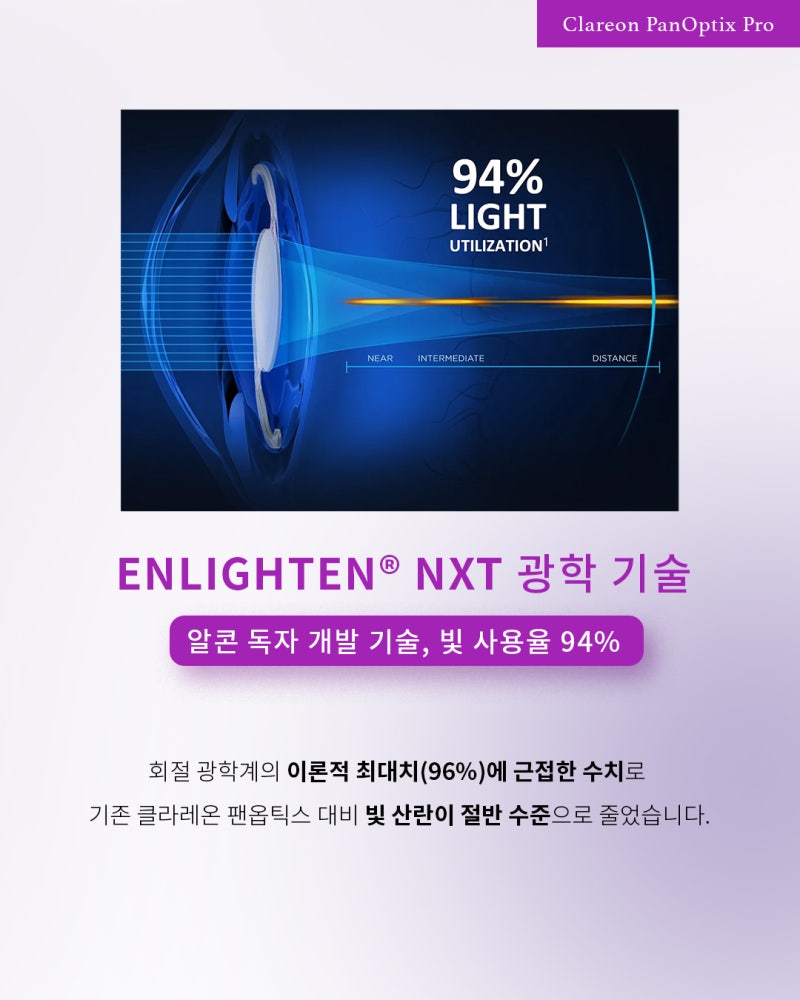

While retaining the proven trifocal visual profile of the original PanOptix,
it integrates ENLIGHTEN NXT optical technology
to significantly enhance light transmission efficiency.
Manufacturer data indicates that while the original PanOptix offered 88% light utilization,
PanOptix Pro achieves 94%,
thereby reducing optical light scatter from 12% down to 6%.
Rather than merely considering PanOptix Pro as “just a new multifocal lens,”
it is best understood as a next-generation trifocal IOL with optimized optical design,
preserving the broad multi-distance advantages of PanOptix while enhancing visual quality.
PanOptix Pro is recommended for individuals who:

Naturally, the most pressing question is:
“So, who is PanOptix Pro best suited for?”
PanOptix Pro can be an optimal choice for individuals desiring the following lifestyle conveniences:
① Those wishing to reduce post-operative dependence on glasses
This is one of the primary reasons for choosing a multifocal lens.
Because it is engineered to cover distance, intermediate, and near vision seamlessly,
patients can expect to significantly cut down reliance on glasses during daily activities.
② Those who frequently use smartphones and computers,
or regularly drive and cook
Nowadays, people spend extensive time on smartphones or tablets even after retirement,
and many actively use computers for hobbies or social engagements.
If your day alternates continuously between far, intermediate, and near vision,
a multifocal IOL designed for continuous ranges is worth serious consideration.
③ Those who frequently read or perform detailed near-range tasks
For activities requiring close-up vision such as reading books or checking phones,
multifocal lenses are an attractive option.
PanOptix Pro presents clinical data aimed at delivering
functional near vision down to a comfortable reading distance of approximately 33 cm.
*Individual visual acuity and the need for reading glasses can vary.
④ Those who wish to see objects at multiple distances without glasses post-surgery
While monofocal IOLs focus on a predetermined distance,
trifocal IOLs like PanOptix Pro
aim to secure a comprehensive field of view across far, intermediate, and near distances.
Therefore, if your visual demands change constantly throughout the day
and you prefer freedom from spectacles, a consultation for multifocal IOLs is well warranted.
Is PanOptix Pro suitable for everyone?
Not necessarily.
This is the most critical consideration when selecting an intraocular lens.
While multifocal IOLs offer the major benefit of vision across multiple ranges,
they do not guarantee identical outcomes for every individual.
In particular, if there are pre-existing structural issues in the retina, macula, or optic nerve,
a multifocal lens may not be advisable.
Additionally, patient sensitivity to potential visual phenomena,
such as nighttime glare or halos, must be factored in.
Thus, rather than deciding based solely on the idea that
“it is the latest lens, so it must be better,”
it is vital to holistically assess:
Current eye health + Lifestyle patterns + Desired visual ranges
+ Expectation of spectacle independence + Tolerance for optical side effects.
Monofocal vs. PanOptix Pro: How do they compare?

A brief comparison is outlined below:
| Monofocal IOL | PanOptix Pro |
Primary Focus | Single focal point | Distance, Intermediate, Near |
Distance Vision | Aimed at sharp distance clarity | Provides clear distance vision |
Intermediate Vision | Glasses may be required | Aimed at functional intermediate vision |
Near Vision | Reading glasses typically needed | Aimed at functional near vision |
Glasses Dependence | Required depending on task | Aimed at minimizing reliance |
Key Considerations | Willingness to wear reading glasses | Ocular health & optical sensitivity |
It cannot be definitively stated that one lens is universally superior.
For someone who rarely uses mobile devices or reads books and primarily focuses on far distances,
a monofocal IOL can deliver highly satisfactory results.
Conversely, for individuals whose routines demand fluent shifts across multiple distances
and wish to maximize life without glasses, multifocal lenses are strongly recommended for consideration.
Before choosing PanOptix Pro, evaluating eye health comes first

Because an intraocular lens remains in the eye permanently once implanted,
decisions should not be based solely on product features;
a thorough pre-operative examination is essential to inspect the eye’s structural health.
Evaluating the cornea, retina, macula, and optic nerve,
along with assessing baseline visual acuity, refractive state, and personal lifestyle habits, is necessary.
When considering multifocal IOLs, it is vital to pair the desire for
“seeing clearly across all distances”
with a comprehensive understanding of their optical design and the potential
visual sensations that can emerge after surgery.
Discover if PanOptix Pro is the right fit for your eyes

PanOptix Pro is an enhanced multifocal IOL that builds upon
the proven trifocal profile of the original PanOptix with improved optical light transmission efficiency.
It presents a compelling alternative for those desiring a broad visual spectrum across distance, intermediate, and near ranges,
and who wish to reduce reliance on corrective glasses post-cataract surgery.
However, multifocal lenses are not universally the best option for every patient.
The most suitable lens for your eyes depends far less on brand fame
and far more on current ocular health, lifestyle habits, and visual goals.
If you are preparing for cataract surgery and weighing monofocal versus multifocal IOLs,
start by undergoing a precise ocular examination followed by in-depth clinical consultation.
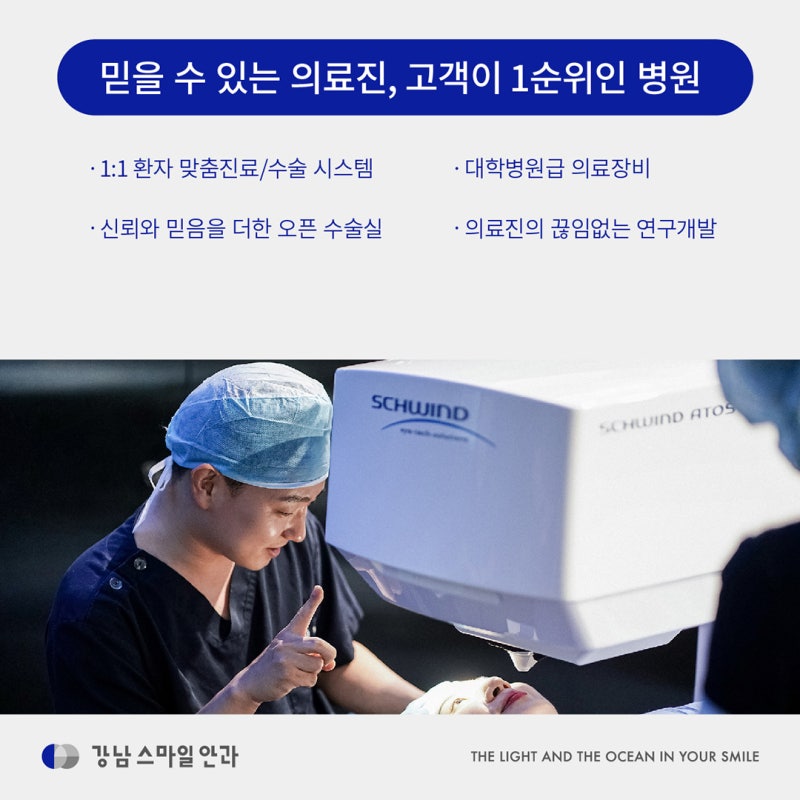
At Gangnam Smile Eye Clinic, we provide detailed consultations
to help you choose the ideal intraocular lens based on your unique eye conditions and daily routine.
If you have questions regarding PanOptix Pro or other premium IOL options,
take the time to thoroughly assess which solution will serve your eyes best.
💙 For SMILE Surgery, Trust Gangnam Smile Eye Clinic 💙
💙🤍 𝖦𝖠𝖭𝖦𝖭𝖠𝖬 𝖲𝖬𝖨𝖫𝖤 𝖤𝖸𝖤 𝖢𝖫𝖨𝖭𝖨𝖢💙🤍
𝗧𝗛𝗘 𝗟𝗜𝗚𝗛𝗧 𝗔𝗡𝗗 𝗧𝗛𝗘 𝗢𝗖𝗘𝗔𝗡 𝗜𝗡 𝗬𝗢𝗨𝗥 𝗦𝗠𝗜𝗟𝗘



Frequently Asked Questions
What is the biggest difference between monofocal and multifocal IOLs?
The primary difference lies in the focal range and dependence on glasses. Monofocal IOLs focus on a single distance (typically distance vision), requiring reading glasses for close-up tasks, whereas multifocal IOLs provide functional vision across distance, intermediate, and near ranges, substantially lowering reliance on spectacles after surgery.
How does PanOptix Pro differ from the conventional PanOptix?
It enhances optical efficiency to reduce light scatter that can trigger glare and halos. PanOptix Pro incorporates ENLIGHTEN NXT technology, elevating light utilization from 88% to 94% and lowering optical scatter from 12% to 6%, engineered to deliver crisper visual clarity across various focal distances.
Who is PanOptix Pro recommended for?
It is well-suited for individuals seeking to minimize glasses dependence during varied daily activities like smartphone browsing, computer work, and driving. Designed to support close vision down to roughly 33 cm, it offers an appealing choice for those performing reading and detail work alongside standard distance demands.
Can all cataract patients receive PanOptix Pro?
No, suitability depends on individual ocular health. Patients with underlying pathologies affecting the retina, macula, or optic nerve, or those sensitive to visual phenomena such as glare and halos, may not be ideal candidates. A comprehensive pre-operative examination and professional consultation are essential.