2026-07-20
What is the Golden Time for Appropriate Cataract Surgery According to Cataract Type?
Cataracts are a common eye disease that can lead to blindness if not treated surgically at the right time. The optimal timing for surgery varies depending on the type of cataract, as each type has different progression rates and risks.


Hello, this is Gangnam Smile Eye Clinic 😊
Cataracts are one of the most common ophthalmic diseases that occur with aging.
Initially, they may feel like simple vision deterioration, but as they progress,
they are characterized by blurred vision or difficulty accurately distinguishing the shape and color of objects.
If cataracts progress to a certain point, they can lead to blindness,
so surgical treatment is required at the appropriate time.
In particular, there are several types of cataracts,
and since the progression rate and risk of symptoms differ for each type of cataract,
it is necessary to preserve vision by observing the appropriate ‘golden time’ for treatment according to each cataract type.
From now on, we will find out at what point surgery is needed for each type of cataract,
and in which cases immediate surgery is required.
Types of Cataracts

Cataracts are broadly classified into
nuclear sclerotic cataracts, cortical cataracts, posterior subcapsular cataracts, and congenital cataracts.
Among them, nuclear sclerotic cataracts are the most common form,
accounting for most cataracts.
Nuclear sclerotic cataracts occur as the central part (nucleus) of the lens
gradually hardens and yellows with age.
Initially, myopia appears and vision slowly deteriorates, but the progression rate is slow,
so surgery is often required when vision correction is needed.
The ‘golden time’ for surgery is when corrected vision drops below 0.6.
Cortical cataracts start from the outer cortex of the lens and spread as radial opacities,
characterized by glare, light sensitivity, and visual distortion.
In such cases, the onset of night vision deterioration is the opportune time for surgery.
Posterior subcapsular cataracts involve opacities forming in the posterior capsule (back part) of the lens,
accompanied by decreased near vision and severe glare, and progress very rapidly.
Located in the center, they significantly affect vision from the early stages,
and if uncomfortable symptoms occur in the eye, immediate surgery should be performed.
Congenital cataracts are cataracts present at birth or occurring in childhood,
a condition where lens opacification affects proper vision development.
There is a risk of causing permanent vision damage during the critical period of vision development,
so it is advisable to perform surgery within 6 months of birth if necessary.
What is an effective cataract treatment?
The fundamental treatment for cataracts is to remove the clouded lens
and insert an intraocular lens (IOL) in its place.
This fundamentally resolves the cause of vision deterioration and simultaneously corrects myopia, hyperopia, and astigmatism.
Customized IOLs allow for correction tailored to each patient's individual vision needs.
The advantage of IOLs is that they are stable long-term and cataracts do not recur,
meaning they can be used for life.
What are the advantages and features of the Tecnis PureSee intraocular lens?
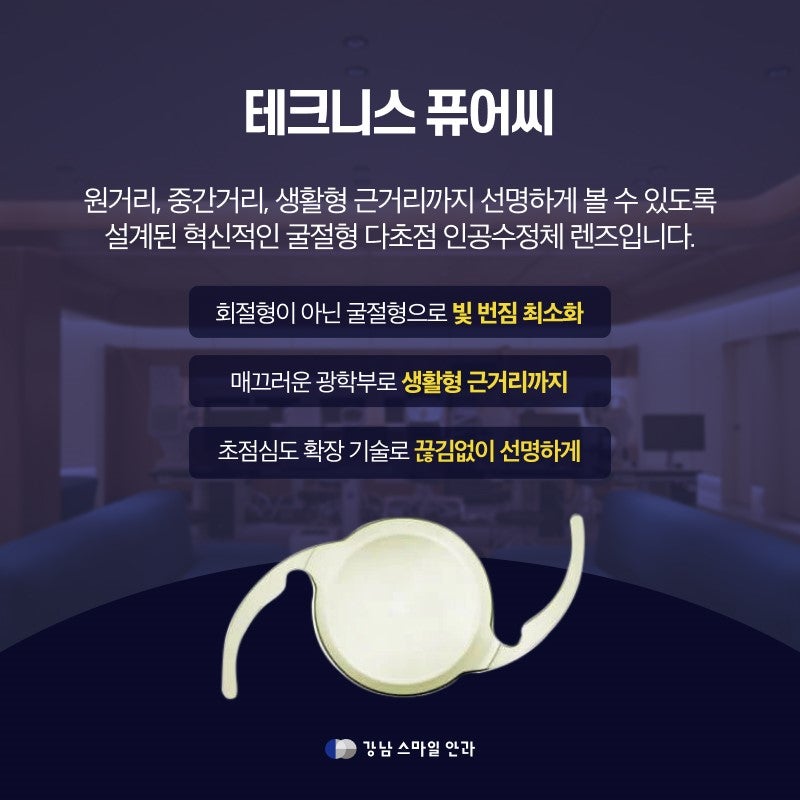
Compared to existing intraocular lenses, the Tecnis PureSee intraocular lens
adopts an advanced aspheric design, significantly improving night vision and contrast sensitivity,
with the advantage of greatly reducing glare and light sensitivity.
Equipped with a violet (UV) filter, it minimizes light scattering,
allowing for blue light and UV protection without wearing sunglasses.
It is characterized by providing clear vision both day and night,
and by improving color differentiation, all colors are accurately focused on the retina, providing vivid color perception.
Tecnis PureSee is made of a durable polymer hydrophobic material, so there is almost no deformation even with long-term use,
and it minimizes corneal inflammatory reactions, resulting in a significantly lower probability of postoperative complications compared to other IOLs.
For cataract patients with astigmatism, choosing the Toric model of Tecnis PureSee
can achieve stable vision after surgery without additional astigmatism correction.
Thanks to these characteristics, Tecnis PureSee not only aids in vision recovery after cataract surgery
but also excels in enhancing overall vision satisfaction in daily life,
going beyond simply removing cataract opacities to provide clear and stable vision,
helping patients experience the highest quality of vision.
Cataracts are a complex disease where the timing of surgery must be determined differently depending on the type,
but if appropriate treatment is received at the precise ‘golden time’, vision recovery is possible without problems.
In particular, choosing a premium intraocular lens, such as the latest Tecnis PureSee,
can lead to even better vision results.
For eye health, please regularly check your eye condition,
and if cataracts are suspected, visit an ophthalmologist to ensure you don't miss the optimal treatment time.
Gangnam Smile Eye Clinic is equipped with advanced equipment comparable to university hospitals
and a systematic examination system, always treating each individual
with sincerity during examinations and surgeries.
We also always prioritize the patient
and place transparency and safety first.
💙🤍 𝖦𝖠𝖭𝖦𝖭𝖠𝖬 𝖲𝖬𝖨𝖫𝖤 𝖤𝖸𝖤 𝖢𝖫𝖨𝖭𝖨𝖢💙🤍
𝗧𝗛𝗘 𝗟𝗜𝗚𝗛𝗧 𝗔𝗡𝗗 𝗧𝗛𝗘 𝗢𝗖𝗘𝗔𝗡 𝗜𝗡 𝗬𝗢𝗨𝗥 𝗦𝗠𝗜𝗟𝗘





Frequently Asked Questions
When is the best time for cataract surgery?
The timing of cataract surgery varies depending on the type of cataract. While it may initially feel like vision deterioration, it can lead to blindness if it progresses, so it is important to preserve vision by observing the appropriate ‘golden time’ for each type of cataract.
When is the ‘golden time’ for nuclear sclerotic cataract surgery?
The ‘golden time’ for nuclear sclerotic cataract surgery is when corrected vision drops below 0.6. This type of cataract involves the hardening and yellowing of the central part of the lens, and its progression is relatively slow.
Why is immediate surgery necessary for posterior subcapsular cataracts?
Yes, immediate surgery is necessary for posterior subcapsular cataracts because they progress very rapidly and significantly affect vision from the early stages. This type of cataract involves opacities forming in the posterior capsule of the lens, accompanied by decreased near vision and severe glare.
When is it best to operate on congenital cataracts?
For congenital cataracts, it is advisable to perform surgery within 6 months of birth if necessary. This condition is present at birth or occurs in childhood and carries a risk of causing permanent vision damage during the critical period of vision development.
What are the advantages of the Tecnis PureSee intraocular lens?
The Tecnis PureSee intraocular lens significantly improves night vision and contrast sensitivity, greatly reducing glare and light sensitivity. It also blocks blue light and UV rays with a violet filter, is highly durable with minimal deformation during long-term use, and has a low probability of complications.