2026-07-22
Sinsa-dong Plastic Surgery: Which is Better for Double Eyelid Surgery, Incisional or Non-Incisional?
Choosing between incisional and non-incisional double eyelid surgery depends on individual eye conditions like skin thickness, fat, and muscle strength. A thorough consultation is crucial for natural results.
Sinsa-dong Plastic Surgery: Which is Better for Double Eyelid Surgery, Incisional or Non-Incisional?

Hello.
When researching double eyelid surgery, one of the first things people often consider is whether to opt for the non-incisional (suture/buried) method or the incisional method.
The non-incisional method is known to be relatively simple, while the incisional method is often thought to create a more defined line. Therefore, some people decide on the surgical method beforehand and then seek consultations.
However, double eyelid surgery requires a process of checking various factors together, rather than just deciding based on the name of the method. These factors include the thickness and laxity of the eyelid skin,
the amount of fat, the strength of the eye-opening muscles, and the presence or absence of existing lines.
This is because even with the same non-incisional or incisional technique, the appearance and recovery process can vary depending on the eyelid structure.

Eyelid Conditions to Check Before Deciding on the Surgical Method
When planning double eyelid surgery, it's beneficial to consider various conditions that make up your current eye shape, rather than simply choosing between non-incisional and incisional methods.
The way the line appears can differ depending on whether the eyelid skin is thin or thick, the amount of fat in the upper eyelid,
and the degree to which the skin covers the eye.
Additionally, it's important to check if you use a lot of force from your forehead or eyebrows when opening your eyes, if there's a difference in the size and height of your two eyes,
or if you have existing multiple folds or faint lines.
In particular, if the eye-opening strength is insufficient, even creating a double eyelid line can leave you with a stuffy or sleepy impression.
Conversely, if your eye-opening strength is fine but a lot of skin covers your eyes, you need to consider how to manage the excess skin.
If you're looking for information related to Sinsa-dong plastic surgery, it can be helpful to not only prepare photos of your desired line but also to organize any uncomfortable aspects of your current eye shape and your usual eye-opening habits.
This is because double eyelid surgery can lead to a natural impression only when the line's height, eyelid structure, and overall facial atmosphere are harmonized.
Double Eyelid Line Shape Must Also Be Considered.
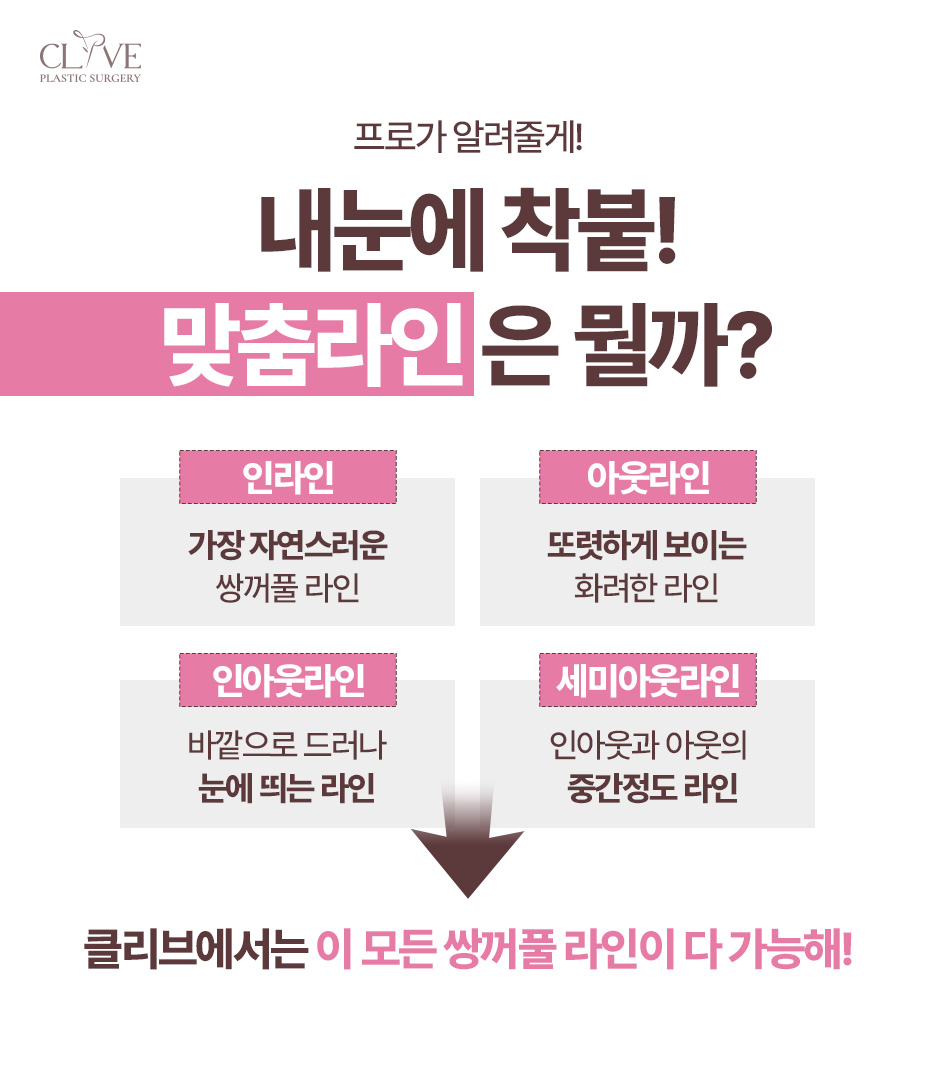
When considering double eyelid surgery, people often first look for various line shapes such as in-line, in-out line, semi-out line, and out-line.
However, the same line does not appear identical on everyone.
In-line | A shape where the double eyelid starts from the inner corner of the eye | |
In-out line | A shape that starts like an in-line at the front but becomes slightly more exposed towards the outer corner | |
Semi-out line | Characterized by the line appearing slightly more outward than an in-out line | |
Out-line | A shape where the line is clearly exposed from the very front of the eye | |
However, these distinctions are merely criteria for describing the shape of the line. Depending on the degree of the epicanthal fold, the thickness of the eyelid skin, the distance between the eye and eyebrow, and the strength of the eye-opening muscles, the actual appearance of the same line can vary.
Therefore, if you are considering double eyelid surgery at a Sinsa-dong plastic surgery clinic, it's important to not just decide on the name of your desired line, but to also confirm which line would naturally suit your current eye structure. Finding a direction that harmonizes with your eye shape and overall facial atmosphere, rather than trying to create a line identical to a desired photo, can help increase satisfaction.

Blepharoptosis Correction May Also Be Considered with Double Eyelid Surgery.
While double eyelid surgery alone can change the eye shape, blepharoptosis correction may also be considered for those with weak eye-opening strength.
This is because if the function of the muscles that lift the eyelid is insufficient, even with a double eyelid line, the eyes may still appear sleepy or create a stuffy impression.
Furthermore, if there's a habit of unconsciously using forehead muscles to open the eyes, forehead wrinkles may deepen, or one might easily feel fatigued.
However, blepharoptosis correction is not necessary for all double eyelid surgeries. Deciding whether to perform it together after comprehensively checking the degree of eye-opening strength, eyelid structure, and usual eye habits can help achieve natural results.
Non-Incisional and Incisional Methods: Not Just Different Recovery Times.
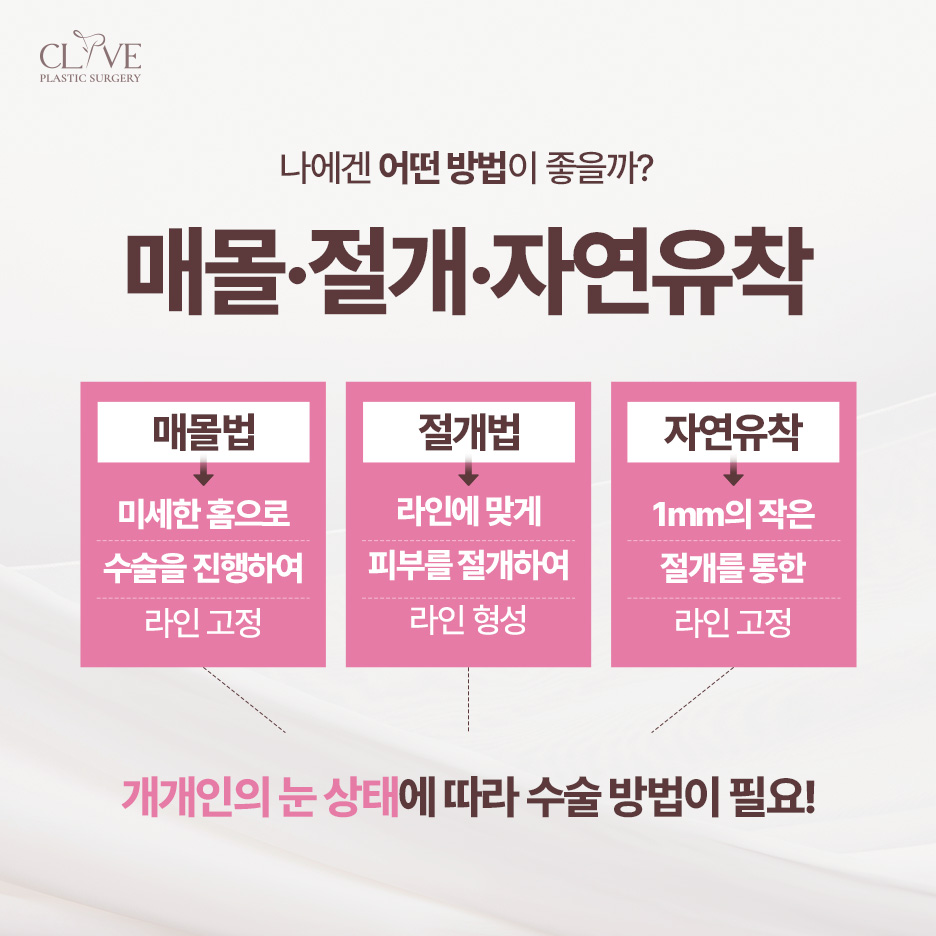
The non-incisional method can be described as creating a double eyelid line using small connection points without making a long incision in the skin.
It is typically considered when the eyelid skin is relatively thin, there isn't significant sagging, and the fat layer is not thick.
While some may feel less burdened by initial swelling or bruising due to the smaller incision area, this method is not suitable for all eyes.
If the skin is thick, the upper eyelid fat is prominent, or there is a lot of excess skin, there's also a possibility that the desired line may appear faint or loosen over time.
On the other hand, the incisional method involves incising the skin along the planned double eyelid line and forming the line while checking the internal eyelid tissues.
It may be considered in cases of skin sagging, when there's a need to adjust the thickness of fat and muscle, or when existing lines form multiple folds.
However, the incisional method does not guarantee a more defined and long-lasting result for everyone. Recovery patterns can vary depending on skin condition, scar response, and the desired line height. Therefore, when consulting at a Sinsa-dong plastic surgery clinic, it's important to not just hear about the advantages of the surgical method, but also to confirm the expected changes based on your own eyelid conditions.

Double Eyelid Surgery: Various Methods, But Eye Condition is the Selection Criterion.
Double eyelid surgery is often thought of as being simply divided into non-incisional and incisional methods,
but in reality, various methods can be utilized depending on the condition of the eyelids and the desired outcome.
For example, there are methods with different characteristics such as non-incisional buried suture, one-day natural adhesion, hybrid natural adhesion, minimal incision natural adhesion, and incisional natural adhesion.
The choice is made by comprehensively considering the thickness of the eyelid skin, the amount of fat, the degree of sagging, and the strength of the eye-opening muscles.
Non-incisional buried suture |
Non-incisional one-day natural adhesion |
Minimal incision hybrid natural adhesion |
Minimal incision natural adhesion |
Incisional natural adhesion |
If the skin is relatively thin and there isn't much sagging, methods with smaller incision areas can be considered. If there is a lot of excess skin or tissue correction is also needed, methods involving incisions may be reviewed. Furthermore, if previous double eyelids have loosened or if a more stable line needs to be maintained, the appropriate natural adhesion method or whether to use an incision can be determined based on the current eye condition.
Therefore, if you are considering double eyelid surgery at a Sinsa-dong plastic surgery clinic, rather than deciding on a specific surgical method first, it can be helpful to thoroughly confirm which method is suitable for your current eye structure before making a decision to achieve natural results. More important than the name of the surgical method is the process of finding a direction that matches your eyelid conditions and desired image.








Frequently Asked Questions
Which surgery is more suitable, non-incisional or incisional?
The surgical method depends on individual eyelid conditions. It is crucial to comprehensively assess factors like eyelid skin thickness, fat amount, eye-opening strength, and the presence of existing lines to determine the most suitable method for you. It's best to consult with an expert rather than deciding based solely on the method's name.
How should I choose the double eyelid line shape?
While there are various line shapes such as in-line, in-out line, semi-out line, and out-line, they do not appear the same on everyone. Considering factors like the degree of the epicanthal fold, eyelid thickness, the distance between the eye and eyebrow, and eye-opening strength to find a line that naturally suits your eye structure can help increase satisfaction.
Is blepharoptosis correction necessary for all double eyelid surgeries?
No, blepharoptosis correction is not necessary for all double eyelid surgeries. It may be considered if eye-opening strength is weak, as insufficient muscle function to lift the eyelid can make the eyes appear sleepy even with a double eyelid line. The decision is made after comprehensively checking eye-opening strength, eyelid structure, and habits.
What are the differences between non-incisional and incisional methods, besides recovery time?
The non-incisional method creates a double eyelid line using small connection points without a long incision, suitable for thin skin with minimal sagging. The incisional method involves incising along the planned line to adjust internal tissues, considered for skin sagging or when fat and muscle adjustment is needed. Each method can differ in results and longevity depending on eyelid conditions.
What eyelid conditions should be considered for double eyelid surgery?
When planning double eyelid surgery, it's essential to comprehensively assess eyelid skin thickness, upper eyelid fat amount, degree of skin sagging, eye-opening strength, use of forehead or eyebrows, differences in eye size, and presence of existing multiple folds. These conditions influence the line's shape and surgical outcome.
If I bring a photo of my desired double eyelid line, can the surgery replicate it exactly?
No, it's more important to find a direction that harmonizes with your eye shape and overall facial atmosphere than to create a line identical to a desired photo. The actual appearance can vary depending on individual eye structures, such as the epicanthal fold, eyelid thickness, and eye-opening strength.