2026-05-18
The Critical Difference Between PRP/Autologous Exosome Treatment and Hematopoietic Stem Cell Transplantation
PRP and autologous exosome treatments, derived from self-blood centrifugation, are fundamentally different in nature, purpose, and scientific basis from hematopoietic stem cell transplantation performed on leukemia patients. Standard PRP kits yielding 10-50cc of extraction contain no therapeutic quantity of hematopoietic stem cells (CD34+), and exosomes cannot be separated or purified by simple centrifugation alone. Before undergoing treatment, you must verify the actual contents—don't be misled

Hello,
This is Snuplastics.
"I'm treating you with stem cells extracted from your own blood."
"This is the latest autologous exosome treatment."
You hear these phrases frequently in cosmetic, orthopedic, and hair loss treatment clinics.
Lately, even the term 'autologous exosome' has emerged,
and since it's difficult to call blood extracts from PRP kit centrifugation 'stem cells,'
the industry is seemingly dodging the issue by rebranding with this new name.
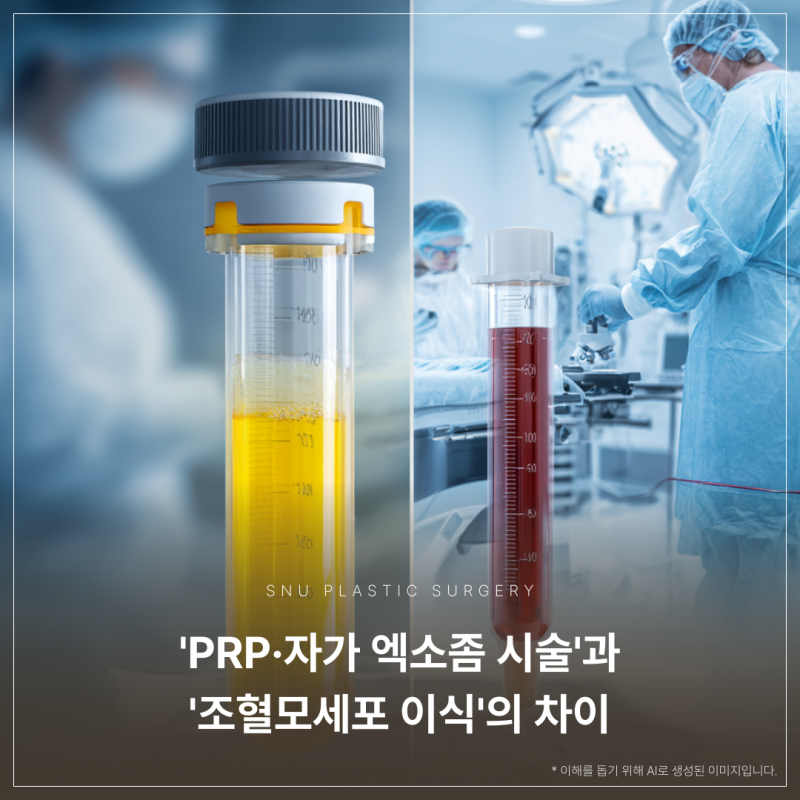
However, the actual hematopoietic stem cell transplantation that leukemia patients receive
and the PRP and autologous exosome treatments commonly performed in dermatology and orthopedic clinics
are only similar in name, but completely different in their actual substance, purpose,
and scientific foundation.
Today, let's clearly identify those differences
and discuss how dangerous the illusion of "stem cells in my blood" is,
as well as why 'autologous exosomes' represent another marketing term.
# Here's What Real 'Hematopoietic Stem Cell Transplantation' Actually Involves
Hematopoietic stem cell transplantation, performed on patients with severe blood cancers such as leukemia,
aplastic anemia, and lymphoma,
is nearly a last-resort treatment for survival.
① What Are Hematopoietic Stem Cells?
They are the root stem cells in our body
that produce all blood cells
(white blood cells, red blood cells, platelets).
They exist primarily in the bone marrow,
with only a tiny number present in peripheral blood.
② Collection Method and Quantity
The donor (usually another person or the patient themselves)
receives hematopoietic stem cell mobilization agents (G-CSF) for several days,
which causes stem cells from the bone marrow to be released in large numbers into the bloodstream.
Afterward, through an apheresis machine over several hours,
5-10L or more of blood is circulated
to separate hematopoietic stem cells.
Alternatively, after general anesthesia, the bone (ilium) in the pelvis is punctured
hundreds of times to directly collect approximately 1L of bone marrow fluid.
③ Conditioning Therapy (Ablative Therapy)
Before transplantation, the patient undergoes total body irradiation or
high-dose chemotherapy to completely destroy existing cells in their bone marrow,
including cancer cells.
At this point, the patient has no immune function whatsoever and must receive
intensive care in a sterile environment for several weeks.
④ Hospitalization and Recovery
Sterile room isolation, antibiotics, and platelet transfusions are essential
until the transplanted hematopoietic stem cells begin creating new bone marrow.
Repeated bone marrow biopsies are performed to confirm engraftment.
👉🏻 In other words, real hematopoietic stem cell transplantation is
a life-or-death major medical procedure,
completely different in scale from simply
'drawing blood and centrifuging it.'
# What's Separated by PRP Kit Centrifugation Is NOT 'Stem Cells'
PRP (Platelet Rich Plasma)
is plasma obtained by centrifuging whole blood
to increase platelet concentration.
✅ The Reality of PRP Centrifugation
When 10-50cc of blood is centrifuged, it separates into
red blood cells, a layer of white blood cells and platelets, and plasma.
The PRP obtained contains
platelets and small amounts of white blood cells, monocytes, etc.
However, it contains no therapeutic quantity of
hematopoietic stem cells.
✅ Registration Status with HIRA (Health Insurance Review and Assessment Service)
Most centrifugation kits currently used in medical practice
are registered as 'Platelet Rich Plasma (PRP) Extraction Kits.'
These kits are not approved or licensed for purposes of
'stem cell separation' or 'exosome separation.'
👉🏻 Therefore, calling products obtained from these kits
'stem cells' or 'exosomes'
constitutes misleading overclaiming beyond the approved scope.
# How Many 'Hematopoietic Stem Cells' Are in Peripheral Blood?
In 100ml of peripheral blood from a healthy person,
the number of hematopoietic stem cells (CD34+ cells) is extremely small.
To obtain the quantity needed for actual hematopoietic stem cell transplantation,
G-CSF administration plus processing of tens of thousands to hundreds of thousands of times more blood is required.
📍 Why Can't You Get Meaningful Results from Less Than 1L of Collection?
Whether from bone marrow or peripheral blood,
you cannot secure the therapeutic quantity of stem cells needed for treatment
unless you collect at least 1L or more of bone marrow fluid or
process 5-10L or more of blood after mobilization.
At the 10-50cc level collected with PRP kits,
it is medically factual to say that therapeutic stem cells essentially don't exist.
📍 Risks and Need for Expert Supervision
in Large-Volume Collection
Collecting 1L or more of blood or bone marrow fluid at once
is not a simple procedure.
Without appropriate fluid replacement, large-volume phlebotomy can cause
hypovolemic shock, presenting symptoms including increased heart rate,
dropped blood pressure, cold clammy skin,
and decreased consciousness.
For adults, total blood volume is only about 6-7% of body weight,
so collecting large volumes without professional monitoring can cause
sudden drops in blood pressure and
even organ damage.
👉🏻 Therefore, genuine stem cell treatment requiring such large collection
must absolutely be performed under the direct supervision and instruction of a hematologic oncologist,
in a medical facility equipped to handle complications
(hypovolemic shock, severe thrombocytopenia, etc.).
If It's Your Own Blood, There's No Immune Rejection But...
That's correct.
Because autologous blood is used,
there is no immune rejection such as graft-versus-host disease (GVHD)
that occurs with transplants from others.
So, is it safe then?
Separate from safety concerns,
the key point is that cells don't exist in quantities
sufficient to be called 'stem cell treatment.'
It's like saying "I'll cook a bowl of rice from a single grain of rice from my own field."
It's not that the grain doesn't exist,
but it's woefully insufficient to produce a therapeutic effect.
# The Illusion Behind the Term 'Autologous Exosome'
Recently, some companies and treatment facilities have begun using
the term 'autologous exosome (exosome)'
instead of the term 'stem cell.'
Blood extracts from PRP kits are being packaged as
"exosomes secreted by stem cells."
✅ What Are Exosomes?
Exosomes are nano-sized small vesicles secreted by cells
that deliver intercellular signaling molecules.
Real exosome treatment requires culturing stem cells in large quantities,
then purifying and concentrating the exosomes they secrete—
advanced cell culture technology is needed.
✅ Can 'Autologous Exosomes' Come from PRP Kits?
It's nearly impossible.
Standard PRP kits cannot separate or purify exosomes through simple centrifugation alone.
To obtain exosomes, additional processes are required such as
ultracentrifugation, size exclusion chromatography, and ultrafiltration,
which cannot be performed with a single simple kit.
✅ Why Use the Term 'Autologous Exosome'?
Since the term 'stem cell' might create problems with regulatory authorities
or the medical community,
it's a strategy to package it with a similarly premium-sounding and scientific-seeming term.
From a consumer perspective, it's easy to mistakenly think,
"Is this newer technology than stem cells?"
But in reality, most cases are nothing more than
putting an 'exosome' label on PRP.
It's no different from "putting the label 'hydrogen water' on regular mineral water."
The terminology changes, but the substance remains at the PRP level.
# The Same 'Blood,' But Completely Different Paths
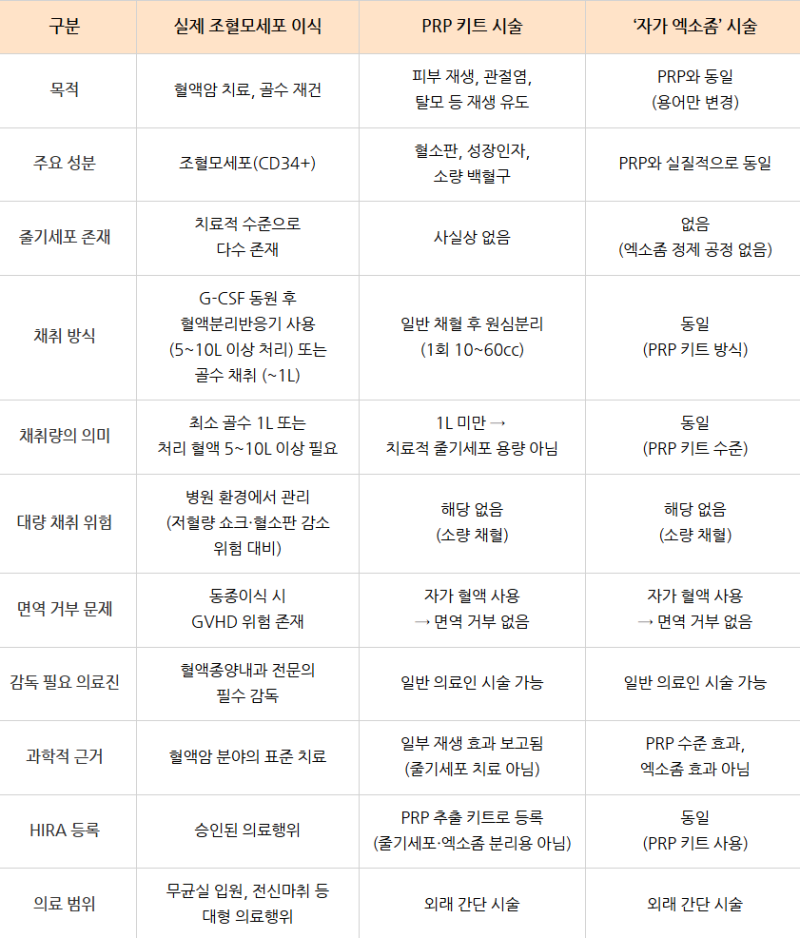
# Don't Be Deceived by Terminology
PRP treatment using autologous blood in itself is not inherently bad.
Growth factor-mediated regenerative induction effects from platelets
have been reported in some clinical settings.
However, calling it
'stem cell treatment' or packaging it with the term 'autologous exosome'
as if it were cutting-edge stem cell technology
is clearly false advertising.
As a consumer, you must remember the following points:
1. When you hear "stem cells in my blood,"
question whether there's 'therapeutic quantity of hematopoietic stem cells (CD34+ cells)
actually present.'
👉🏻 Standard PRP kits absolutely will not yield that quantity.
2. When you hear "autologous exosome,"
verify whether it's 'real exosomes that have undergone purification and concentration processing
or just PRP with a new name.'
👉🏻 In most cases, it's the latter.
3. If a hospital proposes to collect 1L or more of blood or bone marrow
and perform stem cell treatment,
be sure to verify that 'a hematologic oncologist is directly supervising
and that equipment and personnel are in place to address complications such as hypovolemic shock.'
👉🏻 If these conditions aren't met,
it's a dangerous procedure you shouldn't undergo.
4. Autologous procedures have no immune rejection,
but that doesn't make it 'stem cell treatment.'
👉🏻 Safety and efficacy are separate issues.

Stem cells are a truly captivating word.
But before paying high costs based on that single word
and holding inflated expectations,
Is what I'm about to receive the cells actually used in hematopoietic stem cell transplantation?
Or are they just cells with a stem cell name?
Please be sure to ask your medical team.
Understanding the true meaning behind each and every cell in our bodies
is the first step toward protecting your health!
https://www.instagram.com/snuplastics/
Website
📌 Kakao Talk Channel (Click the image below to go)

Frequently Asked Questions
Is PRP treatment stem cell therapy?
No, PRP treatment is not stem cell therapy. PRP is plasma obtained by centrifuging whole blood to increase platelet concentration. With 10-50cc of blood collection, no therapeutic quantity of hematopoietic stem cells (CD34+ cells) exists. Domestic PRP kits are registered only for platelet-rich plasma extraction and are not approved for stem cell separation purposes.
Is autologous exosome treatment real exosome therapy?
In most cases, it is not. Real exosome therapy requires culturing stem cells in large quantities and then purifying and concentrating the secreted exosomes through ultracentrifugation, size exclusion chromatography, ultrafiltration, and other methods. Simple centrifugation with standard PRP kits makes exosome separation and purification virtually impossible, and in many cases, it's just PRP with a renamed label.
How does real hematopoietic stem cell transplantation proceed?
Hematopoietic stem cell transplantation is a life-or-death major medical procedure. After G-CSF administration, an apheresis machine processes 5-10L or more of blood, or under general anesthesia, approximately 1L of bone marrow fluid is collected directly from the pelvis. The patient's existing bone marrow is then destroyed through whole-body radiation or high-dose chemotherapy, followed by intensive care in a sterile environment for several weeks.
Is autologous blood treatment safe?
In terms of immune rejection, it is safe. Since autologous blood is used, there is no immune rejection such as graft-versus-host disease (GVHD) that can occur with transplants from other sources. However, safety and efficacy are separate issues, and the core point is that cells don't exist in sufficient quantity to be called stem cell treatment.
What should I do if a hospital recommends large-volume phlebotomy for stem cell treatment?
You must verify expert supervision and safety equipment. For collecting 1L or more of blood or bone marrow fluid, direct supervision by a hematologic oncologist and equipment and personnel to address complications such as hypovolemic shock and severe thrombocytopenia are essential. If these conditions aren't met, it's a dangerous procedure you shouldn't undergo.
Is stem cell treatment possible with 10-50cc of peripheral blood?
It is not possible. The number of hematopoietic stem cells (CD34+ cells) in 100ml of peripheral blood from a healthy person is extremely small. To obtain the quantity needed for treatment, processing 5-10L or more of blood after G-CSF mobilization is required. At the 10-50cc level collected with PRP kits, it is medically accurate to say that therapeutic stem cells essentially don't exist.