2026-09-30
PanOptix Pro: What Distances Can You See, From Smartphones to Driving?
Discover how PanOptix Pro quadrifocal IOL covers near (40 cm), intermediate (60 cm), and distance vision for everyday tasks like reading and driving.


Hello. This is Gangnam Smile Eye Clinic. 😊💙
For those preparing for cataract surgery and exploring PanOptix Pro,
there is one question that is asked most frequently.
“If I receive PanOptix Pro, can I look at my smartphone, use a computer, and read distant road signs?”
When searching for multifocal intraocular lenses (IOLs),
they are often described simply as offering "distance, intermediate, and near vision."
However, as surgery approaches, patients naturally wonder about the specific details.
At what distance can I comfortably view my smartphone?
Is computer work manageable?
How will vision be when watching TV or driving?
Will I still need reading glasses after surgery?
PanOptix Pro is
a quadrifocal intraocular lens designed to accommodate a broad range of vision across distance, intermediate, and near ranges.
However, the key point to remember
is that this does not mean every individual will achieve identical sharpness at every exact distance.
Today, we will clearly explain the focal structure of PanOptix Pro, the focal distances relevant to daily life,
and the essential points to check before choosing this lens.
What kind of intraocular lens is PanOptix Pro?
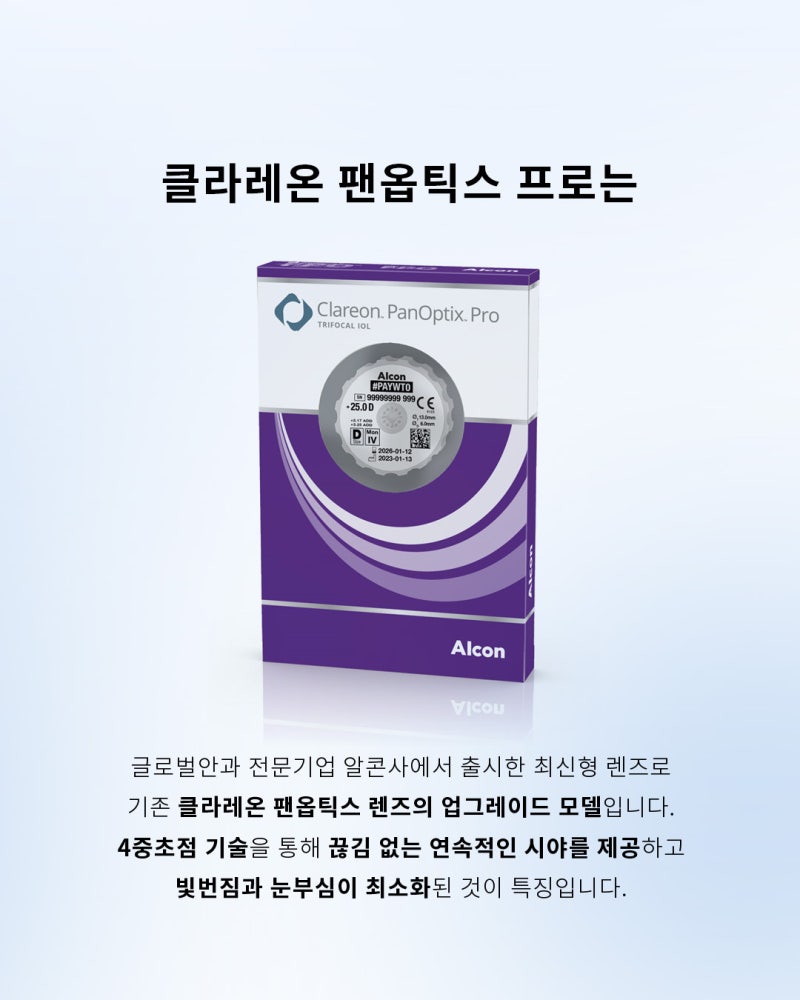
A cataract is a condition where the eye's natural crystalline lens becomes cloudy, leading to blurred vision.
During cataract surgery, the cloudy natural lens is removed
and replaced with an artificial intraocular lens (IOL).
Depending on which IOL you choose,
your primary functional distances and post-surgery dependence on glasses can vary significantly.
PanOptix Pro is a quadrifocal IOL designed
to provide functional vision across distance, intermediate, and near ranges.
According to manufacturer data, PanOptix Pro features an optical design with
an intermediate add power of +2.17 D
and a near add power of +3.25 D.
Simply put, rather than focusing on sharpness at a single distance,
this lens aims to secure functional vision across the various ranges most frequently used throughout the day:
Far Distance → Intermediate Distance → Near Distance.
What functional distances can you expect in real life with PanOptix Pro?
This leads to the most common question:
“So, how many centimeters away can I actually see?”
When understanding PanOptix Pro,
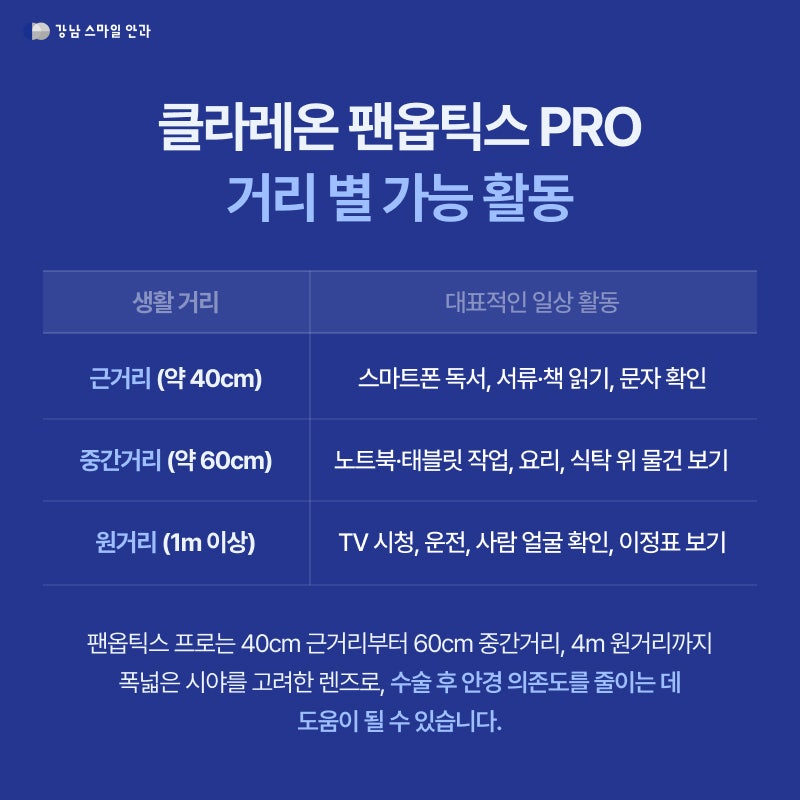
the two primary reference distances to keep in mind are approximately 40 cm and 60 cm.
📱 Around 40 cm
This represents the near distance used for reading books or checking smartphones.
Clinical studies on the PanOptix platform have evaluated near visual acuity at 40 cm.
Domestic clinical studies evaluating patients with bilateral PanOptix implantation demonstrated favorable near vision at 40 cm.
💻 Around 60 cm
This corresponds to intermediate distance, such as viewing desktop computer monitors or laptops located slightly further away.
Prospective domestic studies on PanOptix also assessed intermediate vision at 60 cm,
reporting favorable bilateral visual outcomes.
🚗 Distance Vision Beyond 4 Meters
This represents far distance vision, such as watching TV, driving, or reading street signs and billboards.
Clinical trials for PanOptix have consistently evaluated distance visual acuity at 4 meters alongside near and intermediate metrics.
Therefore, PanOptix Pro is best understood as an IOL that accommodates a wide range of everyday focal needs:
Near vision at around 40 cm
Intermediate vision at around 60 cm
Far distance vision
However, the exact distance at which focus feels most natural and comfortable
can vary depending on each patient's individual ocular characteristics and post-operative refractive status.
Is PanOptix Pro a multifocal lens?
Yes.
PanOptix Pro is a type of multifocal intraocular lens.
Intraocular lenses are broadly divided into monofocal IOLs
and multifocal IOLs.
While monofocal IOLs are designed to provide sharp focus primarily at one specific distance,
multifocal IOLs are optically engineered to enable vision across multiple distances.
Among them, this quadrifocal IOL
is designed to account for major daily living ranges,
providing continuous focal transition between distance, intermediate, and near vision.
Saying that it covers near, intermediate, and distance ranges
does not mean you can only see at strict points of 40 cm, 60 cm, and 4 m.
The optics are structured to allow a continuous functional visual range across focal transitions,
though individual visual experiences may vary based on pre-existing eye conditions.
📱 Can I view my smartphone and 💻 work on a computer?
This is one of the most common concerns for prospective patients.
In daily life, we rarely rely on a single visual distance.
In the morning, we check our smartphones,
at the office, we look at computer monitors,
after work, we watch TV,
and when going outdoors, we read signs and look at distant faces.
Therefore, when selecting an IOL for cataract surgery,
identifying which distances you rely on most in daily life
is just as important as asking "how many centimeters can I see?"
In clinical studies evaluating the PanOptix platform, bilateral visual acuity was assessed at 4 m (distance), 60 cm (intermediate), and 40 cm (near),
demonstrating favorable visual performance across all three ranges.
Additionally, retrospective domestic studies indicated that PanOptix provides strong intermediate and 40 cm near vision, achieving a broad, continuous functional field.
Will I completely eliminate the need for reading glasses after surgery?
It is crucial to clarify this expectation.
Choosing a multifocal intraocular lens does not guarantee
a 100% glasses-free outcome in every single situation.
Postoperative visual acuity depends not only on the optical design of the lens, but also on:
Corneal condition
Astigmatism
Retinal and optic nerve health
Postoperative refractive outcome
Overall ocular health
Ambient lighting conditions
Individual visual quality expectations
For tasks requiring prolonged reading of very fine print
or high levels of visual precision at specific ranges,
supplementary reading glasses can still be beneficial.
Therefore, when considering a multifocal lens, rather than asking:
“Can I eliminate glasses 100% of the time?”
it is far more realistic to ask:
“To what extent do I want to reduce my dependence on glasses in daily life?”
How does PanOptix Pro differ from the original PanOptix?
PanOptix Pro is a next-generation quadrifocal intraocular lens that builds upon
the proven trifocal PanOptix platform with an upgraded optical design.
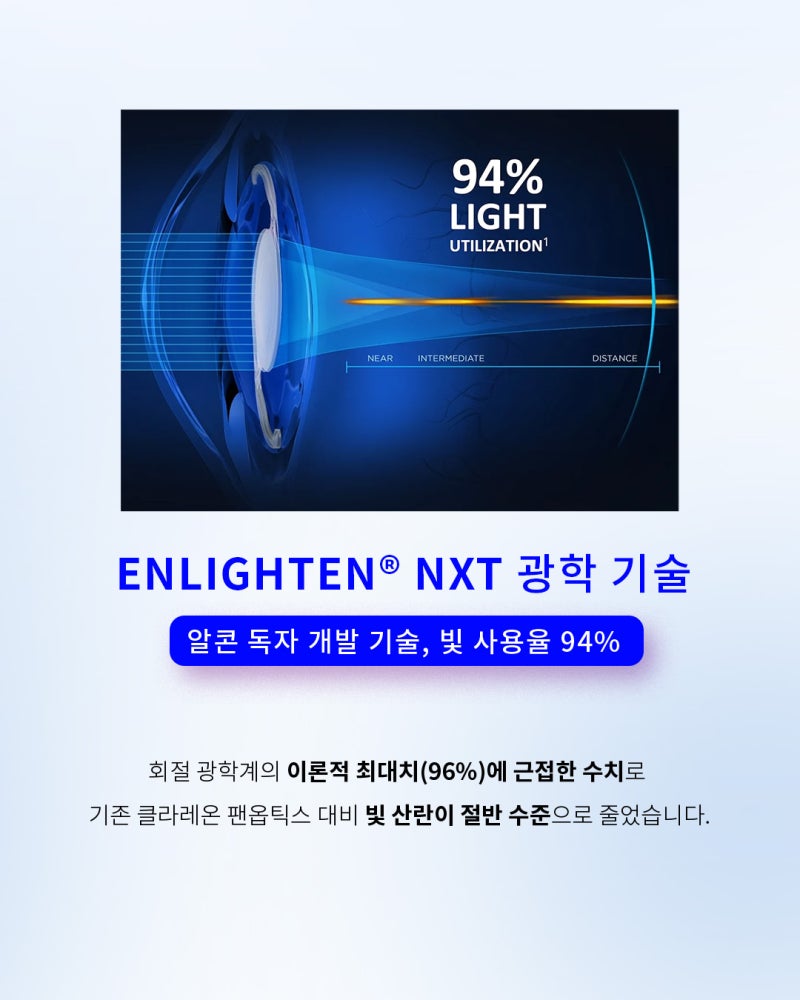
According to manufacturer data, PanOptix Pro incorporates
ENLIGHTEN NXT optical technology,
engineered to enhance light utilization efficiency and reduce light scatter compared to previous-generation PanOptix.
The manufacturer reports a 94% light transmission rate
and an approximate 50% reduction in light scatter compared to the original design,
aiming to deliver a more seamless distribution of light from distance to near while improving image contrast.
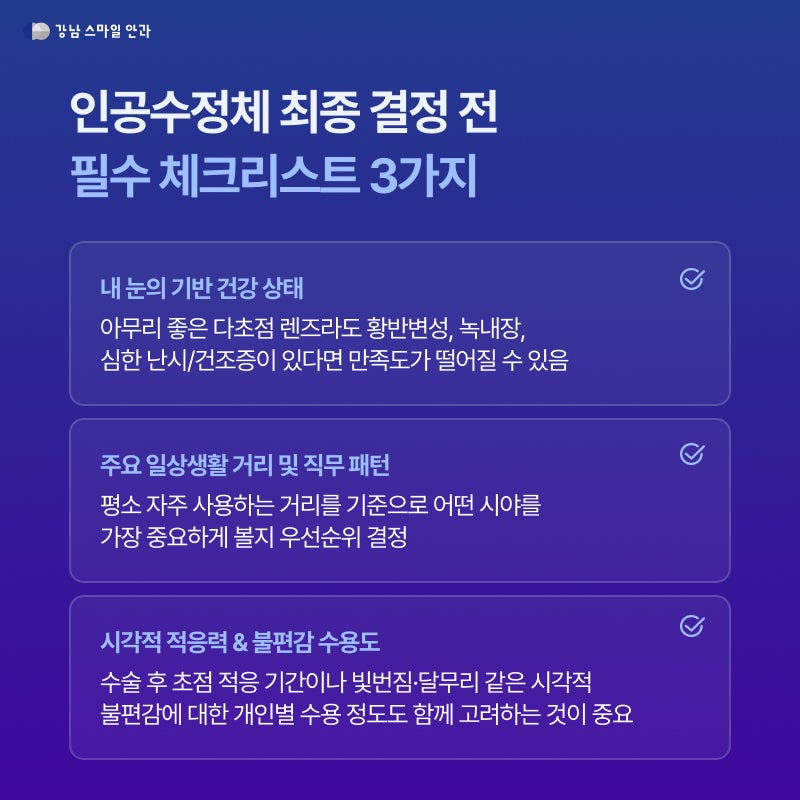
What should you consider before choosing an IOL?
Many patients preparing for cataract surgery ask,
“Is PanOptix Pro a good lens?”
However, when selecting an intraocular lens,
it is more important to determine whether it suits your ocular anatomy and daily lifestyle
than to focus merely on brand reputation or the number of focal points.
For instance:
💻 For office workers spending extensive hours on computers,
intermediate distance vision may be the top priority.
📱 For those who frequently use smartphones or read books,
sharp near vision is essential.
🚗 For frequent drivers,
distance clarity and minimal nighttime visual phenomena (such as glare or halos) must be carefully weighed.
🏌️ For individuals with active outdoor lifestyles,
clear distance vision without glasses may be the primary goal.
Even with the exact same intraocular lens,
visual satisfaction depends heavily on the focal ranges each individual values most.
Consider your lifestyle before choosing PanOptix Pro

If you are considering PanOptix Pro, start by answering these questions:
① At what distance do you typically hold your smartphone?
② What is your most comfortable reading distance?
③ How far away is your computer monitor positioned?
④ From what distance do you usually watch TV?
⑤ How frequently do you drive, especially at night?
⑥ To what degree do you hope to reduce glasses dependence after surgery?
Reflecting on these daily patterns in advance allows for
a far more personalized and productive consultation when planning your cataract procedure.
In addition, an in-depth clinical evaluation of your cornea, retina, optic nerve, and astigmatism
is essential to assess your overall eye health.
PanOptix Pro: Choosing what fits your eyes matters more than the exact centimeters

PanOptix Pro is a quadrifocal intraocular lens
designed to provide functional vision across distance, intermediate, and near ranges with smooth focal transitions.
Clinical evaluations of the PanOptix platform have assessed vision across near, intermediate, and distance zones,
with domestic studies reporting favorable visual outcomes across these daily living ranges.
However, this should not be misinterpreted
as a guarantee that every patient will achieve identical, pin-sharp vision from 40 cm to infinity.
Postoperative visual outcomes depend not only on lens optics,
but also on preoperative ocular anatomy, postoperative refractive stability,
corneal, retinal, and optic nerve status, and individual visual expectations.
Ultimately, the key question when considering PanOptix Pro
should go beyond:
“How many centimeters can PanOptix Pro see?”
and instead focus on:
“Which distances do I rely on most in my daily life, and which intraocular lens is best suited for my eyes?”
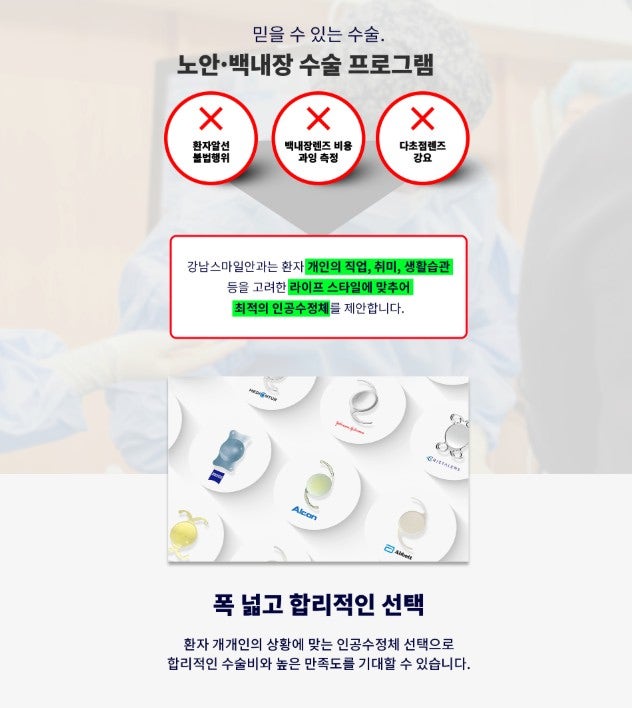
If you are considering cataract surgery and PanOptix Pro,
we recommend undergoing precision diagnostic testing to evaluate your ocular health
and having a comprehensive consultation with an ophthalmologist regarding your lifestyle and visual goals before selecting a lens.
At Gangnam Smile Eye Clinic, we guide intraocular lens selection
based on meticulous examinations tailored to each patient's ocular health and lifestyle patterns.
If you have any questions regarding PanOptix Pro, multifocal IOLs,
or cataract surgery, feel free to reach out to us anytime.
Thank you. 😊💙
💙 For SMILE surgery, trust Gangnam Smile Eye Clinic 💙
💙🤍 GANGNAM SMILE EYE CLINIC 💙🤍
𝗧𝗛𝗘 𝗟𝗜𝗚𝗛𝗧 𝗔𝗡𝗗 𝗧𝗛𝗘 𝗢𝗖𝗘𝗔𝗡 𝗜𝗡 𝗬𝗢𝗨𝗥 𝗦𝗠𝗜𝗟𝗘



PanOptix Pro
Frequently Asked Questions
Can I see smartphones or read books with PanOptix Pro?
Yes, it supports comfortable near vision around 40 cm. PanOptix Pro is a quadrifocal intraocular lens designed to accommodate near vision for reading books and smartphones at 40 cm, intermediate vision for computer monitors at 60 cm, and far distance vision beyond 4 m. Clinical studies have reported favorable near visual acuity outcomes.
Will I never need reading glasses after PanOptix Pro surgery?
Not necessarily. A multifocal IOL does not guarantee a 100% glasses-free experience in every circumstance. Factors such as corneal health, astigmatism, retinal condition, and lighting can affect outcomes. Low-power reading glasses may still be helpful when reading very small print for prolonged periods or performing intricate tasks requiring maximum sharpness.
What is the difference between original PanOptix and PanOptix Pro?
PanOptix Pro features an upgraded optical design that increases light transmission efficiency while reducing light scattering. According to manufacturer specifications, it incorporates ENLIGHTEN NXT technology, achieving 94% light utilization and cutting light scatter roughly in half compared to the predecessor to optimize continuous light distribution and image contrast.
What is the most important factor when choosing PanOptix Pro?
You should prioritize your personal lifestyle habits and overall ocular health. Identify the focal distances you use most frequently—such as computer work, reading, driving, or outdoor activities. These considerations should be combined with thorough diagnostic evaluations of your cornea, retina, optic nerve, and astigmatism during clinical consultation.