2026-09-07
Neglecting Tooth Root Inflammation in Dongdaemun Affects Dental Implant Duration
Delaying dental treatment, especially for tooth root inflammation, can significantly prolong the overall implant process. Early intervention is crucial for better outcomes and shorter treatment times.
Hello,
This is Dr. Kim Tae-young, chief director of Bareunyoung Dental Clinic, personally explaining a treatment case.
One of the most important aspects of dental treatment, I believe, is the timing of treatment.
Often, starting treatment quickly when symptoms first appear or when a disease begins to progress leads to a less complicated treatment process and a better prognosis.
However, dental treatment can be intimidating, and it's often difficult to make time in a busy daily life,
leading to delayed treatment in many cases.

Our medical team at Bareunyoung Dental Clinic
strives to make patients feel as comfortable as possible about dental care
by providing detailed explanations to those who visit us
and working together to address their concerns.
Fortunately, thanks to patients who view us favorably,
they trust us, bravely undergo treatment,
and overcome their dental phobia, which is incredibly rewarding for us!^^
Today's case study will explore
how the timing of treatment affects the overall treatment duration.
‘My teeth feel loose and swell frequently.’
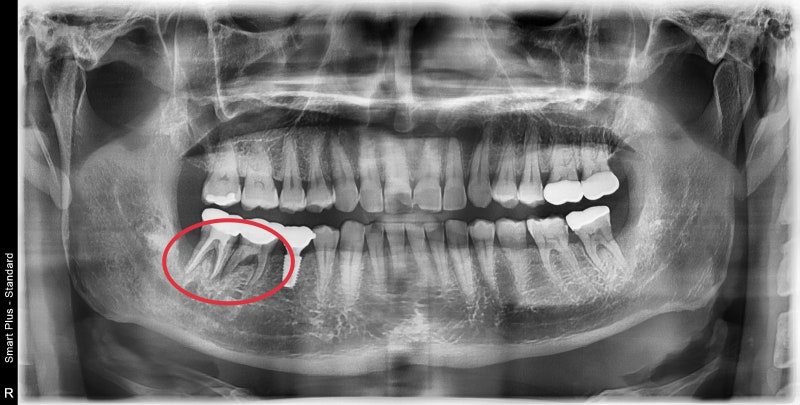
The patient visited us with two loose and swollen lower right molars.
X-rays showed significant bone absorption around the roots, indicating severe mobility.
Further preservation of the teeth seemed difficult, and extraction along with implant surgery was necessary.
Unfortunately, saving the natural teeth was challenging, and when diagnosing extraction,
it's important to consider whether immediate implant surgery is possible for subsequent treatment.
This is because immediate surgery can reduce the overall treatment period by 2-3 months.
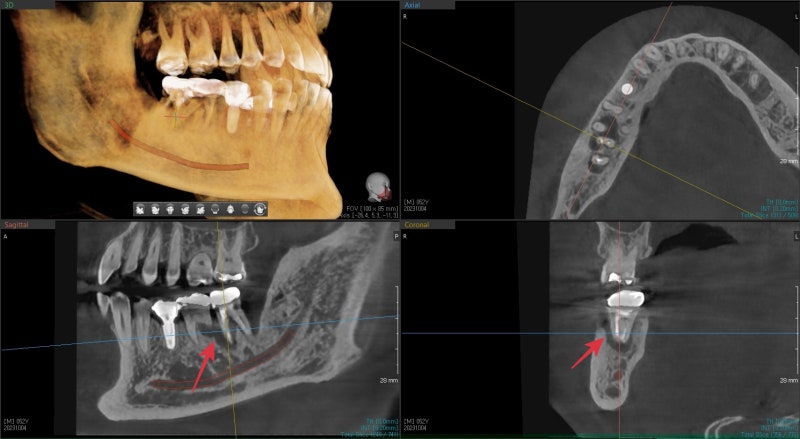
A 3D CT scan showed that the bone around the tooth roots had been absorbed due to inflammation,
but the four surrounding bone walls were relatively healthy, making immediate implant surgery with bone grafting possible after extraction.
Since the patient experienced pain during their initial visit,
the plan was to alleviate the symptoms and then schedule the surgery date.
Re-visit 5 months after the initial visit
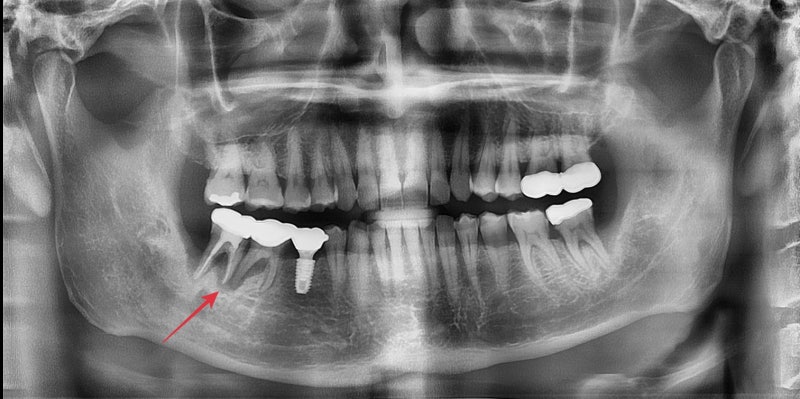
After the initial inflammation treatment, the symptoms improved slightly, and the pain significantly decreased.
However, it was difficult to find time for scheduling thereafter.
The patient visited again after 5 months,
and the bone around the teeth had absorbed even more than in the initial visit's photos.
Unlike the initial diagnosis, a lot of bone had been absorbed in the space where the implant needed to be placed,
making immediate surgery on the extraction day impossible, even with alveolar bone grafting.
We decided not to rush and to perform the surgery after restoring the volume of the surrounding bone.
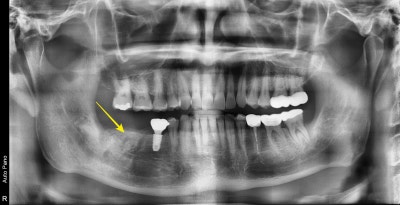
Approximately 3 months later, the bone around the surgical site was evaluated.
Fortunately, the bone had recovered well, creating favorable conditions for implant placement.
The yellow-marked area showed that the bone graft had solidified, providing a good environment.
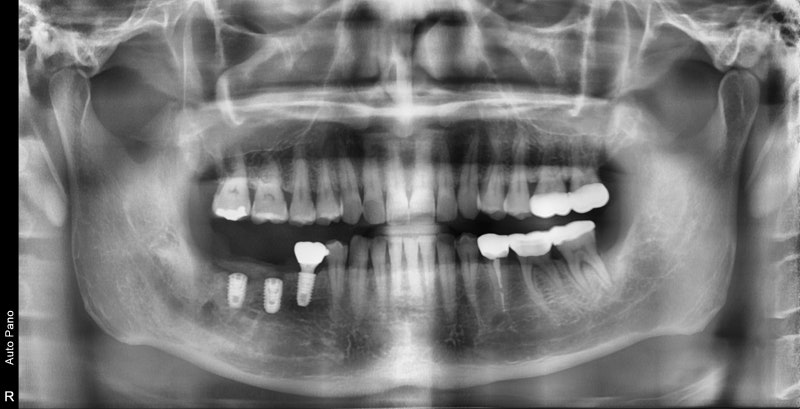
Since the bone was not yet completely solid, after placing the implant in a good position,
we waited about 2 months for the implant and bone to integrate more firmly.
If the surgery had been performed as initially planned, the treatment would have already been completed.
However, given the delay, we decided not to rush and to wait sufficiently to ensure a safe completion.
‘It feels as comfortable as if nothing was done.’
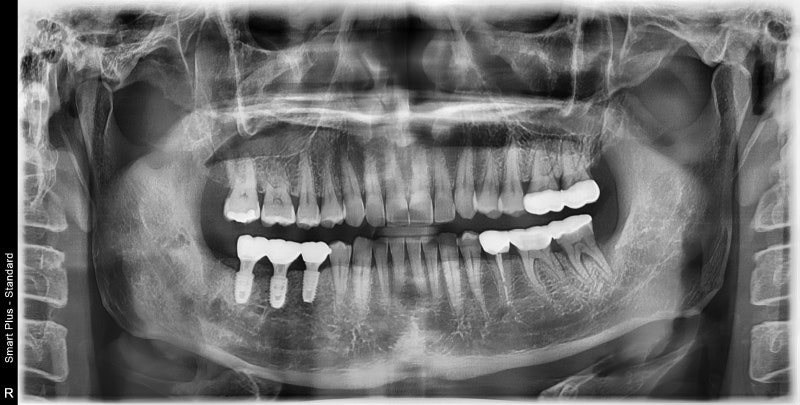
Extraction, alveolar bone grafting, implant surgery, waiting, and prosthetic completion
took approximately 7 months.
This was twice as long as it would have taken with immediate implant placement after extraction.
Although it was inconvenient, the patient understood the meanings of each step of the treatment and cooperated well, leading to a beautifully completed prosthesis.
The patient expressed that it felt so comfortable, ‘as if nothing was done,’
and mentioned during regular check-ups that they were eating well, making this a very rewarding case.
When the timing of treatment is missed like this,
the unexpected duration often increases.
Therefore, for teeth where an inflammatory reaction is already occurring internally, even if symptoms are not strongly felt,
it is sometimes better to take proactive measures in advance for future treatment,
even if immediate treatment is not pursued.
Today,
we looked at cases where the overall treatment period can vary depending on the timing of treatment.
For slowly progressing cavities or
chronic periodontitis, even when the condition has advanced significantly,
it is often difficult to feel pain or subjective symptoms.
Therefore, we recommend regular X-ray examinations and check-ups.
I hope your questions have been somewhat resolved,
and I will return with another case next time.
Thank you!^^
▼ Related cases to read together
‘I believe that proper treatment leads to proper results. My ideal dental clinic is one where everyone who visits with worries leaves feeling reassured and confident.’
- Bareunyoung Dental Clinic
Directions
JYJ Building, 2nd floor, 179 Dongho-ro, Jung-gu
Right in front of Exit 6 of Yaksu Station, towards Yaksu Market
Village bus No. 5 (Yaksu Station)
Village bus No. 12 (Namsan Town, Yaksu Police Station)
Bus stops (Yaksu Heights, Sindang Social Welfare Center, Gaon Library, Kumho Tunnel Entrance)
From Yu Yu Pharmaceutical towards Kumho Station
This post was written directly by Bareunyoung Dental Clinic for the purpose of providing medical information and hospital advertising (in compliance with Article 56, Paragraph 1 of the Medical Service Act).
Frequently Asked Questions
Why is the timing of dental treatment important?
Yes, the timing of dental treatment is very important. This is because starting treatment quickly when symptoms begin or when a disease progresses often leads to a less complicated treatment process and a better prognosis.
What problems can arise if tooth root inflammation is left untreated?
If tooth root inflammation is left untreated, the bone around the root can be absorbed, causing the tooth to become loose and swollen. If severe, it may become difficult to preserve the natural tooth, requiring extraction and implant surgery. Severe bone absorption can also delay implant placement.
Is immediate implant placement always possible after extraction?
No, it is not always possible. Immediate implant surgery after extraction is possible when the bone walls surrounding the tooth are healthy, even if the bone around the tooth root has been absorbed due to inflammation. In such cases, the overall treatment period can be reduced by 2-3 months.
How much longer can the implant period be if treatment is delayed?
If treatment is delayed, the implant treatment period can be significantly extended. In the case described in the main text, it took approximately 7 months, which was twice as long as it would have taken with immediate implant placement after extraction. This was due to the need for additional bone recovery time.
Should I get a dental check-up even if I don't feel any pain?
Yes, it is advisable to get regular dental check-ups even if you don't feel any pain. In cases of cavities or chronic periodontitis, it is often difficult to feel pain or subjective symptoms even when the condition has advanced significantly. Therefore, regular X-ray examinations and check-ups are important for taking proactive measures.