2026-07-20
Must-Read for Gangnam Station SMILE Surgery | Reasons Why People with Astigmatism Failed Surgery
Discover why astigmatism can complicate SMILE surgery and how advanced technologies like Smart LASIK address these challenges. Learn about correction ranges, eye rotation compensation, offset adjustment, and the impact of side cuts on surgical outcomes and visual quality.

Hello, this is Gangnam SMILE Eye Clinic 😊💙
Today, we'll discuss important considerations for people with astigmatism before SMILE surgery.
We'll also compare the key specifications of SMILE Pro and New SMILE, so if you're considering SMILE surgery, please read this post to the end!
Must-Read for Gangnam Station SMILE Surgery: What is Astigmatism?
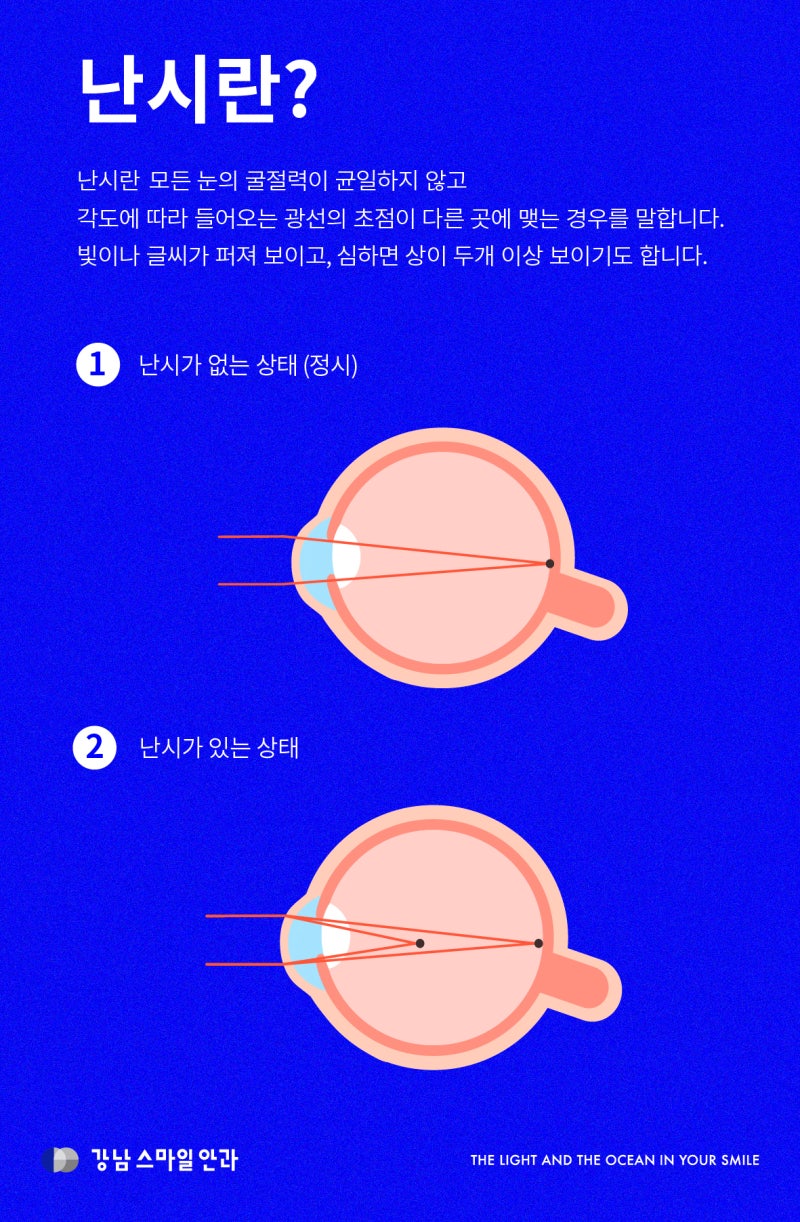
First, let's briefly define astigmatism.
Astigmatism is a condition where the cornea or lens has an irregular shape, causing light to scatter rather than focusing on a single point.
This results in blurry vision and difficulty distinguishing signs or fine details.
So, what problems can arise when people with astigmatism undergo traditional SMILE surgery?
1. Gangnam Station SMILE Surgery: Astigmatism Correction Range

First, there's the issue of the correction range.
While traditional SMILE surgery can generally correct both myopia and astigmatism, the correction range might be insufficient for severe cases of myopia and astigmatism.
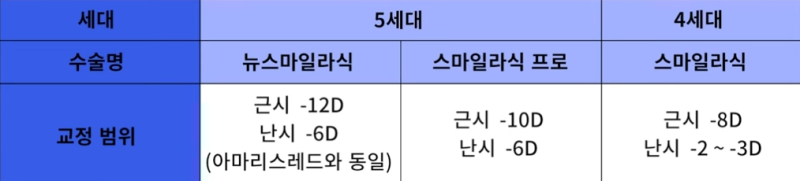
For example, SMILE LASIK using ATOS (=New SMILE, Smart LASIK) can correct up to -6D of astigmatism, while SMILE Pro can correct up to -5D.
Regular SMILE LASIK is often practically limited to 2-3D.
Therefore, for individuals with a high degree of astigmatism,
choosing a surgery that considers the correction range is crucial.
2. Gangnam Station SMILE Surgery: Eye Rotation Axis Compensation

The second important feature is eye rotation axis compensation.
This feature is arguably the decisive factor why ATOS's SMILE LASIK (=Smart LASIK) excels in astigmatism correction.
Our eyeballs subtly change position when we are sitting versus lying down.
At this time, a slight cyclotorsion occurs in the cornea.
If surgery is performed without considering this eye cyclotorsion,
it's like ablating the cornea in the wrong direction.
In the case of conventional SMILE, which did not have this technology,
vision correction was sometimes performed by marking the visual axis on the eye with a marking pen.
In other words, it relied on the surgeon's estimation.
Consequently, the surgical outcome could vary depending on the surgeon's experience.
Any surgery needs good reproducibility to be considered stable, and traditional SMILE was quite lacking in that regard.
However, only 5th-generation Smart LASIK perfectly solves this problem.
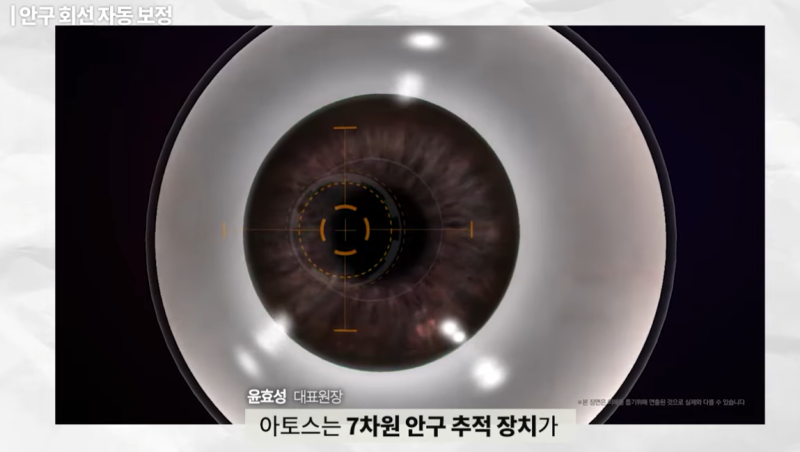
ATOS (=Smart LASIK machine) uses a 7-dimensional eye tracking system
to track the eye in real-time and accurately detect the pupil's center.
The rotation axis compensation function then precisely adjusts the laser's angle according to the cyclotorsion,
minimizing vision correction errors.
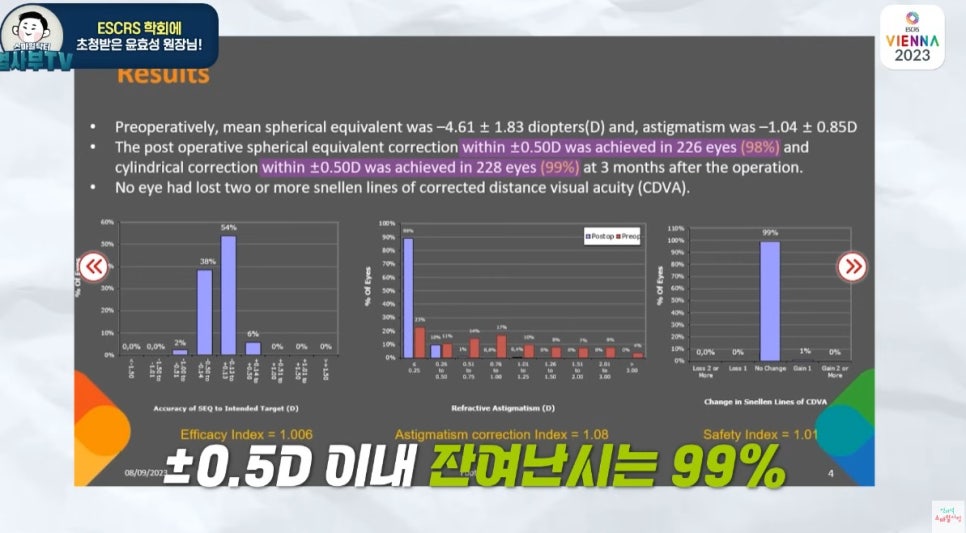
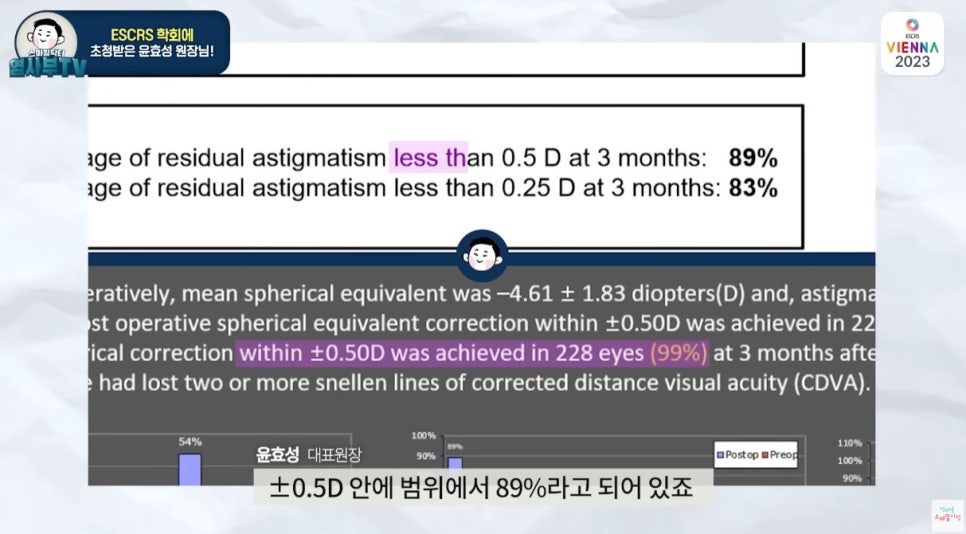
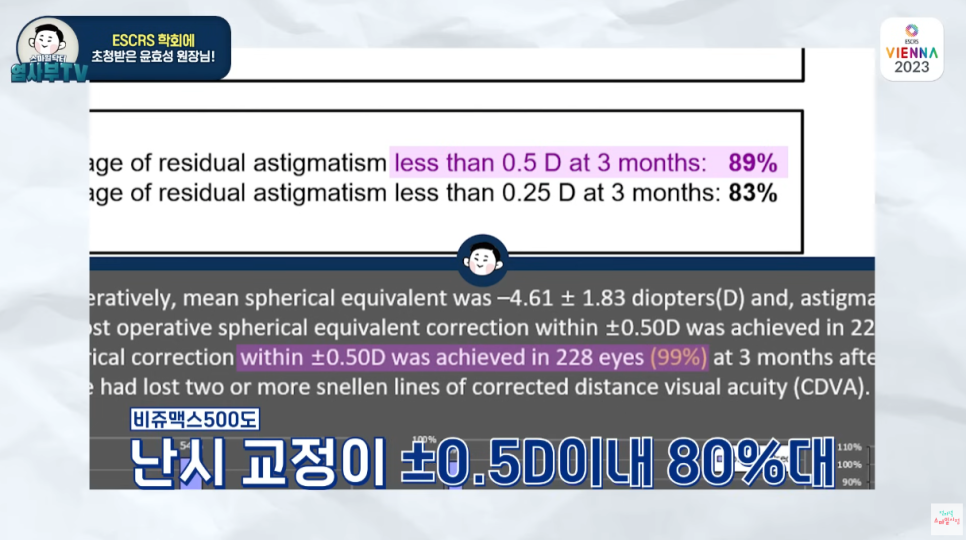
While Smart LASIK automatically compensates for eye cyclotorsion,
SMILE Pro requires the surgeon to semi-automatically manipulate the surgical screen
to compensate for cyclotorsion. Therefore, for high astigmatism, it's difficult to expect the same level of astigmatism correction as ATOS.
3. Gangnam Station SMILE Surgery: Offset Adjustment Function & Sirius
Finally, the offset adjustment function.
This feature is also a technology uniquely applicable to ATOS's SMILE LASIK.
It's a very important aspect, especially for those with astigmatism,
so please pay close attention and keep it in mind.
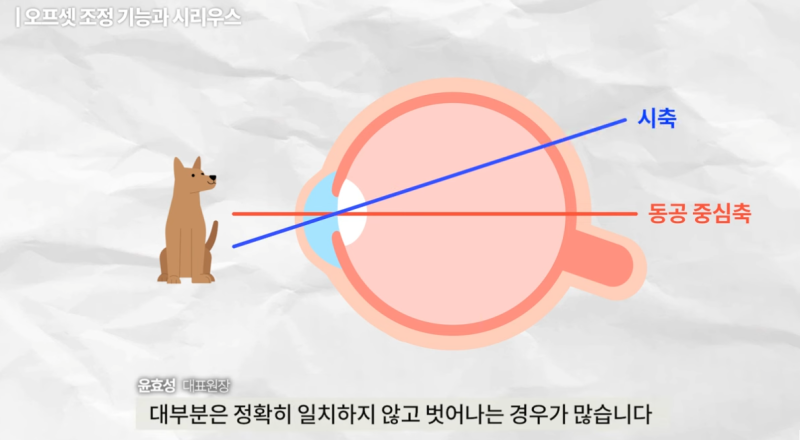
Our eyes have a central point of the pupil.
We usually assume that the center of the pupil and the center we are looking at,
i.e., the visual axis, coincide.
However, in most cases, they do not exactly coincide and often deviate.
Since this visual axis varies for each individual,
finding the visual axis is extremely important.
Smart LASIK uses a device called Sirius before surgery.
When this Sirius device is linked to the machine,
it can find the center of the visual axis.
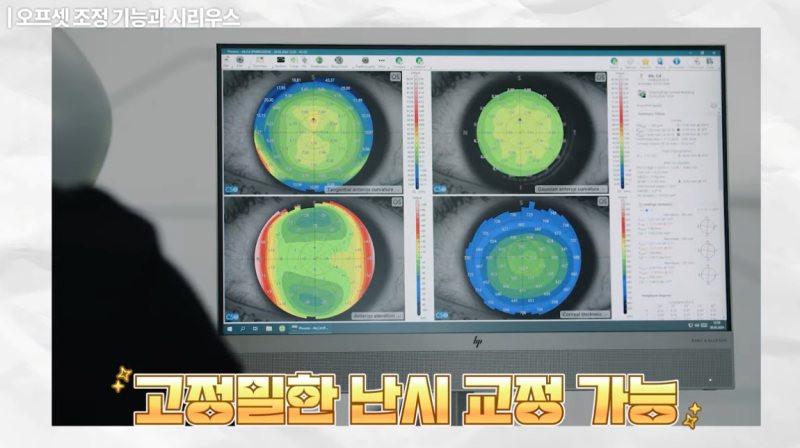
By generating the surgical lenticule in this way,
accurate correction becomes possible.
This means high-precision astigmatism correction is achievable.
This function was originally a technology integrated into Schwindt's Amaris Red device,
a master in laser equipment.
Therefore, it is a technology applicable only to Schwindt's femtosecond device, ATOS,
i.e., Smart LASIK.
Thus, for individuals with astigmatism, when undergoing Gangnam Station SMILE surgery,
Smart LASIK can be a very advantageous procedure.
4. Gangnam Station SMILE Surgery: Side Cut and Glare
So, for those with mild or no astigmatism,
you might think there's no significant difference between surgeries.
But that's not true.
Before undergoing SMILE LASIK,
checking if the SMILE LASIK you're receiving has a ‘side cut’
is a very important aspect for all patients.
A side cut is a method of adding an incision to the side during surgery to separate the surgical lenticule.


Simply put, it's like creating a 'handle' on the side to make it easier for the surgeon to grasp and remove the lenticule during surgery.

While this side cut might be beneficial for medical staff as it makes the surgery easier,
from the patient's perspective, it's a surgical method with mostly disadvantages.
First, creating a side cut thickens the lenticule,
reducing the amount of residual cornea after surgery.
In the case of Zeiss's SMILE or SMILE Pro, which have side cuts,
approximately 20-30 micrometers more tissue is ablated than with ATOS's New SMILE LASIK.
Conversely, if there is no side cut,
only the actually necessary corneal tissue is ablated,
meaning more can be saved.
Considering that correcting 1D of astigmatism requires ablating approximately 13 micrometers,
unnecessarily ablating an amount that could correct more than 1D of astigmatism is wasteful.
The reason why ablating less corneal tissue is important is that a thinner residual cornea after surgery affects long-term safety.
This is arguably the most crucial part of the surgery.
If your myopia and astigmatism (D) are higher than others,
the risk will increase even more.
Furthermore, creating a side cut
reduces the optical zone and prevents a smooth connection.
If light enters through the gap between the optical zone and the pupil,
night vision glare can worsen.
However, if a side cut (i.e., a handle) is not created,
the optical zone becomes relatively wider, preventing night glare.
Also, because no unnatural boundary remains, clarity improves,
and the quality of vision increases.
Therefore, before undergoing SMILE surgery,
checking whether the SMILE machine you are using
creates a side cut or not
is a very important point.
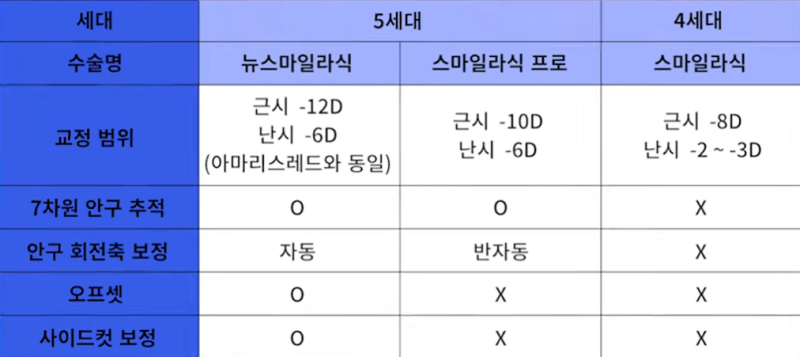
When choosing Gangnam Station SMILE surgery,
please refer to this table for comparison.
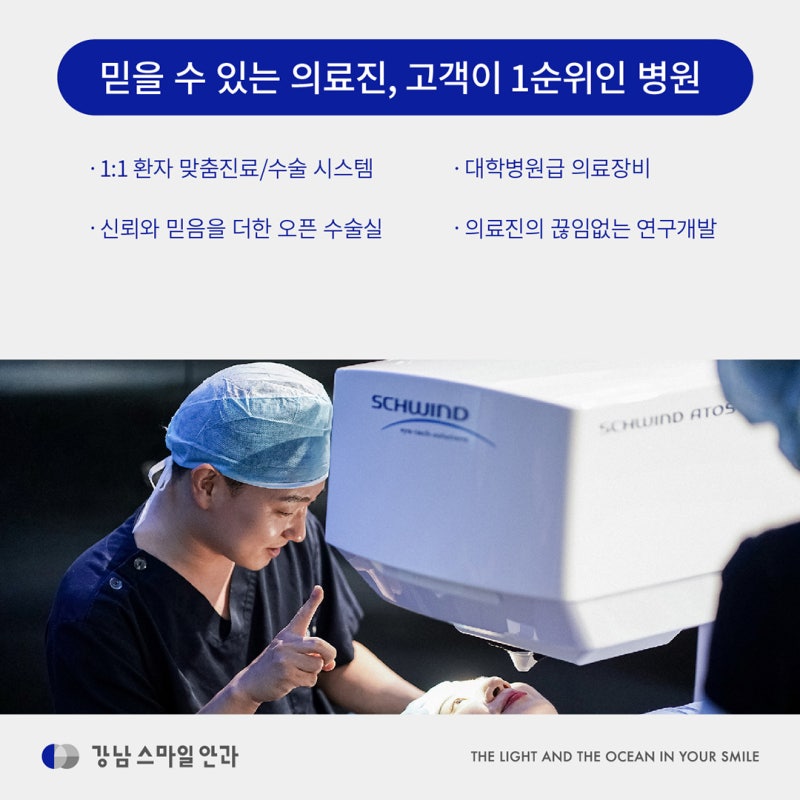
Gangnam SMILE Eye Clinic doesn't just emphasize surgical equipment.
We accurately assess the eye's condition through various precise examinations before surgery,
and guide patients to the most suitable surgical method.
Equipped with the latest equipment and a systematic examination system,
we provide authentic one-on-one customized consultations and surgeries for each individual.
Furthermore, we always prioritize the patient,
and place transparency and safety above all else.
If you have any other questions,
please feel free to contact the clinic at any time.
💙🤍 𝖦𝖠𝖭𝖦𝖭𝖠𝖬 𝖲𝖬𝖨𝖫𝖤 𝖤𝖸𝖤 𝖢𝖫𝖨𝖭𝖨𝖢💙🤍
𝗧𝗛𝗘 𝗟𝗜𝗚𝗛𝗧 𝗔𝗡𝗗 𝗧𝗛𝗘 𝗢𝗖𝗘𝗔𝗡 𝗜𝗡 𝗬𝗢𝗨𝗥 𝗦𝗠𝗜𝗟𝗘
Gangnam Station SMILE Surgery Gangnam Station SMILE Surgery Gangnam Station SMILE Surgery Gangnam Station SMILE Surgery Gangnam Station SMILE Surgery


Gangnam Station Eye Clinic Gangnam Lens Implantation Gangnam Station Lens Implantation Gangnam Station Eye Clinic Gangnam Lens Implantation Gangnam Station Lens Implantation Gangnam Station Eye Clinic Gangnam Lens Implantation Gangnam Station Lens Implantation











Frequently Asked Questions
What is astigmatism?
Astigmatism is a condition where the cornea or lens has an irregular shape, causing light to scatter rather than focusing on a single point. This results in blurry vision and difficulty distinguishing signs or fine details.
What is the astigmatism correction range for SMILE surgery?
SMILE surgery can generally correct both myopia and astigmatism, but the correction range varies depending on the degree of astigmatism. For example, Smart LASIK using ATOS can correct up to -6D of astigmatism, SMILE Pro up to -5D, and conventional SMILE LASIK is often limited to 2-3D.
Is eye rotation axis compensation important for astigmatism correction?
Yes, eye rotation axis compensation is very important for astigmatism correction. Our eyeballs subtly rotate when sitting versus lying down, and if this rotation is not considered during surgery, it's like ablating the cornea in the wrong direction, which can lead to vision correction errors. Smart LASIK uses a 7-dimensional eye tracking system to compensate for this in real-time.
What is a side cut in SMILE surgery and why is it important?
A side cut is a method of adding an incision to the side during surgery to separate the lenticule. This method thickens the lenticule, reducing the amount of residual cornea after surgery, and can make the optical zone smaller, potentially worsening night glare. Therefore, choosing a surgery without a side cut is beneficial for long-term safety and improved visual quality.
Does the offset adjustment function help with astigmatism correction?
Yes, the offset adjustment function is a very important technology for individuals with astigmatism. This is because the center of our pupil and the visual axis often do not exactly coincide. Smart LASIK uses a Sirius device before surgery to accurately locate the center of the visual axis, enabling high-precision astigmatism correction.