2026-07-20
LASEK Halos: Is it Equipment Difference? Recommended LASEK Without Halos
Many worry about halos after LASEK, especially during night driving. This article explains why halos occur, how equipment affects them, and introduces advanced technologies like AMARIS RED and Co-Wave to minimize them.


Hello, this is Gangnam Smile Eye Clinic 😊💙
One of the biggest concerns for those considering vision correction surgery is LASEK halos.
Many people, especially those who frequently drive at night or live in dark environments, worry that headlights or streetlights might appear blurred after surgery.
So, why do LASEK halos occur? And does surgical equipment make a difference?
Reasons for LASEK Halos
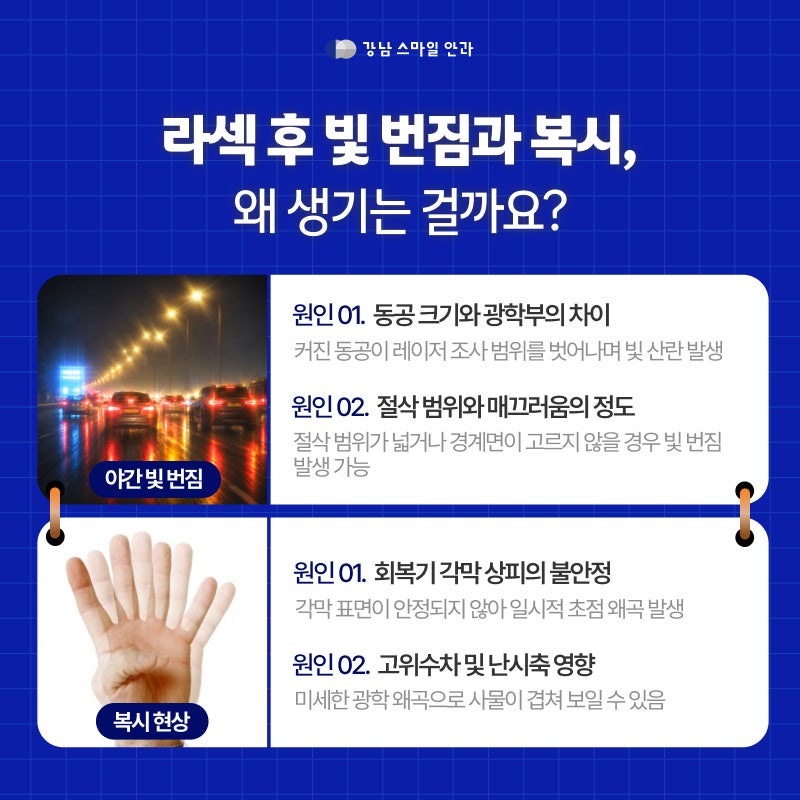
First, it's due to the difference between pupil size and optical zone size.
In dark environments, the pupil naturally dilates. If the pupil expands larger than the surgically corrected area (optical zone), both the corrected and uncorrected areas are used simultaneously, which can cause light to scatter.
This can lead to halos or blurred light around sources, a phenomenon known as LASEK halos.
Individuals with larger pupils may be more sensitive to this phenomenon.
Second, it's related to the ablation zone and the smoothness of the corneal surface.
LASEK surgery precisely reshapes the cornea with a laser to correct vision.
If the ablation zone is insufficient or the corneal surface is not formed smoothly during this process, light can scatter in various directions.
In other words, the uniformity and precision of the corneal surface after surgery are also important factors influencing LASEK halos.
Reasons for LASEK Double Vision (Diplopia)
Occasionally, some individuals experience diplopia, where objects appear double, after surgery.
In most cases, this is a temporary phenomenon that occurs during the recovery process.
The first cause is the corneal epithelial healing process.
LASEK involves the regeneration of the corneal epithelium. Until the epithelium is fully stable, the surface may not be uniform, leading to inconsistent light refraction and potentially causing diplopia.
The second cause is an increase in higher-order aberrations.
If higher-order aberrations increase during or after surgery, light may not focus precisely at a single point on the retina.
In this case, symptoms such as overlapping or blurred vision may appear.
Lastly, the influence of astigmatism.
For severe astigmatism, precise correction of the astigmatic axis is crucial. Even a slight misalignment of the axis can prevent clear image formation, leading to diplopia or residual blurring.
Therefore, for patients with severe astigmatism, the precision of the surgical equipment becomes even more important.
Do LASEK Halos Differ by Equipment?
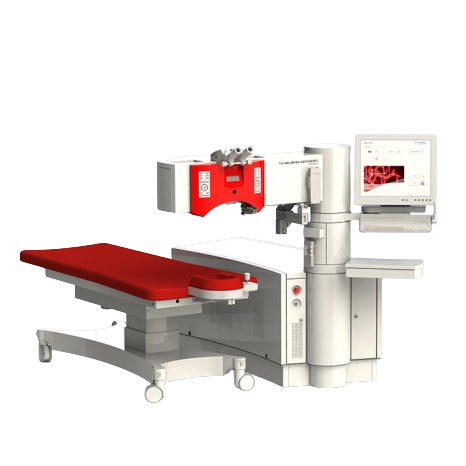
To put it simply, yes, it can make a difference.
To reduce halos, it's not just about achieving the correct vision, but also about:
✅ Whether the laser is applied to the exact location
✅ How smoothly the corneal surface is created
✅ How precisely the astigmatic axis is tracked
These factors are crucial.
AMARIS RED's 7-Dimensional Eye Tracking System
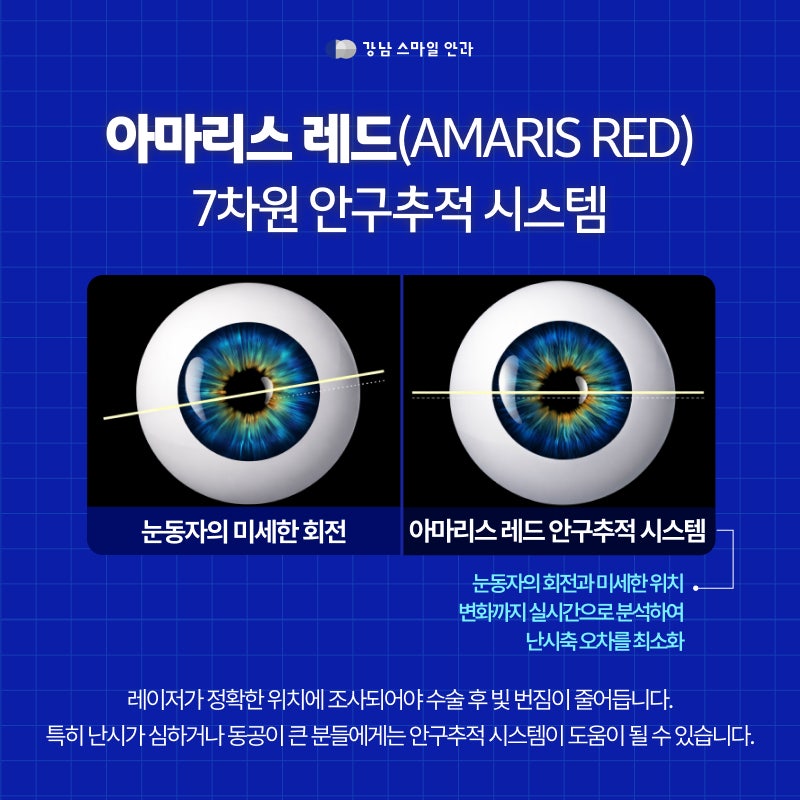
The recently used AMARIS RED incorporates a 7-dimensional eye tracking system.
During surgery, the human eye moves subtly, with various movements such as up-down, left-right, front-back, and rotation occurring simultaneously.
The 7-dimensional eye tracking system analyzes these movements in real-time, helping the laser to be precisely applied to the planned location.
This precise tracking technology is especially important for severe astigmatism or large pupils.
More accurate correction can help reduce the likelihood of LASEK halos after surgery.
AMARIS RED: Minimizing Halos

Ultra-High-Speed Laser and Thermal Energy Control Technology
The longer the laser application time, the greater the thermal energy burden on the cornea.
AMARIS RED uses an ultra-high-speed laser system to shorten surgery time and employs technology that efficiently disperses thermal energy.
This minimizes the stimulation applied to corneal tissue and promotes more stable ablation.
Smoother Corneal Surface with SmartPulse Technology
Another factor in reducing LASEK halos is the smoothness of the corneal surface.
AMARIS RED's SmartPulse technology optimizes the laser ablation pattern to help create a more uniform and smooth corneal surface after ablation.
Co-Wave Program: Helping to Reduce LASEK Halos
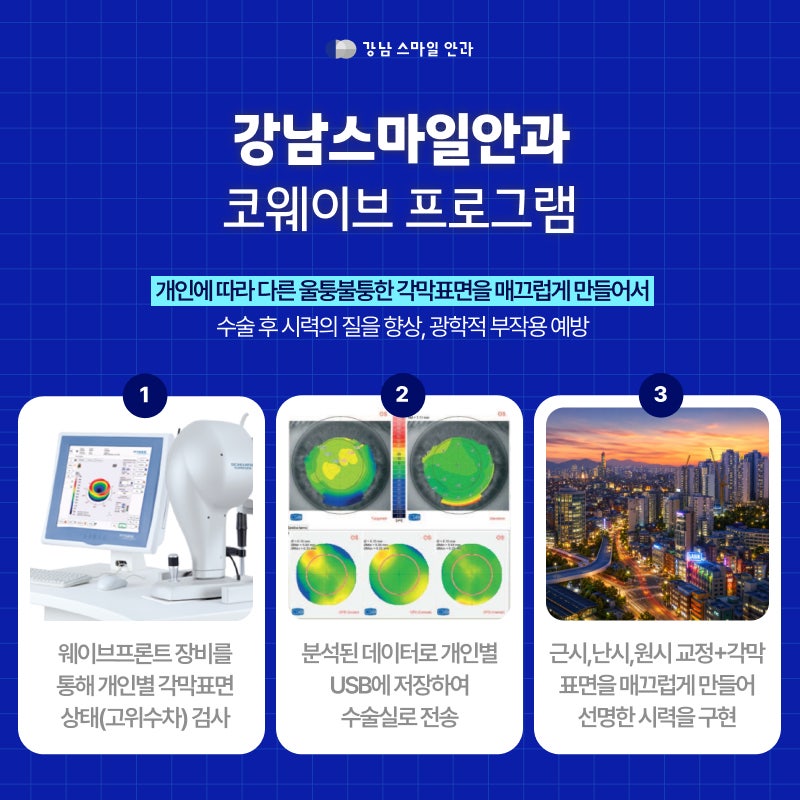
Standard vision correction surgeries focus on correcting lower-order aberrations such as myopia, astigmatism, and hyperopia.
However, even if vision is 20/20 or better, some individuals may still experience halos or glare.
This can be due to higher-order aberrations that cannot be explained by simple visual acuity measurements.
An increase in higher-order aberrations can prevent light from focusing accurately on the retina, leading to:
✅ Nighttime halos
✅ Glare
✅ Reduced contrast sensitivity
✅ Decreased clarity
These symptoms may appear.
Co-Wave: Analyzing Individual Corneal Shapes
The Co-Wave program precisely analyzes each individual's corneal shape, performing customized correction that considers even subtle irregularities of the cornea.
Even for the same -5 diopter myopia, corneal shapes vary, so ablating in the same way can lead to unnecessary higher-order aberrations.
Co-Wave helps design a more precise ablation pattern by reflecting these individual differences.
Considering Visual Quality by Reducing Higher-Order Aberrations
The important point is not just to make vision clear, but to enhance the quality of vision.
Utilizing Co-Wave can help minimize higher-order aberrations that may occur during surgery, which in turn can help improve satisfaction in terms of night vision and clarity.
This technology is particularly valued for:
✅ People who drive frequently at night
✅ People with large pupils
✅ People with severe astigmatism
✅ People who are already sensitive to halos
It is considered a significant technology.
Finally

LASEK halos can be caused by various factors, including pupil size, optical zone size, corneal surface smoothness, and the degree of astigmatism.
Therefore, rather than just checking if vision correction has been achieved, it's important to also check for equipment that features:
✅ A precise eye tracking system
✅ An ultra-high-speed laser
✅ SmartPulse function
✅ Co-Wave based customized correction
Especially if you have severe astigmatism or large pupils, the precision of the surgical equipment can help reduce LASEK halos after surgery. Therefore, it is recommended to choose a surgical method suitable for you through thorough examination and consultation.
💙 Smile surgery is best at Gangnam Smile Eye Clinic 💙
💙🤍 𝖦𝖠𝖭𝖦𝖭𝖠𝖬 𝖲𝖬𝖨𝖫𝖤 𝖤𝖸𝖤 𝖢𝖫𝖨𝖭𝖨𝖢💙🤍
𝗧𝗛𝗘 𝗟𝗜𝗚𝗛𝗧 𝗔𝗡𝗗 𝗧𝗛𝗘 𝗢𝗖𝗘𝗔𝗡 𝗜𝗡 𝗬𝗢𝗨𝗥 𝗦𝗠𝗜𝗟𝗘












Frequently Asked Questions
Why does glare occur after LASEK surgery?
Glare after LASEK surgery can primarily occur when the pupil dilates in a dark environment, causing light to scatter as both the corrected and uncorrected areas are used simultaneously, or when the ablation zone is insufficient, or the corneal surface is not smooth. Pupil size, optical zone size, and corneal surface uniformity all play a role.
Can double vision occur after LASEK surgery?
Yes, double vision can occur after LASEK surgery. In most cases, it is a temporary phenomenon that appears during the corneal epithelial healing process, and increased higher-order aberrations or insufficient precision in astigmatism correction can also be causes.
Does LASEK surgical equipment affect glare?
Yes, LASEK surgical equipment can affect glare. Factors such as whether the laser is accurately delivered to the correct position, how smoothly the corneal surface is made, and how precisely the astigmatic axis is tracked play an important role in reducing glare.
How does the AMARIS RED device help reduce glare?
The AMARIS RED uses a 7-dimensional eye-tracking system to analyze minute eye movements in real-time and precisely deliver the laser. It also helps reduce glare by creating a uniform and smooth corneal surface with its ultra-fast laser and SmartPulse technology.
In what cases is the Co-Wave program helpful?
The Co-Wave program precisely analyzes an individual's corneal shape to perform customized correction that reduces higher-order aberrations. It is particularly beneficial for improving vision quality and reducing glare for people who frequently drive at night, have large pupils, or have severe astigmatism.
What should I check to reduce glare after LASEK surgery?
To reduce glare after LASEK surgery, it is important to check if the equipment has a precise eye-tracking system, an ultra-fast laser, SmartPulse function, and Co-Wave-based customized correction. You should choose a surgical method suitable for you through sufficient examination and consultation.