2026-07-20
Is SMILE LASIK recommended for high astigmatism and high myopia?
Many people wonder if SMILE LASIK is suitable for high myopia and astigmatism. Thanks to advancements in technology, it is now possible to correct even severe astigmatism with SMILE LASIK, emphasizing the importance of precise centering and advanced equipment.
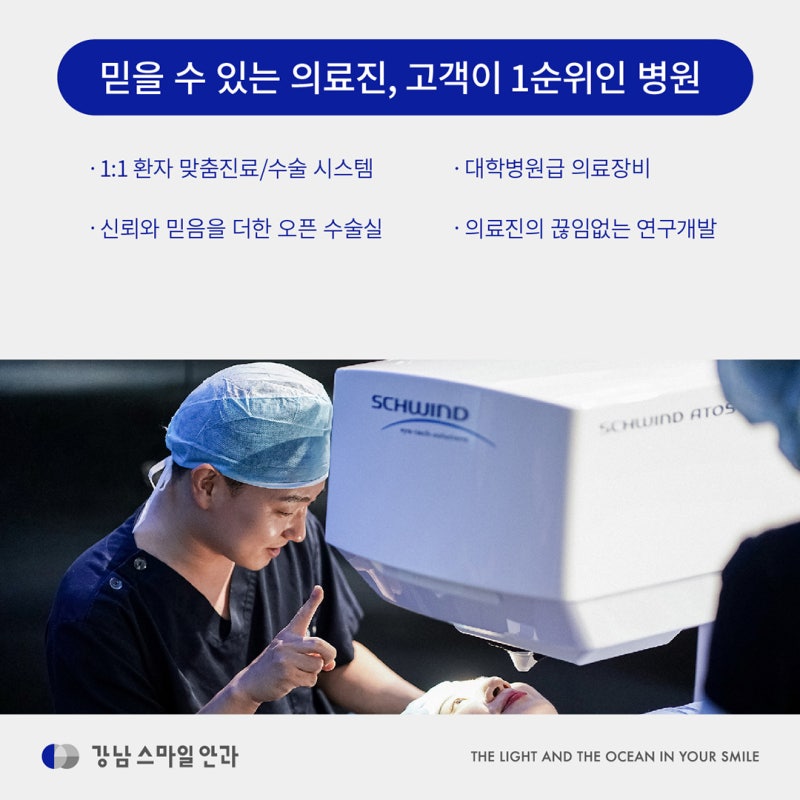

Hello,
We are Gangnam Smile Eye Clinic, the clinic many people think of when they consider SMILE LASIK recommendations 😊💙
Recently, many people who are considering vision correction surgery ask if SMILE LASIK is possible for high myopia and high astigmatism.
‘My myopia or astigmatism is quite severe; can I still be recommended for SMILE LASIK?’
It's a very understandable concern.
To get straight to the point,
Thanks to recent advancements in equipment and technology,
it is now an era where high myopia and high astigmatism,
especially high astigmatism, can be sufficiently corrected with SMILE LASIK.
However, in these cases, the most important point is
‘how accurately the correction is centered,’
in other words, ‘centering accuracy.’
Therefore, for high astigmatism, the criteria for SMILE LASIK recommendation emphasize equipment and precision.
SMILE LASIK Recommendation: What exactly is high astigmatism?
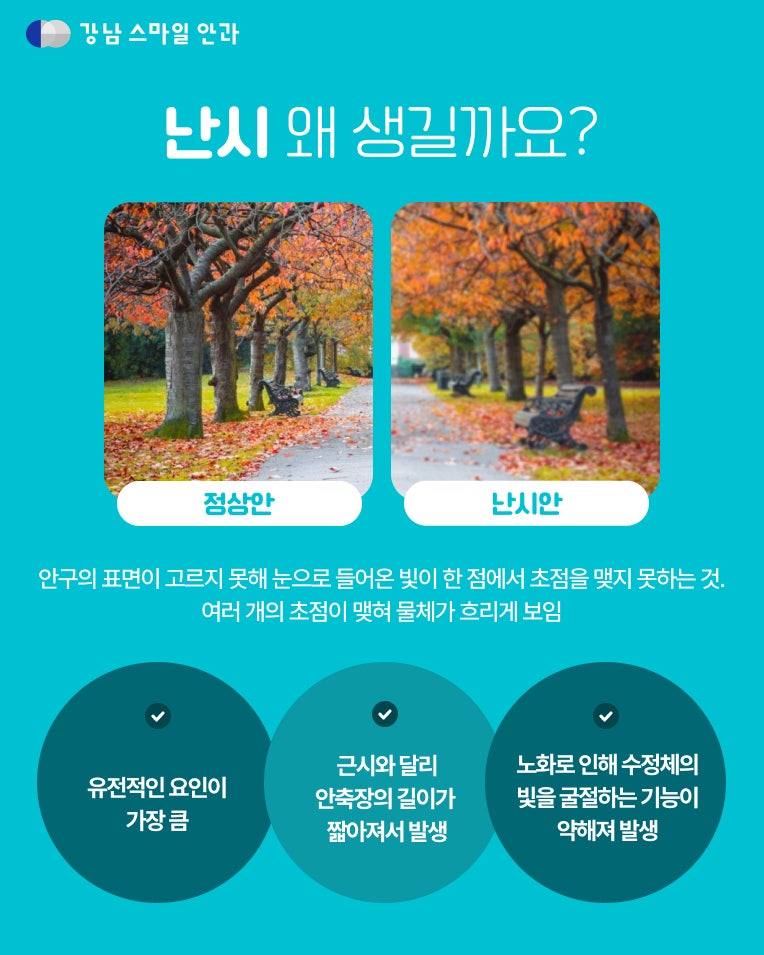
Astigmatism is a condition where the cornea or lens is not perfectly spherical but has an asymmetrical shape, like a rugby ball,
causing light to scatter instead of focusing precisely at one point.
Generally, astigmatism with a power of 2D (diopters) or more is classified as high astigmatism.
In such cases, objects may appear blurry or doubled,
and symptoms like eye fatigue, headaches, and glare at night can worsen.
If high myopia is also present, the quality of vision further deteriorates,
leading to significant discomfort in daily life.
Therefore, for high astigmatism,
beyond simply achieving good vision,
precise correction that accurately aligns the astigmatic axis is paramount.
This is a key factor that must be considered when recommending SMILE LASIK.
SMILE LASIK Recommendation: Why astigmatism correction is important
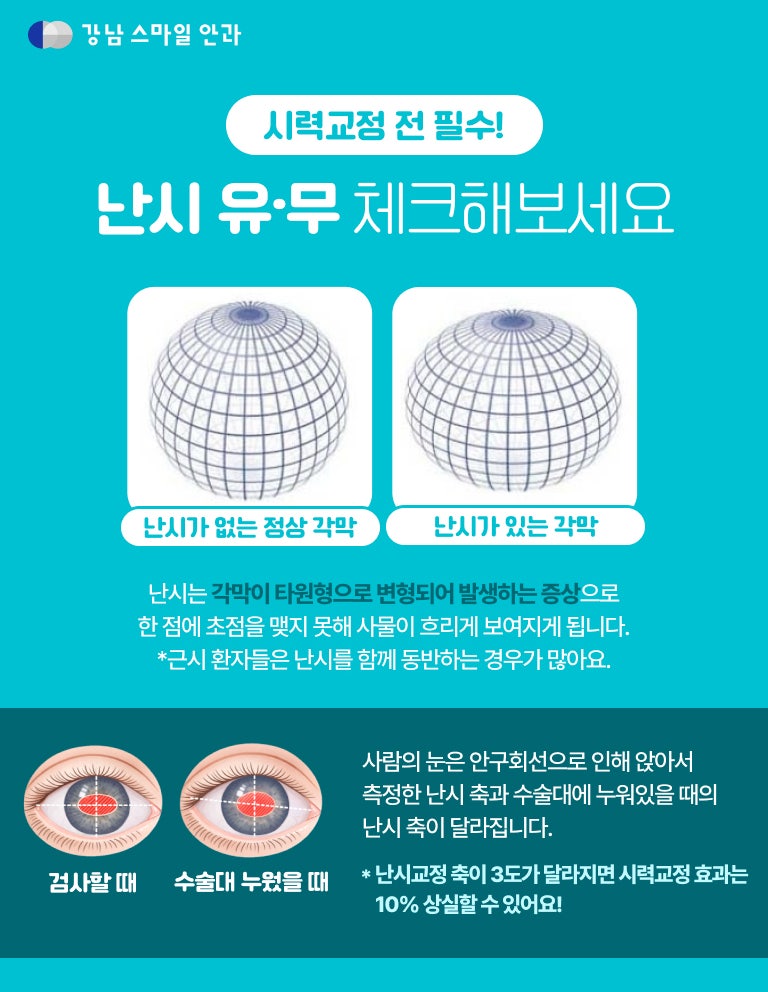
The most challenging aspect of high myopia or astigmatism surgery is the astigmatic axis.
Most patients with high myopia also have high astigmatism.
Astigmatism is not resolved by simply correcting the power;
a clear field of vision can only be achieved when the axis is precisely aligned.
Especially during surgery, a phenomenon called ‘ocular cyclotorsion’ occurs, where the eye subtly rotates when we lie down on the operating table compared to when we are sitting.
If this cyclotorsion is not accounted for, the actual laser application point and
the astigmatic axis can become misaligned.
Even a 1-degree misalignment of the astigmatic axis can reduce the correction effect,
and if it's off by 10 degrees or more, the correction effect can drop by more than half.
Therefore, for high myopia that includes high astigmatism,
real-time eye tracking and cyclotorsion compensation are essential.
So, the current criteria for SMILE LASIK recommendation are not just about the small incision, but rather about
- ✔ Astigmatic axis compensation
- ✔ Ocular cyclotorsion compensation
- ✔ Real-time eye movement tracking
- ✔ Maintaining precise centering
It depends on how precisely these four aspects can be implemented.
SMILE LASIK Recommendation: Why is New SMILE LASIK, which can treat high myopia and astigmatism, gaining attention?
SMILE LASIK corrects vision with a micro-incision of less than 2mm without creating a corneal flap,
It is known as a surgery with fast recovery and less corneal nerve damage,
resulting in a lower risk of dry eye syndrome.
Therefore, it is generally a highly recommended vision correction surgery.
In the past, there was a perception that SMILE LASIK was somewhat limited in astigmatism correction,
but recently, with the introduction of New SMILE LASIK technology,
the range of correction for high myopia, especially high astigmatism, has significantly expanded.
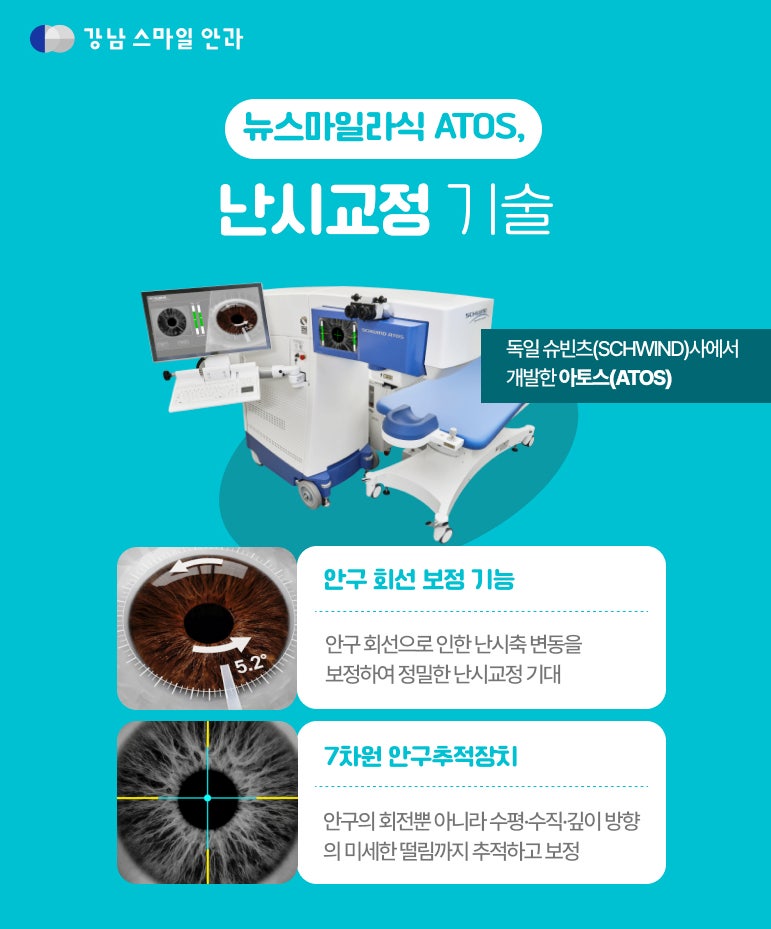
The ATOS laser from Schwindt, Germany, used in New SMILE LASIK, features
- ✔ 7-dimensional eye tracking system
- ✔ Real-time eye movement detection
- ✔ Automatic ocular cyclotorsion compensation
These functions ensure precise centering even during surgery.
Thanks to this technology, stable results can be expected even for patients with high astigmatism, where astigmatic axis accuracy is crucial.
That's why New SMILE LASIK is often chosen as the recommended SMILE LASIK surgery among patients with high myopia or astigmatism these days.
SMILE LASIK Recommendation for High Myopia and Astigmatism: Ultimately, ‘precise planning’ is key.
In summary,
the era when SMILE LASIK was impossible for high myopia and astigmatism is long gone.
Especially for high astigmatism,
- ✔ Accurate examination
- ✔ Astigmatic axis analysis
- ✔ Consideration of ocular cyclotorsion
- ✔ Centering accuracy of the equipment
Satisfactory results can be expected when all these factors align.
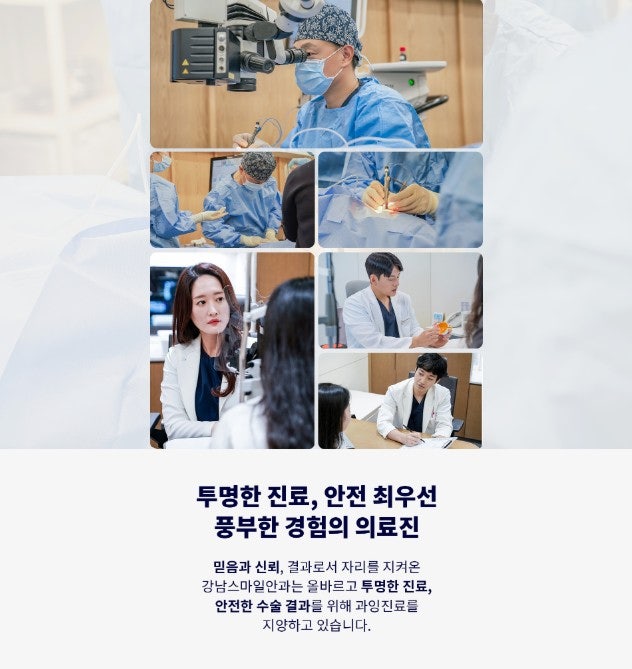
Gangnam Smile Eye Clinic focuses on precise examinations and customized SMILE LASIK recommendation consultations for patients with high myopia, high astigmatism, and high astigmatism,
and aims for safer and more accurate vision correction based on clinical experience with the ATOS laser.
If you are curious about the surgery suitable for your eye condition,
feel free to consult us anytime.
Gangnam Smile will be with you until the end for clear vision and eye health. 😊
💙 SMILE Surgery is indeed Gangnam Smile Eye Clinic 💙
💙🤍 𝖦𝖠𝖭𝖦𝖭𝖠𝖬 𝖲𝖬𝖨𝖫𝖤 𝖤𝖸𝖤 𝖢𝖫𝖨𝖭𝖨𝖢💙🤍
𝗧𝗛𝗘 𝗟𝗜𝗚𝗛𝗧 𝗔𝗡𝗗 𝗧𝗛𝗘 𝗢𝗖𝗘𝗔𝗡 𝗜𝗡 𝗬𝗢𝗨𝗥 𝗦𝗠𝗜𝗟𝗘













Frequently Asked Questions
Is SMILE eye surgery possible for high myopia or high astigmatism?
Yes, it is possible. With recent advancements in equipment and technology, high myopia, high astigmatism, and especially high astigmatism can now be sufficiently corrected with SMILE eye surgery. However, accurate centering and precise astigmatism axis correction are very important.
What is considered high astigmatism?
High astigmatism refers to an astigmatism power of 2 diopters (D) or more. The cornea or lens shape is asymmetrical, causing light to scatter instead of focusing at a single point, which can result in blurry or double vision.
Why is astigmatism correction important in SMILE eye surgery?
Astigmatism correction is very important for clear vision. Due to subtle eye rotation during surgery, the astigmatism axis can shift, and even a 1-degree deviation can reduce the correction effect, making precise axis compensation essential.
What is the difference between New SMILE eye surgery and traditional SMILE eye surgery?
New SMILE eye surgery is a technology that significantly expands the correction range for high myopia and high astigmatism. It uses the German Schwindt ATOS laser, featuring 7-dimensional eye tracking, real-time eye movement detection, and automatic eye rotation compensation to enhance precision.
What are the important considerations for high astigmatism SMILE eye surgery?
The most important factors are 'centering accuracy' and 'precise astigmatism axis correction.' How precisely astigmatism axis correction, eye rotation compensation, real-time eye movement tracking, and accurate centering maintenance are implemented are key elements for successful surgery.