2026-07-20
If you have high myopia, you ‘must’ know about these diseases: Gangnam Station Eye Clinic Recommendation
High myopia increases the risk of serious eye diseases like retinal detachment, glaucoma, and macular degeneration. Regular eye exams and early management are crucial for prevention.


Hello, this is Gangnam Smile Eye Clinic 😊💙
Recent research indicates that high myopia is more than just poor vision;
it can increase the risk of various eye diseases.
Conditions like retinal detachment, glaucoma, and macular degeneration, in particular,
can lead to serious complications that threaten vision, requiring careful attention.
Today, with Gangnam Smile, a recommended eye clinic near Gangnam Station,
we will delve into the major complications that can arise from high myopia
and discuss methods for their prevention and management.
Gangnam Station Eye Clinic Recommendation: What is High Myopia?
Myopia is a refractive error where light entering the eye focuses in front of the retina,
making distant objects appear blurry
while nearby objects are relatively clear.
It primarily occurs when the eyeball's length is longer than normal
or when the cornea or lens has excessive refractive power.
In normal vision, light passing through the cornea and lens
must focus precisely on the retina to form a clear image, but
in myopia, this focus occurs in front of the retina,
causing distant objects to appear blurry.
High myopia generally refers to severe myopia of -6.00 diopters (D) or more.
Simply put, it means a state where it's difficult to distinguish the largest letters on an eye chart,
and even nearby objects are not seen well, making daily life challenging without glasses.
Particularly, high myopia is closely associated with serious complications that can lead to vision loss, beyond mere vision deterioration, thus requiring caution.
Gangnam Station Eye Clinic Recommendation: Eye Diseases to Watch Out for with High Myopia
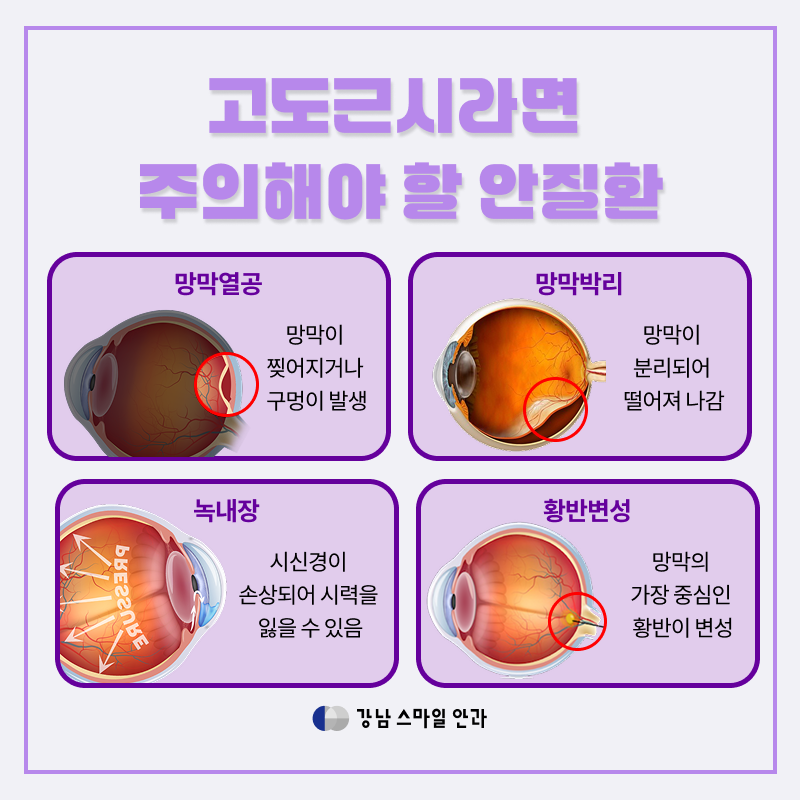
Retinal Detachment
The reason why individuals with high myopia must be particularly careful about retinal detachment is
that changes in the eye's structure make the retina susceptible to damage.
High myopia is typically characterized by an abnormally elongated axial length, which is the front-to-back length of the eyeball.
This causes various tissues of the eye, including the retina, to become thin and stretched.
The retina, in particular, is a very thin and delicate tissue, making it vulnerable to these physical changes.
As the 'vitreous,' a jelly-like substance inside the eye, contracts due to aging or myopia,
it can pull on the retina, creating tears. If fluid seeps through these tears,
the retina gradually separates from the eye wall, a phenomenon known as ‘retinal detachment.’
Glaucoma
With high myopia, as the length of the eyeball becomes abnormally long,
the structure of the area where the optic nerve connects can stretch and thin.
This makes the optic nerve sensitive to external pressure or minor damage,
increasing the risk of glaucoma compared to the general population.
Glaucoma is a disease where the optic nerve is progressively damaged due to causes such as increased intraocular pressure or abnormal blood flow,
and in its early stages, there are almost no noticeable symptoms, making early detection difficult.
By the time symptoms appear, optic nerve damage is often already significantly advanced.
At this point, once the optic nerve is damaged, it is difficult to recover, so
it is necessary to make a habit of checking the eye's condition even without special symptoms.
Macular Degeneration
The ‘macula’ is an area located in the center of the retina,
where photoreceptor cells are densely packed, playing a crucial role in seeing objects clearly and distinguishing colors.
However, in cases of high myopia, as the eyeball length becomes abnormally long,
the retina stretches and thins, accumulating microscopic damage in the macular area,
which can eventually lead to tissue deformation or atrophy.
This condition is called ‘myopic macular degeneration’
and occurs with a relatively high frequency in patients with high myopia.
Myopic macular degeneration causes a decrease in central vision,
which can significantly interfere with daily activities such as reading and driving.
Even if one eye is affected, the other eye often compensates,
so the condition often goes unnoticed until it is quite advanced.
Gangnam Station Eye Clinic Recommendation: Regular Check-ups are Essential if You Have High Myopia!
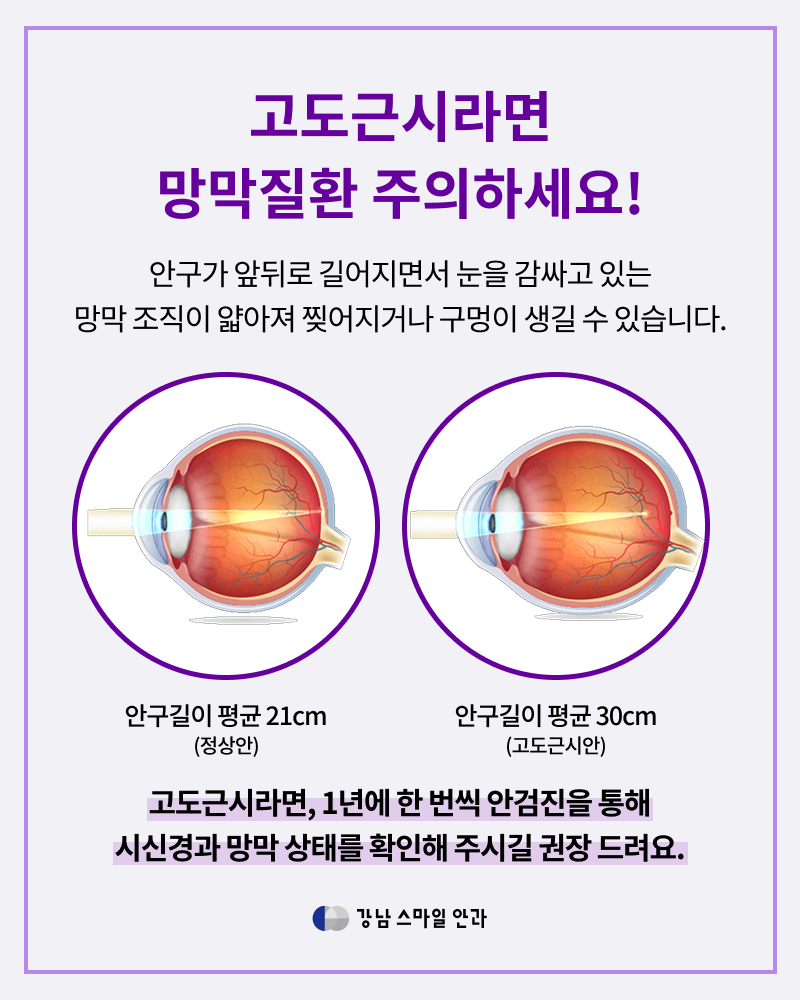
Once high myopia progresses, it is difficult to reverse,
making prevention and systematic management extremely important.
The most basic yet effective method for this is
to regularly check the condition of your eyes through periodic ophthalmological examinations.
For growing children or those who already have myopia, it is advisable to undergo a comprehensive examination, including vision tests, intraocular pressure tests, and fundus examinations, once every 6 months to a year.
This allows for early detection of myopia progression
and, if necessary, the initiation of active treatment.
Especially for growing children, during the rapid growth period between 6 and 10 years of age,
the length of the eyeball also elongates, accelerating the progression of myopia.
If ultra-high myopia develops during adolescence, even after vision stabilizes in adulthood,
it may become difficult to undergo vision correction surgeries like LASIK or LASEK.
Therefore, if diagnosed with childhood myopia, to prevent high myopia,
consultation with medical staff is necessary, keeping both vision correction and myopia progression control in mind.
To prevent progression to high myopia, which has many complications,
myopia control treatment is essential. After consultation, it is best to choose the most suitable treatment method for the child from various myopia control methods, such as orthokeratology lenses or glasses.
High myopia is a condition that goes beyond simple vision deterioration
and can increase the risk of various eye diseases.
Therefore, it is important to protect eye health through regular eye exams and lifestyle improvements.
Especially if there is a family history, more meticulous management is required.
Since the eyes are organs that are difficult to recover once damaged,
we recommend continuous care and prevention for eye health in daily life.
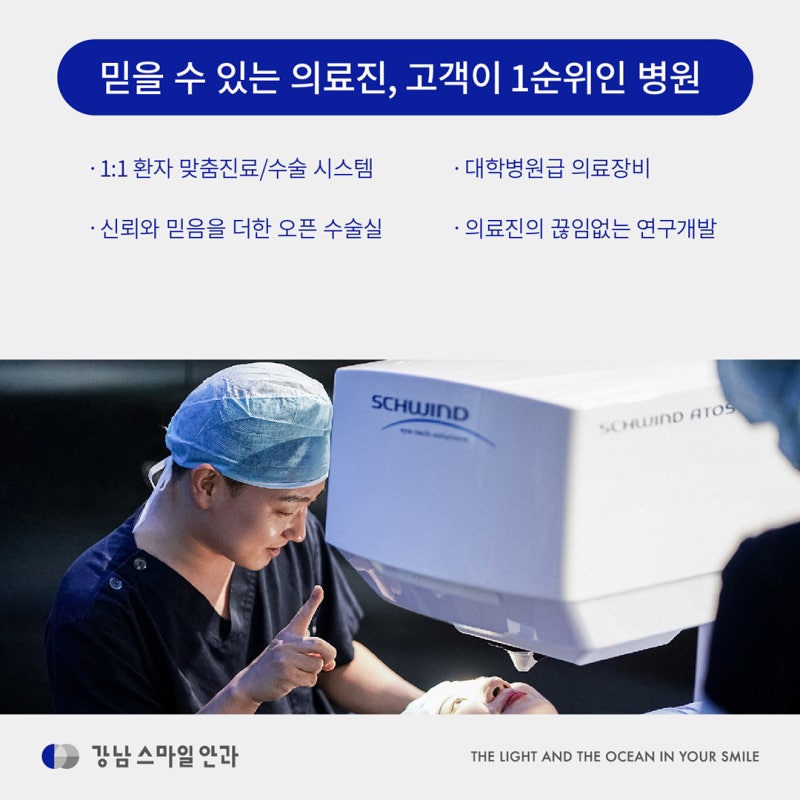
Gangnam Smile Eye Clinic
is equipped with the latest equipment and a systematic examination system,
providing sincere treatment and surgery to each individual through 1:1 customized consultations.
Furthermore, we always prioritize the patient,
and place transparency and safety above all else.
If you have any other inquiries,
please feel free to contact the eye clinic at any time.
💙🤍 𝖦𝖠𝖭𝖦𝖭𝖠𝖬 𝖲𝖬𝖨𝖫𝖤 𝖤𝖤 𝖢𝖫𝖨𝖭𝖨𝖢💙🤍
𝗧𝗛𝗘 𝗟𝗜𝗚𝗛𝗧 𝗔𝗡𝗗 𝗧𝗛𝗘 𝗢𝗖𝗘𝗔𝗡 𝗜𝗡 𝗬𝗢𝗨𝗥 𝗦𝗠𝗜𝗟𝗘


Gangnam Station Eye Clinic Recommendation Gangnam Station Eye Clinic Recommendation Gangnam Station Eye Clinic Recommendation Gangnam Station Eye Clinic Recommendation Gangnam Station Eye Clinic Recommendation Gangnam Station Eye Clinic Recommendation

Frequently Asked Questions
What is high myopia?
High myopia generally refers to severe myopia of -6.00 diopters (D) or more. It means a state where it's difficult to see not only distant objects but also nearby objects well, making daily life challenging without glasses.
What eye diseases should I be careful about if I have high myopia?
High myopia increases the risk of serious eye diseases such as retinal detachment, glaucoma, and macular degeneration. Changes in eyeball length can thin the retina, make the optic nerve susceptible to damage, and cause deformation in the macular area.
Why do complications from high myopia occur?
High myopia is characterized by an abnormally elongated front-to-back length of the eyeball. This causes various tissues within the eye, such as the retina, optic nerve, and macula, to become thin and stretched, making them vulnerable to damage.
How should patients with high myopia manage their eyes?
Regular eye exams are essential for patients with high myopia. It is necessary to consistently check the eye's condition through comprehensive examinations, including vision, intraocular pressure, and fundus exams, once every 6 months to a year, and manage it early.
Is preventing high myopia in growing children important?
Yes, it is very important. Growing children can experience a rapid increase in eyeball length, accelerating the progression of myopia. If diagnosed with childhood myopia, it is advisable to consult with medical staff about myopia control treatment to prevent high myopia.
Can damaged optic nerves from high myopia recover?
No, once the optic nerve is damaged, it is difficult to recover. Diseases like glaucoma often have almost no early symptoms, making early detection difficult, so it is necessary to make a habit of checking the eye's condition through regular check-ups even without special symptoms.