2026-09-03
If Sagging Cheeks Bother You Every Time You Look in the Mirror, Let's Talk About Vertical Mini Facelift
Learn about the vertical mini facelift, a procedure designed to address sagging cheeks and jawlines by repositioning facial tissues upwards. This article covers why cheeks sag, what a vertical mini facelift entails, how it differs from a regular mini facelift, and who might be a good candidate.
※ This article is intended to provide medical information.
It is not subject to review under Article 56, Paragraph 2 and Article 57 of the Medical Act,
and we inform you that it is not an advertisement unrelated to the review content.
Hello,
I am Dr. Jung-Geun Park,
Director of Faceplus Plastic Surgery Clinic.

Hello.
When I consult about vertical mini facelifts,
many people share similar concerns.
‘I haven't gained weight, but my face looks heavy.’
‘My jawline seems less defined than before.’
‘When I take pictures, my cheek fat looks like it's sagging down.’
In reality, facial aging
doesn't just involve wrinkles.
As the soft tissues in the cheek area move downwards,
the facial contour collapses,
and the jawline becomes less defined.

These changes sometimes have limitations in improvement
with makeup or
simple skin treatments alone.
Today, I will explain what a vertical mini facelift is,
and in what cases it can be considered.
Table of Contents | ||
Why do cheeks sag downwards? What is a vertical mini facelift? Differences from a regular mini facelift When to consider a vertical mini facelift |
1. Why do cheeks sag downwards?
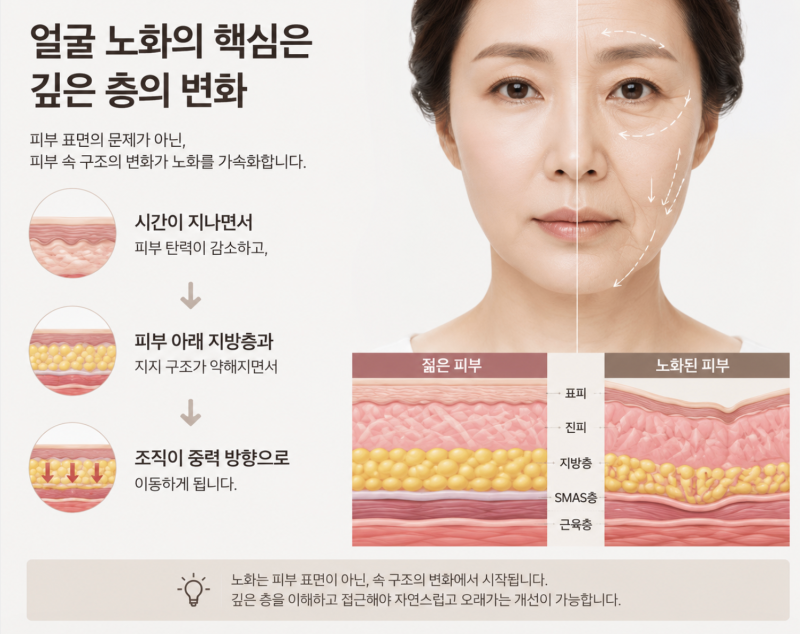
The core of facial aging
lies in changes in the deeper layers
rather than the skin itself.
Over time,
skin elasticity decreases,
and as the fat layer and
supporting structures beneath the skin weaken,
tissues move in the direction of gravity.
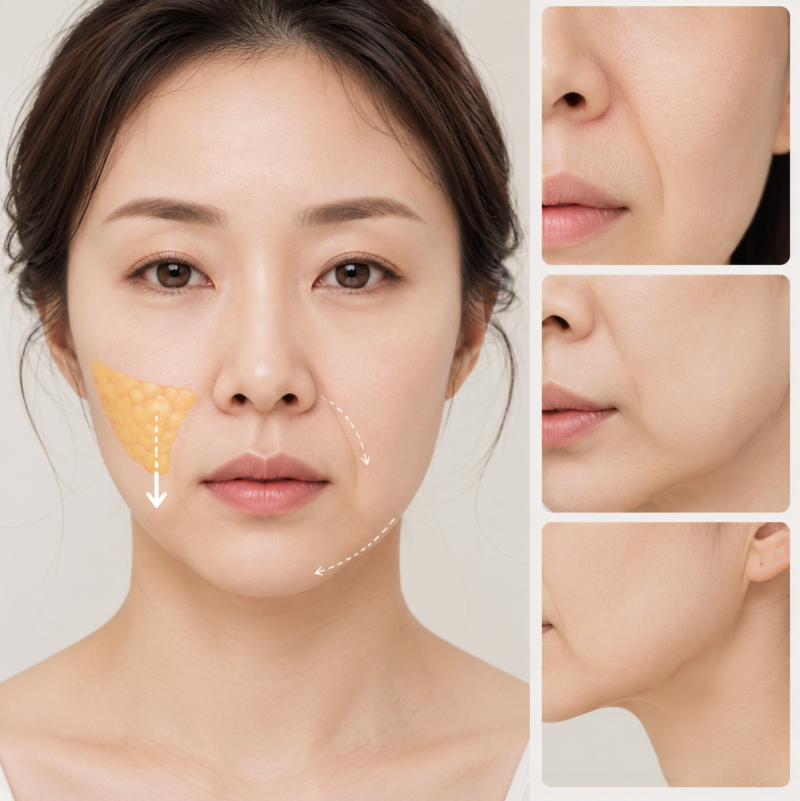
A representative change that occurs in this process is
deep cheek sagging.
When the deep cheeks descend,
nasolabial folds can appear deeper,
the area around the mouth can look heavy,
and the jawline can also become blurred.
Especially among those in their 30s to 50s,
one of the most frequently consulted concerns is
precisely this sagging of the cheeks.
In many cases, the face hasn't actually gotten bigger,
but the impression changes
due to the altered position of the tissues.
2. What is a vertical mini facelift?
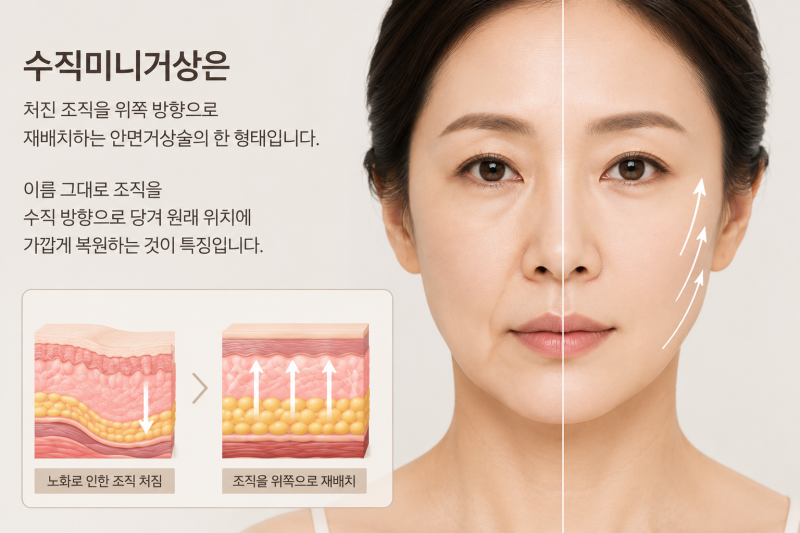
A vertical mini facelift is
a type of facelift that repositions
sagging tissues in an upward direction.
As the name suggests,
it is characterized by lifting the tissues vertically
to restore them closer to their original position.
Facial tissues move downwards
during the aging process.
Therefore, improvement should also be
upwards, which is the opposite
of the actual direction of sagging.
The vertical mini facelift
is performed based on this principle.
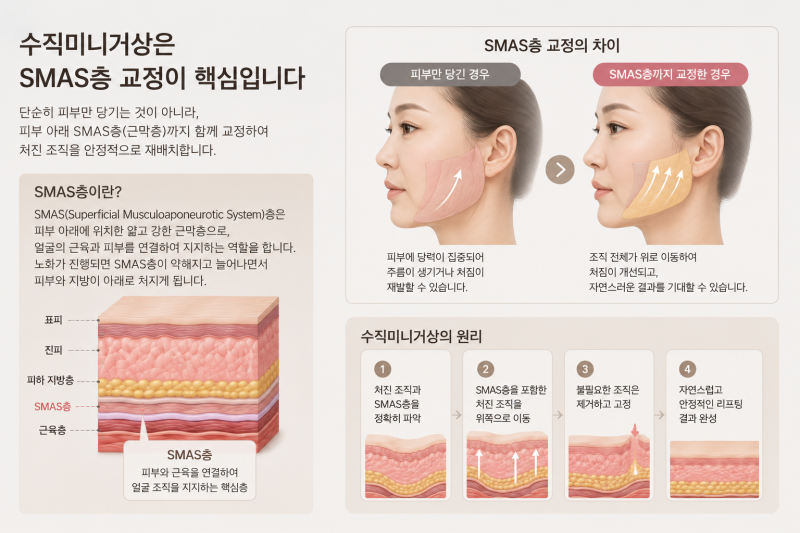
It's not just about pulling the skin;
the key is to reposition the sagging tissues
more stably by correcting the SMAS layer
located beneath the skin.
Currently, in the field of facelifts,
SMAS correction is
considered a very important factor.
If only the skin is pulled,
the tension burden is concentrated on the skin,
but if the SMAS layer is corrected together,
the entire tissue moves,
allowing for more natural results.
3. Differences from a regular mini facelift
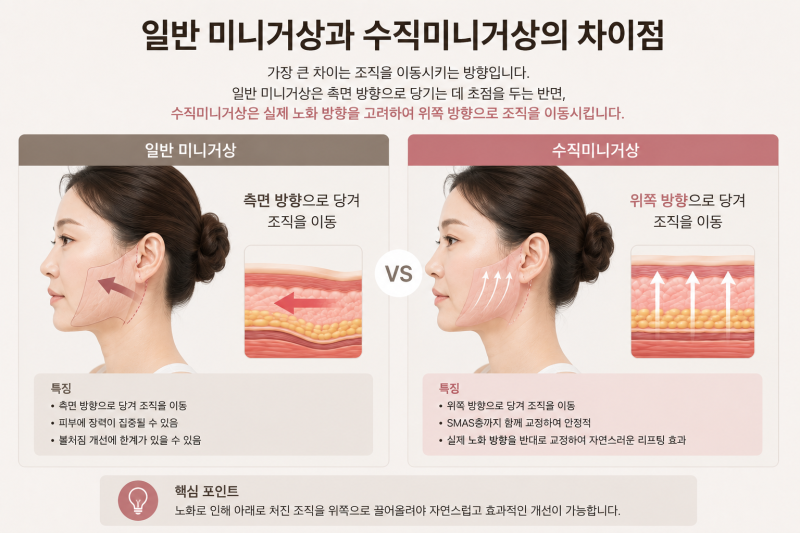
One of the most common questions during consultation is,
‘What's the difference from a regular mini facelift?’
The biggest difference is
the direction in which the tissues are moved.
Some methods focus on
pulling in a lateral direction.
In contrast, the vertical mini facelift
is characterized by moving tissues in an upward direction,
considering the actual direction of aging.

Especially when prioritizing the improvement of the midface,
i.e., sagging cheeks,
vertical correction can be
a more suitable choice.
Furthermore, it is often performed
using small incisions in front of the ear,
meaning the incision range is relatively limited
compared to traditional facelifts.
However, the choice of surgical method
can vary depending on the individual's degree of sagging
and tissue condition.
The same method is not suitable
for everyone.
4. When to consider a vertical mini facelift
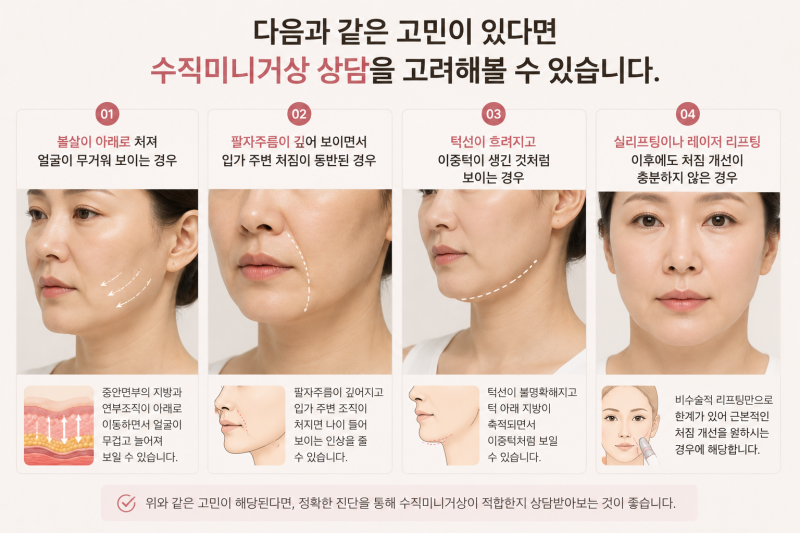
If you have the following concerns,
you might consider a vertical mini facelift consultation.
First,
if your cheeks are sagging downwards,
making your face look heavy.
Second,
if your nasolabial folds appear deep
and are accompanied by sagging around the mouth.
Third,
if your jawline is blurred
and appears as if you have a double chin.
Fourth,
if the improvement in sagging is not sufficient
even after thread lifting or laser lifting.

What's important is
to accurately diagnose your current facial condition.
The appropriate treatment method varies
depending on whether the cause of aging is
decreased skin elasticity,
fat migration,
or sagging of the muscles and SMAS layer.
Therefore, sufficient consultation and diagnosis
must precede the decision to undergo surgery.
Sagging cheeks are not a change that naturally improves
over time.
Since the cause is a change in tissue position,
it is important to accurately assess the current condition
and formulate an appropriate plan.
If a collapsed facial contour and sagging cheeks bother you
every time you look in the mirror,
rather than just thinking of it as a skin problem,
considering the entire facial structure together
can be a more important starting point.
-Operating Hours-
Weekdays 9:00 ~ 18:00 Saturdays 9:00 ~ 16:00 Public Holidays / Sundays Regular closure |
-Contact Us-
Faceplus Plastic Surgery Clinic | ||
Consultation Phone: 02-541-8500 Inquiries: KakaoTalk Inquiry |
-Directions-
Frequently Asked Questions
What is a vertical mini facelift?
A vertical mini facelift is a type of facelift that repositions sagging facial tissues in an upward direction, restoring them closer to their original position. As the name suggests, it is characterized by lifting the tissues vertically for improvement.
What is the main cause of sagging cheeks?
The main cause of sagging cheeks is the decrease in skin elasticity due to aging, and the weakening of the fat layer and supporting structures beneath the skin, causing tissues to move in the direction of gravity. Deep cheek sagging is a representative outcome of this process.
What is the difference between a regular mini facelift and a vertical mini facelift?
The biggest difference is the direction in which the tissues are moved. A regular mini facelift focuses on pulling in a lateral direction, whereas a vertical mini facelift is characterized by moving tissues in an upward direction, considering the actual direction of aging.
When can a vertical mini facelift be considered?
It can be considered if your cheeks are sagging, making your face look heavy, if your nasolabial folds appear deep and are accompanied by sagging around the mouth, if your jawline is blurred, or if the improvement in sagging is not sufficient even after thread lifting or laser lifting.
Why is SMAS layer correction important during a vertical mini facelift?
SMAS layer correction is very important. If only the skin is pulled, the tension burden is concentrated on the skin, but if the SMAS layer is corrected together, the entire tissue moves, allowing for more natural and stable results.