2026-07-20
How to Reduce SMILE LASIK Side Effects and Glare
Learn how to minimize SMILE LASIK side effects like glare and dry eyes. This article explains lower-order and higher-order aberrations, and how advanced techniques and post-operative care at Gangnam Smile Eye Clinic can improve visual quality and recovery.


Hello, this is Gangnam Smile Eye Clinic 😊💙
What do you think is the role of vision correction surgery?
The purpose of vision correction surgery is to correct existing
myopia, astigmatism, and hyperopia to achieve emmetropia,
allowing patients to stop wearing glasses and contact lenses.
Did you know that vision correction surgery now not only
corrects myopia, astigmatism, and hyperopia,
but also eliminates higher-order aberrations that interfere with visual quality?
You may have heard the word ‘aberration’ many times,
but many people might be unfamiliar with the concept of aberrations in relation to vision correction surgery.
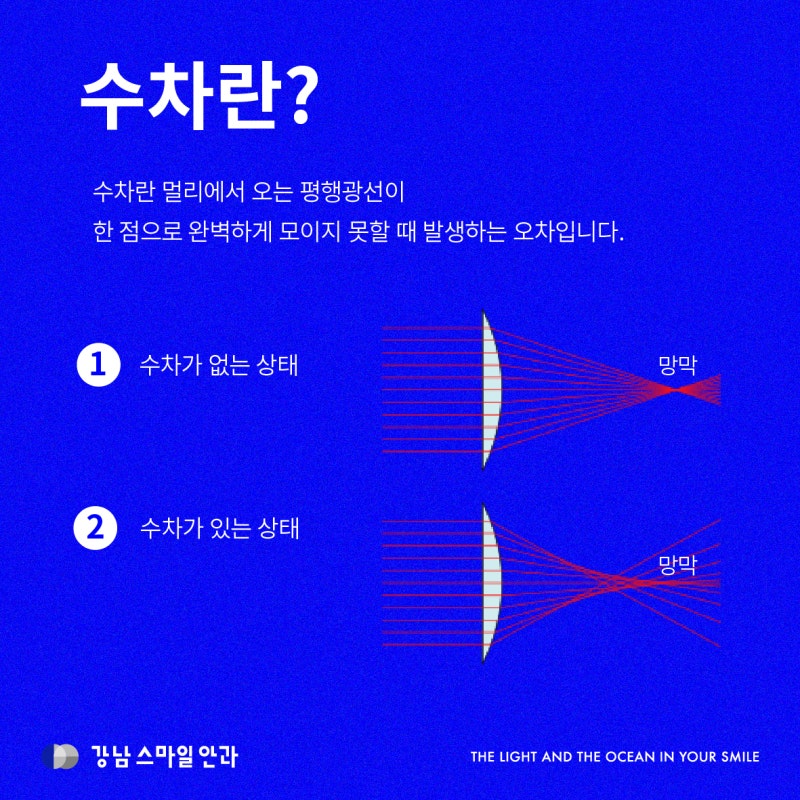
First, aberration refers to
a phenomenon where light rays originating from a single point do not converge perfectly at one point when forming an image through a lens or mirror, causing the image to appear blurry or distorted.
The cornea and lens of our eyes act as lenses,
and if light rays do not converge where they should due to the refractive power of the cornea and lens, causing aberrations, we say that vision is poor.
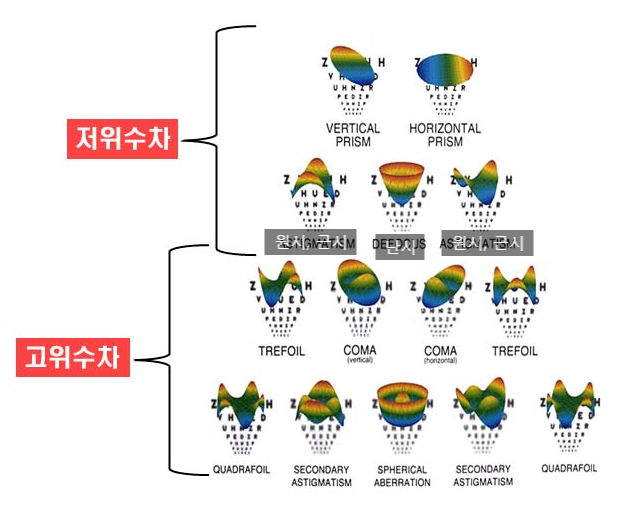
At this time, the types of aberrations that affect vision include
lower-order aberrations and higher-order aberrations.
What is the difference between higher-order and lower-order aberrations?
How to Reduce SMILE LASIK Side Effects: Lower-Order and Higher-Order Aberrations

Lower-order aberrations are
refractive errors such as myopia, hyperopia, and astigmatism.
If light coming from a distance converges in front of its intended location, it is myopia; if it converges behind, it is hyperopia;
if it fails to converge at one point and converges at two or more points, it is astigmatism.
Higher-order aberrations are
aberrations that arise from complex factors.
The important point is that higher-order aberrations are responsible for visual quality,
and therefore cannot be corrected with ordinary glasses or contact lenses.
(Glasses can actually worsen higher-order aberrations due to the lens itself.)
So, what are the main causes of higher-order aberrations in our eyes?
First, there is the tear film.
If the cornea has dryness and tears are not evenly distributed,
an abnormal tear film can degrade visual quality.
Second, if the corneal surface is not smooth.
Generally, after LASIK or LASEK, the shape of the cornea becomes irregular,
the tear film also becomes unstable, and higher-order aberrations significantly increase.
How to Reduce SMILE LASIK Side Effects: Impact of Higher-Order Aberrations

Even if vision is measured at 1.0 emmetropia, these higher-order aberrations can cause
qualitative differences in vision, such as night vision, glare, and contrast sensitivity.
A typical side effect caused by higher-order aberrations in vision correction is
glare due to an uneven corneal surface.
Gangnam Smile Eye Clinic has researched methods to reduce SMILE LASIK side effects
and has introduced the ATOS device, offering New SMILE LASIK.

The SMILE procedure with the ATOS device, or New SMILE LASIK,
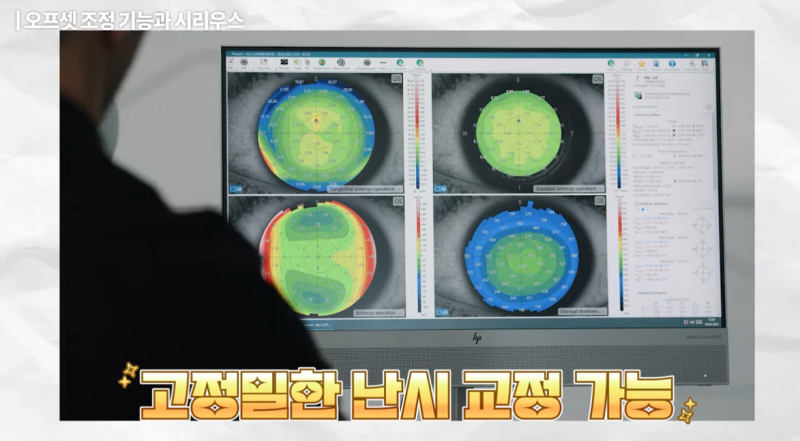
includes a device called Sirius, which significantly reduces the likelihood of irregular astigmatism or higher-order aberrations compared to standard SMILE LASIK devices.
While it's commonly thought that the center of the pupil and the center of one's gaze are the same,
this actually varies from person to person.
In the past, when there was no eye-tracking device, the pupil's central axis was used as the correction standard.
However, New SMILE LASIK uses a device called Sirius before surgery to
find the center of the cornea to be ablated, and by linking Sirius to the ATOS device during surgery,
it creates a precise surgical lenticule, enabling accurate correction without irregular astigmatism.
This means highly precise astigmatism correction is possible.
This function is an exclusive technology originally developed by Schwindt, a master of LASEK devices, for their Amaris Red,
and therefore
it is only applicable to Schwindt's SMILE device, ATOS.
So, for those without astigmatism,
is there no difference in the SMILE surgery?
No, that's not true.
The second important factor that determines the presence of higher-order aberrations is
the stabilization of the tear film, i.e., dry eye care.
Gangnam Smile Eye Clinic has its own dedicated Eye Care Center.
How to Eliminate Dry Eyes, a SMILE LASIK Side Effect

The Eye Care Center addresses dry eyes by resolving their fundamental cause through ocular IPL and meibomian gland expression (squeezing).
IPL sterilizes the skin surface with instantaneous heat and
coagulates tiny blood vessels, reducing telangiectasia, making it
a widely used care method in dermatology as well.
When this IPL is used on the oil glands of our eyes,
it melts the oil glands, aids in the lubrication of the ocular surface,
and creates a clean oil layer to balance both oil and water,
thereby stabilizing the tear film.
Furthermore, if dry eyes are severe, it is advisable to combine it with squeezing treatment.
Especially, squeezing treatment carries risks of infection or safety issues if done as home care,
so it is essential to visit an ophthalmologist for care.
Our clinic's squeezing treatment, which prevents meibomian gland infection and provides a refreshing extraction effect,
is always performed by an ophthalmologist with extensive expertise,
using thoroughly sterilized hands, forceps, and cotton swabs.
SMILE LASIK Side Effect: Dry Eye Care
In addition, Gangnam Smile Eye Clinic
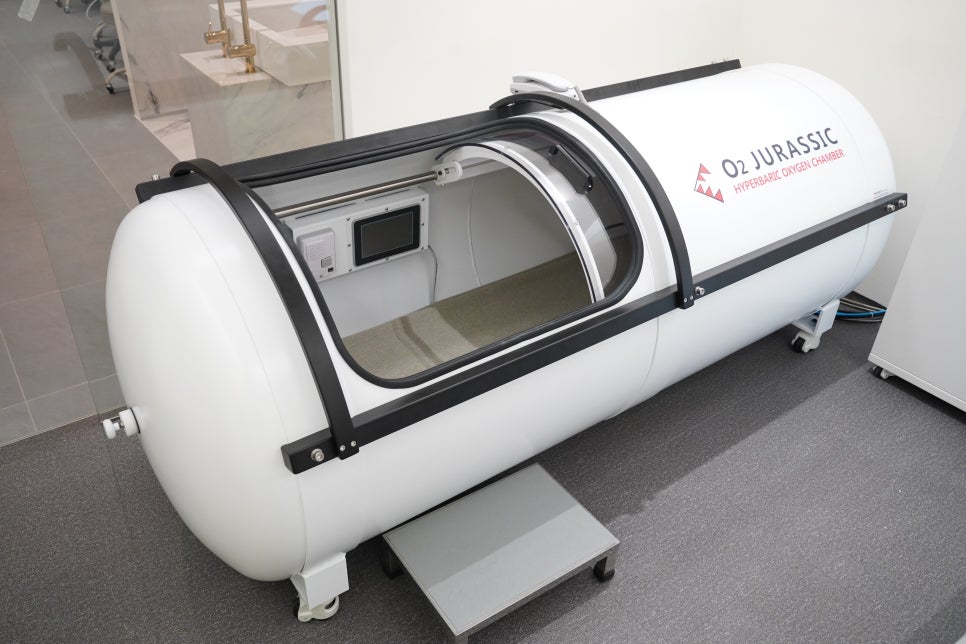
provides hyperbaric oxygen therapy to manage SMILE LASIK side effects more systematically.
Hyperbaric oxygen therapy is a cell treatment and recovery machine
that has recently gained global attention.
It is a treatment method that involves inhaling high-concentration oxygen inside a chamber.
During this process, the oxygen level in the body increases,
and as oxygen is supplied from cells to tiny peripheral blood vessels,
new blood vessels are formed, enhancing healing and regenerative capabilities,
and potentially improving the treatment effects for various diseases.
Hyperbaric oxygen therapy helps to restore the tear nerve layer and cornea damaged by surgery,
and to provide higher quality medical services to patients,
we have introduced this treatment device.
For more detailed information on SMILE LASIK side effects and differences between SMILE LASIK types, please refer to the video below.
Gangnam Smile Eye Clinic
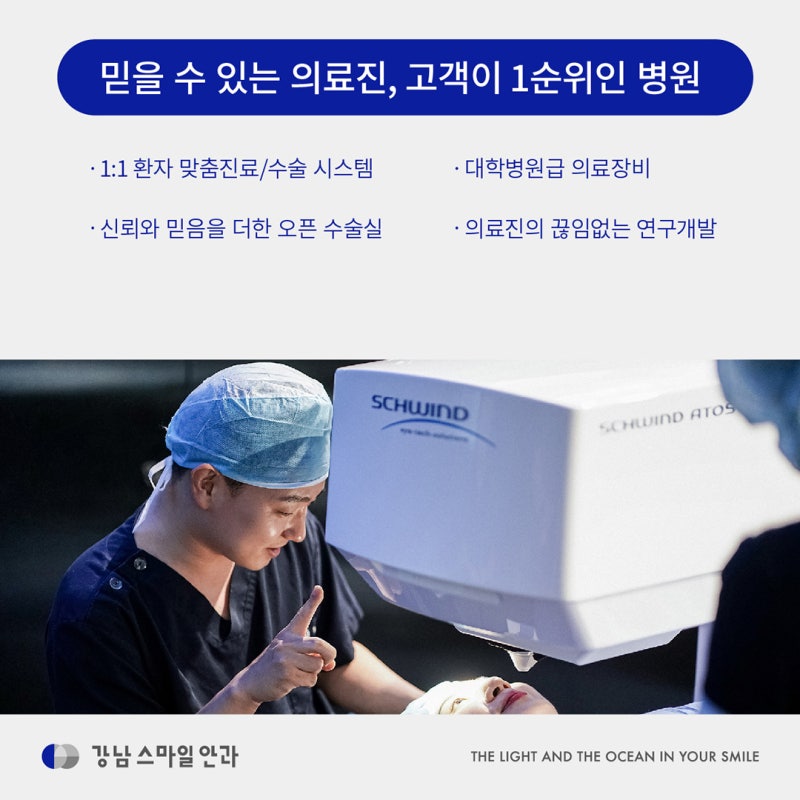
is equipped with the latest equipment and a systematic examination system,
providing sincere 1:1 customized consultations and surgeries for each individual.
We also always prioritize the patient,
placing transparency and safety above all else.
💙🤍 𝖦𝖠𝖭𝖦𝖭𝖠𝖬 𝖲𝖬𝖨𝖫𝖤 𝖤𝖸𝖤 𝖢𝖫𝖨𝖭𝖨𝖢💙🤍
𝗧𝗛𝗘 𝗟𝗜𝗚𝗛𝗧 𝗔𝗡𝗗 𝗧𝗛𝗘 𝗢𝗖𝗘𝗔𝗡 𝗜𝗡 𝗬𝗢𝗨𝗥 𝗦𝗠𝗜𝗟𝗘


SMILE LASIK side effects SMILE LASIK side effects SMILE LASIK side effects SMILE LASIK side effects SMILE LASIK side effects











Frequently Asked Questions
What is the purpose of vision correction surgery?
The purpose of vision correction surgery is to correct existing myopia, astigmatism, and hyperopia to achieve emmetropia without glasses or contact lenses. It also includes eliminating higher-order aberrations that interfere with visual quality.
What are higher-order aberrations, and why are they important?
Higher-order aberrations are vision degradation phenomena caused by complex factors, and they are responsible for visual quality. They cannot be corrected with ordinary glasses or contact lenses and are important because they cause qualitative differences in vision, such as reduced night vision, glare, and decreased contrast sensitivity.
Can glare side effects after SMILE LASIK be reduced?
Yes, they can be reduced. At Gangnam Smile Eye Clinic, New SMILE LASIK with the ATOS device helps reduce the likelihood of irregular astigmatism or higher-order aberrations, thereby alleviating glare. Additionally, dry eye care and hyperbaric oxygen therapy assist in managing side effects.
What is the difference between New SMILE LASIK and standard SMILE LASIK?
New SMILE LASIK uses the Sirius device integrated into the ATOS machine to accurately locate the center of the cornea before surgery and links it during the procedure, enabling highly precise astigmatism correction. This virtually eliminates the possibility of irregular astigmatism and higher-order aberrations.
How is dry eye managed after SMILE LASIK?
At Gangnam Smile Eye Clinic's Eye Care Center, dry eyes are addressed by resolving their fundamental cause through ocular IPL and meibomian gland expression (squeezing). IPL melts the oil glands to stabilize the tear film, and squeezing provides meibomian gland infection prevention and a clean extraction effect.
Does hyperbaric oxygen therapy help with SMILE LASIK recovery?
Yes, it can help. Hyperbaric oxygen therapy involves inhaling high-concentration oxygen, which increases oxygen levels in the body and supplies oxygen from cells to tiny blood vessels, enhancing healing and regenerative capabilities. This positively impacts the recovery of the tear nerve layer and cornea damaged by surgery.