2026-07-20
Gangnam Today LASEK: Recommended for ‘These Cases’! (Why LASEK is Good)
Considering vision correction surgery? This article explains why LASEK, especially Gangnam Today LASEK, might be the right choice for you. Learn about its benefits, differences from LASIK, and who it's recommended for.
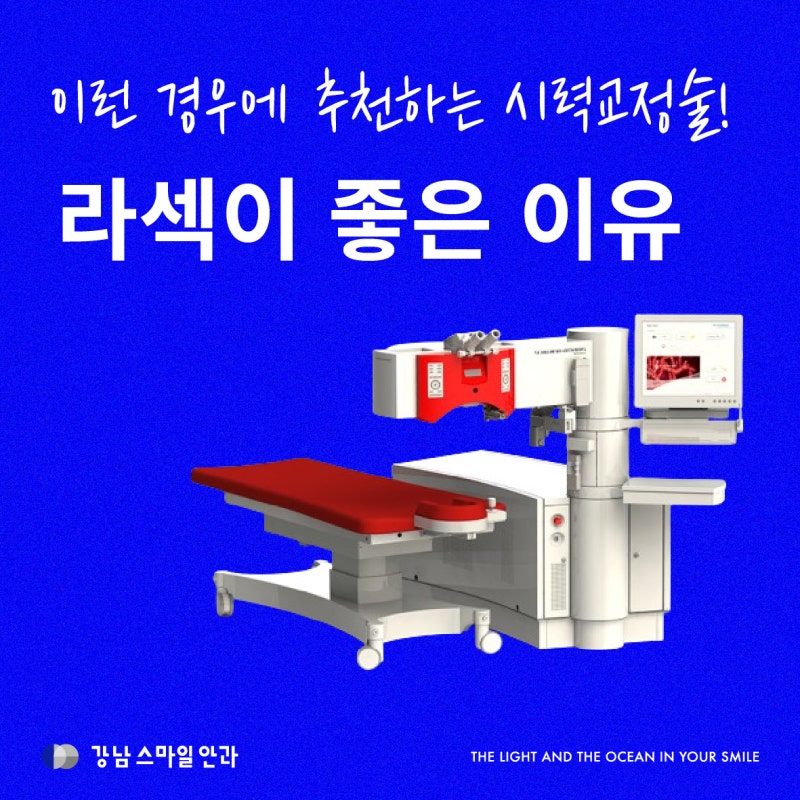
Hello, this is Gangnam Smile Eye Clinic 😊
Many of you might be considering vision correction surgery but feel confused about which method is right for you among the various options.
LASIK, LASEK, and SMILE surgery all share the common goal of correcting vision using a laser, but the choice can vary depending on the surgical method, recovery process, and suitable eye condition.
LASEK is a stable surgical method that does not create a corneal flap, making it a vision correction surgery that can be more suitable than LASIK in certain situations.
In this article, we will explain in detail why LASEK is a good option, what Today LASEK is, and who is recommended for LASEK.
What is LASEK? Differences from LASIK and Today LASEK
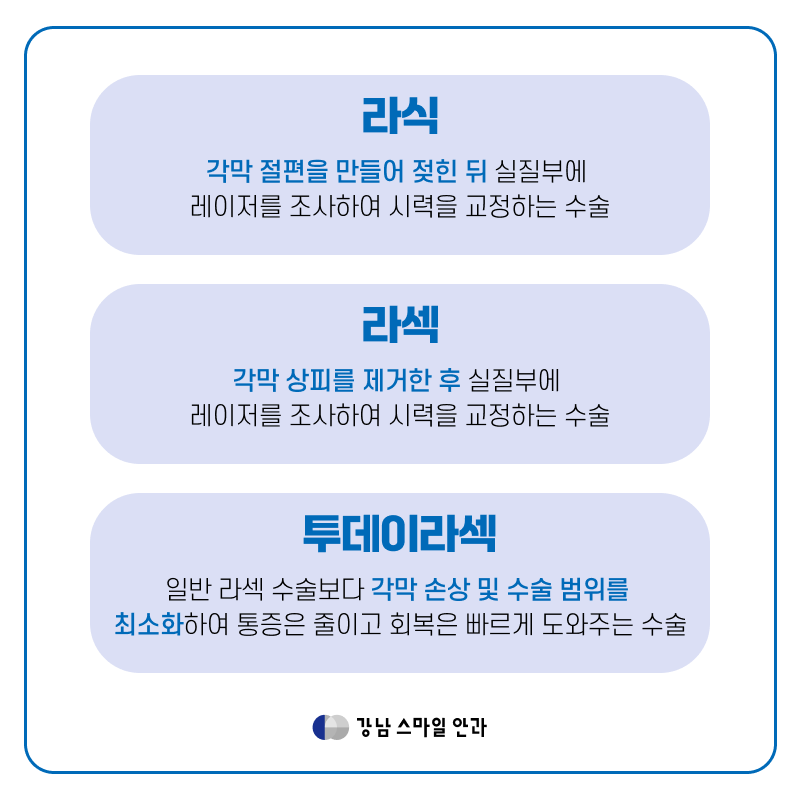
LASEK is a method of correcting vision by precisely ablating the corneal stroma after removing the epithelial layer of the cornea using a laser.
Unlike LASIK, it is characterized by not creating a corneal flap but rather gently pushing back or removing the epithelial layer to apply the laser.
LASIK surgery involves creating a corneal flap, lifting it, and then correcting the corneal stroma. It has the advantages of faster recovery and less pain. However, the process of creating a corneal flap can make the eye vulnerable to external impact, and it may not be suitable for those with thin corneas or a risk of keratoconus (corneal ectasia).
On the other hand, LASEK does not create a corneal flap, allowing for stable vision correction even with thin corneas. It is also resistant to external impact, making it suitable for individuals who engage in sports or have high activity levels.
After surgery, the corneal epithelial layer naturally regenerates over time, so the cornea remains stable.
However, in the initial period after surgery, symptoms such as pain, tearing, and glare may occur, and complete vision recovery takes longer than with LASIK.
Nevertheless, Gangnam Today LASEK maintains the advantages of traditional LASEK while shortening the recovery period.
Through advanced laser technology, it minimizes pain and accelerates the speed of vision recovery.
Features of Gangnam Today LASEK
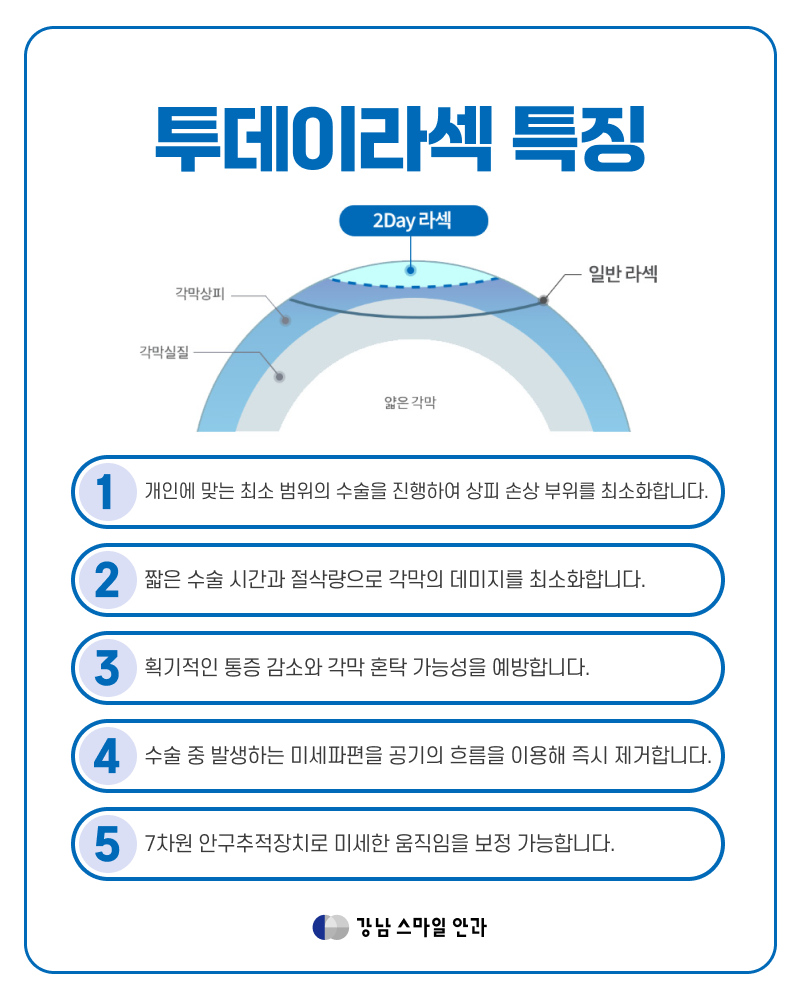
It precisely corrects the cornea using an excimer laser, allowing for faster recovery after surgery and easier return to daily life.
The rapid 1,050Hz laser application protects the tear film and promotes the regeneration of the corneal epithelium, significantly reducing the initial discomfort that was considered a drawback of traditional LASEK.
Furthermore, it meticulously analyzes refractive errors for each individual eye, minimizing higher-order aberrations such as glare.
This allows for clear vision at night.
Using smart pulse technology, it analyzes even the microscopic irregularities of the corneal surface, allowing for the correction of irregular astigmatism or subtle defects on the corneal surface. It is particularly special for significantly improving the quality of vision compared to general LASEK.
When and Why Gangnam Today LASEK is Recommended
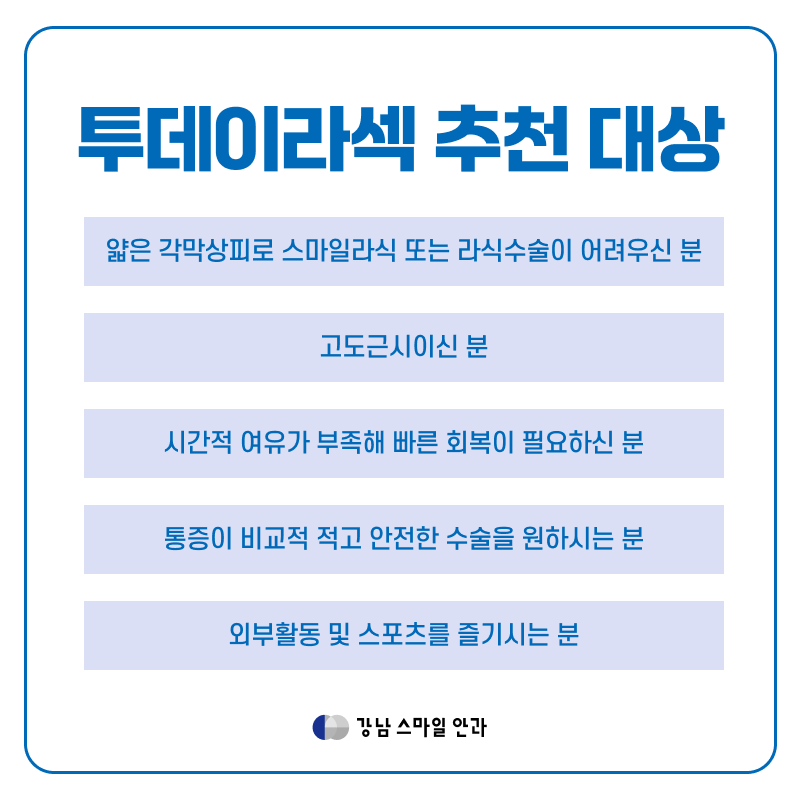
If your cornea is thin or irregular,
it is advisable to consider Gangnam Today LASEK.
Since LASIK surgery involves creating a corneal flap for correction,
sufficient corneal thickness must remain for safe surgery.
Today LASEK removes the epithelial layer without creating a corneal flap and then corrects vision using a laser,
thus preserving as much corneal thickness as possible, making it safe.
Today LASEK utilizes topography-guided ablation technology to precisely correct even abnormal curvatures of the corneal surface,
allowing for effective vision correction even in cases of irregular astigmatism or uneven corneal surfaces.
Today LASEK can also be an alternative for those with high myopia or high astigmatism.
For individuals with high myopia of -8D or more, or high astigmatism of 2D or more,
a significant amount of corneal tissue needs to be ablated, making LASEK, which does not create a corneal flap, a safer option.
Today LASEK is known to minimize corneal ablation during laser application,
thereby increasing corneal safety during correction of high myopia or astigmatism.
For individuals in professions or lifestyles where unexpected impacts may occur, such as athletes, police officers, soldiers, or those caring for young children,
Today LASEK is recommended.
LASIK surgery can be vulnerable to physical impact until the corneal flap settles, but
Today LASEK carries no risk of the flap moving or being damaged,
making it safe against external impacts.
In such cases, it becomes a safe method to protect vision even when individuals who engage in strenuous exercise or sports experience physical stimulation or pressure on their eyes.
Finally, if you have previously undergone vision correction surgery
(if vision regression occurred after LASIK or LASEK, or if additional vision correction is needed),
a surgical method that does not create a corneal flap can minimize corneal damage while allowing for additional vision correction.
We recommend undergoing stable surgery tailored to your individual eye condition through precise examination.
Immediately after surgery, during the regeneration of the corneal epithelium,
you may experience foreign body sensation, stinging, glare, or tearing.
These symptoms usually subside after 2-3 days,
and sufficient rest is required during the initial recovery period.
LASIK offers fast recovery and high initial visual stability,
with the advantage of a quick return to daily life.
If you have sufficient corneal thickness and desire fast recovery, LASIK may be suitable, but
if safety is your top priority, we recommend Gangnam Today LASEK.
Gangnam Today LASEK Gangnam Today LASEK Gangnam Today LASEK
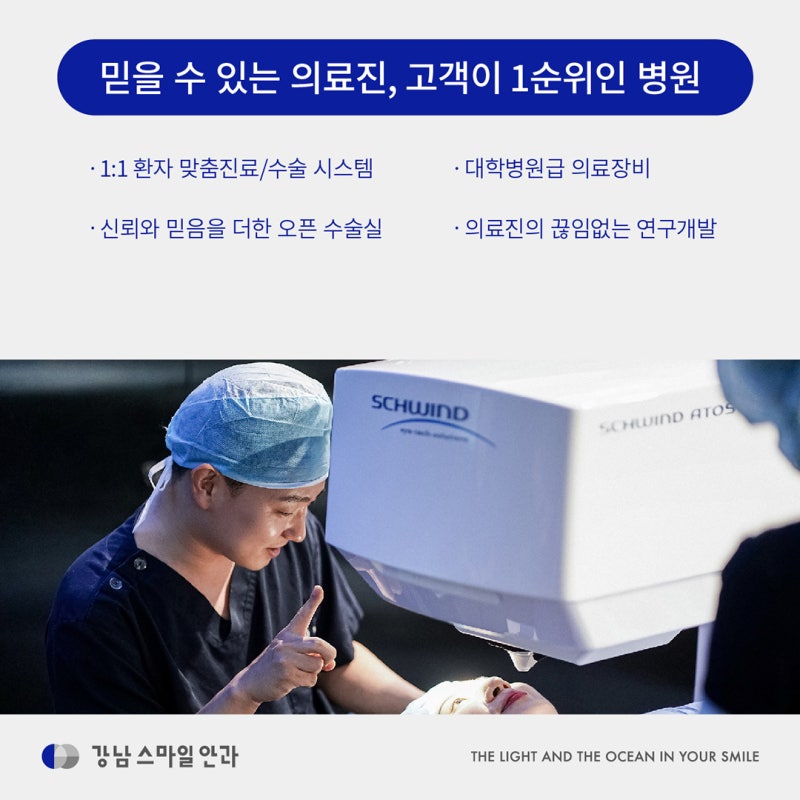
Gangnam Smile Eye Clinic
is equipped with the latest equipment and a systematic examination system,
providing sincere one-on-one customized consultations and surgeries for each individual.
Furthermore, we always prioritize the patient,
emphasizing transparency and safety above all else.
💙🤍 𝖦𝖠𝖭𝖦𝖭𝖠𝖬 𝖲𝖬𝖨𝖫𝖤 𝖤𝖸𝖤 𝖢𝖫𝖨𝖭𝖨𝖢💙🤍
𝗧𝗛𝗘 𝗟𝗜𝗚𝗛𝗧 𝗔𝗡𝗗 𝗧𝗛𝗘 𝗢𝗖𝗘𝗔𝗡 𝗜𝗡 𝗬𝗢𝗨𝗥 𝗦𝗠𝗜𝗟𝗘













Gangnam Today LASEK Gangnam Today LASEK Gangnam Today LASEK Gangnam Today LASEK Gangnam Today LASEK Gangnam Today LASEK Gangnam Today LASEK Gangnam Today LASEK Gangnam Today LASEK
Frequently Asked Questions
What is the biggest difference between LASEK and LASIK?
LASEK corrects vision by removing the corneal epithelial layer without creating a corneal flap, whereas LASIK creates and lifts a corneal flap before correction. LASEK is stronger against external impact due to the absence of a corneal flap and can be performed even with thin corneas.
What are the advantages of Gangnam Today LASEK?
Gangnam Today LASEK maintains the stability of traditional LASEK while minimizing pain and accelerating vision recovery speed through advanced laser technology. It offers precise correction with an excimer laser, allowing for a quick return to daily life, reduced glare, and improved quality of vision.
Is LASEK surgery possible for people with thin corneas?
Yes, it is possible. LASEK does not create a corneal flap, allowing for maximum preservation of corneal thickness. Therefore, stable vision correction is possible even with thin or irregular corneas. It can be performed more safely than LASIK.
How long is the recovery period after LASEK surgery?
Immediately after surgery, symptoms such as foreign body sensation, stinging, glare, and tearing may appear for about 2-3 days, but these symptoms usually subside after this period. Complete vision recovery may take longer than with LASIK.
Why is Today LASEK recommended for athletes or highly active individuals?
Today LASEK does not create a corneal flap, making it resistant to external impact. Therefore, it is a safe method for protecting vision for athletes, police officers, soldiers, and other highly active individuals who are at risk of exposure to strenuous exercise or physical stimuli.
Can high myopia or astigmatism be corrected with Today LASEK?
Yes, it can. Even in cases of high myopia of -8D or more, or high astigmatism of 2D or more, Today LASEK can minimize corneal ablation, thereby increasing corneal safety and serving as an effective alternative.