2026-09-28
Gangnam Station 2-Day LASEK: 3 Essential Things to Know if You Have Large Pupils
Having large pupils does not prevent you from receiving 2-Day LASEK. Discover how optical zone planning, corneal thickness, and comprehensive diagnostics ensure optimal night vision.

Hello, this is Gangnam Smile Eye Clinic. 😊💙
During a vision correction consultation at an eye clinic,
patients are sometimes told, "You have relatively large pupils."
Those who frequently drive at night or experience light scattering in dim settings often express concerns:
"Is it difficult to undergo 2-Day LASEK with large pupils?" "Will light glare and halos worsen significantly after surgery?"
To address these concerns directly:
A large pupil size alone does not determine candidacy for 2-Day LASEK.
What matters most is a comprehensive assessment of how large the pupils dilate in low-light conditions,
the dimension of the optical zone ablated by the laser,
and the degree of myopia, astigmatism, and corneal anatomy that needs correction.
Today, we will discuss the correlation between pupil size and night vision quality for anyone considering 2-Day LASEK.
Why is pupil size measured during a 2-Day LASEK exam?
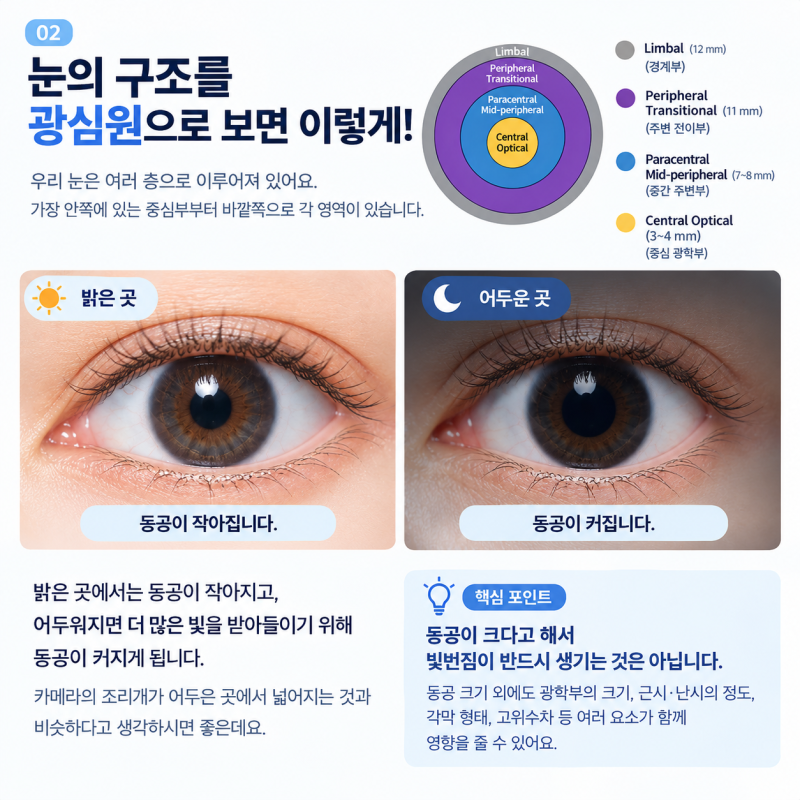
The pupil of the human eye functions much like the aperture of a camera.
It constricts in bright light
and dilates in low light to allow more light to reach the retina.
As a result, pupil diameter naturally fluctuates between day and night.
When planning refractive surgery, these dynamic variations must be taken into account.
In dark environments, as the pupil enlarges,
a higher proportion of incoming light may pass through the peripheral regions of the cornea.
Depending on the eye's individual optical properties, this can occasionally lead to symptoms such as:
Light scattering (glare)
Halos around lights
Star-bursting
Nighttime photophobia (dazzling)
However, one crucial point must be emphasized:
Having large pupils does not guarantee that light scattering will occur.
Historically, a large scotopic (nighttime) pupil size was simplified as a direct predictor of post-operative glare.
In modern practice, however, pupil size alone cannot predict post-operative night vision quality.
Night vision is influenced by multiple interrelated factors, including the refractive error (myopia/astigmatism), optical zone diameter, corneal topography, higher-order aberrations,
centration of the ablation, and dry eye status.
Therefore, the primary concern is not simply,
"How many millimeters is my pupil?"
Instead, the proper question is,
"What are the overall optical and anatomical characteristics of my eyes?"
What is the relationship between pupil size and the optical zone?
When researching vision correction procedures such as 2-Day LASEK,
you will frequently encounter the term 'optical zone.'
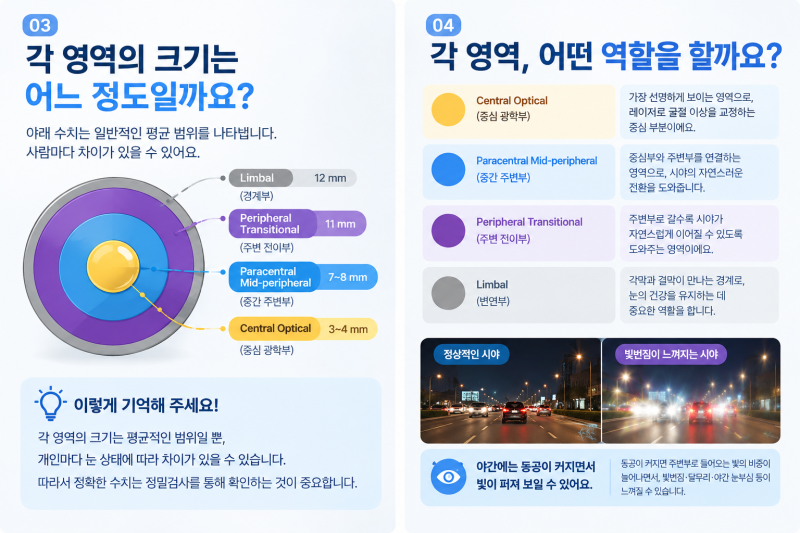
Simply put, the optical zone is
the central treatment area designed to be reshaped by the excimer laser to correct refractive errors.
This is where the relationship between pupil size and the optical zone becomes critical.
If the pupil dilates beyond the boundaries of the laser-treated optical zone in dim light,
light entering through the untreated periphery may affect visual quality.
However, this does not mean
"We should just make the optical zone as large as possible for large pupils."
The decision is not that simple.
Expanding the optical zone substantially increases the required depth and volume of corneal ablation.
Consequently, setting the optical zone requires a careful, balanced evaluation of:
Pupil diameter + Refractive power (myopia/astigmatism) + Corneal thickness + Corneal curvature/topography + Estimated ablation depth
The ultimate goal is not to enlarge the treatment area unconditionally, but to calculate an optimal and safe correction zone customized to the patient's individual eye profile.
Will large pupils inevitably lead to light scattering after 2-Day LASEK?
Not necessarily.
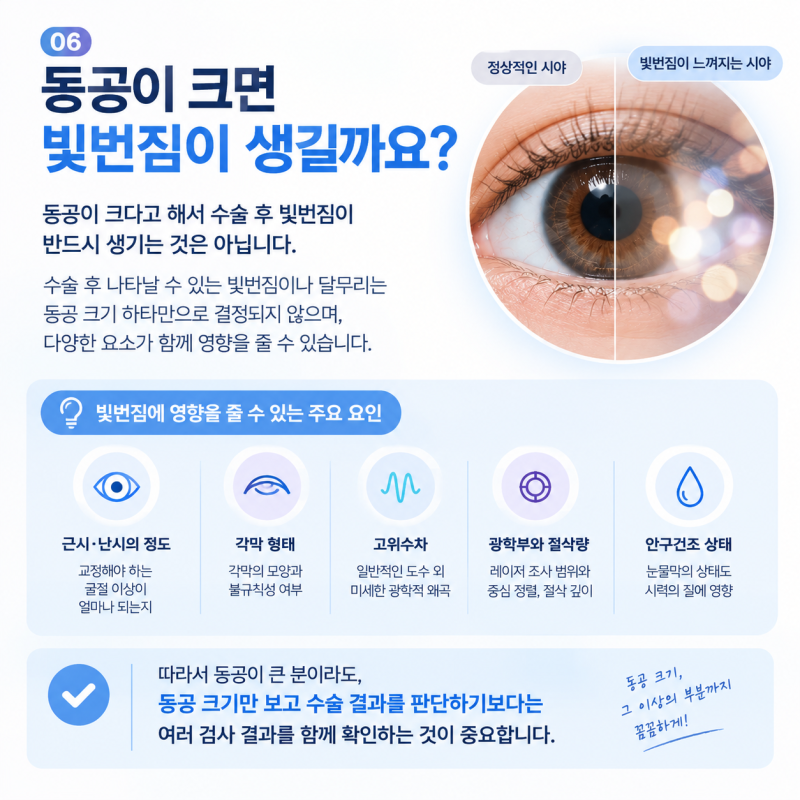
Post-operative optical phenomena such as glare and halos
are not determined solely by pupil size.
Various factors work in combination, including:
✔ Degree of myopia and astigmatism
Evaluating the severity of the refractive error that requires correction.
✔ Corneal topography and shape
Checking for overall regularity, symmetry, and elevation profiles of the cornea.
✔ Higher-order aberrations (HOAs)
Assessing subtle optical distortions across the visual system beyond standard lower-order myopia and astigmatism.
✔ Optical zone and ablation depth
Balancing an adequate functional zone while preserving a safe residual corneal bed.
✔ Ocular surface and dry eye condition
The stability of the tear film before and after surgery strongly influences functional vision quality.
Therefore, individuals with large pupils should rely on comprehensive diagnostic evaluations rather than focusing solely on pupil diameter.
Does having large pupils disqualify someone from 2-Day LASEK?

No, it does not.
A large pupil measurement does not automatically make someone ineligible for 2-Day LASEK.
The essential focus should shift from
"Are my pupils too large?" to "Which surgical plan is safest and most effective given my overall ocular parameters?"
Pre-operative evaluations analyze far more than pupil size alone, including:
Myopia and astigmatism degree
Best-corrected visual acuity (BCVA)
Corneal thickness (pachymetry)
Corneal topography/tomography
Corneal biomechanics and architecture
Higher-order aberrations (wavefront analysis)
Planned optical zone
Estimated tissue ablation volume
Based on these integrated findings, the ophthalmic surgeon determines overall candidacy and tailors the precise ablation profile.
Please inform your doctor if you drive frequently at night
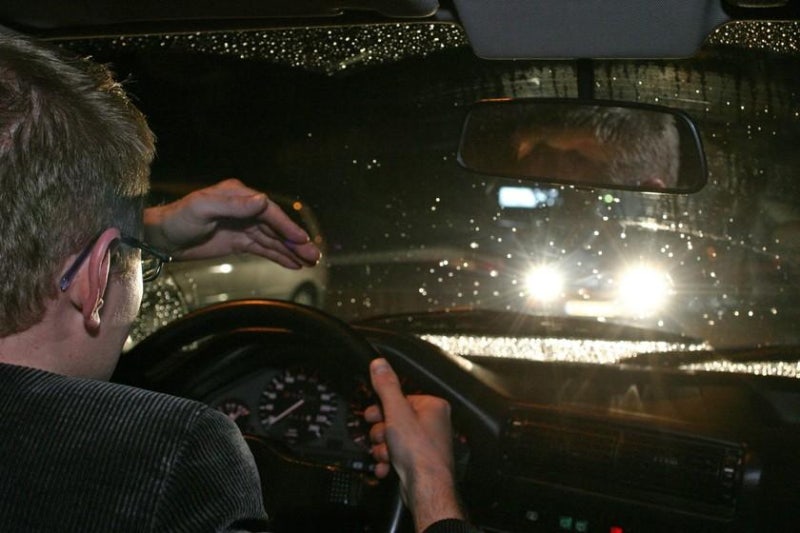
Patients who routinely drive at night should mention this lifestyle factor during consultation.
Even with identical diagnostic measurements,
visual demands differ significantly from person to person.
For instance, an individual who works primarily in daylight will have different visual priorities
compared to someone who commutes or operates vehicles for extended periods at night.
Rather than focusing exclusively on standard daytime visual acuity charts,
it is important to discuss how you utilize your vision in real-world scenarios.
3 Things to Remember if You Have Large Pupils
If you have been told your pupils are large while preparing for 2-Day LASEK, keep these three points in mind:
① Large pupils do not automatically rule out surgery.
Candidacy is never evaluated based on pupil measurement alone.
② The relationship between pupil size and optical zone must be balanced.
Scotopic dilation must be considered alongside the achievable, safe optical zone parameters.
③ Corneal thickness and refractive profile must be evaluated collectively.
Surgical planning relies on combined data: prescription, corneal volume, structural symmetry, wavefront aberrations, and residual bed safety.
2-Day LASEK: The Big Picture Extends Far Beyond Pupil Size


Hearing that your pupils are larger than average can naturally cause apprehension about post-operative glare.
However, this single metric does not dictate the surgical outcome.
It is vital to examine how nighttime pupil dilation
interacts with the customized optical zone,
the amount of myopia or astigmatism requiring treatment,
the structural integrity and thickness of the cornea,
and whether higher-order aberrations or subtle irregularities are present.
Refractive surgery is not a standardized procedure decided by an isolated number, but a bespoke process tailored to each patient's ocular anatomy.
If you are considering 2-Day LASEK in Gangnam
or have hesitated due to large pupils,
a comprehensive diagnostic screening is the first step toward confirming feasibility and optimal treatment strategies.
Gangnam Smile Eye Clinic provides individualized vision correction plans based on advanced multi-point diagnostic assessments.
Feel free to reach out with any questions regarding 2-Day LASEK or other vision correction procedures.
Thank you. 😊💙
※ Candidacy for 2-Day LASEK and the selection of the most suitable procedure depend on individual refraction, corneal geometry, thickness, and overall ocular health, which require evaluation by an ophthalmologist following detailed examinations.
💙 For SMILE and Laser Vision Correction: Gangnam Smile Eye Clinic 💙
💙🤍 𝖦𝖠𝖭𝖦𝖭𝖠𝖬 𝖲𝖬𝖨𝖫𝖤 𝖤𝖸𝖤 𝖢𝖫𝖨𝖭𝖨𝖢💙🤍
𝗧𝗛𝗘 𝗟𝗜𝗚𝗛𝗧 𝗔𝗡𝗗 𝗧𝗛𝗘 𝗢𝗖𝗘𝗔𝗡 𝗜𝗡 𝗬𝗢𝗨𝗥 𝗦𝗠𝗜𝗟𝗘













Gangnam Station 2-Day LASEK
Frequently Asked Questions
Can I get 2-Day LASEK if I have large pupils?
Yes. A large pupil size by itself does not make surgery impossible. Candidacy for 2-Day LASEK is determined comprehensively by medical specialists evaluating corneal thickness, refraction, corneal geometry, and predicted tissue ablation depth.
Do large pupils guarantee light glare and halos after surgery?
Not necessarily. Post-operative visual symptoms like glare and halos are influenced by multiple optical parameters beyond pupil size, including corneal curvature, higher-order aberrations, optical zone coverage, and tear film stability.
Can the optical zone be enlarged indefinitely to prevent glare?
No. The optical zone cannot simply be expanded without limit. A wider optical zone requires greater corneal tissue removal, meaning it must be balanced safely against the patient's corneal thickness and prescription profile.
Should I mention regular night driving during my consultation?
Yes, sharing your night driving routine is highly recommended. Daily visual requirements differ between daytime workers and individuals who drive extensively at night, allowing the surgeon to tailor treatment to your specific lifestyle demands.
What tests are conducted before surgery for patients with large pupils?
In addition to scotopic pupilometry, precision tests include corneal topography/tomography, wavefront higher-order aberration analysis, corneal pachymetry, and ablation depth modeling to customize the safest, most effective surgical plan.