2026-09-17
Gangnam Cataract Surgery Recovery Period: Can You Resume Daily Life the Next Day?
Explore the cataract surgery recovery timeline, from next-day activities and screen use to driving and key precautions. Understand how individual eye health shapes visual recovery.
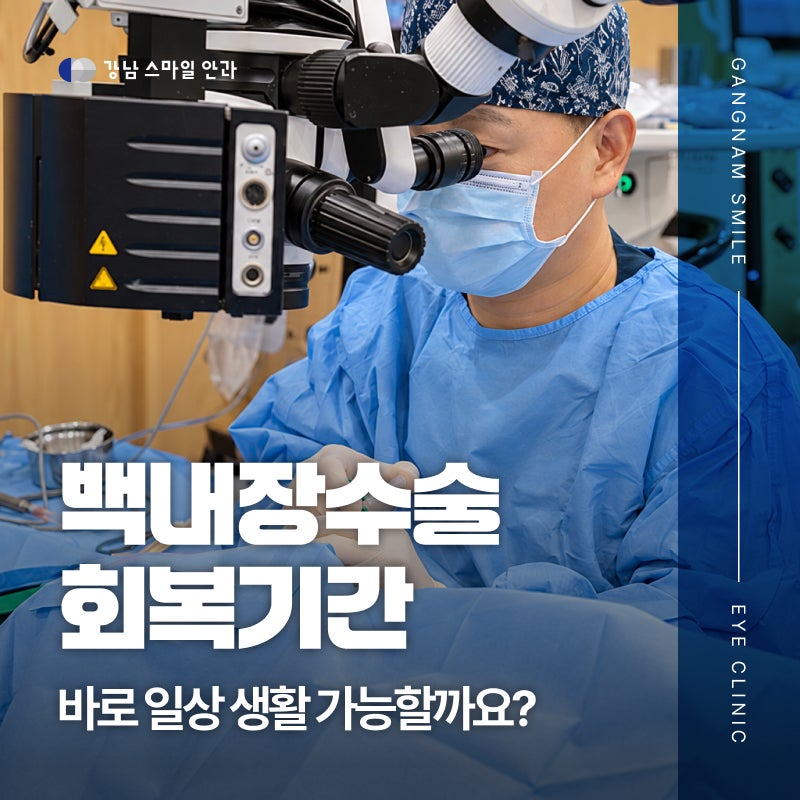
Hello, this is Gangnam Smile Eye Clinic 😊💙
When you start looking into cataract surgery,
there is a question that comes up just as often as the surgical methods or types of intraocular lenses (IOLs):
"When can I go back to my normal routine after surgery?"
Patients frequently ask practical, everyday questions such as:
Can I go to work the day after surgery?
Is it okay to look at my phone or watch TV?
When can I wash my face and take a shower?
After how many days can I drive?
When will my vision stabilize?
To answer straight to the point: cataract surgery allows a relatively quick return to daily life,
but recovery speed varies depending on each individual's ocular condition.
And there is one crucial thing to remember:
"Seeing well" does not necessarily mean "the eye is completely healed."
So, if you are planning for cataract surgery in Gangnam, what key aspects should you understand about the recovery process?
When does vision start to improve after Gangnam cataract surgery?
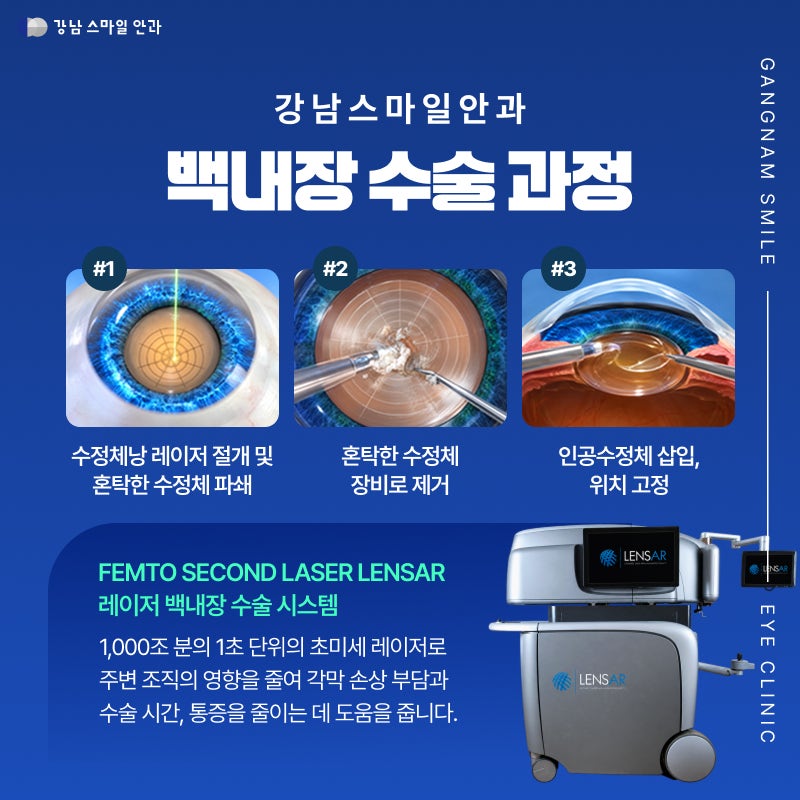
A cataract is a condition where the eye's natural crystalline lens becomes cloudy, causing blurred vision.
During surgery, this cloudy lens is removed and an artificial intraocular lens (IOL) is inserted in its place.
Nowadays, because the procedure is performed through tiny micro-incisions, patients typically return home on the same day,
and if there are no complications, you can resume everyday activities fairly quickly.
However, finishing the surgery does not mean the healing process is instantly over.
Immediately after surgery, the cornea may temporarily swell, making vision appear hazy or foggy.
Mild post-operative inflammation or pre-existing dry eye syndrome
can also cause feelings of ocular discomfort.
Furthermore, your eyes need time to neuroadapt to the focus of the newly implanted IOL.
Consequently, while some people feel their vision has cleared up significantly by the next morning,
others may experience blurriness, glare, or light halos for several days.
In other words, the recovery period cannot be defined as a fixed number of days that applies universally to everyone.
What daily activities are allowed the day after surgery?

Light everyday tasks can generally be resumed quite quickly.
For example, walking indoors or doing light office work
activities that place minimal strain on the eyes—are usually fine depending on your individual status.
However, in the early post-op period, it is vital to distinguish between what you "can do" and what you "must avoid."
During the initial phase, you must strictly avoid:
Rubbing your eyes forcefully
Allowing water, soap, or foreign matter into the eyes
Lifting heavy objects or excessive physical straining
It is also essential to use all prescribed eye drops exactly according to instructions.
Guidelines on when you can wash your face or shower can differ based on surgical technique and healing progress,
so it is always best to prioritize the instructions provided by your attending surgeon.
Can I look at my phone or watch TV right away?

This is another very common question after cataract surgery in Gangnam.
As long as your eyes feel comfortable and there are no specific issues,
using your phone or watching television is not strictly forbidden.
However, immediately after surgery, your eyes may tire and dry out more easily than usual.
Straining to read small fonts for extended periods
can trigger eye fatigue. Rather than looking at screens continuously,
it is better to take frequent rests.
The important takeaway is not simply whether screen time is permitted,
but avoiding unnecessary ocular strain right after surgery.
Whenever your eyes feel tired, gritty, or dry, look away from the screen and take a break.
When can I start driving after Gangnam cataract surgery?
Driving requires far more caution than returning to desk work.
Even if you feel your vision has cleared after surgery, you should never assume you can drive immediately.
Safe driving involves much more than reading lines on an eye chart.
*Please refer to the link above for detailed information.
On the road, you must consider:
How clearly you can distinguish distant objects
Whether there is a vision disparity between both eyes
Presence of glare, halos, or starbursts
Whether your focal depth is steady and reliable
Whether your overall visual field feels comfortable and stable
Back to work quickly, yet healing is not complete?
That is correct.
The point when you can resume daily work and the point when your ocular tissues fully stabilize can differ.
For instance, returning to indoor desk jobs using computers
is often possible relatively early on,
yet precautions vary depending on your specific work environment.
On the other hand, if your work involves:
Dusty or dirty environments
Frequent heavy lifting
Strenuous physical exertion
Settings where sweat or particles can easily enter the eyes
you will need to exercise much greater caution initially.
Therefore, when assessing recovery based on your job,
it is better to look at your actual working conditions rather than simply counting the days off.
Why does cataract surgery recovery differ for each person?

This naturally leads to the question:
"Why does one person see clearly the next day while another experiences blurriness for days after the exact same cataract surgery?"
Because every individual's eye condition is unique.
Factors like the density of the cataract before surgery, corneal clarity, presence of dry eye disease,
and pre-existing retinal or optic nerve conditions all influence how quickly vision stabilizes.
In addition, the type of implanted IOL and the patient's visual demands play a role.
Importantly, having a cataract does not always mean it is the sole reason for reduced vision.
If there are underlying issues in the retina, macula, or optic nerve,
cataract extraction alone may not deliver the full extent of vision improvement expected.
This is why a comprehensive pre-operative eye examination is essential.
What should you check before considering the recovery period?
Before asking,
"How many days will it take to recover?"
it is far more vital to ask:
"What is the overall health of my eyes?"
Even with the same cataract diagnosis,
lens opacity levels and the health of the cornea, retina, and optic nerve differ from person to person.
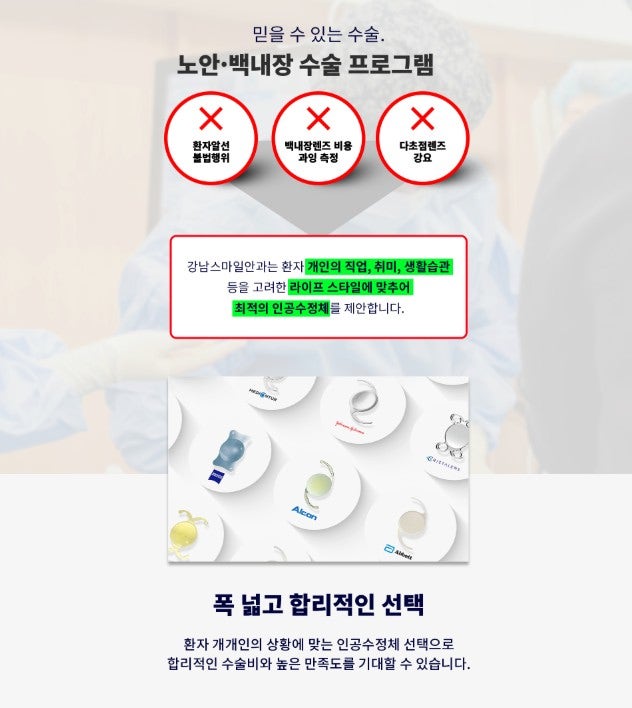
Furthermore, depending on which IOL you select,
post-operative visual expectations and the neuroadaptation process can vary.
Therefore, a proper surgical plan must look beyond the cataract itself,
comprehensively evaluating your ocular health, daily lifestyle, and target visual range.
💡 Recommended Reading
*What criteria should you consider when choosing an IOL for cataract surgery?
Do not wait if you experience these symptoms after surgery
Most patients progress through a predictable healing phase after surgery.
However, there are red-flag symptoms that should never be ignored as "just part of healing."
Seek immediate medical care if you notice:
A sudden, sharp drop in vision
Severe eye pain
Intense ocular redness
New dark floaters or flashes of light in your vision field
Because post-operative sensations vary individually,
never assume "this must be normal after surgery." If unexpected or worsening symptoms occur,
an prompt evaluation by your ophthalmologist is crucial to identify the cause.
Focus on eye healing, not just the calendar days

While cataract surgery allows for a rapid return to daily living,
not everyone heals at the exact same pace.
Being able to move around the next morning and
having fully stabilized ocular tissues are two separate stages.
Therefore, questions like:
✔ When can I return to work?
✔ When can I drive?
✔ When can I wash my face and shower?
✔ At what level will my vision stabilize?
should not be decided by a fixed date on the calendar,
but by monitoring your pre-operative status alongside your post-operative healing progress.
At Gangnam Smile Eye Clinic, we thoroughly assess each patient's eye health first,
providing tailored consultations on surgical techniques and IOL selections matched to your lifestyle.
If you are planning for cataract surgery, look beyond "how fast can I recover"
and explore "what journey my eyes will take to heal safely."
This has been Gangnam Smile Eye Clinic. 😊💙
💙 For SMILE surgery, trust Gangnam Smile Eye Clinic 💙
💙🤍 𝖦𝖠𝖭𝖦𝖭𝖠𝖬 𝖲𝖬𝖨𝖫𝖤 𝖤𝖸𝖤 𝖢𝖫𝖨𝖭𝖨𝖢 💙🤍
𝗧𝗛𝗘 𝗟𝗜𝗚𝗛𝗧 𝗔𝗡𝗗 𝗧𝗛𝗘 𝗢𝗖𝗘𝗔𝗡 𝗜𝗡 𝗬𝗢𝗨𝗥 𝗦𝗠𝗜𝗟𝗘













Frequently Asked Questions
Can I go to work the day after cataract surgery?
It depends on your work environment, but light desk work is generally possible. However, if your job involves heavy lifting, high dust levels, or physical strain, extra caution and rest are needed to protect early healing.
Can I watch TV or use my smartphone right after cataract surgery?
Yes, screen viewing is generally permitted if there are no complications. However, because eyes tire and dry out more easily post-surgery, take regular breaks instead of staring at screens for extended periods.
When is it safe to drive after cataract surgery?
You should only drive once your vision has stabilized and your road view feels completely comfortable. Beyond acuity, factors like binocular balance, glare, halos, and distance focusing must be thoroughly considered.
What activities should I avoid after cataract surgery?
Avoid rubbing your eyes forcefully or lifting heavy items. Prevent water or foreign matter from entering the eyes, and be diligent about applying prescribed post-operative eye drops as directed.
What symptoms require immediate medical attention after surgery?
Contact your clinic immediately if you experience a sudden sharp decrease in vision or severe eye pain. Intense redness, new dark spots (floaters), or flashing lights also require urgent ophthalmologic evaluation.