2026-09-03
Facelift for Twenties: What to Check Before Age
For a facelift in your 20s, it's crucial to identify if sagging is due to skin, fat, or muscle (SMAS), or if it's a volume issue, not just age.
※ This article is intended to provide medical information.
It is not subject to deliberation under Article 56, Paragraph 2 and Article 57 of the Medical Act,
and is not an advertisement unrelated to the content of deliberation.
Hello,
I am Dr. Jung-Keun Park,
Director of Faceplus Plastic Surgery Clinic.

‘Should I get a facelift even though I'm in my 20s?’
This is a question I hear more often than you might think.
Many people search for facelifts, regardless of age,
if they feel their jawline looks blurred or their nasolabial folds have deepened when they look in the mirror.
However, what I check first
is not ‘age’.
Even for someone in their 20s, the necessary approach varies completely
depending on whether the cause is the skin, fat, or the muscle layer (SMAS).
Therefore, rather than immediately considering surgery just by seeing the term ‘facelift for twenties’,
there are criteria that need to be checked first.
Today, I will discuss those criteria.

Table of Contents | ||
1. Is it sagging, or a volume issue? 2. Structures deeper than the skin 3. Cases where something else is needed before lifting 4. Facelift for Twenties: Judgment Criteria |
1. Is it sagging, or a volume issue?
Many people immediately think of a facelift for their 20s
when their jawline appears to have collapsed or nasolabial folds are visible.
However, in reality,
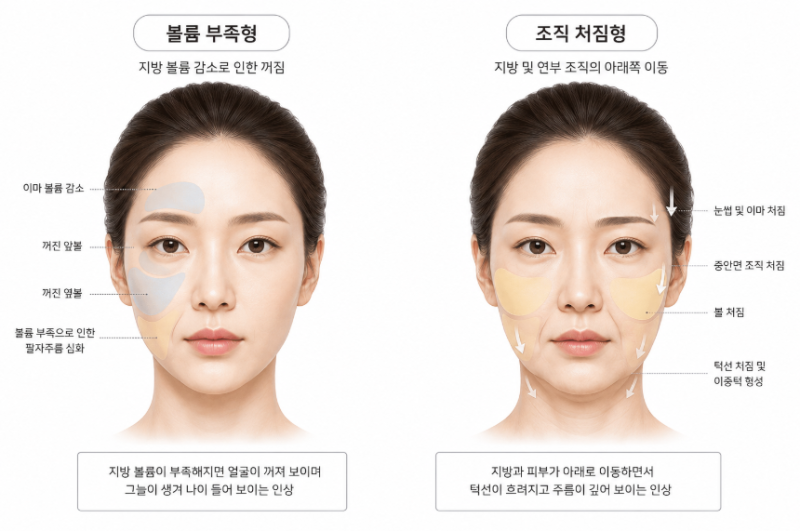
it's not uncommon for it to appear that way
due to volume loss rather than actual sagging.
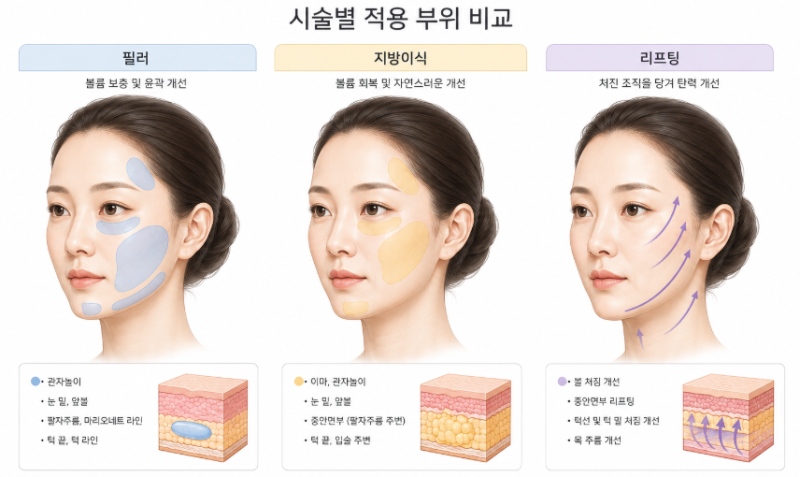
If there is insufficient fat around the cheekbones
or if the front cheeks are sunken,
it can create an optical illusion
that the entire face is sagging downwards.
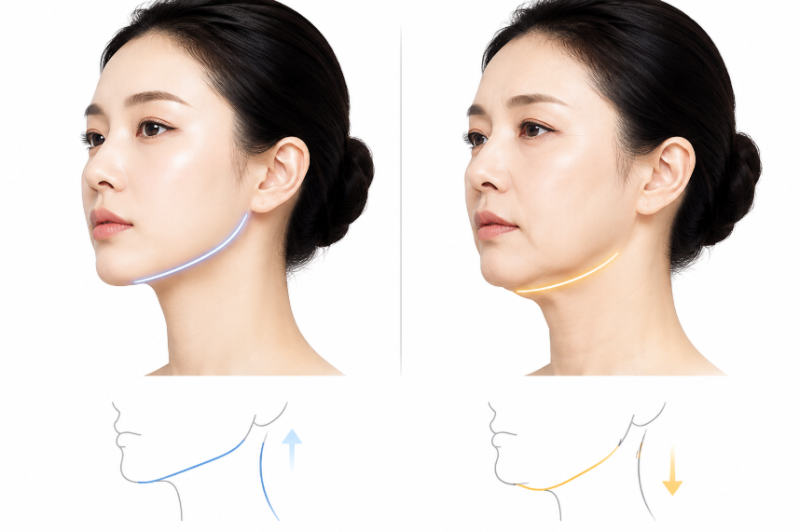
Conversely, if there is sufficient volume
but the tissue itself has moved downwards,
the approach changes.
In other words, the first thing to check is
not the ‘wrinkles’
but where the cause lies.
2. Structures deeper than the skin
When discussing a facelift for someone in their 20s,
people often only think about the skin.
However, facial elasticity
is not determined by the skin alone.
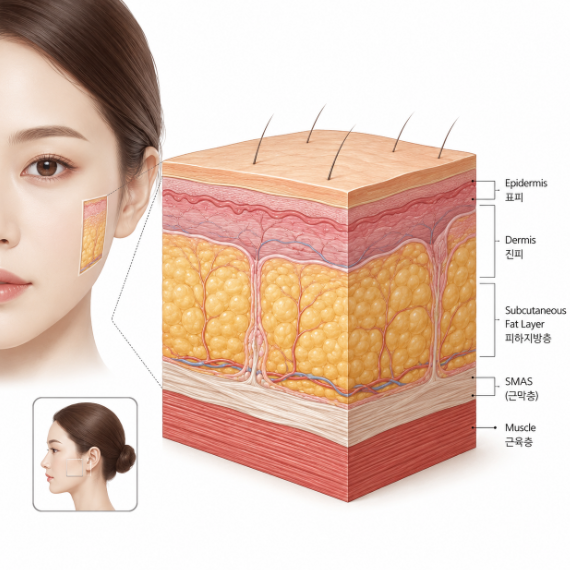
Beneath the skin, there are fat layers, ligaments,
and a deep supporting structure called the SMAS layer.
Due to aging, weight changes,
or congenital structure,
these layers move together,
leading to sagging.
Therefore, simply pulling the skin
may not lead to fundamental changes in some cases.
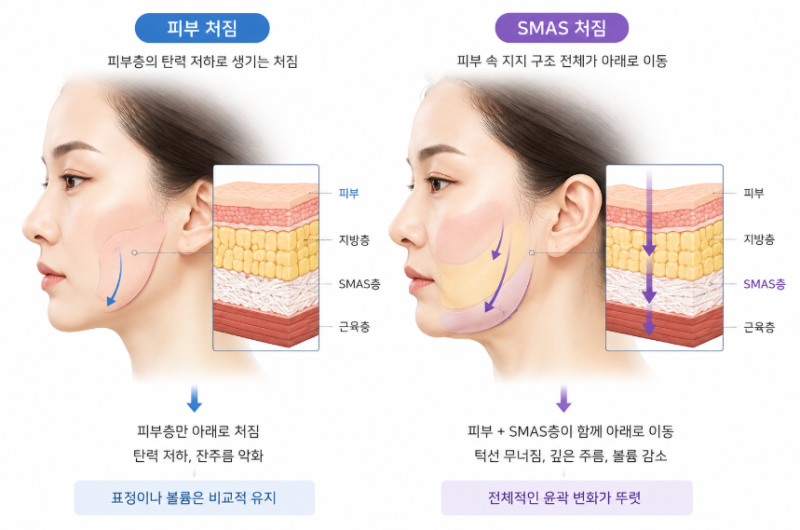
This is precisely why we examine
the internal structures of the face along with the visible appearance.
3. Cases where something else is needed before lifting
Not all sagging
can be resolved with a facelift.
On the contrary,
if the cause is volume deficiency, hollowness, or asymmetry,
a different approach than lifting
can sometimes produce more natural results.
Conversely,
if the tissue has actually moved downwards,
simply adding volume
might make the face appear heavier.
Therefore, even when considering a facelift in your 20s,
the most important process is to first find out why your face looks that way,
rather than just which method is right.
4. Facelift for Twenties: Judgment Criteria
Being in your 20s does not mean
a facelift is absolutely unnecessary,
nor does it mean
a facelift is required just because you're in your 20s.
Ultimately, what's important is

to consider your current facial structure, the cause of sagging, skin elasticity,
the location of fat, and future changes together.
This way, unnecessary procedures can be reduced,
and even when necessary,
a more natural direction can be chosen.
More important than the keyword ‘facelift for twenties’

is finding the answer to the question:
‘Why does my face look this way?’
-Operating Hours-
Weekdays 9:00 ~ 18:00 Saturdays 9:00 ~ 16:00 Public Holidays / Sundays Regular closure |
-Contact Us-
Faceplus Plastic Surgery Clinic | ||
Consultation Phone: 02-541-8500 Inquiries: KakaoTalk Inquiry |
-Directions-
Frequently Asked Questions
Do people in their 20s need a facelift?
No, a facelift is not absolutely unnecessary for people in their 20s. It's more important to accurately identify the cause of a blurred jawline or deep nasolabial folds than age, and the necessity can vary depending on an individual's facial structure.
If I have a sagging jawline or nasolabial folds, does it automatically mean I need a facelift?
No, a facelift is not always necessary. It could be an optical illusion where the face appears to sag due to volume loss, such as insufficient fat around the cheekbones or sunken front cheeks, rather than actual sagging. Therefore, the cause must be identified first.
Is it enough to just pull the skin during a facelift?
No, simply pulling the skin may not lead to fundamental changes. Facial elasticity is determined by deep supporting structures beneath the skin, including the fat layer, ligaments, and the SMAS layer. Therefore, the internal structures should be considered along with the visible appearance.
Are there other solutions besides lifting?
Yes, there are. Not all sagging can be resolved with lifting. In fact, if the cause is volume deficiency, hollowness, or asymmetry, a different approach than lifting can produce more natural results. The appropriate method should be found based on the cause.
What are the most important criteria for deciding on a facelift in your 20s?
The most important criteria are to consider the current facial structure, the cause of sagging, skin elasticity, the location of fat, and future changes together. This allows for the reduction of unnecessary procedures and the selection of a more natural direction when necessary.