2026-09-21
Essential Guide Before Cataract Surgery: How the Eye's Autofocus Mechanism Works
Discover how the eye adjusts focus, why aging causes presbyopia, and how cataract surgery replaces the clouded lens with a customized IOL for optimal vision.

Hello, this is Gangnam Smile Eye Clinic 😊💙
When you look up from your smartphone and gaze out the window, your eyes shift focus effortlessly in an instant.
Small text up close appears crisp and sharp,
and when you look into the distance, far-off objects become clearly defined once again.
When you think about it, it is truly fascinating.
How does the human eye automatically adjust its focus depending on viewing distance?
The secret lies within the crystalline lens and tiny muscles inside the eye.
Today, through this visual guide, we will explore the eye's autofocus mechanism,
how this accommodation function changes with age,
and why the crystalline lens and intraocular lenses (IOLs) are so critical in cataract surgery.
Our eyes function much like an autofocus camera lens.
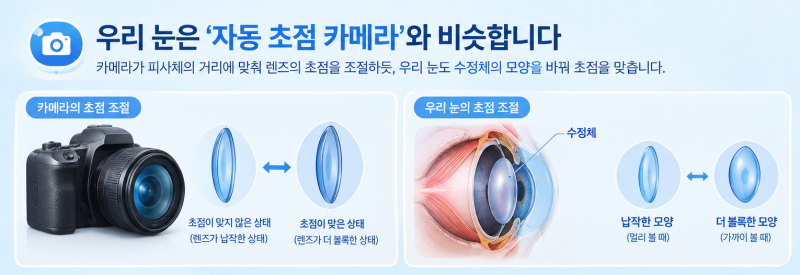
When looking at nearby objects, your eyes do far more than simply redirect your gaze.
The crystalline lens inside the eye dynamically alters its shape to adjust optical focus.
Just as a camera lens calibrates focus based on subject distance,
our eyes modify the refractive power of the natural lens according to how near or far an object is.

When viewing close-up objects, the lens thickens into a more convex curve,
and when viewing distant scenery, it flattens out.
Thanks to this accommodation, we can effortlessly see across a wide spectrum of distances—from
a phone screen right before us to towering buildings far away.
This raises a natural question:
How exactly does the crystalline lens reshape itself?
Delicate muscles inside the eye control our focus.
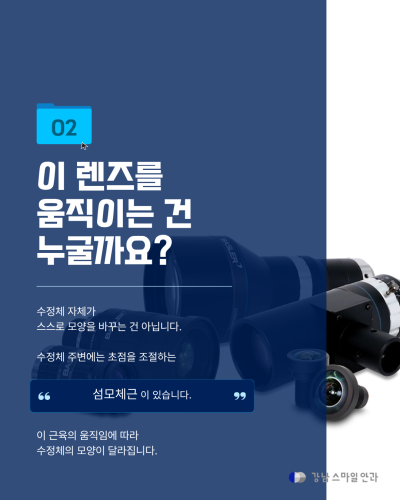
The crystalline lens does not change shape on its own.
Surrounding the lens is a specialized band called the ciliary muscle.
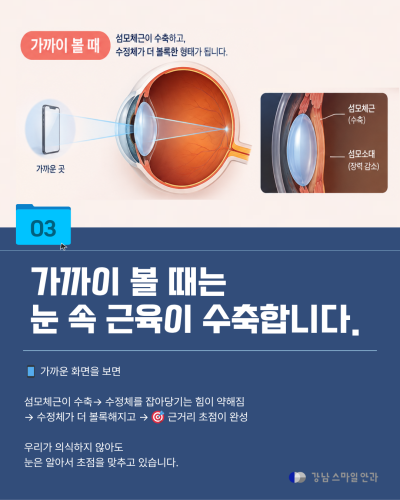
As this muscle contracts and relaxes, the tension in the zonular fibers supporting the lens changes, causing the lens to alter its curvature.
For near vision, the ciliary muscle contracts, releasing tension so the lens naturally flexes into a rounder, thicker convex shape.
Conversely, for distance vision, the ciliary muscle relaxes, increasing zonular tension and flattening the lens into a thinner profile.
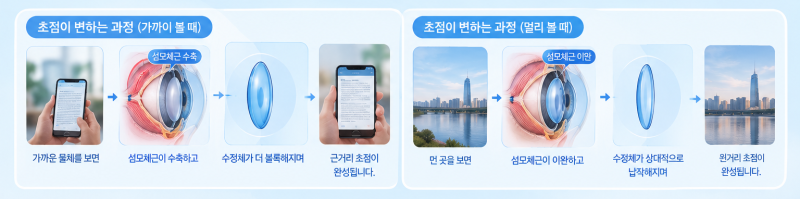
In summary:
Near vision → Lens becomes rounder and more convex
Distance vision → Lens becomes relatively flatter
These shape changes accurately refocus incoming light.
Even without our conscious control,
the eyes perform this remarkable calibration automatically every single second.
Why does reading close-up text become difficult as we age?

This leads directly to the mechanism behind presbyopia.
In our younger years, the crystalline lens is soft and pliable, flexing with ease.
However, as years pass and the lens loses its natural elasticity,
it struggles to curve sufficiently for close-range focusing.
Consequently, the ability to focus sharply on nearby print progressively declines.

Eventually, you might notice yourself thinking:
“The text on my phone looks blurry.” “I have to hold books further away to read.” “I need brighter lighting to see fine print clearly.”
These experiences are classic signs of aging vision.
This physiological change is what we call presbyopia.
Here, a crucial distinction must be made:
Presbyopia and cataracts are entirely different conditions.
Presbyopia is primarily a loss of lens flexibility,
which impairs the eye’s accommodation capacity for close-up tasks,
whereas a cataract is a pathological opacification (clouding) of the lens that obscures your entire visual field.
What happens to the internal lens when a cataract develops?
When the crystalline lens clouds over, it is diagnosed as a cataract.
The natural lens in a healthy eye is crystal clear.
Light must pass unimpeded through this clear lens onto the retina for us to perceive sharp, vibrant images.
However, when various aging and metabolic factors cause the lens protein to clump and cloud over,
light cannot transmit cleanly, resulting in pervasive visual blur.
Common symptoms include:
A misty or foggy visual field, as if looking through a haze
A progressive reduction in overall visual acuity
Light scattering, glare, or heightened light sensitivity
Halos around lights, especially when driving at night
Colors appearing dull, yellowish, or less vivid than before
Such visual degradation caused by lens opacification is diagnosed as a cataract.
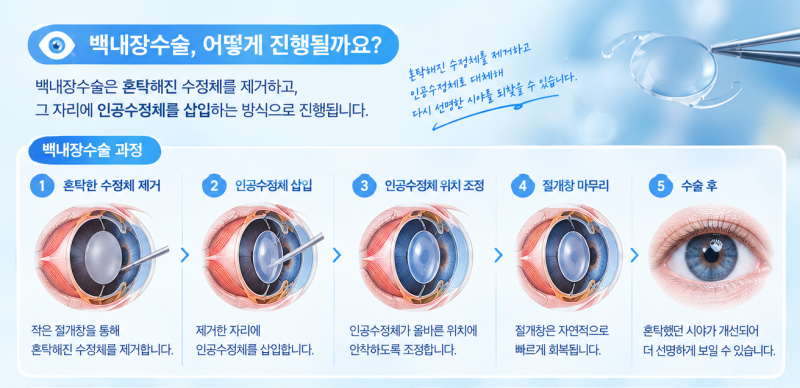
How is the crystalline lens addressed during cataract surgery?
This is where cataract surgery meets modern intraocular lens (IOL) technology.
Cataract surgery involves gently removing the clouded natural lens
and replacing it with an artificial intraocular lens (IOL).
In other words, you can think of it as replacing your eye's worn, clouded internal optic
with a pristine, biocompatible synthetic lens that refracts light with clarity.
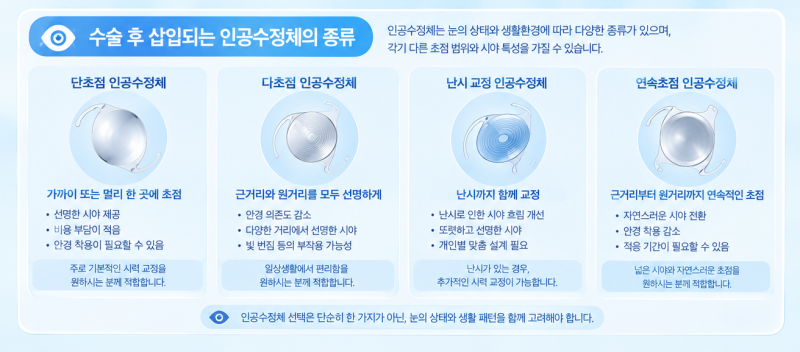
Therefore, when exploring cataract surgery options, the decision goes beyond
“simply removing the cataract.”
The crucial question becomes:
“Which intraocular lens design will deliver the ideal visual outcome for my lifestyle?”
Because the category of IOL chosen—monofocal, multifocal, or extended depth of focus (EDOF)—
directly determines your postoperative focal range and visual independence from glasses.
Why customized IOL selection matters so much in cataract surgery

When preparing for cataract surgery,
patients often assume, “Isn't it just a matter of removing the cloudy lens?”
However, the intraocular lens implanted during the procedure
remains in your eye permanently for the rest of your life.
Choosing the correct IOL requires a comprehensive evaluation of your ocular anatomy and daily habits.
For instance, your primary visual demands depend heavily on:
Whether you spend prolonged hours on computer monitors,
How frequently you drive, especially after sunset,
How much time you devote to smartphones or reading books,
And at which specific distances you prefer freedom from prescription glasses.
Moreover, corneal regularities, astigmatism, and retinal health must be factored into the equation.
Rather than assuming a single premium IOL model is universally ideal for everyone,
it is essential to undergo precision diagnostics to select an implant tailored to your visual profile and personal lifestyle.
Understanding the link: Presbyopia, cataracts, and modern surgical solutions
Here is a clear summary to help connect the concepts:
Youthful Eye:
A flexible lens shifts shape easily, focusing dynamically on near and far distances.
↓
Presbyopia:
Lens elasticity decreases with age, diminishing near-focus accommodation.
↓
Cataract:
The crystalline lens becomes cloudy and opacified, blurring the entire visual field.
↓
Cataract Surgery:
→ The clouded natural lens is removed and replaced with a customized intraocular lens (IOL).
Viewing it through this lens makes the distinction between presbyopia and cataracts crystal clear,
and emphasizes why IOL selection represents the cornerstone of a successful procedure.
Your eyes are continuously refocusing with every passing moment.

Every time you glance at your phone, turn a page in a book, or look out across the horizon,
your ocular focusing system works ceaselessly behind the scenes.
Coordinated micro-muscle adjustments and subtle lens flexes provide your natural autofocus capability.
Yet as aging diminishes lens compliance
and optical clarity begins to degrade, gradual shifts in vision are inevitable.
If close-range print begins to blur, avoid assuming it is merely normal presbyopia.
Pay careful attention to the pattern, onset, and progression of visual changes.
In particular, if blurriness persists, light glare increases, or vision feels consistently foggy,
it is prudent to seek a comprehensive eye examination to evaluate for cataracts and other ocular conditions.
In Gangnam cataract surgery, the operation itself is only part of the equation
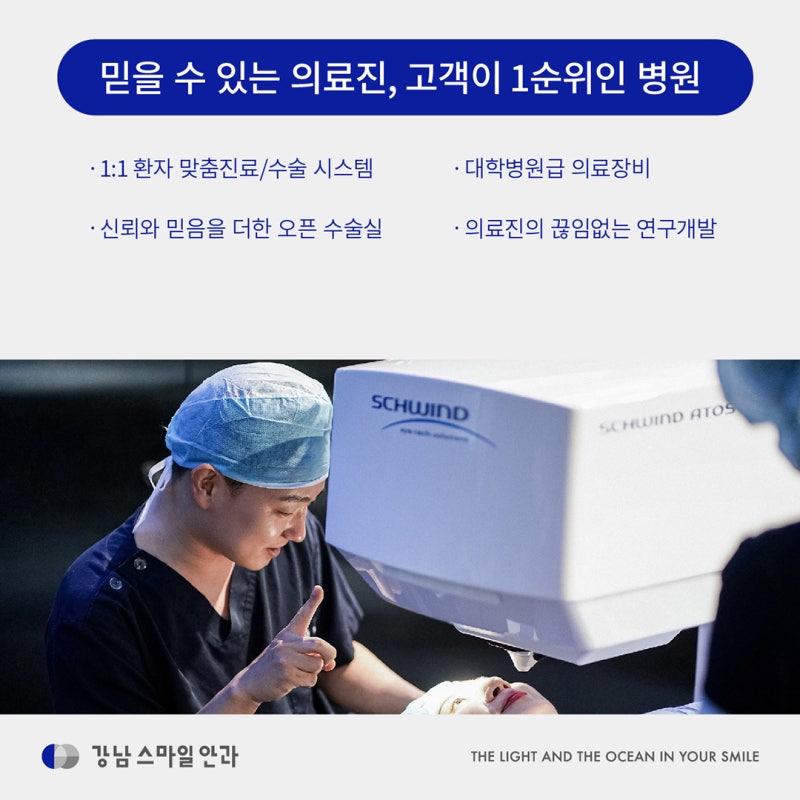
When considering cataract surgery, looking strictly at procedural techniques is not enough.
A truly successful outcome depends on assessing the state of your crystalline lens, cornea, and retina,
clarifying your preferred postoperative functional visual range,
and selecting the optimal intraocular lens suited to your daily routine.
Because cataract progression, corneal curvature, and ocular health vary widely among individuals,
one should never simply copy another patient's choice of lens implant.
Instead, a personalized surgical blueprint based on comprehensive diagnostic scans is vital.
At Gangnam Smile Eye Clinic, we perform detailed diagnostics for patients exploring cataract solutions,
factoring in overall eye health, occupational environments, and visual priorities
to guide you toward the ideal surgical method and IOL selection.
💙 For Precision Eye Care, Trust Gangnam Smile Eye Clinic 💙
💙🤍 𝖦𝖠𝖭𝖦𝖭𝖠𝖬 𝖲𝖬𝖨𝖫𝖤 𝖤𝖸𝖤 𝖢𝖫𝖨𝖭𝖨𝖢 💙🤍
𝗧𝗛𝗘 𝗟𝗜𝗚𝗛𝗧 𝗔𝗡𝗗 𝗧𝗛𝗘 𝗢𝗖𝗘𝗔𝗡 𝗜𝗡 𝗬𝗢𝗨𝗥 𝗦𝗠𝗜𝗟𝗘



Gangnam Cataract Surgery
Frequently Asked Questions
How does the eye adjust focus across different distances?
Focus is calibrated through the coordination of the crystalline lens and the ciliary muscle. For near vision, the ciliary muscle contracts, causing the lens to thicken and become more convex. For distant objects, the muscle relaxes, allowing the lens to flatten and adjust refractive power accordingly.
What is the key difference between presbyopia and cataracts?
Presbyopia is an accommodation deficit, whereas a cataract is a physical clouding of the lens. Presbyopia occurs when the natural lens loses its elasticity, making close print hard to read. In contrast, a cataract occurs when the clear lens turns cloudy, scattering light and creating a pervasive hazy or foggy visual field.
How is cataract surgery performed?
The procedure involves removing the opacified natural lens and replacing it with an artificial intraocular lens (IOL). The implanted IOL permanently restores clarity and refractive focusing capability to the eye.
Why is IOL selection so crucial in cataract surgery?
Because the specific type of IOL determines your post-surgical focal depth and daily visual convenience. Since the implant remains permanently in the eye, the choice must align with your corneal and retinal health, driving frequency, digital device usage, and personal visual expectations.