2026-09-03
Endoscopic Forehead Lift Review: When Do Post-Surgery Changes Appear? Differences from Incision Methods
This article discusses endoscopic forehead lift reviews, explaining when post-surgery changes become visible and detailing the differences between endoscopic and incision methods, including recovery processes and outcomes.
Endoscopic Forehead Lift Review: When Do Post-Surgery Changes Appear?
※ This article is written for the purpose of providing medical information.
It is not subject to deliberation under Article 56, Paragraph 2 and Article 57 of the Medical Act,
and we inform you that it is not an advertisement unrelated to the content of the deliberation.
Hello,
I am Dr. Junggeun Park,
Director of Faceplus Plastic Surgery Clinic.
Among those considering a forehead lift,
many frequently ask, ‘What is the difference between the endoscopic and incision methods?’
Although they both appear to be forehead lifts, the surgical methods and recovery processes are quite different,

so it is important to understand this precisely
before making a choice.
Today, I will calmly explain when changes appear after an endoscopic forehead lift,
based on the recovery process.
Table of Contents | ||
1. Endoscopic Forehead Lift vs. Incision Forehead Lift: Differences 2. How Do the Surgical Methods Differ Structurally? 3. Comparison of Pain and Recovery Period 4. How Does the Recovery Process Proceed? |
1. Endoscopic Forehead Lift vs. Incision Forehead Lift: Differences
The biggest difference is the ‘approach method’.
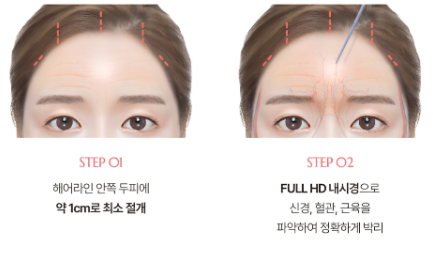
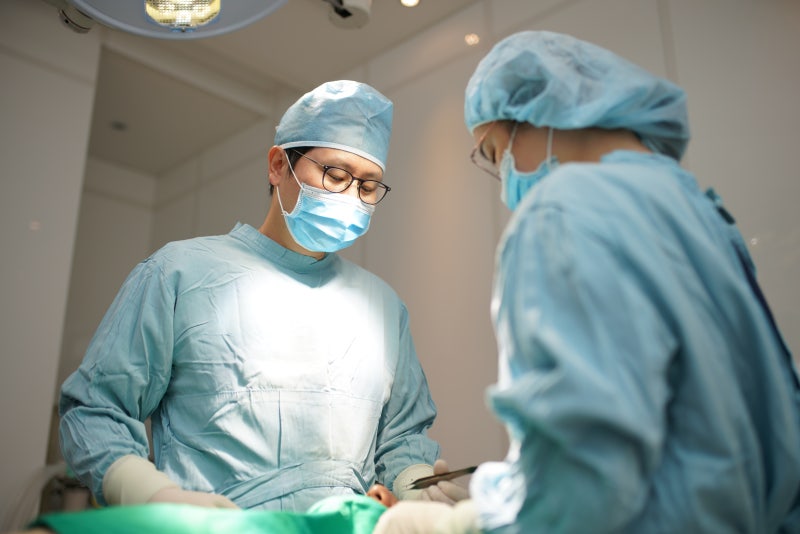
An endoscopic forehead lift involves making several small incisions within the scalp
and then dissecting and fixing the tissue while viewing it with an endoscope.
In contrast, an incision forehead lift involves a long incision along the hairline,
after which the tissue is pulled and fixed under direct visualization.

Therefore, endoscopy generally results in less scarring
and faster recovery.
The incision method, with its wider field of view, is advantageous for cases requiring significant correction.
2. How Do the Surgical Methods Differ Structurally?
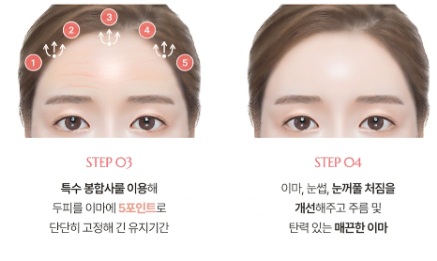
An endoscopic forehead lift does not just pull the skin;
it involves dissecting the retaining ligaments that hold the forehead and eyebrows,
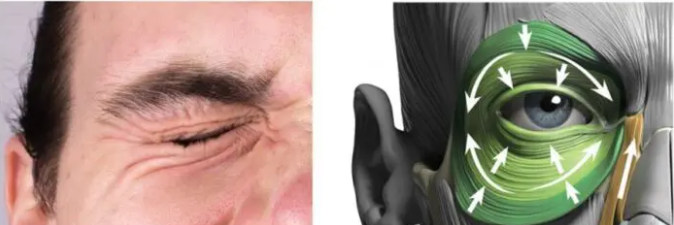
adjusting the muscles, and then repositioning them upwards.
Although performed through small incisions, internally, the eyebrow position and glabella muscles are adjusted together.
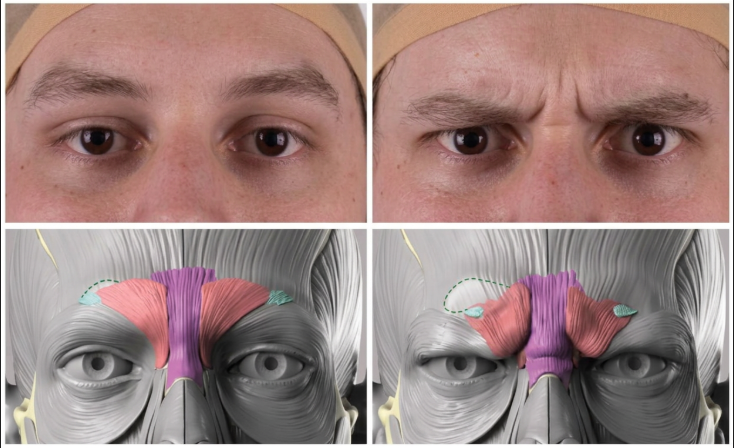
An incision forehead lift is performed by opening a wider area for direct visualization,
allowing for a stronger lift in cases of severe sagging or abundant skin.
However, the wider incision area means a relatively greater initial recovery burden.
3. Comparison of Pain and Recovery Period
Category | Endoscopic | Incision |
Incision Area | Small incisions within scalp | Long incision along hairline |
Surgical Method | Dissection and fixation with endoscope | Direct visualization and lifting |
Pain | Relatively mild | Relatively stronger |
Swelling | Moderate, quickly subsides | Swelling lasts longer |
Return to Daily Life | Around 1 week | More than 2 weeks needed |
Scar | Hidden by hair | Potentially exposed around hairline |
4. How Does the Recovery Process Proceed?
For an endoscopic forehead lift, swelling and a pulling sensation are most intense during the first 2-3 days after surgery.
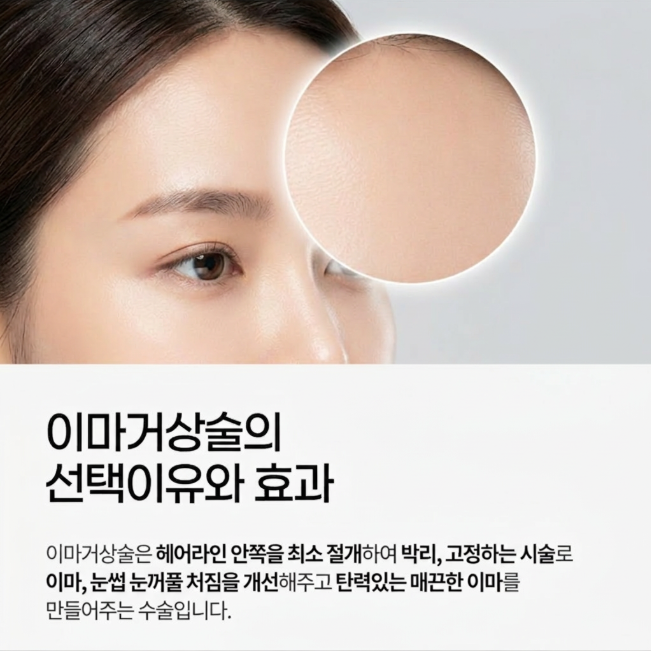
After about 1 week, the eyebrow position gradually becomes more natural, and daily activities become possible.
After 2-3 weeks, the awkwardness in appearance significantly decreases, and others begin to notice a more refined impression.
After about 3 months, the tissues stabilize and settle into a much more natural position.
Furthermore, anti-aging surgery requires time for internal tissues to stabilize, separate from visible swelling,
so the final results are generally evaluated after 6 months.
Thank you for reading this long article today ^^
-Operating Hours-
Weekdays 9:00 ~ 18:00 Saturdays 9:00 ~ 16:00 Public Holidays / Sundays Regular Day Off |
-Contact Us-
Faceplus Plastic Surgery Clinic | ||
Consultation Phone: 02-541-8500 Inquiries: KakaoTalk Inquiry |
-Directions-
Endoscopic Forehead Lift Review
Frequently Asked Questions
What are the differences between an endoscopic forehead lift and an incision forehead lift?
The biggest difference is the approach method. An endoscopic forehead lift involves small incisions within the scalp, using an endoscope to fix the tissue, while an incision forehead lift involves a long incision along the hairline, allowing for direct visualization during the lift. Endoscopy results in less scarring and faster recovery, while the incision method allows for stronger correction in cases of severe sagging.
When do post-surgery changes become visible after an endoscopic forehead lift?
After about 1 week post-surgery, the eyebrow position gradually becomes more natural, and daily activities become possible. After 2-3 weeks, the awkwardness in appearance significantly decreases, and after about 3 months, the tissues stabilize and settle into a much more natural position.
How long is the recovery period after an endoscopic forehead lift?
For an endoscopic forehead lift, it is possible to return to daily life in about 1 week. Swelling and a pulling sensation are most intense during the first 2-3 days after surgery, gradually decreasing thereafter. The final results are generally evaluated after 6 months, as internal tissue stabilization requires time even after visible swelling subsides.
How much pain is experienced after an endoscopic forehead lift?
An endoscopic forehead lift generally involves relatively milder pain compared to the incision method. Swelling and a pulling sensation may be most intense during the first 2-3 days after surgery.
How are scars managed after an endoscopic forehead lift?
Since an endoscopic forehead lift is performed through small incisions within the scalp, the scars are hidden by the hair, reducing the burden of exposure. The incision method involves a long incision along the hairline, so scars may be visible around the hairline.
When can the final results of an endoscopic forehead lift be known?
The final results are generally evaluated after 6 months. This is because even after visible swelling subsides, internal tissues require time to stabilize.